How To Tell If Recessed Lighting Is IC Rated?
Shine a flashlight inside the can after pulling the trim — the only definitive answer is a "Type IC" or "IC-AT" label stamped near the lampholder. Vent slots, light leakage, and housing color are hints, not proof.
 Eugen
EugenEugen Nikolajev
Creator of LED Lighting Info
Hi, I am Eugen. I was always one of those kids who had all sorts of weird lighting gadgets for every occasion.
Now, I want to share my knowledge and experience about lighting with you on LED Lighting Info.
Read my editorial standards
Key Takeaways
The most reliable way to confirm an IC rating is the UL or ETL label stamped or stickered inside the housing — typically marked "Type IC" or "IC-AT" near the lampholder. Color and vent slots are useful visual hints, but only the label is definitive.
Lights installed in an insulated ceiling must be IC-rated. If they're not, heat from the fixture can build up against the insulation, creating a real fire hazard.
Below, I'll cover:
- What separates IC-rated and non-IC-rated recessed lights
- How to identify IC-rated fixtures already installed in your ceiling
- Whether IC-rated lights are the same as fire-rated lights
Difference Between IC And Non-IC Recessed Lights
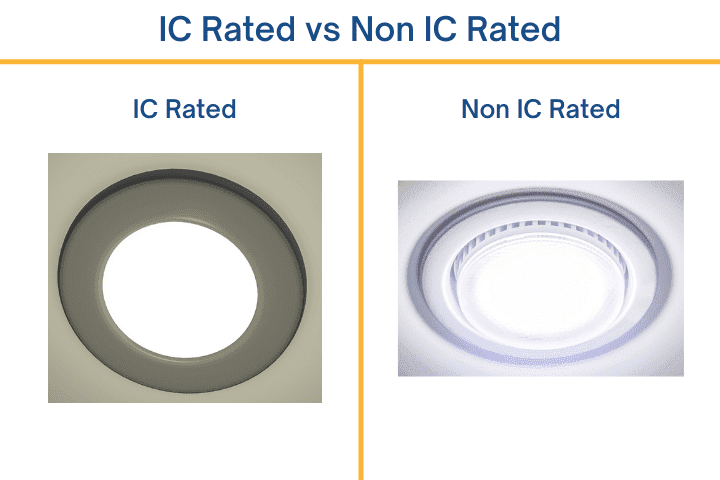
"IC" stands for Insulation Contact, and the rating means the fixture has been tested as safe to sit in direct contact with thermal insulation.
Recessed lights generate heat — LEDs less than halogens, but every fixture warms up as it runs. In a non-IC can, that heat is shed through vents into the surrounding ceiling cavity. If insulation covers those vents, heat builds up against the housing. That's the fire risk, and it's why these fixtures need an air gap around them.
Common insulation materials don't all behave the same way under heat. Fiberglass batts use non-combustible glass fibers, but their kraft-paper or foil facings can burn. Cellulose insulation is combustible by nature, though it's typically treated with borate fire retardants. Spray foam can ignite if exposed to direct flame and is required by code to be covered with a thermal barrier in occupied spaces. Trapped heat from a non-IC fixture can ignite or degrade any of these materials and damage wiring in the process.
IC-rated fixtures handle this through a combination of features: sealed housing construction, lower lamp wattage limits, and a built-in thermal cutoff that shuts the fixture off if it overheats. Some traditional housings also use a double-wall, can-within-a-can design with an air gap acting as an extra thermal buffer, but that's not a universal mechanism — modern IC-AT LED housings are typically single-wall sealed enclosures with low-heat LEDs and a thermal protector.
There's a related rating worth knowing: IC-AT (sometimes written ICAT). An IC fixture is safe in contact with insulation. An IC-AT fixture is also airtight, sealing against air leakage between conditioned space and the attic above. Many US energy codes (including the IECC) require airtight fixtures in insulated ceilings of new construction, so when upgrading or building, look for IC-AT specifically.
IC-rated lights are the only lights you should use in an insulated ceiling. Per NEC 410.116, non-IC fixtures are technically permitted in an insulated ceiling provided you maintain a 3-inch clearance between the fixture and any insulation — on all sides, including above — plus at least 1/2 inch from combustible materials. In practice, that gap is nearly impossible to maintain with blown-in or loose-fill insulation, which settles and shifts over time. For new installs, IC-rated (and ideally IC-AT) is the only practical option.
How To Identify IC-Rated Recessed Lights
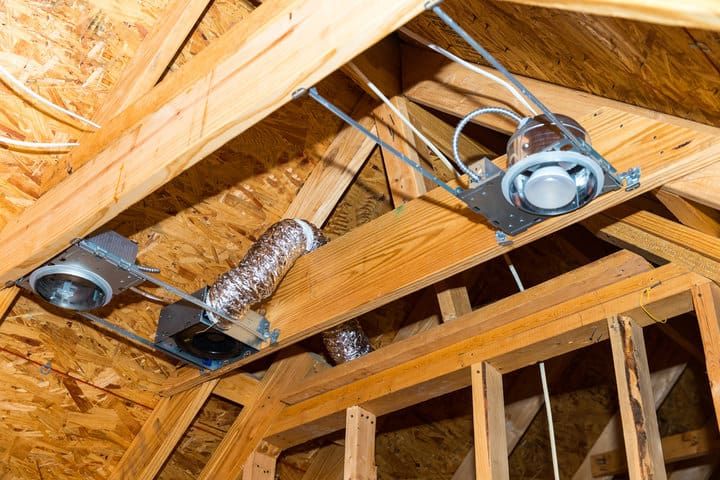
Work from the most reliable check to the visual hints. The label is definitive; everything else is supporting evidence.
- Look for the label inside the housing. Cut the power, remove the trim and bulb, and shine a flashlight at the inner wall of the can. UL- or ETL-listed IC fixtures will be marked "Type IC" or "IC-AT" (sometimes "ICAT") on a stamped or stickered label, usually near the lampholder. This is the only definitive test.
- Check for vent slots along the side wall. Non-IC cans have visible slits around the upper portion of the housing to dump heat into the ceiling cavity. IC-rated housings are sealed; small holes for screws or wiring are normal, but slot-shaped vents are not.
- Turn the fixture on and look for light leaking out the sides. From the attic or a vantage above the can, light visible through the side wall confirms the housing is vented and not IC-rated. Note: some modern non-IC LED housings have small vent holes that pass very little visible light, so a clean result here doesn't rule out non-IC on its own — fall back to the label.
- Check the color, but only as a soft hint. Older incandescent-era IC cans were often silver or galvanized while non-IC cans were white-painted, and that shorthand still circulates. It's unreliable today: modern LED housings come in many finishes, and plenty of non-IC commercial cans are silver. Don't make a decision based on color alone.
Also read: How To Convert Incandescent Recessed Fixture To LED?
Are IC-Rated Lights The Same As Fire-Rated Lights?
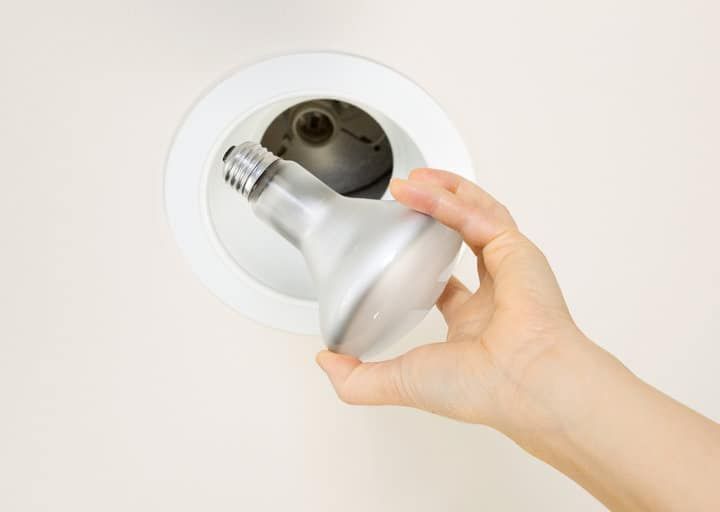
No — IC-rated and fire-rated address different problems. IC-rated fixtures are designed not to cause a fire when in contact with insulation. Fire-rated fixtures are designed to slow the spread of an existing fire through a hole cut in a rated ceiling assembly.
Cutting a hole for a recessed light weakens the fire resistance of the ceiling above. Fire-rated solutions either come as housings tested as part of a UL 263 rated assembly, or as intumescent covers — pads that expand when heated to seal the hole and block flame and smoke.
| IC-Rated | Fire-Rated | |
|---|---|---|
| Purpose | Safe to operate in direct contact with thermal insulation | Maintains the fire rating of the ceiling assembly |
| Protects against | Fire caused by heat buildup against insulation | Spread of an existing fire through the cut-out |
| Required when | The ceiling above the fixture is insulated | The ceiling is part of a rated assembly (common in commercial and multi-family construction) |
| Typical mechanism | Sealed housing, thermal cutoff, lamp-wattage limits | Intumescent pad/cover that expands under heat, or housing tested as part of a rated assembly |
| Can a fixture be both? | Yes — IC-AT fire-rated housings exist | Yes — but check the labeling, since neither rating implies the other |
Fire-rating standards differ by jurisdiction. In the UK and EU, downlights are tested individually to BS 476 Part 21 (and increasingly EN 1364/EN 1365) for 30, 60, or 90-minute ratings to match the corresponding ceiling assembly. In the US, fire resistance is governed by UL 263 and tested at the assembly level rather than per-fixture. Common US solutions include UL-classified intumescent covers like Tenmat FF109X (rated for 1- and 2-hour assemblies) and pre-rated housings such as Halo's Fire Rated New Construction Housings.
IC ratings apply to any type of recessed light installed in the ceiling. The "fire-rated lights are self-contained downlights with no can" framing reflects the small UK-style LED downlight form factor only. In US construction, fire-rated can housings and intumescent retrofit covers are both common, particularly in commercial and multi-family work where the ceiling assembly itself has to maintain a UL 263 rating.
Also read: How To Measure Recessed Lighting Size?
What To Do Next
If the checks above turned up non-IC fixtures in an insulated ceiling, you have three practical paths forward:
- Replace the housing. The most thorough fix is to swap in a new IC-rated (ideally IC-AT) housing. Several manufacturers make remodel-friendly IC-AT cans that drop into an existing hole.
- Add a UL-classified intumescent cover. Products like Tenmat FF109X install over an existing recessed can in the attic, bringing the assembly into compliance for insulation contact (and, where applicable, a UL 263 fire rating) without disturbing the fixture below the ceiling.
- Maintain code-required clearance. Per NEC 410.116, a non-IC fixture needs a 3-inch gap on all sides — including above — between the fixture and insulation, plus 1/2 inch from combustibles. This is hard to maintain reliably with blown-in or loose-fill insulation, so treat it as a temporary tolerance rather than a long-term plan.
Recessed lighting work in an insulated ceiling typically requires a permit and inspection in most US jurisdictions, particularly when modifying or replacing housings. Consult a licensed electrician if you're unsure whether your existing fixtures are compliant or if you're planning a retrofit.