
Are LED Lights Inductive Or Resistive Load?
An incandescent bulb is a textbook resistive load — but the driver inside an LED makes things murkier, and that gap is exactly where dimmer flicker and buzzing hide.
 Eugen
EugenEugen Nikolajev
Creator of LED Lighting Info
Hi, I am Eugen. I was always one of those kids who had all sorts of weird lighting gadgets for every occasion.
Now, I want to share my knowledge and experience about lighting with you on LED Lighting Info.
Read my editorial standards
Key Takeaways
LED lights are considered a resistive-dominant load, but the AC-to-DC driver inside means they aren’t purely resistive. Power factor varies widely: residential LED bulbs commonly fall in the 0.5–0.7 range, while quality commercial LED drivers achieve 0.9 or better.
Anything powered by an electrical circuit is defined as a “load” — it places a demand on the circuit by drawing current.
There are three main load types: resistive, inductive, and capacitive. Different electrical components, depending on their design, fall into different categories.
So what about LED lights — what kind of load are they?
In this article I’ll cover:
- The difference between inductive and resistive loads
- What type of load LED lights are
- Why power factor matters — and when it doesn’t
What Is The Difference Between Inductive And Resistive Loads?
Types Of Power
Before comparing load types, here’s the quick electrical background.
There are two types of electrical current: Alternating Current (AC), which periodically changes direction, and Direct Current (DC), which always moves the same way. Home circuits run on AC; battery-powered devices run on DC.
In an AC circuit, three types of power are at play:
| Power Type | Also Called | Unit | Symbol | What It Represents |
|---|---|---|---|---|
| Active Power | True / Real Power | Watts (W) | P | Power actually consumed by the load |
| Reactive Power | — | Volt-Amps Reactive (VAR) | Q | Power absorbed and returned each cycle, not consumed |
| Apparent Power | — | Volt-Amps (VA) | S | Total power drawn from the source |
Reactive power (Q) arises when current and voltage are out of phase, which happens with inductive or capacitive loads. Energy gets temporarily stored in magnetic fields (inductors) or electric fields (capacitors) and returned to the source on each cycle, rather than being dissipated.
In short: AC circuits carry three kinds of power — active, reactive, and apparent — and the ratio between them defines a device’s power factor.
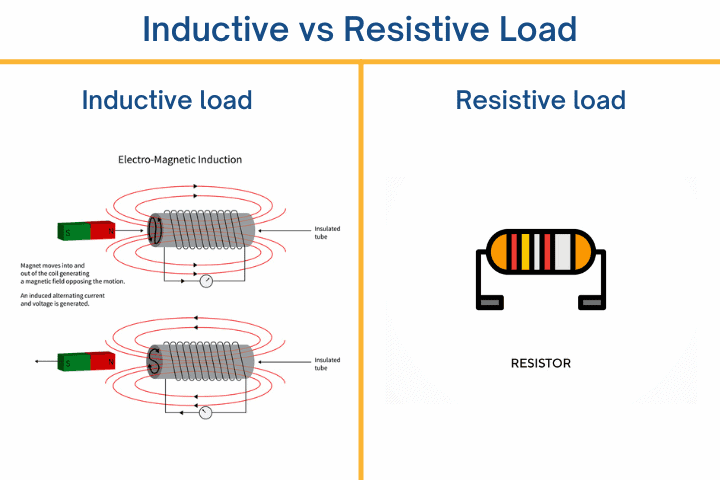
Inductive vs Resistive
Resistive loads offer pure resistance. They convert all the active power they draw into heat or another form of useful work, with no reactive component. A resistive load behaves the same way in AC and DC circuits.
An incandescent bulb is a textbook example — it takes the full active power and uses it to heat the filament, which then glows.
Inductive loads are different. They store energy in magnetic fields, which means they consume reactive power along with active power. If DC is applied to an inductive load like a transformer winding, the inductive reactance collapses to zero (since reactance depends on frequency), leaving only the tiny DC resistance of the wire to limit current. The result is a very large current draw that quickly overheats and burns out the winding — not technically a short circuit, but functionally just as destructive.
Common inductive loads include anything with a motor or rotating parts — think fans, washing machines, and power tools.
Which Type Of Load Are LED Lights?
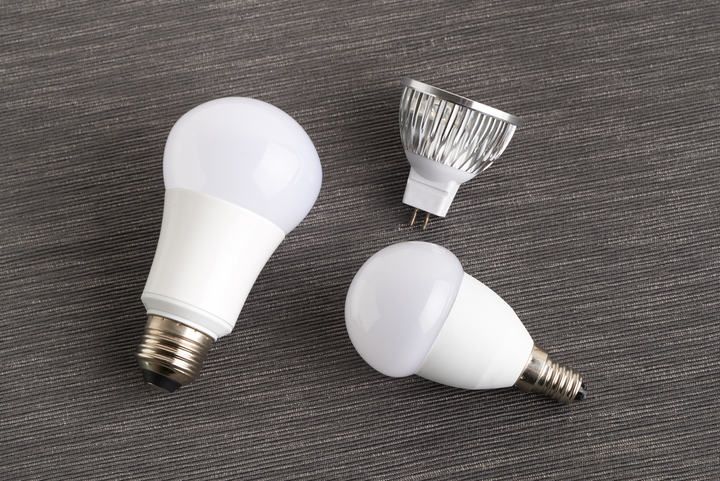
If incandescent bulbs are resistive, are all bulbs? The honest answer is “sort of.”
LEDs don’t have rotating parts, so they aren’t inductive. But they aren’t purely resistive either. Strictly speaking, the load classification applies to the driver circuit inside the bulb, not the LED diode itself — the diode is a semiconductor junction, and its electrical behavior is shaped by the driver feeding it.
The driver converts AC mains power to DC for the diode, and depending on its design it can introduce some reactive characteristics. Many LED drivers actually exhibit slightly capacitive behavior — the opposite of inductive — because of the filter capacitors used to smooth the rectified DC.
On balance, LEDs are best described as resistive-dominant loads with a small non-resistive component. The cleanest way to summarize that is through the power factor.
What Is The Power Factor Of LED Lights?
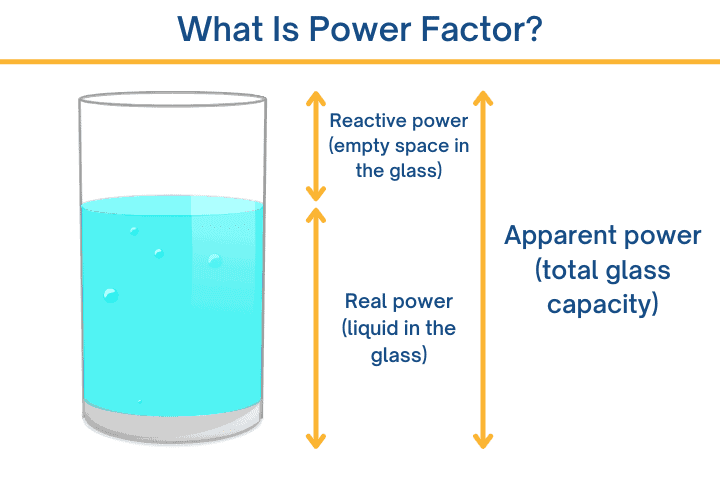
Power factor is the ratio of active (real) power to apparent power. Put simply, it tells you how much of the power drawn from the grid is actually doing useful work.
An ideal power factor is 1 — every watt drawn is consumed by the load with no reactive overhead. In practice, residential LED bulbs commonly land in the 0.5–0.7 range, while quality commercial LED drivers achieve 0.9 or better. Cheap, poorly made bulbs can fall below 0.5.
Under the ENERGY STAR Lamps program (which was sunset at the end of 2024), residential LED lamps over 10W needed a minimum power factor of 0.7, while 5–10W lamps needed at least 0.6. The U.S. Department of Energy now governs federal lamp efficiency standards.
Impact On Your Electricity Bill
A low power factor doesn’t directly increase a residential electricity bill. Home meters measure real power in watts, so a 6W LED costs you the equivalent of 6W regardless of its power factor. The reactive power is drawn from and returned to the grid on each cycle — it isn’t consumed.
Power factor matters most for commercial customers, who can be billed on apparent power (VA) or face surcharges for low PF. It also matters at the grid level: a low PF means utilities have to size wiring and transformers to handle more current to deliver the same usable wattage.
Why Retailers Don’t List It
Because the impact on a home bill is negligible, most retailers don’t print the power factor on the packaging. To find it, check the product spec sheet on the manufacturer’s website. For commercial fixtures, look for DesignLights Consortium (DLC) certification — DLC requires a power factor of at least 0.9, so the badge alone is a reliable proxy.
Power Factor And Dimmer Compatibility
The most common practical issue with LED power factor isn’t your bill — it’s dimmer compatibility. Older leading-edge (TRIAC) dimmers were designed for the high, predictable resistive loads of incandescent bulbs. LED drivers, with their lower wattage and non-linear current draw, often fall below a leading-edge dimmer’s minimum load and cause flicker or buzzing.
Trailing-edge (ELV) and LED-rated dimmers are designed for the low, slightly capacitive loads of LED drivers and generally produce smoother dimming. If you’re replacing incandescents with LEDs on a dimmed circuit, swap the dimmer too.
Mixing LEDs With Incandescents
Mixing LEDs and incandescents on the same circuit can cause issues, but not because incandescents “steal” power — every load on a parallel circuit draws its own current independently. The real culprits behind LED flicker are usually a leading-edge dimmer fighting the LED driver, or LEDs falling below a dimmer’s minimum load.
Counterintuitively, an incandescent bulb in parallel can sometimes stop LED flicker by adding enough stable resistive load to mask leakage current and steady a marginal driver.
Final Words
Pulling it together: LEDs are resistive-dominant loads, but the driver inside makes them slightly reactive. Most residential bulbs land between 0.5 and 0.7 power factor, and quality commercial drivers reach 0.9 or higher.
For home use, power factor isn’t worth losing sleep over. Your meter bills you on real watts, so a low PF won’t show up on your bill. It matters at scale, where lower PF forces utilities to handle more current for the same useful power — which is why commercial installations and grid operators care so much about it.
When power factor isn’t listed on packaging — which is most of the time — DLC certification is a reliable proxy for commercial fixtures. For residential bulbs, my advice is to focus on driver quality and dimmer compatibility rather than chasing PF numbers.
Those two things will affect your experience far more than a few percentage points of power factor ever will. If you want to dig deeper into related topics, what are diffused LEDs? is a good next read.
FAQ
Are LED lights inductive or resistive loads?
LED lights are best classified as resistive-dominant loads. The diode itself is a semiconductor junction, but the AC-to-DC driver inside the bulb introduces a small non-resistive (often slightly capacitive) component, so they aren’t purely resistive. They are not inductive — there are no motor windings or rotating parts.
What is the typical power factor of an LED bulb?
Residential LED bulbs typically have a power factor between 0.5 and 0.7. Commercial-grade LED drivers — used in offices, warehouses, and street lighting — usually reach 0.9 or higher because harmonic-current standards and utility programs require active power factor correction.
Does a low power factor LED cost me more on my electricity bill?
No, not directly. Residential electricity meters measure real power in watts. A 6W LED costs you the equivalent of 6W of energy regardless of its power factor. Power factor surcharges generally apply only to commercial and industrial customers, not homes.
Can I dim LED bulbs with my old incandescent dimmer?
Often not reliably. Leading-edge (TRIAC) dimmers built for incandescents frequently cause LEDs to flicker, buzz, or fail to dim smoothly because LEDs draw too little current to give the dimmer a stable load. Use a trailing-edge or LED-rated dimmer for the best results.
Where can I find the power factor of an LED bulb?
Check the product spec sheet on the manufacturer’s website — packaging rarely lists it. For commercial fixtures, DLC (DesignLights Consortium) certification guarantees a power factor of at least 0.9, so the DLC badge is a quick way to confirm a high-PF driver.