
What Are Diffused LEDs?
That frosted glow covering the whole bulb surface isn't just cosmetic — a typical diffuser scatters enough light to absorb 10–30% of the source's brightness in exchange for softer shadows and zero glare.
 Eugen
EugenEugen Nikolajev
Creator of LED Lighting Info
Hi, I am Eugen. I was always one of those kids who had all sorts of weird lighting gadgets for every occasion.
Now, I want to share my knowledge and experience about lighting with you on LED Lighting Info.
Read my editorial standards
Key Takeaways
Diffused LEDs shine through a semi-transparent cover that scatters the light in many different directions. Instead of seeing the individual LED light up, the whole bulb shines as one, giving a more uniform spread over a greater area.
Look at any LED bulb or strip light and you'll notice the cover is either crystal clear, with the individual diodes visible inside, or frosted, glowing as a single uniform surface. That second style is what "diffused" means.
In this article, I'll explain:
- What diffused light actually is, and how scattering works
- How diffused LEDs differ from clear ones in bulbs and strips
- Where diffused LEDs shine — and where clear ones win
- How to diffuse a clear bulb yourself, safely
What Is Diffused Light?
Broadly speaking, when you diffuse light, you scatter it — typically by passing it through a semi-transparent material like frosted glass, or, less commonly, by bouncing it off a textured surface. As the light hits irregularities (surface roughness, tiny air bubbles, or particles inside the material), it refracts and reflects internally at many different angles.
The result is a softer, more uniform glow spread over a wider area. The total light output drops a little — a typical frosted diffuser absorbs and loses roughly 10–30% of the source's brightness depending on the material — but in exchange you get gentler shadows and far less glare from looking directly at the source.
Diffused vs Clear LED: What Is The Difference?
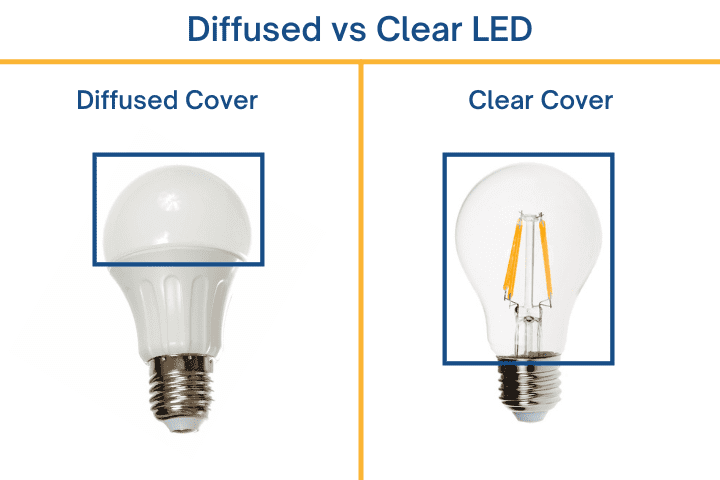
If the casing is clear, you'll see the actual light-emitting diode. If it's diffused, you'll see a surface that's lit up. LED light bulbs and LED light strips are the two clearest examples.
Bulbs: frosted, clear, and filament
Many LED light bulbs are frosted. The outer shell — typically glass or plastic (polycarbonate) — is not transparent but has a milky white appearance. Switch the bulb on, and the entire surface glows uniformly in your chosen color.
The alternative is a clear bulb (Amazon), where you can see the diodes inside a clear glass case. When switched on, the diodes themselves are visible as bright points. They look bright and have a classical design, though they don't spread light as evenly.
Sitting between the two are filament LED bulbs (Amazon), designed to look like old incandescent filaments inside a clear glass shell. The "filament" isn't a single diode, though — each strip is actually a linear array of 20–40 tiny LED chips mounted directly on a transparent glass or sapphire substrate, then coated with a phosphor-in-silicone layer that converts blue LED light to white. The chips and phosphor coating together act as a slim diffuser, so the strip glows like a traditional filament while the clear outer glass lets the light shine through.
Strip lights: open vs sealed
An LED light strip makes the difference even easier to see. Compare a standard Philips strip against a Philips gradient strip on Amazon.
On the standard strip, you can see each individual LED. When switched on, the light isn't uniform — it has hot spots where each diode sits. Even tucked behind coving or under kitchen units, those bright spots can show up in the projected light.
The gradient strip is sealed, with the silicone case acting as a diffuser. The output is more uniform and even, although it might not appear as bright at any one point because the light is being scattered (and slightly absorbed) by the case. As a bonus, sealed diffused strips usually carry higher IP ratings — IP65 or IP67 — which makes them suitable for kitchens, bathrooms, and outdoor runs where moisture is a concern.
Where Diffused LEDs Are Worth It
Diffused lights have real benefits over clear ones, but they aren't always the right pick — clear bulbs can be brighter and more directional, which matters in workshops and garages. Here are the situations where I reach for diffused LEDs:
Softer shadows in living spaces
In a busy room, a clear bulb leaves dark corners wherever furniture blocks the direct path from the source. Diffused light scatters around the room, so corners stay better lit — more inviting and safer to walk through.
Better ambient light around furniture
It's not just bigger items that cast problem shadows. Bookshelves, plants, and decorative objects all create harsh outlines under directional light. A diffused source softens those edges and makes a room feel more even.
Video calls and webcam lighting
If you rely on a clear overhead bulb during video calls, your own features will fall into shadow under the brow and nose. The result is a darker, blotchier image and worse compression on streaming platforms. Diffused light fills those shadows in.
Photography and content creation
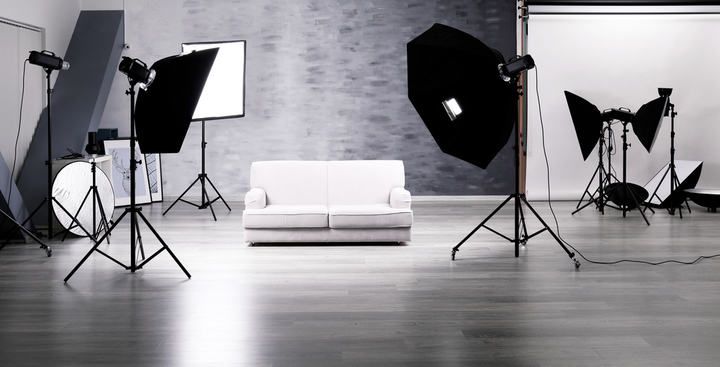
It's why photographers use softboxes and diffusion panels in their work. The same principle applies to product shots, food photography, and short-form video — diffused light flatters skin, food, and matte surfaces in ways a bare bulb never will. If color accuracy matters, also check the bulb's CRI rating: aim for CRI 90+ for art studios, retail, and content work, since the diffuser itself doesn't fix poor underlying color rendering.
Eye comfort and glare reduction
Bare LED chips concentrate a lot of luminance into a tiny point, which is what makes a clear bulb genuinely uncomfortable to glance at. A diffuser spreads that intensity across a larger area, dropping point-source glare to something the eye can shrug off. For office and commercial spaces, this is the same problem the Unified Glare Rating (UGR) standard is designed to measure — diffused fittings are the standard tool for keeping UGR low.
Can You DIY Diffuse An LED Light?
Yes, you can diffuse an LED light yourself. There are four common approaches, each with its own trade-offs around safety, permanence, and difficulty:
| Method | Materials | Permanence | Heat Safety | Difficulty |
|---|---|---|---|---|
| Heat-resistant paint | Glass paint + sandpaper | Permanent | Moderate risk — open fittings only | Easy |
| Parchment paper | Parchment + clips | Temporary | Fire risk — never touch the bulb, never enclosed | Easy |
| Acrylic sheet | Acrylic + standoff fixture | Semi-permanent | Low risk with LEDs only (softens 80–100 °C) | Medium |
| Enclosed lampshade | Off-the-shelf shade | Permanent | Low risk | Easy |
Painting the bulb
The easiest hands-on method is to paint the bulb. Use heat-resistant glass paint, and lightly sand the surface first so the paint creates a rough, scattering layer rather than a smooth opaque film — otherwise it'll either let the diode shine through as a hot spot or block the light entirely.
Be aware that paint traps heat against the bulb surface. That will shorten the bulb's lifespan, and in enclosed or semi-enclosed fittings it can risk electrical shorts or fire. Apply paint sparingly, in well-ventilated open fittings only. If you want color rather than just diffusion, a colored lampshade, a clip-on diffuser, or a color-changing smart bulb is safer.
Adding a diffuser layer
Alternatively, add a separate diffuser layer — something semi-transparent that scatters and refracts the light. Parchment paper and acrylic both work, but each has limits.
⚠️ Safety: never let parchment paper touch the bulb directly, and don't use it at all with incandescent or halogen bulbs — paper can ignite within minutes against a hot bulb. Even with cooler-running LEDs, leave a clear air gap so heat can dissipate, and avoid paper diffusers inside enclosed fittings where heat builds up. Acrylic softens around 80–100 °C, so it's only safe near low-heat LEDs.
How you mount the diffuser depends on the fitting. Photographers often just clip a sheet in front of a standalone light, which is fine for a temporary setup but isn't a permanent fix for a home pendant or ceiling fitting. For those, an enclosed lampshade is the most reliable option — find a style you like in any home store and let the shade do the diffusion work.
Final Words
Diffused LEDs are the right call in most living spaces — bedrooms, lounges, dining rooms — where soft, even light without harsh shadows is what you're after. They're also the better choice for video calls, photography, and any commercial space where glare is a concern.
Clear LEDs still have their place in workstations, garages, and workshops, where a brighter, more directional beam helps you see fine detail. They also win on pure decorative grounds — a vintage filament bulb in a visible fitting looks great in a way no frosted bulb can match.
If you've already bought clear LEDs and don't love the look, replacing the bulbs is usually the simplest fix. But a well-chosen shade or a careful coat of heat-resistant paint can do the job too — just respect the heat and never improvise with paper inside an enclosed fitting.