Are LED Lights From China Safe?
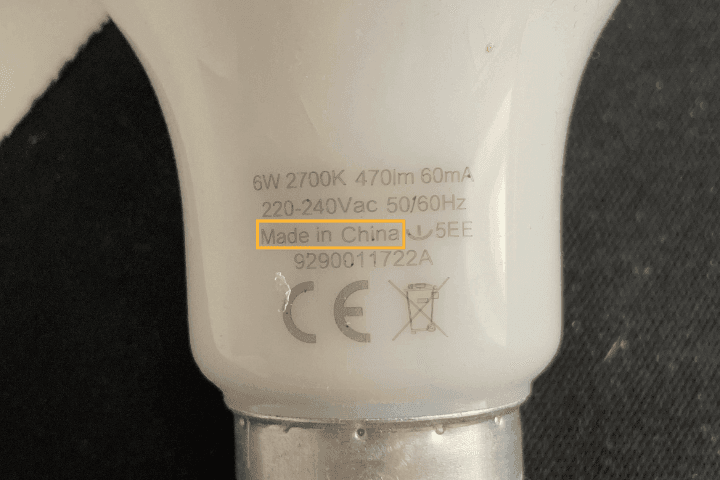
Philips, GE, and Cree bulbs are also manufactured in China — the danger isn't the country, it's unregulated marketplaces where no safety lab has ever seen the product.
 Eugen
EugenEugen Nikolajev
Creator of LED Lighting Info
Hi, I am Eugen. I was always one of those kids who had all sorts of weird lighting gadgets for every occasion.
Now, I want to share my knowledge and experience about lighting with you on LED Lighting Info.
Read my editorial standards
Key Takeaways
LED lights from unregulated Chinese marketplaces are not always safe. Many manufacturers use cheaper materials or components, such as capacitors, which can overheat and cause the bulb to burn out. The bulbs can be unsafe to handle at these temperatures and can even fail catastrophically.
They're more efficient and longer-lasting than older bulbs, which means you'll achieve the same brightness without anywhere near as much electricity required, and you won't need to replace the bulb for a much longer time.
At least, that's true when it comes to good-quality LED lights. Not every bulb you can buy is manufactured to the same standard, and the internet makes it easy to log onto foreign retailers and marketplaces to buy cheap LED bulbs that just aren't up to scratch.
The problem isn't geography — it's the lack of safety regulation and quality control on many low-cost platforms. The vast majority of LED bulbs sold under trusted Western brands (Philips, GE, Cree) are also manufactured in China. The real risk is buying from sellers on unregulated marketplaces who aren't accountable to any safety regulator.
Sometimes you can get bulbs for as little as 1 cent if you buy in bulk. But are they safe to use?
In this article I'll explain:
- The main quality problems with cheap marketplace LED bulbs
- Why overloaded capacitors are dangerous
- What to look for — including the certifications that signal a bulb has been independently tested
What Makes Cheap Marketplace LED Bulbs Poor?
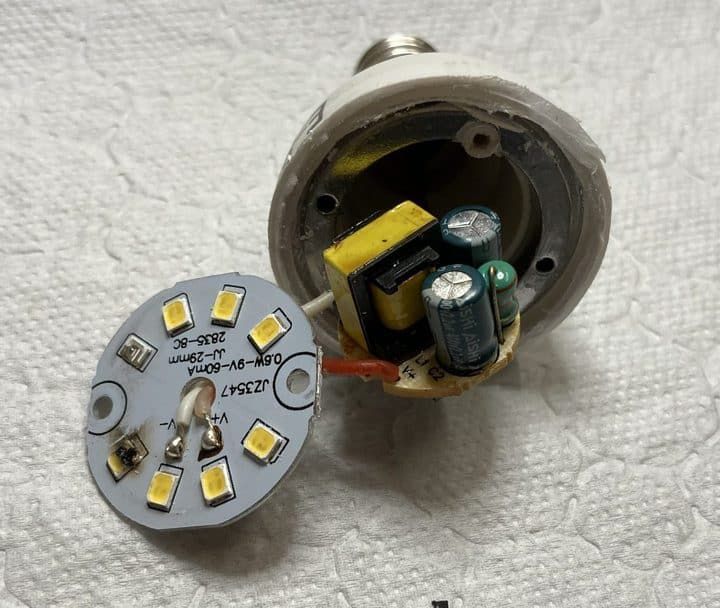
Cheap marketplace bulbs cut corners in four predictable places:
- Cheap capacitors — The capacitor's job in an LED bulb's driver is to smooth out the rectified power supply so the driver can deliver clean, stable current to the LEDs. A failing or under-rated capacitor causes flicker, dimming, or driver failure. Since capacitors are one of the most expensive components in a bulb, they're one of the first parts to be downgraded when manufacturers cut costs.
- Inconsistent LED arrays — There's no guarantee the diodes are uniform or that the bulb actually hits the lumen output and color temperature on the label.
- Poor base materials — Aluminum (≈205–237 W/m·K) is widely used in good-quality, branded bulbs because it dissipates heat well. Cheaper bulbs often use nickel-plated bases, and nickel is less than half as conductive as aluminum (≈90 W/m·K). Material is only one factor — geometry, surface area, and joint quality also matter — but a nickel-based heat sink will typically run hotter than an equivalent aluminum one, shortening the bulb's lifespan. See more on the materials used in an LED bulb.
- Low-quality soldering — Weak connections at the chip mean the electricity can't flow through the circuit cleanly. The result is a dimmer bulb or one that flickers.
Read on for why an overloaded capacitor is more than just an efficiency problem.
Why Are Overloaded Capacitors Dangerous?
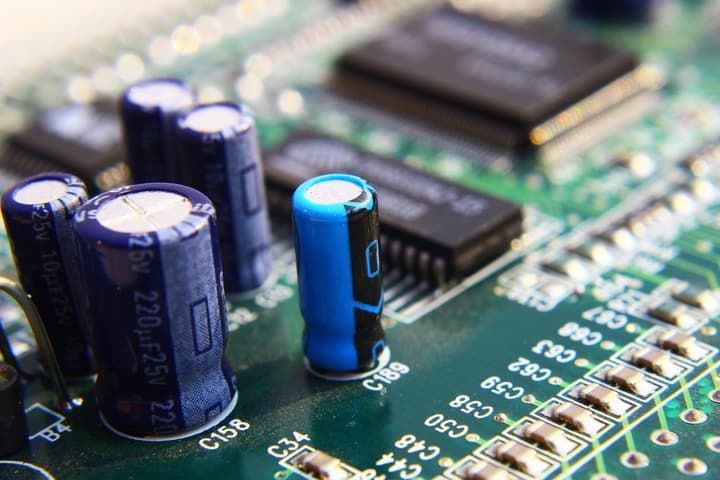
Capacitors have a voltage limit. Push a current through one that it isn't rated for and it starts to heat up, spreading that heat to the rest of the circuit and damaging surrounding components.
There are two types of capacitor used in LED bulbs. Electrolytic capacitors are cheaper but much more susceptible to heat damage — the electrolyte gel inside dries out as heat rises, causing capacitance loss and eventual failure. Ceramic capacitors are more expensive and tolerate heat better, but they're rarely found in bargain bulbs.
When a capacitor is damaged by heat, surrounding components heat up further. In severe cases, the breakdown of dielectric materials creates arcing between capacitor plates, which can short-circuit the bulb and cause it to rupture or explode.
What to Check Before Buying a Cheap LED Bulb
If you're going to buy from an unregulated marketplace anyway, here are the most important things to check before clicking buy.
Lack of Bulb Specification
One of the biggest tells is the lack of precise specifications you can compare.
For example, take a look at this branded lightbulb from Philips, and compare it to this 'similar' two-pack bulb from AliExpress.
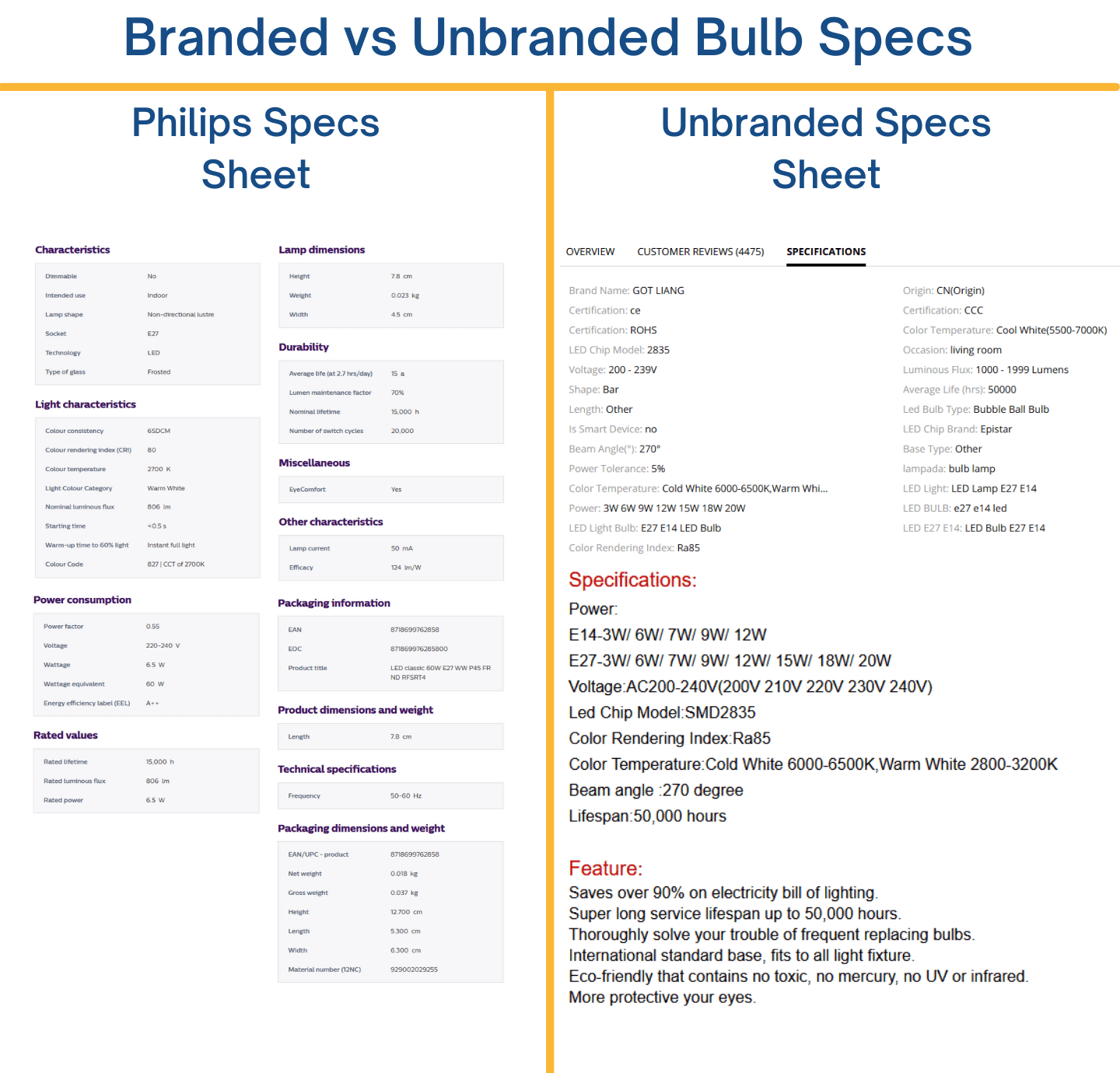
The Philips page has a clearly laid-out specification tab with exact color temperature, precise lumens (806 — no estimates), and both wattage and wattage equivalent.
On the AliExpress listing, the 'Wattage' field shows 220 V — that's the input voltage, not wattage. Wattage is selected via thumbnails. The spec only gives ranges — across the 3W to 20W options, the listed lumen output is somewhere between 1,000 and 1,999 lumens. That's far too vague to be trustworthy.
The page also contradicts itself on color temperature: a 'cool white' is listed as either 6000–6500K or 5500–7000K depending on which part of the page you read.
If a seller can't tell you exactly what a bulb does, assume the worst.
Lumen per Watt Efficiency
Where a listing does give you the numbers, compare the lumen-per-watt (lm/W) efficiency. This tells you how much light a bulb produces for every watt of power it draws.
The formula is simple: divide lumens by watts. Take that Philips example above — with 806 lumens and a 6.5W power draw, it works out to 806 ÷ 6.5 = 124 lm/W.
A quality LED bulb today should achieve at least 80–100 lm/W, with mainstream brands delivering 100–150 lm/W and premium models exceeding 180 lm/W. Anything well below 80 lm/W is a red flag — and the new U.S. Department of Energy general service lamp standard will require more than 120 lm/W for most household bulbs by July 2028.
Low CRI
CRI (color rendering index) is a measure of how accurately a light source reveals colors compared to natural daylight.
The higher the rating, the more accurate the colors. Lower CRI bulbs make shades look duller and washed-out.
The scale runs from 0 to 100, where 100 represents a perfect reference source like daylight. In practice, anything below 80 is a poor score for indoor lighting. Most decent bulbs land at 80 or 85, and exceptional ones break 90+.
Avoid marketplace bulbs with a low CRI — but be skeptical of suspiciously high scores too. A bulb advertising 95+ on an unregulated platform is more likely lying than overdelivering.
Build Materials
High-quality LED bulbs are typically built around a ceramic and aluminum heat sink with a glass globe or diffuser. Glass handles heat better and is more recyclable — independent testing has shown the Philips Ultra Definition glass bulb peaking at around 117°F, while plastic-shell designs can exceed 200°F.
Plastic shells (polycarbonate or epoxy resin) are cheaper and shatter-resistant, which is why they dominate budget bulbs. They also trap more heat. If a bulb listing prominently advertises a plastic body with no mention of a heat-management design, treat it as a budget product, not a long-lasting one.
Also avoid bulbs with a nickel-only base. Nickel-plated bases dissipate heat poorly, leading to bulbs that blow out faster or run hotter than they should.
Safety Certifications
The single most useful filter for a marketplace bulb is independent certification. A certification mark means a third-party lab has tested the bulb against published safety and performance standards. Look for:
- UL listing or ETL listing — U.S. electrical safety testing. Required by most North American building codes.
- CE marking — Mandatory conformity declaration for products sold in the EU. UKCA is the UK equivalent.
- ENERGY STAR — Efficiency and quality testing for North American markets. Includes minimum efficacy, lifetime, and color-quality requirements.
- FCC compliance — Confirms the bulb's electromagnetic interference is within U.S. limits, important for any bulb that could interfere with radios, smart home devices, or medical equipment.
Marketplace bulbs sometimes display fake or unverified certification logos. If a logo matters to your decision, cross-check the model number against the certifying body's public database (UL Product iQ, the EU's NANDO database, the ENERGY STAR product finder).
Final Words
Buying bulbs from an unregulated marketplace can play out in three ways:
- Wasted money — bulbs that don't perform as advertised or burn out long before their rated life.
- Poor performance — flicker, color shifts, premature dimming, or incompatibility with your dimmer switches.
- Real danger — overloaded components that overheat, fail, or in rare cases ignite.
My rule of thumb: if a bulb costs cents and carries no recognizable safety mark, the savings aren't worth the risk. Stick with brand-name bulbs from retailers that handle returns and recalls — most are still made in China, but they pass through quality control before reaching your socket.
If you already have suspect bargain bulbs installed, swap out any that run unusually hot to the touch, flicker, or buzz. You can check whether a specific product has been recalled in the U.S. via the Consumer Product Safety Commission's recall database, or in the EU through the Safety Gate (RAPEX) portal.