
Can LED Lights Be Used In A Sauna?
At 176–212°F, a traditional Finnish sauna runs well past the point where a standard LED holds up — and that kills the one advantage LEDs are supposed to have.
 Eugen
EugenEugen Nikolajev
Creator of LED Lighting Info
Hi, I am Eugen. I was always one of those kids who had all sorts of weird lighting gadgets for every occasion.
Now, I want to share my knowledge and experience about lighting with you on LED Lighting Info.
Read my editorial standards
Key Takeaways
LED lights are good for infrared saunas, which reach lower temperatures, but they aren't recommended for traditional saunas as they get too hot and damage the bulb. For steam rooms, LEDs should ideally be IP68 rated to keep them safe from the vapor.
In this article I'll explain in more detail:
- Why traditional saunas aren't suited to LEDs
- The difference with infrared saunas
- How LED strip lights perform in saunas
- What to consider with steam rooms and LED bulbs
Will High Temperatures In The Sauna Damage An LED Bulb?
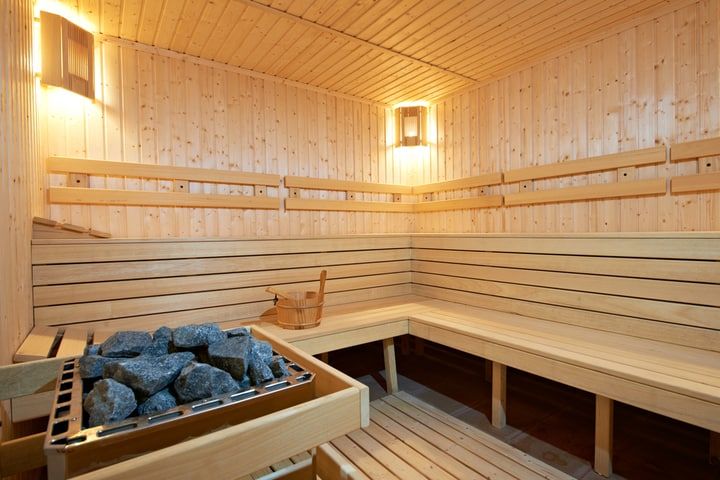
LED bulbs are sensitive to heat — here's what that means for sauna use and how to choose the right product.
LED bulbs typically operate efficiently in ambient temperatures up to around 104–140°F (40–60°C), and are most efficient when in a cooler environment. The semiconductor's junction temperature — the chip itself — is rated higher, often above 185°F, but every 10°C (18°F) rise in junction temperature roughly halves the bulb's life.
Once the ambient temperature climbs above 140°F, the semiconductor degrades faster and lifespan drops sharply.
A typical household LED bulb is rated for 15,000–25,000 hours, with commercial-grade products reaching 50,000 hours. Once exposed to sauna temperatures, those numbers fall fast.
So how hot does a sauna get? The Finnish Sauna Society recommends a temperature between 80 and 100°C (176–212°F) — well past the point where a standard LED will hold up.
One of the main benefits of LEDs is their extended lifespan, and you negate that completely at traditional sauna temperatures.
What's the alternative for a traditional sauna?
For a traditional sauna, the practical choices today are purpose-built sauna luminaires or high-temperature halogen fixtures. Standard incandescent bulbs were once the obvious option — they're inefficient (around 90% of their energy becomes heat, only 10% light), so the surrounding ambient temperature affects them less than it does an LED. But incandescent bulbs have been banned for sale across the EU since 2023 and are largely discontinued in the US, so they're no longer a realistic recommendation.
It's also worth keeping in mind how hot incandescent bulbs themselves run: glass surface temperatures range from roughly 200°F on a 60W bulb up to 500°F on higher-wattage models — far hotter than the air around them.
Whichever bulb you choose, the fixture itself must also be rated for sauna temperatures. A correctly rated bulb inside a standard plastic fixture is still a fire and deformation risk.
Can I Use an LED Bulb In An Infrared Sauna?
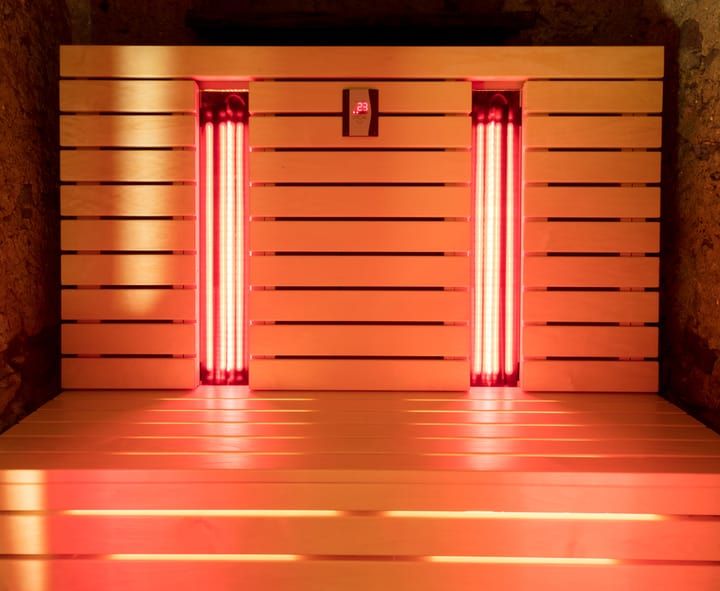
Infrared saunas are a different proposition because they're designed to be smaller and don't reach high temperatures.
An infrared sauna usually heats to between 120°F and 140°F, so even at the maximum, the LED's lifespan won't take a hit. The bulb may run slightly below peak efficiency, but you may be happier with a slightly dimmer light that lasts — particularly in a smaller one-person cabin.
The one thing to consider is whether the infrared emitters can damage the LED. Infrared light generates heat when it contacts a surface, but in any infrared sauna the emitters are positioned away from the lighting so they only reach the user. They're either adjacent to the lights at the top of the cabin pointing down, or in the side walls and aimed horizontally — so the ceiling lights stay cool.
If the infrared was pointed directly at your lighting, it would heat the bulb and shorten its life. In a normal install, that doesn't happen.
So yes — you can use LED lights in infrared saunas without sacrificing bulb life, provided the temperatures stay within the range above.
LED Strip Lights and Saunas
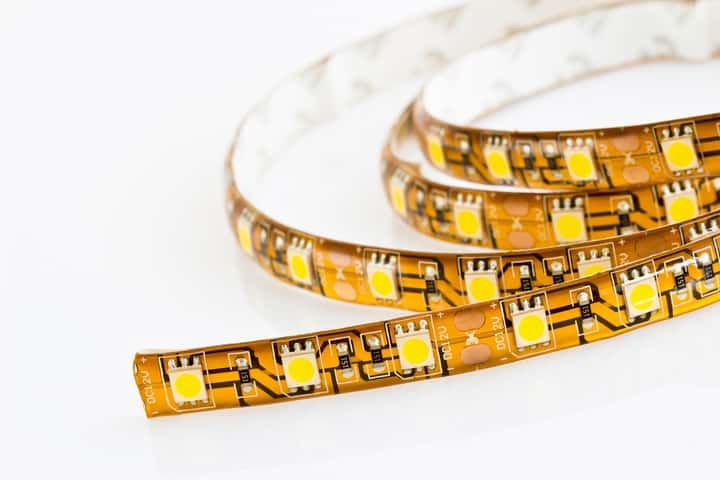
Strip lights are another popular LED solution and can really enhance the look of a sauna. So are LED strip lights any different from a regular LED bulb when it comes to heat resistance?
Generally, no. The same considerations apply — they will overheat and shed lifespan above their rated temperature. Strip lights can sometimes feel hotter than an LED bulb, which might suggest they tolerate higher temperatures, but that's only because with a bulb you'd normally handle the resin casing rather than the base. The actual LED part is still heating up, and a strip is just a series of these LEDs in close proximity and more exposed.
What to look for when buying
You can find LED strip lights specifically marketed for sauna use. When buying, look for strips rated for ambient temperatures above 60°C (140°F), and confirm the IP rating is at least IP67 (IP68 for steam-heavy environments). Sauna-rated strips typically carry a silicone or epoxy coating that acts as both a moisture seal and a thermal buffer for the diodes.
A safety note worth flagging: low-voltage (12V or 24V DC) LED strip systems are meaningfully safer than mains-voltage bulbs in steam-heavy environments. A fault on a low-voltage circuit is far less likely to be hazardous to the user, which is one reason LED strips have largely replaced mains-fed lighting in modern sauna and steam-room builds.
Installation steps
- Position the strips close to the ground, where ambient temperatures are coolest — heat rises, so a low run is exposed to the least thermal stress.
- Avoid mounting directly on wood, which is a poor thermal conductor and traps heat against the strip.
- Mount on a thermally conductive surface where possible. Aluminum profile is the standard heatsink choice for LEDs because it conducts heat roughly 100× better than concrete and pulls heat away from the diodes.
- Confirm the strip carries a heat-resistant coating rated for sauna temperatures, and that any aluminum profile is anodized so it doesn't corrode in humid conditions.
Can Humidity In The Steam Room Damage LEDs?
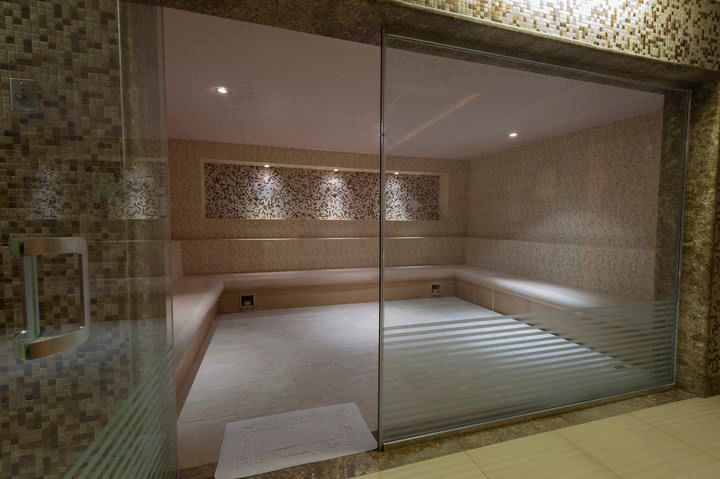
In a steam room, water is heated to generate a lot of steam, which means the air is extremely humid. They can feel as hot as a sauna, but a lot of that is down to humidity — actual air temperatures generally peak around 110°F.
But just because the temperature is in a safe range, that doesn't mean moisture can be ignored. If humid air penetrates the bulb, water will corrode the internal elements and create a shock risk when changing the bulb.
That doesn't make LEDs a no-go for steam rooms or humid saunas — it just means buying the right level of waterproofing. For this, refer to the Ingress Protection code, or IP rating, which tells you how protected a bulb (or any electrical item) is against solids and liquids.
The code is two digits. The first covers solid particles and runs from 0 to 6 — IP0 has no protection, IP6 means completely dust-tight. The second digit relates to liquids and ranges from 0 to 8, with an additional IPX9K specialty rating for high-pressure steam and hot water jets.
Most indoor household bulbs carry no IP rating at all, or a low one like IP20. For demanding environments — including saunas and steam rooms — you want a bulb that's fully sealed against both dust and water:
| IP Rating | Dust Protection | Water Protection | Best For |
|---|---|---|---|
| IP44 | Objects >1 mm | Splashes from any direction | Indoor damp areas |
| IP65 | Dust-tight | Water jets | General outdoor |
| IP66 | Dust-tight | Powerful water jets | Coastal / harsh outdoor |
| IP67 | Dust-tight | Temporary immersion | Wet rooms, sauna strips |
| IP68 | Dust-tight | Continuous immersion | Steam rooms |
Indoor bulbs in normal rooms might be rated IP64 (splash-protected) or outdoor lights typically carry at least IP65 (jet-protected), with IP66 reserved for harsher exposed conditions like coastal or industrial sites.
Neither is enough for a steam room. The constant vapor and steam pressure mean splash- and jet-rated bulbs aren't enough — IP67 or IP68 is the right target if you want LEDs in a steam room or any humid setting with pressured steam.
Final Words
I'd think twice before putting a standard LED in a traditional Finnish sauna — the temperatures are simply too high for the lifespan benefit to hold up. Infrared saunas are far more manageable, and steam rooms are workable as long as the bulb's sealing is up to the job.
Always check the waterproof rating of any bulbs you buy for a steam room — water and electricity don't mix, and steam is essentially high-pressure water in a different form.