Can You Use Indoor LED Flood Lights Outdoor?
Water reaching an indoor bulb's contacts doesn't just kill the bulb — it can arc and ignite nearby material before your breaker even reacts. That's the failure chain a simple IP65 rating is designed to prevent.
 Eugen
EugenEugen Nikolajev
Creator of LED Lighting Info
Hi, I am Eugen. I was always one of those kids who had all sorts of weird lighting gadgets for every occasion.
Now, I want to share my knowledge and experience about lighting with you on LED Lighting Info.
Read my editorial standards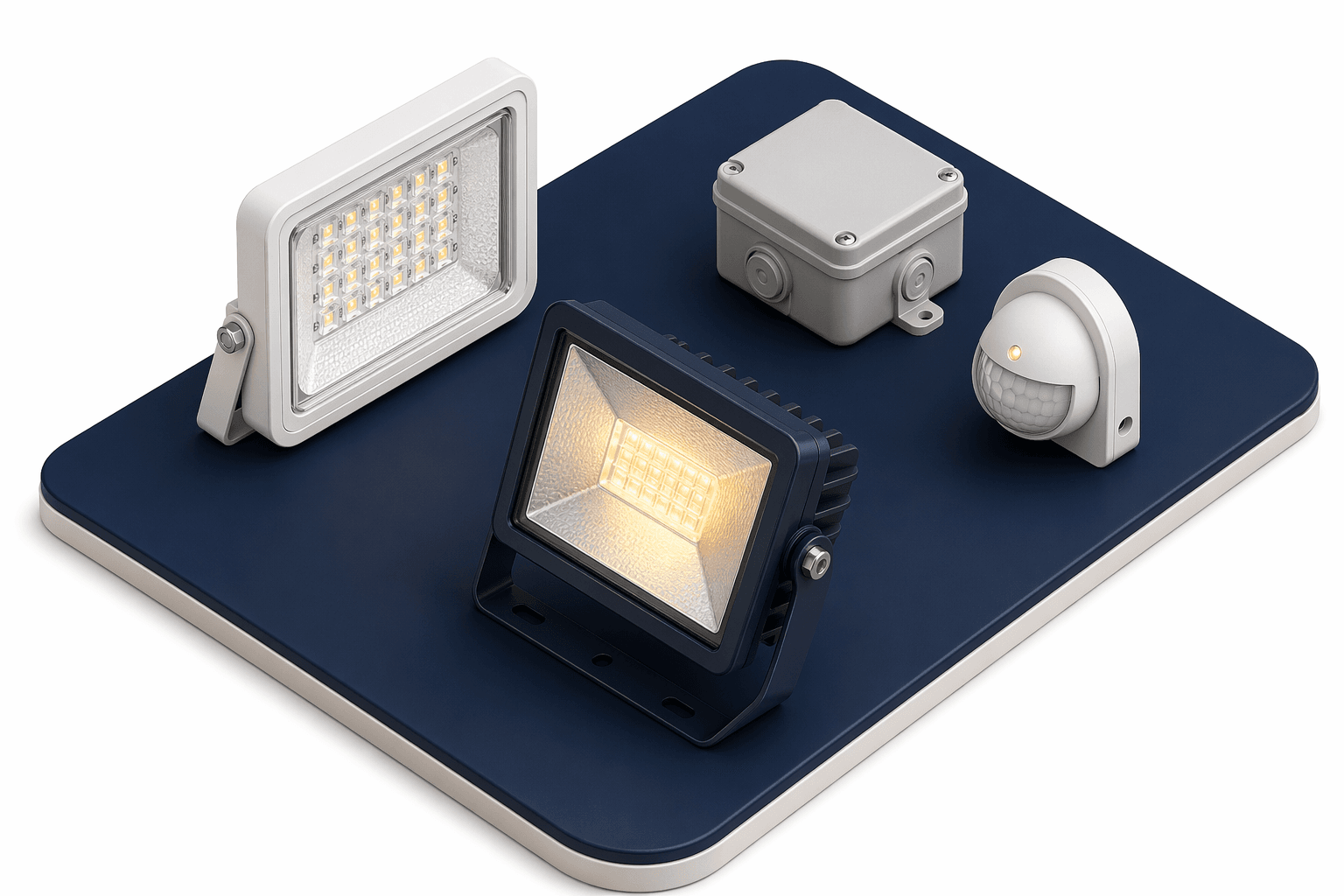
Floodlights aren’t one-size-fits-all. Indoor and outdoor versions are built to different sealing and safety standards, and substituting one for the other creates real fire risk. Here’s what actually goes wrong — and the precautions to take if you have no alternative.
What Is The Difference Between Indoor And Outdoor Flood Lights?
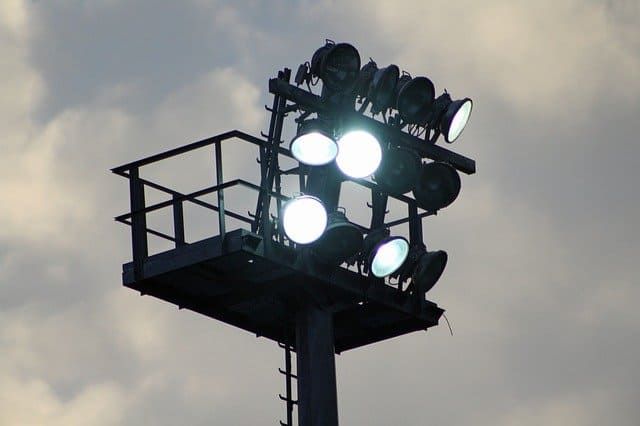
The biggest difference is the location rating. Lighting fixtures and bulbs are tested by Underwriters Laboratories (UL), and that testing produces a location rating that determines where the product can safely be installed:
| Location Type | Examples | Minimum IP Rating |
|---|---|---|
| Dry (indoor only) | Bedroom, living room | IP20 |
| Damp | Bathroom, indoor pool, covered patio or porch | IP44 |
| Wet (outdoor exposed) | Garden lamp posts, outdoor wall sconces | IP65 |
The UL mark itself just confirms the product has been safety-tested. What determines where you can install it is the location rating that accompanies the listing — UL Listed for Dry Locations (indoor, no moisture), UL Listed for Damp Locations (humid or covered areas), or UL Listed for Wet Locations (direct rain or snow exposure). If a fixture only says “UL Listed” with no location rating, treat it as dry-location only.
Damp locations are areas routinely subject to moisture or condensation but not to direct weather — bathrooms, indoor pools, and covered patios all qualify. Wet locations are exposed directly to rain and snow. Lights designed for wet locations are sealed and gasketed; lights for damp locations are not built to handle standing water or wind-driven rain.
Understanding the IP code
An IP rating consists of two digits. The first digit (0–6) indicates protection against solids like dust; the second digit (0–9) indicates protection against water. For damp locations, look for at least IP44 (splash-resistant). For direct outdoor exposure, choose IP65, IP66, or IP67. IP68 is reserved for fixtures designed for continuous submersion, such as fountain or pond lighting.
Can You Use An Indoor Flood Light Outside?
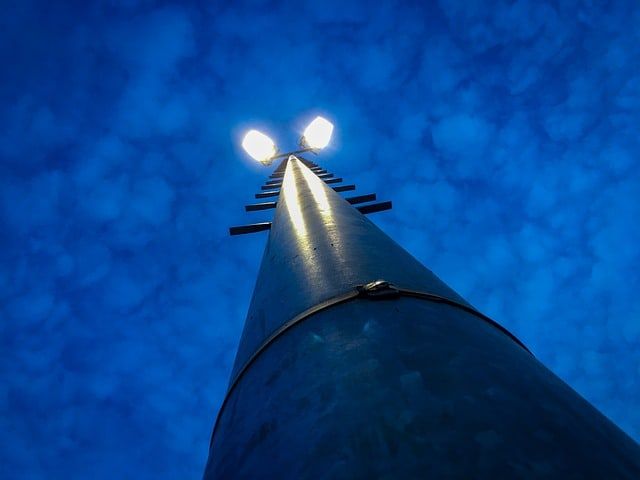
Short answer: no. Indoor bulbs aren’t built to handle moisture, and the failure chain is well-understood. Water seeps past the housing and reaches the contacts or driver electronics. Moisture bridging hot and neutral creates a short circuit. The short produces an arc, which either trips the breaker (best case) or ignites nearby material and leads to a fire (worst case).
Some local codes also prohibit installing indoor-rated fixtures outdoors. Either way, unless a bulb is rated at least IP65, it should not be exposed directly to weather.
A note on bulb types: historically, flood lamps came in several formats — incandescent, halogen, fluorescent, and (in commercial settings) sodium vapor or metal halide. Most household incandescent and halogen flood lamps have been phased out under US efficiency standards, leaving LED as the dominant option for both indoor and outdoor use.
Main Watchouts When Using Indoor Flood Bulbs Outside
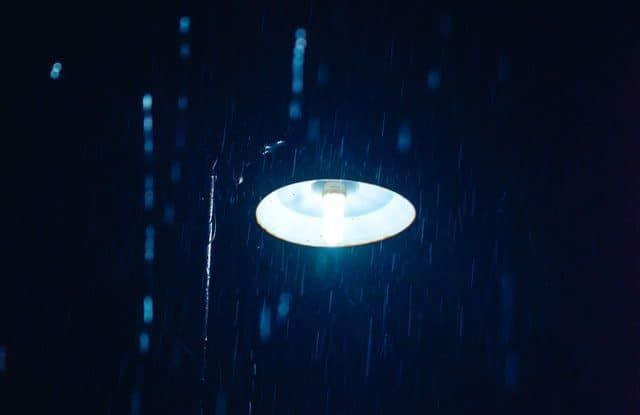
If circumstances require using an indoor bulb outdoors temporarily, take these precautions:
- Shield the bulb from direct weather: Covered porches and balconies are acceptable; open garden lampposts are not. Most indoor bulbs can survive damp air under cover but will fail quickly when hit directly by rain or snow.
- Match wattage to the fixture’s maximum rating: Outlets are rated by voltage and amperage, but light fixtures and sockets carry a maximum bulb wattage. Putting a 100W bulb in a fixture rated for 60W can overheat the wiring and insulation, creating a fire hazard. Lower-wattage bulbs are always safe — they just produce less light. With LEDs, what matters is the actual wattage on the label, not the incandescent equivalent.
- Choose enough lumens for the job: Path and accent lighting typically needs 700–1,300 lumens. Security and floodlight applications need 2,000+ lumens. A bulb that looks bright enough indoors will often look dim once mounted outside.
- Pick the right color temperature: Cool white (5,000K–6,500K) is preferred for security lighting because it improves visibility and camera contrast. Warm white (2,700K–3,000K) suits aesthetic outdoor lighting like patio sconces or string-lit decks.
- Avoid fluorescent bulbs with motion sensors — Fluorescents can take up to 3 minutes to reach full brightness, defeating the point of a motion-triggered light. LED floodlights reach full output instantly.
- Use weatherproof mounting accessories: Non-conducting, weatherproof cable covers reduce the risk of an electrical fire on exposed wiring.
- Install an in-use weatherproof outlet cover: Especially important if the outlet itself is uncovered. In-use weather-resistant covers (Amazon) are inexpensive.
- Keep flammable materials clear of the fixture: Dry leaves, fabric awnings, and wooden trim near a bulb turn a small failure into a serious fire.
- Connect to a GFCI: Outdoor wiring must be GFCI-protected under the US National Electrical Code. A GFCI (Ground-Fault Circuit Interrupter) is a fast-acting safety device that cuts power within about 25 milliseconds when it detects a ground fault. Unlike a standard circuit breaker — which trips on overcurrent — a GFCI senses imbalances between hot and neutral, exactly the condition you’d expect from moisture intrusion.
How To Find Your Bulb’s Rating Without The Box
If the packaging is long gone, IP and location ratings can usually be found in three places:
- Printed on the bulb’s metal base or driver housing, often in small text near the model number.
- On the manufacturer’s website, search the model number for the spec sheet.
- In online retailer listings, which typically reproduce the spec sheet under product details.
If the rating cannot be verified, treat the bulb as indoor-only.
Final Words
In my view, indoor LED bulbs simply shouldn’t be used outdoors. The fire risk is real, and properly rated outdoor LEDs are inexpensive enough that there’s no good reason to substitute. Quality LEDs are typically rated for 15,000–50,000 hours, compared with about 1,000–4,000 hours for halogens — so a properly rated outdoor LED commonly lasts 10 to 25 times longer than the halogen it replaces.
When shopping, look for sealed, gasketed housings and a suitable IP rating (at least IP65 for direct outdoor exposure). Skip any fixture that doesn’t carry a clear Damp or Wet location rating to match where you plan to install it.