
How Long Do LED Bulbs Last? Light Bulbs Comparison
A DOE study tracking over 34 million operating hours found just 10% of LED failures come from the emitter — the other 90% is the driver circuitry giving out first.
 Eugen
EugenEugen Nikolajev
Creator of LED Lighting Info
Hi, I am Eugen. I was always one of those kids who had all sorts of weird lighting gadgets for every occasion.
Now, I want to share my knowledge and experience about lighting with you on LED Lighting Info.
Read my editorial standards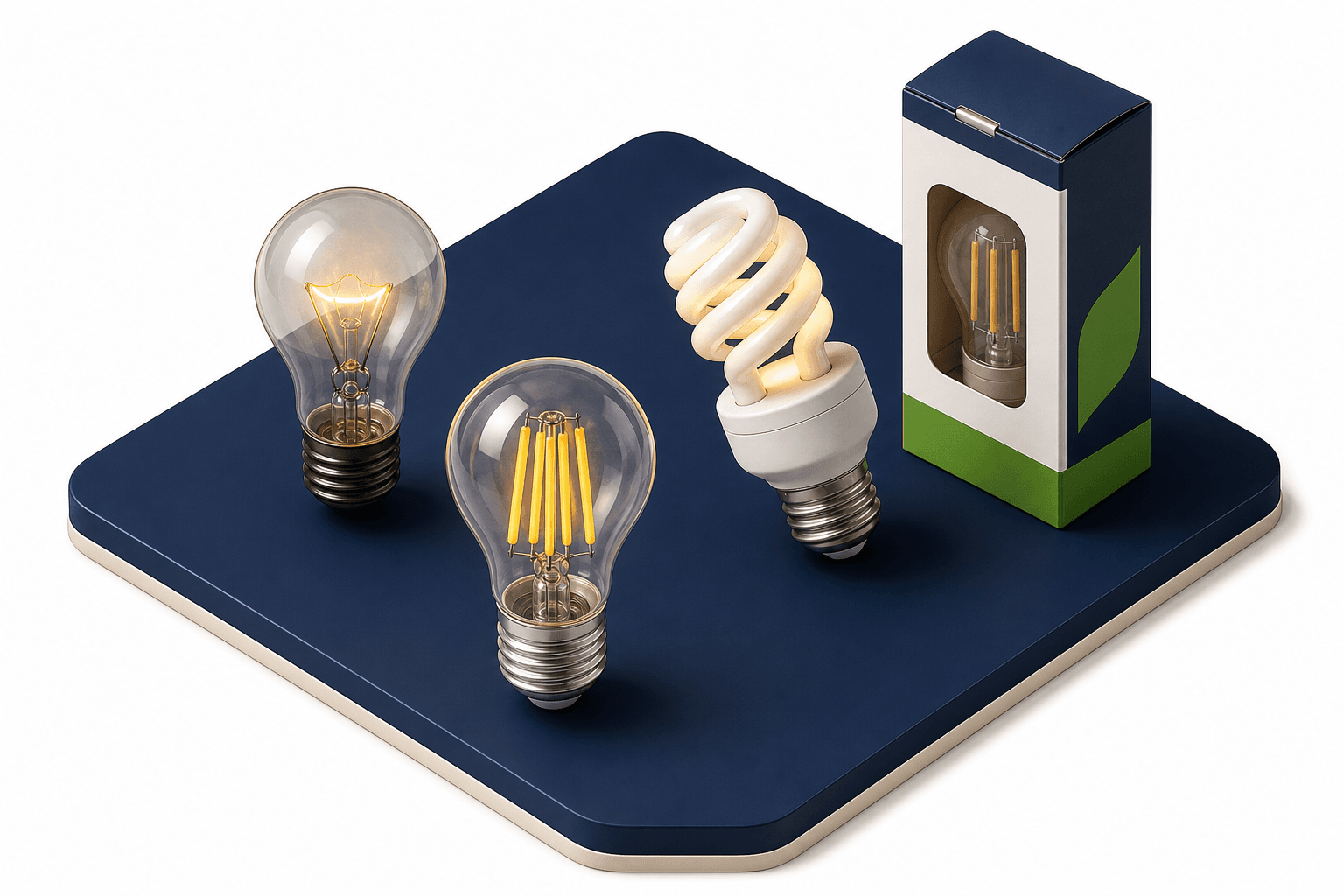
Key Takeaways
Rated LED lifespans are projections based on lumen output, not guarantees. Whether a bulb actually reaches its rated hours depends heavily on heat, switching frequency, driver quality, and how the fixture is installed.
LED bulbs are sold with rated lifespans of 25,000 to 50,000 hours — numbers that translate to anywhere from 15 to 45 years of service. But if you’ve ever swapped out a “long-life” LED after two or three years, you know the marketing and the reality don’t always line up.
Shopping only makes this murkier. Rated lifespans on the shelf range from 15,000 hours to 70,000 hours, paired with warranties of three to ten years that vary widely by manufacturer.
In this guide, I’ll break down how LED lifespan is actually measured, why bulbs fail earlier than rated, and what you can do — for both standard LEDs and strip lights — to get closer to the numbers on the box.
Light Bulbs Lifespan Compared
Comparing other bulbs to LEDs is a bit like comparing apples and oranges.
Incandescents heat up, their filaments break, and they simply stop working. LEDs, on the other hand, go through what’s called Lumen Depreciation: the components slowly degrade and the light output gradually dims year by year, until the bulb is too faint to be useful.
So how do you decide when an LED “dies”? Here’s how each technology compares:
| Type of Bulb | The Science | Average Life Span |
|---|---|---|
| Incandescent | Heating a tungsten filament until it glows; light is a byproduct of heat | ~1,000 hours |
| Halogen | Similar to incandescent, but the bulb is filled with halogen gas that recycles tungsten back onto the filament, slowing burnout | 1,000–3,000 hours |
| CFL | Phosphor-coated tube containing mercury vapor; the ballast ionizes the gas to produce UV light, which the phosphor coating converts to visible light | 8,000–15,000 hours |
| LED | A semiconducting light-emitting diode converts electric current directly into light | 15,000–50,000 hours |
Unlike incandescents and halogens, LEDs don’t really “burn out” — they slowly fade. The industry has settled on two paired metrics to mark end-of-life. L70, called Lumen Maintenance, is the point at which a bulb retains 70% of its original light output. B50 (or Average Rated Life, ARL) is the point at which 50% of a tested sample has failed outright. These are typically reported together — for example, “L70/B50 = 50,000 hours.”
How Long Do LED Strip Lights Last?
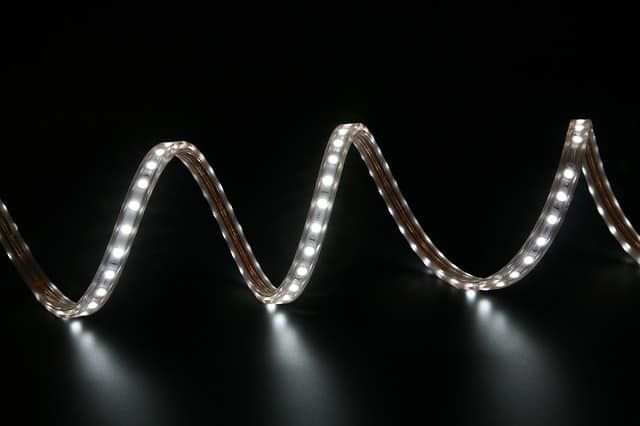
One of the quickest ways to get a Tron-inspired room is to install cyan-colored LED strip lights in creative places.
LED strip lights come as a narrow reel of flexible circuit board, mounted with individual light emitters and backed with double-sided adhesive.
They’re versatile and easy to install — which is why you’ll also find them sold online for dirt cheap. Those bargain reels won’t last.
A quality LED strip can deliver around 50,000 hours. At a typical residential usage of 3 hours per day (the industry-standard assumption for rated-life calculations), that’s over 45 years. Even at 8 hours per day, you’re still looking at more than 17 years of service.
Hitting those numbers takes the right strip and the right installation. Use this checklist:
- Keep the strip cool, dry, and away from dust — the basics of caring for any electronics.
- Choose a strip with 2–4 oz of copper in the circuit board. Thinner copper can’t handle higher current draw, and the solder will fail under load.
- Buy a high-LED-count strip if you want bright light. Low-count strips have to overdrive their emitters to match the same brightness, which dramatically shortens their life.
- Mount the strip inside an aluminum channel that acts as a heatsink to dissipate heat. Wood, plaster, and most cabinet materials are insulators — they trap heat against the strip.
- Size the aluminum housing to match the wattage. The more power the strip draws, the more thermal mass it needs around it.
Most consumer LED strips are rated to operate up to about 50–60°C (122–140°F). Standard SMD 5050 strips typically max out around 50°C; higher-end strips with better thermal design can handle a bit more. Always check the datasheet for your specific product.
How Long Do Integrated LED Bulbs Last?
With the way things are advancing in the LED world, soon changing light bulbs will be a thing your grandparents tell stories about — at least where integrated fixtures are involved.
Integrated LED fixtures combine the fixture and the LED into a single unit, wired directly to mains. The LED is hardwired in and can’t be swapped out.
This is where LED technology really shines. Manufacturers reserve their most durable emitters for these fixtures, since the whole assembly is expected to last for the life of the warranty and beyond.
Theoretically, an integrated fixture can run for decades. In practice, the other electricals — drivers, capacitors, wiring — often fail before the LEDs themselves noticeably degrade.
When something does fail, integrated LEDs can be tedious and costly to replace. An extended warranty helps but adds to an already higher upfront cost. The power supply is usually housed separately, which makes it the easier component to swap out if it goes.
So what actually goes wrong inside an LED?
Why Do Your LED Lights Keep Burning Out?
According to a U.S. Department of Energy study of roughly 5,400 outdoor LED lamps operated for over 34 million hours, only about 10% of failures were attributable to the LED emitter itself — the remaining 90% came from drivers, power supplies, and housing failures. The study covered outdoor luminaires, but the same failure pattern holds inside consumer bulbs.
The weakest link in an LED bulb is almost always the supporting electronics — the capacitors, semiconductors, and power-regulation parts — not the emitter itself. Here are the main culprits:
- Driver electronics. About 60% of LED failures trace to the driver — typically the electrolytic capacitors and power-regulation components sitting on the circuit board at the bulb’s base. The more features a bulb has (dimming, color tuning, smart controls), the more circuitry it carries, and the more potential points of failure.
- Trapped heat. Electronics packed into a small space at the base of the bulb produce heat with nowhere to escape. Heatsinks and finned designs help, but using a bulb that isn’t rated for enclosed fixtures will trap even more heat. See correct LED in enclosed fixtures for what to look for.
- Power surges and missing constant-current chips. A constant-current driver is a small circuit that holds the current flowing to the LEDs steady regardless of voltage fluctuations on the line. Without one, surges from faulty power lines pass straight through to the emitters and shorten their life.
- Electrical Overstress (EOS). Every time a bulb is turned on and off rapidly, a small surge passes through the microchips. Repeated over thousands of switching cycles, that overstress causes micro-cracking at the silicon junction and gradually degrades the chip. Many quality LEDs include Soft Start — a brief ramp-up in current draw at switch-on (not the same as dimming) that eases the bulb into operation. If you only need a bulb off for a few minutes, it’s often better to leave it on.
- Wrong fixture rating. A bulb rated only for open fixtures will overheat and fail early inside an enclosed dome. Always match the bulb’s enclosure rating to the fixture.
How to Increase the Lifespan of LED Bulbs
Beyond buying the right bulb to begin with, a few practical habits will extend the lifespan of any LED:
- Don’t mix bulbs in a fixture. Incandescents run hot and raise the ambient temperature inside the housing, cooking any LEDs that share the fixture.
- Use well-sized luminaires. Adequate ventilation around the bulb is critical for heat dissipation.
- Favor larger bulbs. Bigger envelopes dissipate heat better. Look for air gaps and a visible heatsink at the bulb’s base.
- Don’t leave LEDs on for extended periods. They’re cheap to run, but every hour shortens the rated lifespan and contributes to light pollution.
- Check the components on the datasheet. The quality of the driver and the emitter package matters more than the headline lumen rating.
- Check the operating temperature range. Most consumer LED bulbs perform best somewhere between -20°C and +40°C (-4°F to +104°F), though specialty bulbs extend in either direction. Manufacturers typically rate L70 at a 25°C (77°F) reference ambient — the further you drift from that, the faster lifespan degrades.
Final Words
LEDs are closer to computer tech than light bulb tech, and it pays to treat them that way. The lifespan you actually get depends less on the brand on the box and more on how the bulb is installed and used.
If I had to distill this article into a short checklist, it would be this:
- Pay attention to L70/B50, not just the headline “rated hours.”
- Match the bulb’s enclosure and temperature rating to the fixture.
- For strip lights, mount them in aluminum channels and don’t skimp on copper weight.
- Avoid rapid on-off cycling where you can — look for Soft Start.
- Keep the bulb cool. Heat is the single biggest enemy of LED longevity.
Get those right and you’ll be much closer to the 25,000-plus hours the box promises.