Can You Use LED Bulbs In Lava Lamps?
A 40W incandescent wastes 36 of those watts as heat, and in a lava lamp that waste is exactly the point. Swap in an LED and you get a glowing globe of stationary wax.
 Eugen
EugenEugen Nikolajev
Creator of LED Lighting Info
Hi, I am Eugen. I was always one of those kids who had all sorts of weird lighting gadgets for every occasion.
Now, I want to share my knowledge and experience about lighting with you on LED Lighting Info.
Read my editorial standards
Key Takeaways
LED bulbs cannot be used in traditional lava lamps because they do not generate enough heat to melt the wax. As an energy-efficient light source, an LED does not get the wax inside the globe hot enough to expand and circulate. The wax will remain static and will not move around.
Lava lamps have been a bedroom essential since their invention in 1963, and they remain popular today. But as energy-efficient bulbs replace incandescents in nearly every other fixture, one question keeps coming up: do lava lamps work with LED bulbs?
The short version of the rule: match the wattage and bulb type printed on the base of your lamp. Substituting an LED for the original incandescent will leave you with a glowing globe of stationary wax.
Keep reading to learn how lava lamps work, which bulbs to use, what wattage and base type to look for, and where the few LED-compatible models stand today.
What Are Lava Lamps and How They Work?
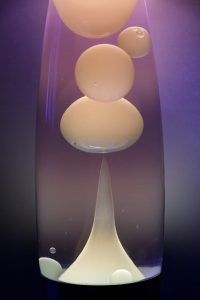
A lava lamp is a decorative light made of a glass globe set on top of a metal base. Inside the globe are two compounds: a transparent, water-like liquid and an opaque, wax-like blob. A bulb inside the base illuminates and gently heats the globe, and the wax slowly drifts up and down in shifting blobs.
Manufacturers are notoriously tight-lipped about their exact ingredients. The transparent liquid is generally a mixture of distilled water, alcohol, and salt. The lava itself is a blend of paraffin wax and other compounds tuned to a very specific density.
Just like oil and water, the two compounds are immiscible — they do not dissolve into one another. They are also very close in density: paraffin wax has a density of approximately 0.9 g/cm³, and the alcohol-water mixture has a density of around 0.8 g/cm³. That tiny gap is what makes the whole effect work.
The wax is engineered to be slightly denser than the surrounding liquid at room temperature, and slightly less dense once warmed by the bulb. The cycle goes like this:
- The bulb heats the base of the globe.
- The wax absorbs heat, expands, and becomes less dense than the surrounding liquid.
- The wax rises to the top of the globe.
- Away from the heat source, the wax cools, contracts, and becomes denser again.
- The wax sinks back to the bottom and the cycle repeats.
The density variations are tiny, but they are enough to keep the wax slowly rising and sinking for hours.
Why LED Bulbs Don't Work In Lava Lamps
Now that you understand how lava lamps work, the LED problem is easy to spot: LEDs do not generate enough heat to melt the wax.
Many standard-sized lava lamps use a 25W or 40W incandescent bulb, though the exact wattage varies by model and manufacturer. These bulbs create light by heating a tungsten filament to around 4,600 degrees Fahrenheit.
That filament throws off enormous amounts of heat — roughly 90% of an incandescent bulb's input energy is wasted as heat, with only about 10% leaving as visible light. A 40-watt incandescent puts out roughly 36 watts of heat and only 4 watts of light, and that heat is exactly what makes the wax circulate.
LEDs are far more efficient — they convert a much larger share of their energy into light, with comparatively little lost as heat. Most LED bulbs are also designed specifically to dissipate the heat they do produce through features like aluminum heat sinks or cooling fins, because excess heat shortens the lifespan of the LED chip and increases the rate of lumen degradation. LEDs do produce heat, but nowhere near enough to melt lava lamp wax. Drop one in and the wax will sit at the bottom in a solid lump, or break into small static blobs floating mid-globe.
Which Bulbs Are Suitable For Lava Lamps?
The right answer depends on how much heat the bulb produces. Inefficient bulbs — incandescents and halogens — are what lava lamps are designed for. Energy-efficient bulbs like CFLs and LEDs should be avoided.
Wattage and Base Type
When buying a replacement, two numbers matter: wattage and base type. Standard 14.5-inch / 20-oz Lava Lamps use a 25W S11 bulb, while larger 16.3″–17″ models use a 40W reflector bulb. Other sizes use 15W, 30W, or higher. Always check the label on the base of your lamp before ordering.
The base type is just as important. Most US lava lamps use an E17 intermediate base, which is smaller than a standard household E26 socket. Many European models use E14. A bulb with the wrong base will not screw in, no matter how perfect the wattage.
Are Lava Lamp Bulbs Being Phased Out?
Inefficient light sources are gradually being banned around the world. The EU's phase-out began in September 2009, when the first stage of Commission Regulation (EC) No 244/2009 took effect. The US completed its own phase-out of general-service incandescents in August 2023.
Incandescent bulbs also have a short lifespan to begin with — typically 750 to 2,000 hours — so a lava lamp will eventually need a replacement bulb.
Lava lamps have been treated as something of an exception to the rules. Specialty replacement bulbs are still produced and sold by lava lamp manufacturers themselves, so the safest first stop for a replacement is the manufacturer's own website rather than a general hardware store.
Matching Wattage: Why It Matters
If you only take away one thing from this article, make it this: the replacement bulb must match the wattage printed on the lamp's base.
Lava lamps depend on a precise heat balance. The wax is formulated to melt and circulate at the specific heat output of the bulb the lamp was designed for. Anything else will throw it off.
If a lava lamp uses a 40-watt bulb, the wax is designed to melt and circulate at roughly that level of heat output. Drop in a lower wattage and the wax may never get warm enough to start moving. Drop in a higher wattage and the wax can overheat: it will not cool fast enough at the top of the globe to sink back down, leaving you with one large floating blob — and a real risk of cracking the globe or damaging the base.
Never exceed the maximum wattage printed on your lamp. Going over the rated wattage is a burn and fire hazard, on top of ruining the wax.
Why Your Lava Lamp Isn't Moving (And It's Not the Bulb)
If your lamp is running but the wax isn't circulating, the bulb isn't always to blame. Two common, easily fixed issues catch a lot of people out.
Give It Time To Warm Up
A cold lamp does not start moving immediately. Most lava lamps need 1 to 3 hours to fully activate, and the first run after long storage can take even longer. If the wax is still sitting at the bottom after 20 minutes, that's normal — leave it on and check back later.
Check the Room Temperature
Lava lamps are designed to run in normal indoor conditions. In a cold room — below about 68°F (20°C) — the wax may never reach the temperature it needs to expand, even with the correct bulb. If your lamp lives near a drafty window or in an unheated room, move it somewhere warmer before you assume the bulb has failed.
What About LED-Compatible Lava Lamps?
Some manufacturers have begun building lava lamps with a separate resistance heater in the base, so the bulb only needs to supply light. In those models, the heater handles the wax and the light source can be an LED. Schylling's Lava brand sells "LED Lava Lamps" along these lines, alongside their classic incandescent line.
These are still a niche product, and they aren't drop-in replacements — you can't simply swap an LED into an existing incandescent lava lamp. If you want the LED experience, buy a model that was specifically designed for it.
Final Words
Traditional lava lamps need the heat from an incandescent or halogen bulb to work, so an LED swap will leave you with a stationary blob. Match the exact wattage and base type printed on your lamp, give it a few hours to warm up, and keep it in a normally heated room. If you specifically want to run an LED, buy a model built around a separate base heater rather than trying to retrofit an old design.
Related Articles
| Bulb Type | Heat Output | Suitable For Lava Lamp? | Notes |
|---|---|---|---|
| Incandescent | High | Yes | The original lava lamp bulb. Match the exact wattage and base type printed on the lamp. |
| Halogen | High | Yes | Acceptable substitute when wattage and base match. Runs hot, so handle with care. |
| CFL | Low | No | Doesn't run hot enough to melt the wax. |
| LED | Very Low | No | Designed to dissipate heat. The wax will not circulate. |