Do LED Lights Attract Bugs? Science-Backed Answer
The "moths confuse lights with the moon" story was overturned in 2024 — insects aren't flying toward your bulb, they're trapped orbiting it by a reflex called the dorsal light response.
 Eugen
EugenEugen Nikolajev
Creator of LED Lighting Info
Hi, I am Eugen. I was always one of those kids who had all sorts of weird lighting gadgets for every occasion.
Now, I want to share my knowledge and experience about lighting with you on LED Lighting Info.
Read my editorial standards
Key Takeaways
LED lights do attract bugs, but far less than older incandescent or fluorescent bulbs. That's because typical household LEDs emit virtually no UV light and produce very little heat, both of which are major draws for insects.
Choosing a warm-white LED (rather than a cool, bluish one) reduces attraction even further, because shorter wavelengths in cool-white light are what insects see best.
Not all light bulbs are equally attractive to bugs — and the difference comes down to wavelength, not just heat. If you've ever wondered why a porch light pulls in a swirling cloud of moths while a red bulb across the yard sits quiet, that's the science at work.
In this guide, I'll cover:
- Why bugs are drawn to artificial light (the modern explanation)
- Which colors of light attract the most and fewest insects
- What color temperature (Kelvin) to choose on a bulb's packaging
- Indoor vs. outdoor recommendations
Why Do Bugs Love Light?
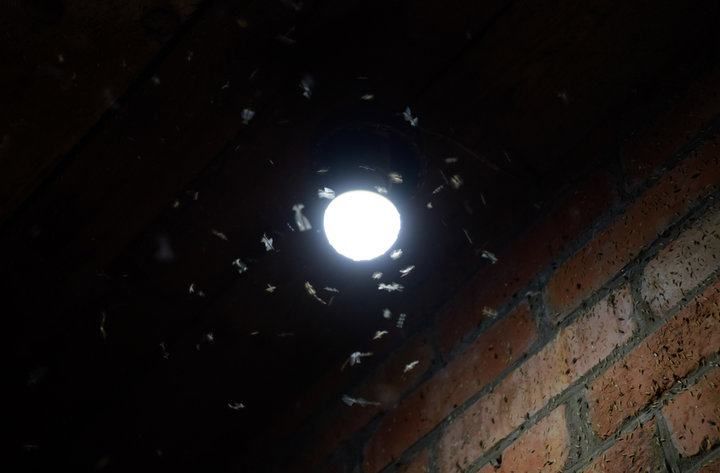
The classic explanation — that nocturnal insects mistake artificial lights for the moon and use them as a navigation reference — has been around for decades. The 2024 research tells a different story.
The Dorsal Light Response (the modern explanation)
The popular "moths confuse lights with the moon" idea has been largely overturned. A 2024 study using high-speed motion capture (Fabian et al., Nature Communications) showed that flying insects use the brightest part of the sky to keep themselves upright — a behavior called the dorsal light response. Near an artificial light, that reflex makes them tilt their backs toward the bulb, which sends them looping, stalling, or flipping around it.
The detection happens through the insect's large compound eyes. The smaller simple eyes called ocelli help with horizon-sensing and flight stabilization but aren't the primary mechanism for what looks like attraction. In short, insects aren't "flying to" the light — they're trying to stay level relative to it, and the geometry traps them in orbit.
What About Heat?
Heat does play a secondary role for some species, but it's not the main driver. Older bulbs attract more insects because they emit a broad spectrum that includes UV and short visible wavelengths — not chiefly because they run hot.
Traditional incandescent and fluorescent bulbs throw off both more UV and more heat than LEDs. That combination is what makes them magnets for bugs. LEDs run cool and emit almost no UV, which is the single biggest reason they pull in fewer insects.
What Light Color Spectrum Attracts Bugs?
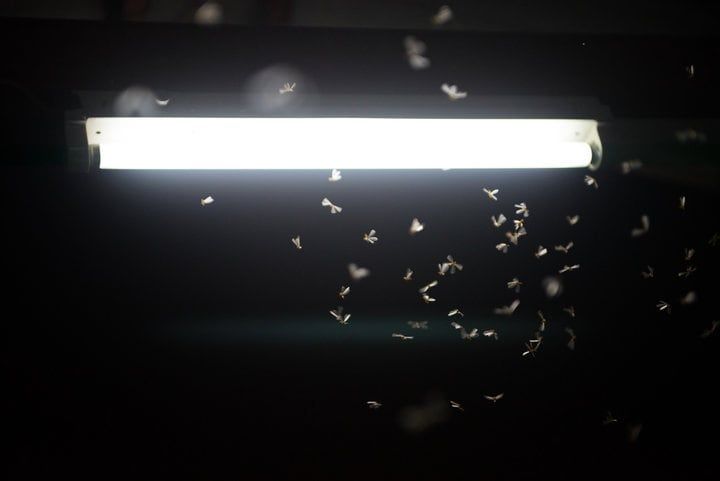
Most insects' compound eyes are most sensitive to ultraviolet, blue, and green wavelengths, and largely insensitive to red. Reviews of domestic light comparisons and broader ecological studies consistently put UV and blue at the top of the attractiveness list, with warm yellows and reds at the bottom. Exact orderings vary by species.
| Attraction Level | Light Color / Type | Typical Color Temperature (K) |
|---|---|---|
| Highest | Ultraviolet / "black light" (~365–395 nm) | Not on the visible Kelvin scale |
| High | Blue | 5000K–6500K and above |
| Moderate | White / cool-white | 4000K–5000K |
| Lower | Green | Specialty / not standard household |
| Low | Yellow / amber ("bug light") | 2000K–2700K |
| Lowest | Red | ~1800K (warm) / dedicated red LEDs |
Note that "black light" is colloquial for near-UV lamps (UVA, roughly 315–400 nm). It isn't a visible color — it's near-ultraviolet radiation that fluoresces certain materials. That's what bug zappers use, not visible blue LEDs.
Why Are Bugs Attracted To Blue Light?
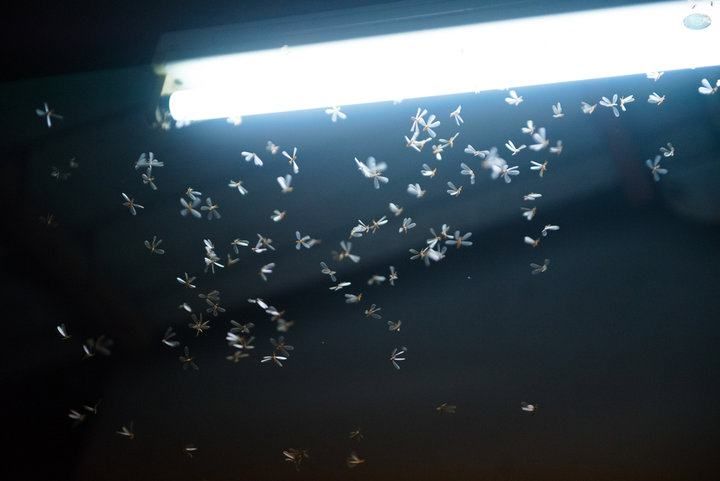
Bluish lights are more attractive to bugs because the short wavelengths in the blue-violet range are what insect compound eyes see most strongly. A cool-white LED — heavy on blue spectrum — is visible to flying insects from farther away than a warm-white one of the same brightness.
Insect light traps typically use actual UV ("black light") tubes — not visible blue LEDs — because UV is what insects see most strongly. A blue LED at ~450 nm is visible blue, not UV, so older claims that "blue means more UV" only really apply to broad-spectrum sources like mercury vapor lamps.
Researchers at Tohoku University (Hori et al., follow-up study in PLOS ONE) showed that high-intensity, narrow-band blue and violet light — around 467 nm for fruit flies and 417 nm for mosquitoes — can be lethal to certain insect pupae. High-intensity blue light physically damages cells in these insects' bodies, leading to death from overexposure.
Importantly, this used focused light at lab intensities, not the diffuse blue component of an ordinary household LED. Your bedside lamp isn't a death ray, and the effect also depends heavily on insect life stage (pupae are most susceptible). The research is being explored as a potential chemical-free pest-control method.
Why Do Red LED Lights Attract Bugs Least?
Lights in the warmer part of the color spectrum — especially red — are at the long-wavelength end of what insect compound eyes can detect. Most insects' photoreceptors are tuned to UV, blue, and green; red is largely invisible to them.
No light color will actively repel bugs, but you can minimize the appeal of a bulb by using warmer lights that are less visible to them.
Yellow fluorescent lights are also used in agricultural settings to disrupt insect behavior. By using yellow light above a specific brightness through the night, growers prevent the nighttime behavior switch in some moths' brains from ever turning on — they sit out the night instead of flying to fruit orchards to feed and mate. The same logic applies at home: yellow bulbs are less visible to most bugs than blue-white ones.
Do LEDs Emit UV Light?
Standard residential LED bulbs emit virtually no UV. Specialty UV LEDs do exist — used in curing, sanitization, and reptile lighting — but a typical warm- or cool-white household LED produces negligible UV output. That's a big part of why they attract fewer bugs than incandescents and especially fluorescent tubes, which leak meaningful UV.
So if you're worried about UV from your LED bulbs drawing in moths — don't be. The wavelength range that matters comes from the visible blue portion of cool-white LEDs, not from any UV they emit.
What Color Temperature Should You Choose?
Color temperature is measured in Kelvin (K) and printed on every LED bulb's packaging. Lower numbers mean warmer (more orange/yellow); higher numbers mean cooler (more blue/white).
- 2000K–2200K — Amber / "bug light" range. Best for outdoor porches and garden lights where bug attraction matters most.
- 2700K — Soft warm white. A good all-around outdoor choice and standard for indoor living spaces.
- 3000K — Warm white, slightly brighter feel. Acceptable but pulls a few more insects than 2700K.
- 4000K and above — Cool white and daylight. Avoid these outside if you want fewer bugs; they're heavier on the blue end of the spectrum.
Look for bulbs explicitly marketed as "bug lights" or "yellow LED" — these typically sit around 2000K and are tinted amber to filter out the wavelengths insects see best.
Indoor vs. Outdoor: Where It Actually Matters
Bug attraction is mostly an outdoor problem. Indoors, with windows shut and screens in place, the choice of LED color temperature doesn't change much — a bug already inside isn't being newly drawn by your reading lamp. Stick with whatever color temperature you find comfortable for a given room.
Where lighting really matters for bugs:
- Porch and entryway lights — every time the door opens, the bugs that gathered around the porch light fly in. Switch these to 2200K or a dedicated bug-light LED.
- Garden and pathway lights — anything near outdoor seating. Warmer is better here.
- Security lights — high-output cool-white floodlights are bug magnets. Where security allows, swap to warm-white motion-activated fixtures.
- Windows that stay lit at night — bugs are drawn to bright cool-white light visible from outside. Either close blinds or use warmer bulbs in rooms facing the yard.
Other Ways to Reduce Bugs Around Lights
- Clean gutters and drains regularly to stop mosquitoes from breeding nearby.
- Install or repair window screens — the cheapest, highest-impact step for keeping bugs out.
- Move outdoor lights away from doorways. A light placed 10–15 feet from the entrance draws bugs there instead of right at the door.
- Use motion-activated fixtures so lights aren't on all night.
- Consider a UV bug zapper placed away from the area you actually use — drawing bugs toward it, not toward you.
Key Takeaways
- LEDs attract bugs — but far fewer than incandescent or fluorescent bulbs, because they emit virtually no UV and very little heat.
- The "moths navigate by the moon" story is outdated. Modern research points to the dorsal light response: insects tilt their backs toward the brightest light source, which traps them in orbit around bulbs.
- UV and blue wavelengths attract the most insects; yellow and red attract the fewest.
- For outdoor lights, choose LEDs rated 2200K–2700K, or look for dedicated "bug light" amber LEDs. Avoid anything 4000K and above.
- Indoor color temperature barely matters for bug attraction — pick what looks good in the room.
- Combine warmer bulbs with screens, clean drainage, and well-placed fixtures for the biggest practical reduction in bugs.
FAQ
Do LED lights emit UV light?
Standard household LED bulbs emit virtually no UV light. Specialty UV LEDs exist for curing, sanitization, and reptile habitats, but typical warm- or cool-white LEDs you buy for home lighting produce negligible UV — which is one of the main reasons they attract fewer insects than fluorescent or incandescent bulbs.
What color LED light attracts the fewest bugs?
Red attracts the fewest insects, followed by yellow and amber. Most insect compound eyes are tuned to UV, blue, and green wavelengths and are largely insensitive to red. For practical outdoor use, a warm-white LED in the 2200K–2700K range or a dedicated "bug light" amber LED is the best choice.
Will switching to LEDs eliminate bugs around my porch light?
Not eliminate — but significantly reduce. LEDs already attract fewer bugs than incandescent and fluorescent bulbs because they don't emit UV and run cool. Switching from a cool-white LED to a warm-white or amber bug-light LED further cuts bug attraction, but no visible light source is completely bug-free.
Does blue light kill insects?
High-intensity, narrow-band blue and violet light can be lethal to certain insect pupae — that's the Tohoku University research from Hori et al. — but the effect requires focused, lab-grade intensity at specific wavelengths (around 467 nm for fruit flies, 417 nm for mosquitoes). Diffuse blue light from a normal household LED at room brightness won't have this effect.
What color temperature LED is best for outdoor lighting if I want fewer bugs?
Aim for 2200K–2700K. Bulbs labeled as "bug lights" are typically around 2000K with an amber tint. Avoid 4000K (cool white) and higher (daylight, 5000K–6500K), since these emit more of the blue wavelengths insects see best.
I've also written guides on whether LED strips attract spiders, how to keep bugs away from outdoor lights, and whether yard lights deter larger critters, if you need more help with wildlife and lighting.