
Can You Use LED Bulbs In Any Light Fixture?
That sealed glass globe on your porch light can quietly cook a standard LED from the inside — enclosed fixtures trap heat with nowhere to go, and most packaging won't warn you.
 Eugen
EugenEugen Nikolajev
Creator of LED Lighting Info
Hi, I am Eugen. I was always one of those kids who had all sorts of weird lighting gadgets for every occasion.
Now, I want to share my knowledge and experience about lighting with you on LED Lighting Info.
Read my editorial standards
Key Takeaways
LED bulbs can be used in any light fixture they fit, as long as they stay within the fixture's wattage rating, the bulb is enclosed-rated if the fixture is sealed, and any dimmer in use is LED-compatible.
Swapping incandescent or halogen bulbs for LEDs sounds simple — but not every fixture is compatible. Here's what to check before you buy.
In this guide, I'll cover:
- Whether LED bulbs work in existing incandescent and halogen fixtures
- How to match wattage and lumen equivalents
- Which fixtures require enclosed-rated LEDs
- Color temperature — picking the right 'white'
- Dimmer compatibility and why LEDs flicker
- Mixing LED and incandescent bulbs
- 3-way lamps, recessed lighting, and smart bulbs
Can I Use An LED Bulb In An Incandescent Fixture?
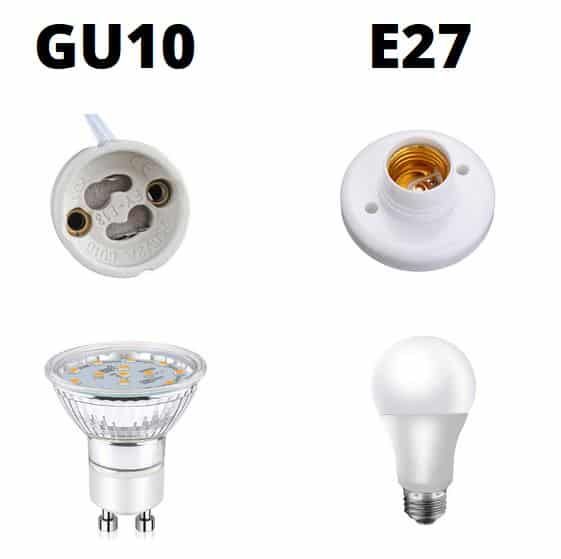
LED bulbs work in a standard incandescent fixture as long as they share the same bulb base and voltage. The same goes for halogen fixtures — LEDs are drop-in replacements for both.
The most common bulb bases in North American homes are the E26 medium screw (the European 220–240V equivalent is E27) and the E12 candelabra screw. GU10 twist-lock pin bases are common in spotlights and track lighting. All of these are widely available as LEDs.
Although E26 and E27 threads are mechanically similar, never mix them across voltage systems — a 120V E26 LED in a 240V European fixture (or vice versa) is a safety hazard.
If the bulb will be visible outside the fixture, make sure it also looks the part. Edison (Amazon) and Globe bulbs (Amazon) are both popular choices in aesthetic lighting.
Can You Replace Incandescent Bulbs With LED?
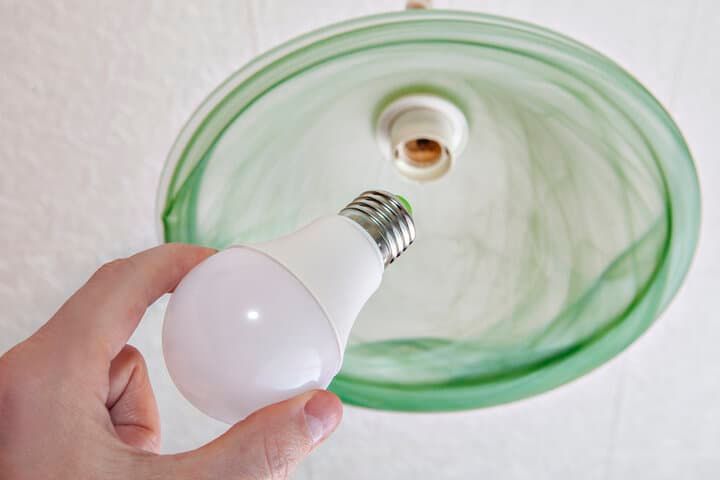
You can replace an incandescent bulb with an LED. The wattage won't match, because LEDs use a fraction of the power to produce the same amount of light. Many LEDs advertise a wattage equivalent — for example, a 9W LED is typically marketed as a 60W incandescent replacement.
Better still, shop by lumens (light output) rather than watts (power consumption).
For example, an LED using about 8.5 watts and a halogen using about 42 watts both produce roughly the same amount of light as a 60-watt incandescent.
An 18W halogen bulb outputs around 220 lumens, while a typical 18W LED bulb outputs roughly 1,800–2,500 lumens — the equivalent of a 100–150W incandescent.
Here is a conversion chart:
| LUMENS TO WATT CONVERSION CHART | |||||
|---|---|---|---|---|---|
| Brightness in Lumens | 220+ | 400+ | 700+ | 900+ | 1300+ |
| Incandescent | 25W | 40W | 60W | 75W | 100W |
| Halogen | 18W | 28W | 42W | 53W | 70W |
| CFL | 6W | 9W | 12W | 15W | 20W |
| LED | 4W | 6W | 10W | 13W | 18W |
For a deeper breakdown, see our guide on the differences between halogen and LED bulbs.
Check The Fixture's Maximum Wattage
Every light fixture has a maximum wattage rating, usually printed on a small sticker inside the socket or on the fixture's canopy. It's the heat ceiling the fixture is engineered for, not a brightness limit. Because LEDs draw a fraction of the watts of an incandescent at the same brightness, you're very unlikely to exceed the rating — just make sure you're checking the LED's actual wattage (the small number, e.g. 9W), not the incandescent-equivalent wattage printed on the front of the box.
Pick The Right Color Temperature
LED bulbs come in a range of color temperatures, measured in Kelvin (K):
- 2700K — warm white, closest to an incandescent bulb; best for living rooms and bedrooms
- 3000K — soft white; slightly cleaner than 2700K
- 4000K — neutral/cool white; good for kitchens, bathrooms, and workspaces
- 5000K+ — daylight; bright and blue-tinted, often too harsh for living spaces
If you're replacing incandescent or halogen bulbs and want to keep that warm glow, stick with 2700K. A common first-time mistake is buying 5000K 'daylight' LEDs for a bedroom and ending up with a clinical, blue-white light.
Are LED Bulbs Safe In Enclosed Fixtures?
Standard LED bulbs can overheat in enclosed fixtures — the trapped heat has nowhere to go, which stresses the driver and shortens the bulb's lifespan. If your fixture is sealed, buy an 'enclosed-rated' LED designed to handle the extra heat.
Common fixtures that need an enclosed-rated LED:
- Semi-flush bathroom and kitchen ceiling lights
- Outdoor porch lights with sealed glass globes
- Mason jar–style fixtures
- Recessed lights (pot or can lights) with a glass cover — open recessed cans with airflow are fine with standard LEDs
Enclosed-rated LEDs cost a bit more, but in a sealed fixture they'll outlast a standard LED by years.
Are Your Dimmers LED-Compatible?
This is where most LED installations go wrong. LEDs work best with modern trailing-edge (LED-compatible) dimmers. Older TRIAC/leading-edge dimmers were designed for the high, resistive load of an incandescent filament — when they meet the small electronic load of an LED driver, you get flickering, buzzing, a narrow dimming range, or bulbs that won't turn off fully.
Two rules to remember: buy LED bulbs explicitly labelled dimmable, and pair them with a dimmer marked as LED-compatible. For the full walkthrough, see our guide to using LEDs on a dimmer.
What About Smart Bulbs?
Smart LEDs from brands like Philips Hue and LIFX fit the same standard E26 sockets, but they come with two quirks. First, the wall switch has to stay on at all times — the bulb's radio needs power to listen for app or voice commands. Second, they should not be paired with a standard wall dimmer; dimming happens inside the bulb itself, and an external dimmer will interfere with the electronics. If you also want wall-switch dimming, use a smart switch instead of (or alongside) a smart bulb.
Can I Mix LED And Incandescent Bulbs?
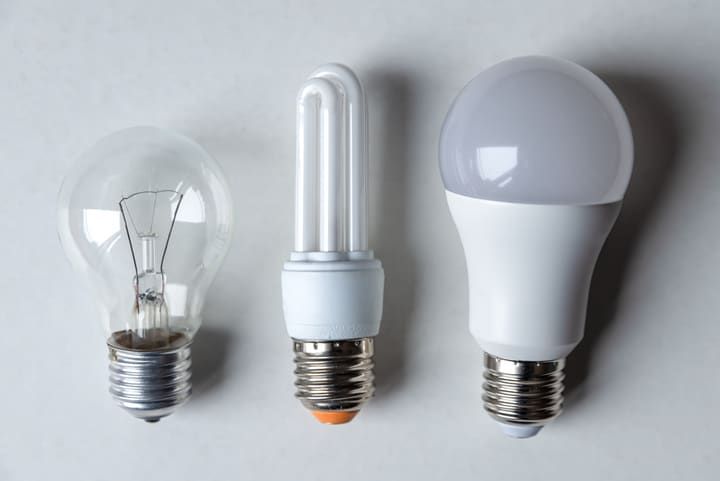
⚠️ Don't mix LED and incandescent bulbs inside the same enclosed fixture — the heat from the incandescent will shorten the LED's lifespan.
Inside a single enclosed fixture, the incandescent's heat output is the real problem. It pushes temperatures well past what an LED's driver and heat sink are designed for, which leads to early failure and, on a shared dimmer, visible flicker.
Using different bulb types in separate fixtures in the same room is electrically and thermally safe. Residential lighting circuits are wired in parallel, so every bulb gets the full 120V regardless of what else is on the circuit — bulbs don't 'steal' current from each other. What you may notice is a color-temperature mismatch (a warm 2700K incandescent beside a cooler 4000K LED will look visibly different) and, if the bulbs share a dimmer, some flicker, since LEDs and incandescents respond differently to the dimmer's output.
FAQ
Do LED Bulbs Work In 3-Way Lamps?
A standard (non-3-way) LED bulb in a 3-way socket will only operate at full brightness — you lose the low and medium settings. However, 3-way LED bulbs are widely available from Philips, Sylvania, GE, and others, typically as 50W/100W/150W incandescent equivalents in an A21 shape. Look for '3-way' on the packaging and all three brightness levels will work as expected.
Do LED Lights Fit In Normal Sockets?
Yes. LED bulbs use the same E26 medium screw bases (E27 in Europe) as incandescent and halogen bulbs, so any LED with a matching base will fit a normal socket. Candelabra bases (E12), GU10 pins, and other form factors are also available in LED — just check the base of the old bulb before you buy.
Can I Use LED Bulbs In Halogen Fittings?
Yes, as long as the bulb base matches and the fixture isn't sealed. If the halogen fitting is enclosed (such as a glass-covered ceiling dome), buy an enclosed-rated LED to prevent heat buildup. For line-voltage halogen spotlights that use GU10 pins, LED GU10 replacements are a direct swap.
Can I Use LED Bulbs In Recessed Lighting Fixtures?
Yes. If the recessed can is open (no glass or plastic cover), a standard LED works fine — the can itself provides enough airflow for heat to escape. If the recessed fixture has a cover or trim that seals the bulb inside, you'll need an enclosed-rated LED to avoid premature failure.
Before You Go…
Switching to LEDs will save you money and outlast anything else you've ever put in the socket — and in most cases, they drop straight into your existing fixtures. Before you buy, run through this short checklist:
- Match the base — E26 for most lamps, E12 for candelabra, GU10 for spotlights and track lighting.
- Check the fixture's wattage rating — printed inside the socket. LEDs rarely get close, but it's still the hard limit.
- Buy enclosed-rated LEDs for sealed fixtures — covered bathroom lights, mason jar fixtures, covered recessed cans.
- Match the dimmer to the bulb — a dimmable LED paired with an LED-compatible dimmer. Old TRIAC dimmers cause flicker and buzz.
Get those four right and the rest is just lumens and color temperature — enjoy the decade of use you're about to get out of a single bulb.