What Is The Difference Between LED And Laser Diode?
LEDs are polychromatic — they scatter a range of wavelengths even when they look like a single color. Laser diodes emit one near-pure wavelength, and that single difference explains everything else.
 Eugen
EugenEugen Nikolajev
Creator of LED Lighting Info
Hi, I am Eugen. I was always one of those kids who had all sorts of weird lighting gadgets for every occasion.
Now, I want to share my knowledge and experience about lighting with you on LED Lighting Info.
Read my editorial standards
Key Takeaways
LEDs and lasers both emit photons to produce light. LED light is more dispersed and multi-directional, while laser light is highly focused, making them specialized in their function. Lasers are used in optics and electronics, while LEDs are the go-to for illumination.
Visible white light is made up of many different wavelengths blended together. LEDs are polychromatic — they emit a range of wavelengths even when they appear to output a single color. Laser diodes, by contrast, emit a single near-pure wavelength, and that one fact drives most of the practical differences between the two technologies.
This article focuses on semiconductor laser diodes — not gas or solid-state lasers — since they share the same p-n junction foundation as LEDs.
How Does An LED Emit Light
An LED, or light-emitting diode, is a junction diode that controls the amount of electricity flowing through it. LEDs are made from semiconducting compounds containing gallium and other materials, and the specific compound determines the color of the light produced.
Blue and green LEDs are produced from Indium Gallium Nitride (InGaN) compounds, while red LEDs are typically produced from Aluminium Gallium Indium Phosphide (AlGaInP) or Gallium Arsenide Phosphide (GaAsP) compounds.
At the heart of the diode is a p-n junction. When the diode is forward-biased, electrons cross the junction from the n-side and recombine with holes on the p-side. Each recombination drops an electron to a lower energy state, and the released energy is emitted as a photon.
These photons then interact with the other materials used in the LED and the current running through it to give off visible light. This property is called electroluminescence.
Not every electron-hole recombination produces a photon — some release their energy as heat through non-radiative processes. This is one reason real-world LED efficiency falls short of theoretical maximums.
Each LED also has a forward voltage threshold (Vf) — typically around 2 V for red and yellow LEDs, and 3 to 3.5 V for blue, green, and white LEDs — below which no light is emitted. Above that threshold, current rises sharply with voltage, so LEDs are usually driven with a current-regulated supply rather than a fixed voltage.
Even so, LEDs are highly efficient compared to incandescent and fluorescent lighting. Modern white LEDs typically convert 30–50% of electrical energy directly into light (wall-plug efficiency), with the rest lost as heat.
How A Laser Diode Works
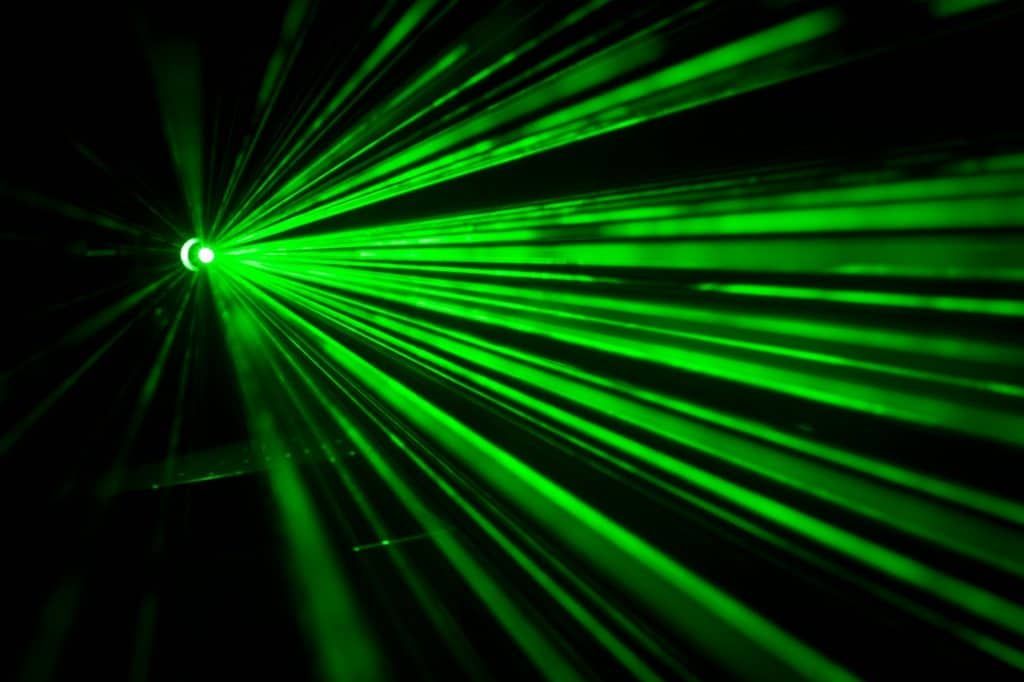
Laser diodes share the same p-n junction foundation as LEDs, but they introduce a key extra mechanism: stimulated emission. The word laser stands for Light Amplification by Stimulated Emission of Radiation.
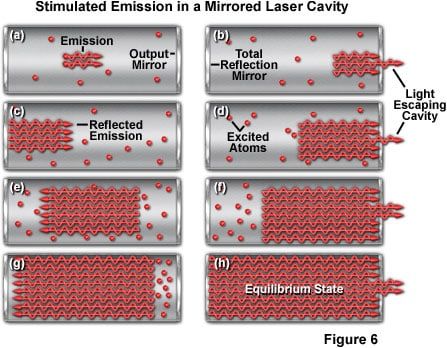
Inside a laser diode, current passes through gallium compounds at the p-n junction just as in an LED — the crucial difference is what happens to the photons next. The amplification process unfolds in a few clear steps:
- A drive current is applied to the p-n junction, pumping electrons into excited states.
- As electrons recombine with holes, they emit photons through spontaneous emission — the same process that produces light in an LED.
- Two parallel mirrored surfaces form an optical cavity that reflects these photons back through the active region.
- Each reflected photon stimulates excited electrons to release identical photons — same wavelength, same phase, same direction.
- The intensity builds with each pass through the cavity until the light exits through a partially transparent mirror as a coherent, focused beam.
Coherent light means all the photons travel in phase, with their wave peaks and troughs aligned. The reinforced waves form a tight, narrow beam that barely spreads — which is why a laser pointer dot stays small at distance, while LED light fans out quickly.
Consumer laser diodes are classified by safety standard IEC 60825-1. A Class 2 laser pointer is limited to 1 mW. Class 3R covers 1–5 mW, and Class 3B spans 5 mW to 500 mW — eye protection is mandatory across the entire Class 3B range, not only at the upper end. Industrial laser diodes can far exceed these consumer levels, reaching tens of watts in single emitters and tens of kilowatts in stacked arrays used for cutting and welding.
Thanks to that high-energy precision, laser diodes are used for cutting and welding metals, drilling, and delicate eye surgery (LASIK). They also carry signals over long distances for telecommunication, and they appear in laser printers, fibre-optic networks, barcode scanners, optical drives, and laser rangefinders.
LED And Laser Diode Characteristics
While both LEDs and laser diodes use p-n junctions and current to emit photons and produce visible light, they differ in some fundamental ways.
| Specification | LEDs | Laser Diodes |
|---|---|---|
| Principle of operation | Electroluminescence (spontaneous emission) | Stimulated emission with optical cavity |
| Electrical-to-optical efficiency | ~30–50% (white LEDs, wall-plug) | ~30–60% depending on type |
| Wavelength spectrum width | ~20–100 nm (broad) | ~0.001–5 nm (single-frequency types <0.001 nm) |
| Coherence | Incoherent, multi-phase light | Coherent, in-phase waves |
| Chroma | Polychromatic — multiple bands of wavelengths | Monochromatic — single narrow wavelength |
| Directionality | Non-directional, dispersed | Highly directional, narrow beam |
| Output power | Milliwatts to tens of watts per emitter; output proportional to forward current | Sub-milliwatt VCSELs to multi-kilowatt industrial arrays; output proportional to current above the lasing threshold |
| Typical operating current | ~5–20 mA for indicator LEDs; up to several amps for high-power LEDs | VCSELs <1 mA, edge-emitting diodes ~25–250 mA, high-power industrial diodes several amps |
Advantages And Disadvantages Of LEDs And Laser Diodes
Since their working principles and applications differ, so do the pros and cons of each light technology.
LED Advantages
- Inexpensive to manufacture and maintain, which is why they dominate residential and commercial lighting.
- Long lifespan — typical white LEDs run for tens of thousands of hours.
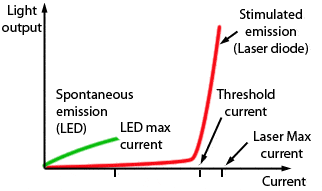
- Begin emitting light at very low currents — typically a few milliamps once their forward voltage threshold is exceeded. Standard indicator LEDs are usually driven at around 20 mA.
- Available in a wide range of colors, from deep red to UV, with smooth dimming.
- Used in displays, automotive lighting, horticultural grow lights, UV curing, signage, and indicator panels — well beyond just general illumination.
LED Disadvantages
- Light is dispersed and non-directional, requiring lenses or reflectors to shape a beam.
- Spectral output is broad compared to a laser, which limits use in precision optics, fiber optics, and interferometry.
- Very bright white and blue LEDs can cause discomfort or retinal stress with prolonged direct viewing, and UV-A or UV-C LEDs require eye and skin protection.
Laser Diode Advantages
- Highly directional — the beam barely spreads even over long distances.
- Coherent, monochromatic output is ideal for fiber optics, holography, interferometry, and precision cutting.
- Can be focused down to micrometer-scale spots, enabling extreme energy density.
- Increasingly used in laser-phosphor headlights and projection displays where intense, directional light is required.
Laser Diode Disadvantages
- More expensive to manufacture and operate than LEDs.
- Have a current threshold below which lasing does not occur — only spontaneous emission. Thresholds vary widely: VCSELs lase below 1 mA, edge-emitting diodes need roughly 25–250 mA, and high-power industrial diodes need several amps.
- Pose eye-safety hazards from very low power levels (Class 2 onward), often requiring protective eyewear.
- Sensitive to electrostatic discharge and temperature fluctuations, which complicates driver design.
- Shorter operating lifespan than typical LEDs, especially under high-power operation.
Where an LED illuminates a spot of around 1 mm² on a surface, a laser beam can be focused down to spots just a few micrometers across — the difference between a flashlight and a scalpel.
While laser-phosphor lighting is now used in some specialized applications such as automotive headlights and high-brightness projection, lasers remain too costly and too directional to replace LEDs for general room illumination.
Final Words
LEDs and laser diodes are close cousins built on the same semiconductor foundation, but they emit light through different mechanisms and are suited to very different jobs. The key takeaways:
- LEDs use spontaneous emission to produce broad-spectrum, multi-directional light; laser diodes use stimulated emission to produce coherent, monochromatic beams.
- LEDs are cheaper, longer-lasting, and ideal for general illumination; laser diodes are unmatched for precision tasks like cutting, surgery, and fiber-optic communication.
- Both are p-n junction devices, but only the laser diode adds an optical cavity to amplify and align its light.