
What Materials Make Up An LED Bulb?
White LED bulbs don't produce white light — a blue InGaN chip excites a yellow phosphor, and your eye does the mixing. That phosphor recipe, not the diode, determines the color temperature you see.
 Eugen
EugenEugen Nikolajev
Creator of LED Lighting Info
Hi, I am Eugen. I was always one of those kids who had all sorts of weird lighting gadgets for every occasion.
Now, I want to share my knowledge and experience about lighting with you on LED Lighting Info.
Read my editorial standards
Key Takeaways
As well as the LED chip that generates the light, an LED bulb contains a phosphor coating that shifts blue light to white; a bulb cover that acts as a lens; a heat sink to draw heat away from the diodes; a driver and printed circuit board that regulate the current; housing that protects the electronics; and a base that connects the bulb to the fixture.
Knowing what is actually inside an LED bulb makes it easier to choose the right one, troubleshoot a flicker, or recycle a dead one responsibly. The component count is small, but each part plays a specific role in why LEDs run cooler, last longer, and use less power than the bulbs they replaced.
In this article, I’ll cover:
- The components used in LEDs in a little more detail
- Whether RGB diodes have different components
- What LED bulb covers are made from, and how to recycle a dead bulb
What Components Are Used In LEDs?
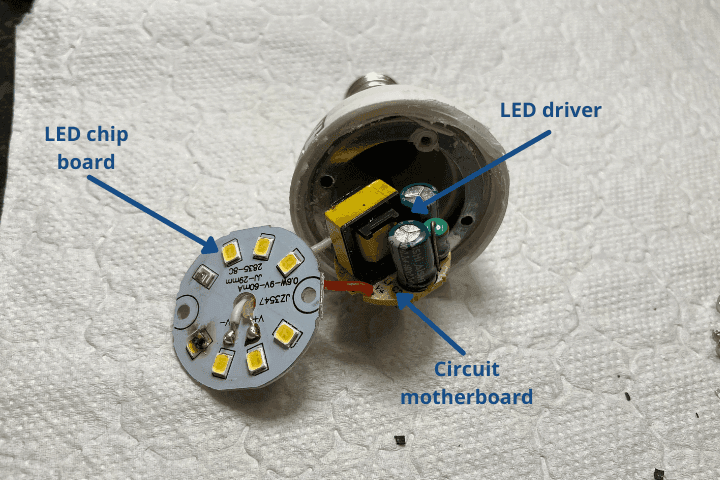
LED light bulbs all contain the same standard components. Here is a quick reference before we dig into each one:
| Component | Material | Primary Function |
|---|---|---|
| LED chip / diode | Semiconductors (e.g. InGaN, AlGaInP) | Generates light |
| Phosphor coating | Cerium-doped YAG (on white bulbs) | Converts blue diode light into white |
| Driver + PCB | Printed circuit board with capacitors, resistors, ICs | Regulates current to the diodes |
| Heat sink | Aluminum (occasionally copper) | Dissipates heat from the diode junction |
| Bulb cover | Plastic, glass, or epoxy resin | Diffuses light and protects internals |
| Housing | Aluminum-lined plastic or metal | Structural protection for the circuit |
| Base | Brass or other metal | Connects the bulb to the fixture |
LED Chips / Diodes
The light-emitting diode is the part of the bulb that actually generates the light. It is made up of semiconductor layers that emit photons when current flows across the junction between them.
A bulb might have a single diode or several wired together as an LED array. Both arrangements do the same job — they just spread the lumen output across more or fewer emitters.
Phosphor Coating
Most white LED bulbs do not produce white light directly. Instead, a blue Indium Gallium Nitride (InGaN) chip is coated with a yellow phosphor — typically cerium-doped yttrium aluminum garnet, abbreviated YAG:Ce. The blue light from the diode excites the phosphor, which re-emits a broad band of yellow light, and the eye perceives the combined output as white.
This is why a bulb’s color rendering and color temperature depend on the phosphor recipe just as much as on the diode itself.
LED Drivers and Circuit Board
The driver’s main job is to deliver a stable, regulated current to the diodes. LEDs are current-driven devices, and a small change in voltage causes a much larger change in current — without regulation they would overheat and fail quickly.
For mains-powered bulbs, the driver also rectifies AC to DC and steps the voltage down to the level the diodes need. For low-voltage products like 12 V or 24 V LED strips, the driver works DC-to-DC instead. LED lighting cannot run directly on the AC power coming from your home’s electrical panel — it needs DC, which is what the driver provides.
All of these components — the driver IC, the rectifier, capacitors, and resistors — sit on a small printed circuit board (PCB) inside the bulb housing. When you flip the wall switch, the driver is what actually energizes the diodes; on a dimmer circuit, it also interprets the dimmer’s chopped waveform to regulate brightness.
Heat Sink
The heat sink is one of the most important parts of an LED bulb. LEDs convert a far larger share of their input electricity into visible light than incandescents do, but a meaningful fraction — roughly half on a typical screw-in bulb — still becomes heat at the diode junction. Diodes do not tolerate that heat well: a rising junction temperature accelerates lumen depreciation and shortens lifespan.
The heat sink draws thermal energy away from the diodes and dissipates it into the surrounding air. It is almost always aluminum — light, cheap, and a good thermal conductor — though high-power fixtures sometimes use copper. Without an adequately sized heat sink (or in a fixture that traps air around it), an LED bulb will dim and fail well before its rated hours.
Bulb Cover
The bulb cover acts as a lens. It diffuses the light output across a wider space, so instead of seeing tiny chip-sized point sources, you see a full glowing bulb.
Some LED bulbs now use clear covers to mimic older incandescent bulbs — that is a styling decision rather than a functional one. Unlike compact fluorescents, there is no gas inside the cover, so if the cover cracks, the bulb is typically still safe to use until the diodes themselves fail. Cover materials and shapes are covered in detail further down.
Housing
The housing is the middle section of the bulb, between the cover and the base. Its job is to protect the circuitry inside. It is usually aluminum-lined and often doubles as the structural mount for the heat sink.
Bulb Base
The base is the part of the bulb that connects to the light fixture. LED bulbs use the same standardized bases as the older lamps they replace, so most retrofits are direct swaps. The most common types are:
- E26 — the standard medium screw base in North America
- E27 — the standard medium screw base in Europe and most of the rest of the world
- B22 — bayonet cap, common in the UK and Australia
- GU10 — twist-and-lock pin base, used for mains-voltage spotlights
- MR16 / GU5.3 — bi-pin base, typically on 12 V spotlights
- G4, G9, E12, E14 — smaller pin and screw bases for chandeliers, accent lighting, and appliances
LED retrofit tubes (T8, T5) for replacing fluorescent lamps use bi-pin bases at each end and follow the same physical standards as the tubes they replace.
Do RGB LED Lights Have Different Components?
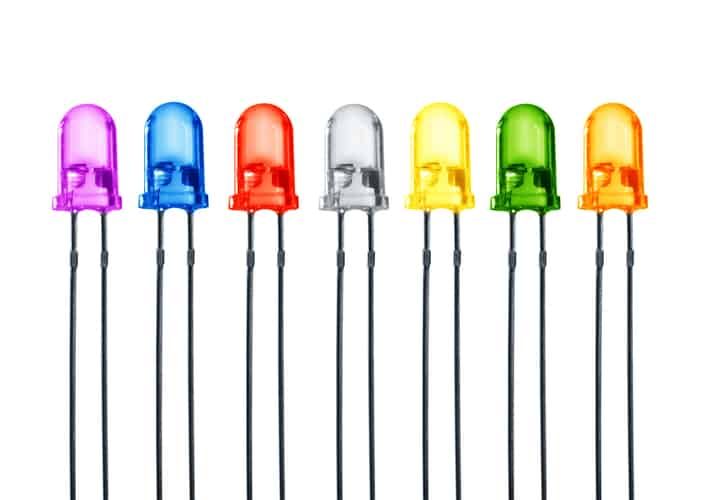
RGB lights share most of the same components as regular LED bulbs, but they pack three differently doped diodes — one red, one green, one blue — into each emitter package. The semiconductors used for each color are different because each material system has its own bandgap and emits photons at a specific wavelength range:
- Aluminum Gallium Indium Phosphide (AlGaInP) — high-brightness red, orange, and yellow (~580–650 nm). This is the modern III-V material system for everything from yellow through deep red.
- Indium Gallium Nitride (InGaN) — blue and the bulk of green in modern RGB devices (~450–530 nm). The same material family powers white LEDs, where it pumps a yellow phosphor.
- Aluminum Gallium Arsenide (AlGaAs) — red and near-infrared only (~650–870 nm). It cannot reach orange or yellow because its bandgap is limited.
Older designs sometimes used Gallium Phosphide (GaP) for green and yellow, but it has been almost completely replaced by InGaN for green because of much higher efficiency. Industry literature still talks about the InGaN “green gap” precisely because InGaN, not GaP, is the modern green LED material.
By independently dimming the red, green, and blue diodes — typically with 8-bit (256-step) control on each channel — RGB LED systems can mix up to roughly 16.7 million distinct colors (256 × 256 × 256). The number is a property of how the controller encodes color, not of the semiconductors themselves; the diodes only produce three primary wavelengths, and the perceived gamut comes from PWM dimming under the controller’s bit depth.
RGB mixing also does not produce a particularly accurate white, so many color-changing bulbs add a fourth, dedicated white diode (RGBW) — usually a phosphor-converted InGaN — for everyday use.
What Materials Are Used In LED Bulb Covers?
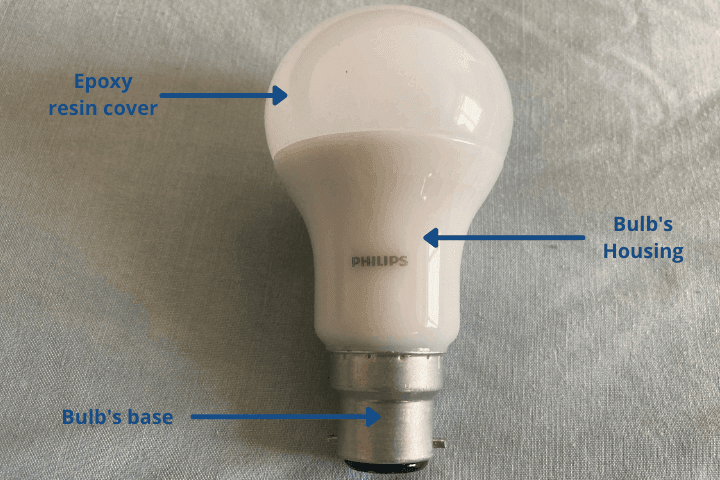
LED bulb covers are most often made from durable plastic — usually polycarbonate or acrylic — but they can also be glass or a tough epoxy resin.
The plastic used is hard-wearing and less likely to break than a glass bulb. Epoxy resin does a similar job and is even more robust. Glass covers are still made for retro-style filament bulbs and Edison-look fixtures; those are more breakable, but they handle normal use fine.
Clear Or Frosted?
Whatever the material, the cover can be clear or frosted. When frosted, the cover also acts as a diffuser, scattering the light from the diodes in many directions so you see one consistent glow rather than several bright dots.
Clear covers are most common on glass bulbs designed to look like older filament lamps — the diodes inside are shaped as long thin filaments for that retro effect.
Cover Color
Most LED bulb covers are white or clear, but they are sometimes tinted. Coloured covers are uncommon for general home lighting, but they show up in signage, decorative strings, and indicator lamps.
An RGB bulb still uses a white, translucent cover so that all three diode colors can shine through cleanly. If a bulb only ever needs to produce a single color, manufacturers usually find it cheaper to use a colored cover over a plain white diode rather than producing a colored chip. You can even paint a bulb cover yourself if you need a custom color for a one-off project.
Recycling and Disposal
LED bulbs do not contain mercury, so they avoid the disposal hazards that come with compact fluorescents. They do, however, contain valuable materials — aluminum, copper, semiconductor compounds, and small amounts of rare earth elements in the phosphor — that can be recovered through e-waste recycling.
Many hardware stores, big-box retailers, and municipal recycling facilities accept LED bulbs at no charge. Some jurisdictions classify them as electronic waste and require dedicated drop-off; check your local rules before throwing them in regular household trash.
Final Words
Solid-state lighting is not complicated, but the components inside each play a specific role — and that is useful when something goes wrong:
- If a bulb flickers on a non-dimmer circuit, the driver is the most likely suspect.
- If it runs unusually hot to the touch or fails well before its rated hours, check that the fixture allows airflow around the heat sink — enclosed fixtures are a common killer.
- If a color-tunable bulb shifts hue over time or one color drops out, the phosphor or one of the RGB diodes is degrading.
- If a dimmable bulb buzzes or strobes at low brightness, the driver and the wall dimmer are not compatible.
For a deeper troubleshooting walkthrough, see my guide on the most common problems with LED lighting.