What Is The LED Watts Equivalent?
Wattage never measured brightness — it measured waste. The shortcut held only because incandescents are uniformly inefficient, which is why your 9W LED now needs a "60W equivalent" label to make sense.
 Eugen
EugenEugen Nikolajev
Creator of LED Lighting Info
Hi, I am Eugen. I was always one of those kids who had all sorts of weird lighting gadgets for every occasion.
Now, I want to share my knowledge and experience about lighting with you on LED Lighting Info.
Read my editorial standards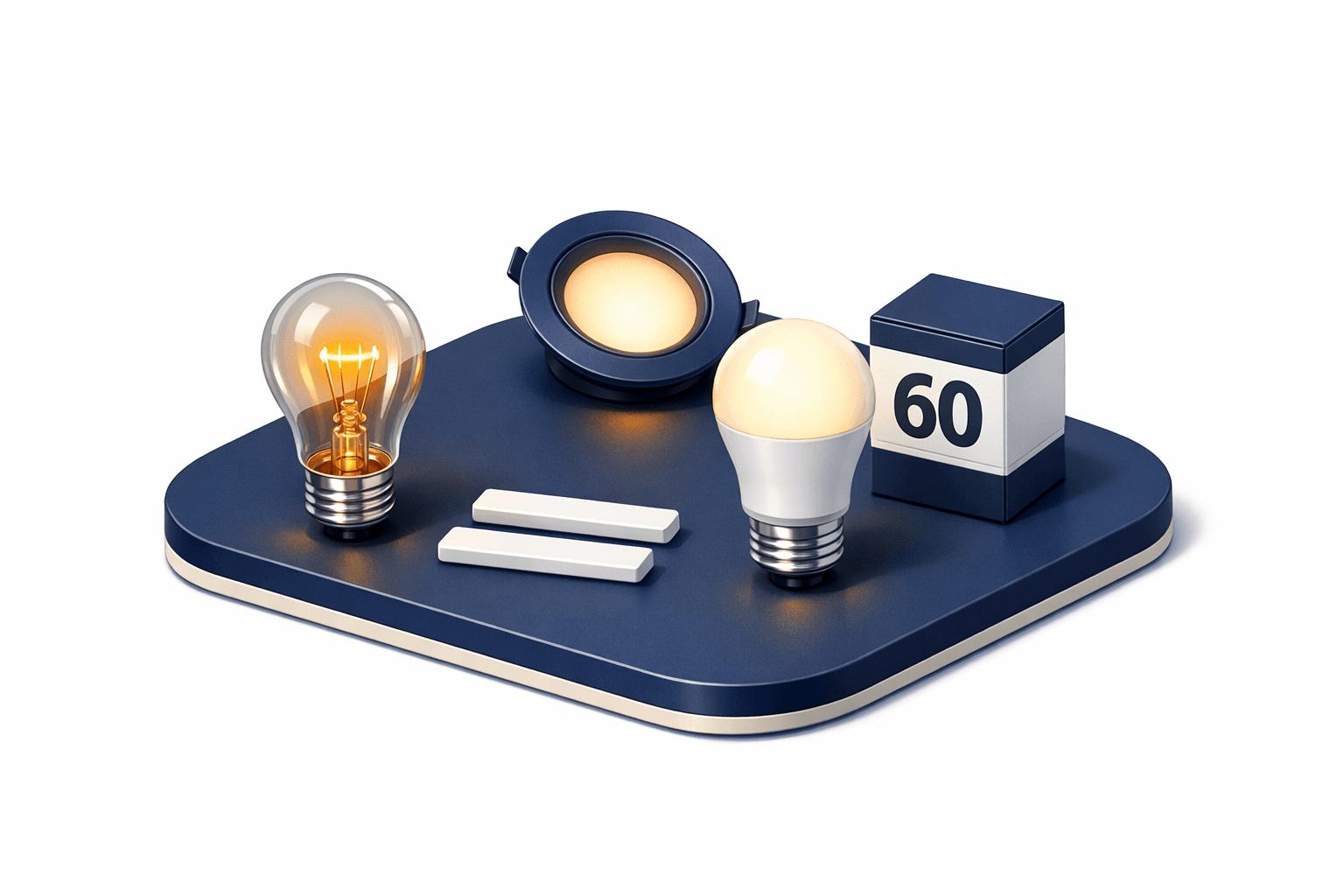
Key Takeaways
LED watts equivalent is the incandescent wattage whose brightness an LED bulb is designed to match. For example, a 9W LED rated "60W equivalent" produces roughly the same 800 lumens as a traditional 60W incandescent — using about 85% less energy.
Wattage has long been treated as shorthand for bulb brightness — a 60-watt bulb is bright, a 100-watt bulb is brighter, and so on. That shortcut never described brightness; it described power consumption.
With LEDs now dominating the bulb aisle, the old rule of thumb breaks down completely: a modern LED produces the same light as a 60W incandescent while drawing less than a seventh of the power.
That is why packaging now shows two numbers — the actual wattage the LED draws, and its "watts equivalent" — a legacy reference to the incandescent wattage that produces the same brightness.
Watts vs. Lumens: What’s the Difference?
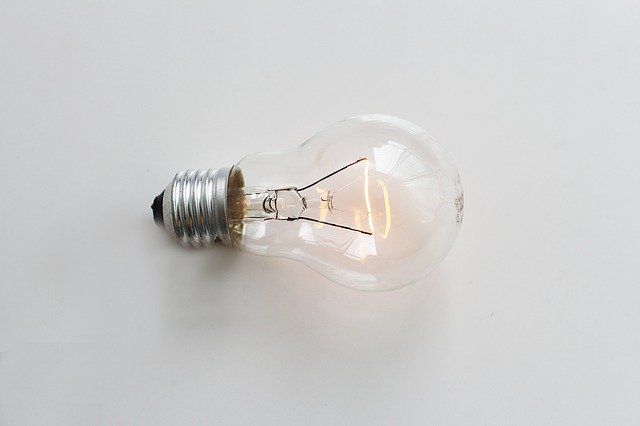
Watts measure electrical power — specifically, 1 watt equals 1 joule of energy used per second. A 40-watt incandescent bulb consumes 40 joules every second, and that energy is released as a mix of light and heat. Wattage only tells you how much energy a bulb draws; it says nothing about how bright the bulb will be, what color its light will look, or anything else that matters when choosing a bulb.
The wattage-equals-brightness habit comes from decades of buying incandescents, where a 60W bulb really was noticeably dimmer than a 120W one. That correlation only held because incandescents are uniformly inefficient — double the wattage, roughly double the light.
LEDs break the rule entirely: if you found a bulb that actually drew 60 watts as an LED (not the "60W equivalent" label on the box), it would output around 5,000 lumens — far more than any household fixture needs.
Two numbers describe a bulb’s actual output. Brightness is measured in lumens — the higher the lumens, the brighter the light. Light color is measured in Kelvin (K): warm white (2700–3000K) looks yellowish and cozy, neutral white (3500–4100K) is balanced, and daylight (5000K+) is crisp and blueish. Both are printed on the Lighting Facts label on every bulb package.
LED Wattage Equivalent Explained
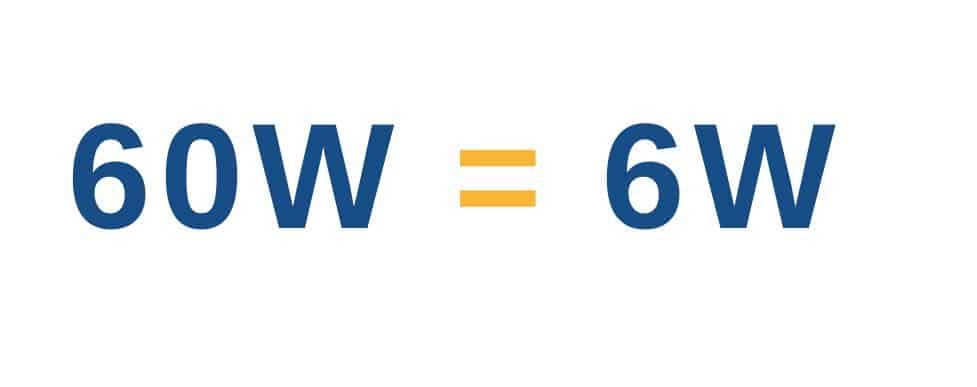
The easiest way to understand "watts equivalent" is with a worked example. Start with the most common bulb size — the traditional 60W incandescent.
- A 60W incandescent produces roughly 800 lumens of light.
- An LED that produces the same 800 lumens draws only about 8–10 watts (a 9W LED is the most common).
- That is roughly 85% less energy for the same brightness.
On the box, that LED will be labeled "60W equivalent" even though it only draws 9W. The equivalent rating is there so you can shop by the familiar number and still land on the right brightness. If you want the brightness of a 60W incandescent, look for an 8–10W LED or a bulb marked "60W equivalent," whichever is easier to find.
The energy savings translate directly into lower lighting costs over the life of the bulb, and the savings multiply across every fixture you convert to LED technology.
Why Is Wattage Not An Important Measure Anymore?
Wattage survived as a brightness shortcut only because incandescent bulbs are uniformly inefficient. Per the U.S. Department of Energy, an incandescent bulb loses roughly 90% of its energy as heat, with only about 10% emerging as visible light. Double the wattage and you mostly double the heat, with a proportional bump in light as a side effect.
LEDs work on completely different principles. A modern LED bulb converts roughly 70–80% of its electrical energy directly into visible light, with the remainder lost at the driver and through phosphor conversion (the process that turns blue LED light into white). Because the efficiency is so much higher, a tiny wattage produces a lot of light — which is exactly why wattage no longer tells you how bright a bulb will be.
This shift is not just a market preference.
In the United States, the Department of Energy began enforcing general service lamp efficiency rules in 2023 that effectively remove most traditional incandescent bulbs from the shelves. The EU completed its own incandescent phase-out over the 2009–2012 period. For most consumers, LED (and occasionally CFL) is now the only option for a standard bulb replacement.
LED vs Incandescent vs CFL Wattage Conversion
The table below shows typical wattage ranges for the same brightness across incandescent, CFL, and LED bulbs. Shop by the lumen value in the first column — that is the only figure that guarantees you will get the brightness you want. The rest are reference points for matching a familiar bulb.
If you are used to a 100W incandescent in a living room, look for an LED in the 15–20W range — which will deliver the roughly 1,600 lumens you were getting. A 75W incandescent corresponds to about 1,100 lumens and a 10–15W LED. For CFL replacements, a 13–15W CFL is roughly equivalent to a 60W incandescent or an 8–10W LED.
A Safety Note on Fixture Wattage Limits
Every lamp or ceiling fixture has a maximum wattage printed on it (for example, "Max 60W"). That limit refers to the actual power draw of the bulb, not its equivalent rating. A bulb sold as "100W equivalent" that actually consumes 15W is well under a 60W fixture limit — the equivalent number is a brightness reference, not a power rating. This distinction matters for fire safety: the wattage limit exists because older high-wattage incandescents produced enough heat to damage insulation or wiring.
If you are replacing one incandescent with multiple LEDs in a multi-socket fixture, add up the actual wattages printed on the LED bulbs and make sure the total stays under the fixture’s maximum.
| Lumens | Incandescent | CFL | LED |
|---|---|---|---|
| 250 lm | 25 W | 6 W | 2 W – 3 W |
| 560 lm | 40 W | 10 W | 3 W – 6 W |
| 800 lm | 60 W | 13 W | 8 W – 10 W |
| 1100 lm | 75 W | 18 W | 10 W – 15 W |
| 1600 lm | 100 W | 23 W | 15 W – 20 W |
| 2600 lm | 150 W | 42 W | 20 W – 30 W |
Final Words
LED watts equivalent is a translation layer between the bulbs you grew up with and the technology that replaced them. Once you know your target brightness in lumens, the equivalent wattage is just a familiar label on the box — useful for shopping, but no longer the number that actually matters.
Next time you shop for a bulb, check the Lighting Facts label for three numbers: lumens (for brightness), Kelvin (for light color), and the actual watts drawn (for fixture compatibility and your energy bill). The "equivalent" number is there only to help you find the right brightness — lumens are what you actually want.
For a deeper dive into how LEDs achieve this efficiency, see our guide to LED light technology.