What Is The Difference Between 12V And 24V LED Strip Lights? (4 Differences)
A 24V strip draws half the current of a 12V strip at the same wattage — and that single fact explains why it runs longer, runs cooler, and fits into a slimmer power supply.
 Eugen
EugenEugen Nikolajev
Creator of LED Lighting Info
Hi, I am Eugen. I was always one of those kids who had all sorts of weird lighting gadgets for every occasion.
Now, I want to share my knowledge and experience about lighting with you on LED Lighting Info.
Read my editorial standards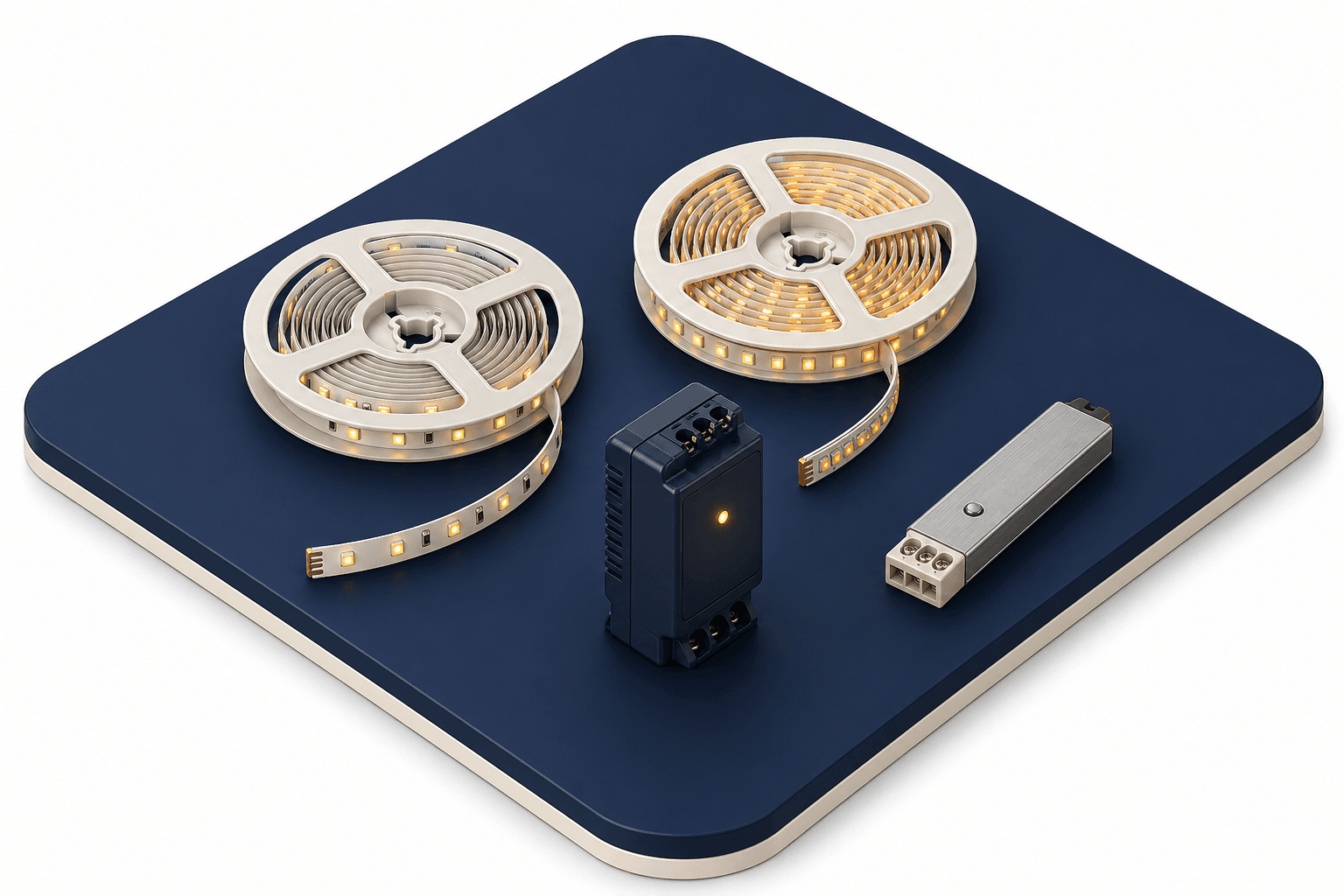
Key Takeaways
12V LED strips have more frequent cut points and are easier to customize for short, intricate runs. 24V strips handle longer distances with less voltage drop, draw less current at the same wattage, and pair with more compact power supplies, making them the better choice for big or commercial installations.
Choosing between 12V and 24V LED strip lights comes down to four factors: run length, cut flexibility, current load, and power supply size.
Most strips sold for the home are 12V, while 24V is typically marketed as a premium option. For most rooms, 12V is plenty — but longer runs and commercial installs often benefit from stepping up to 24V.
Here's how the two compare at a glance:
| Feature | 12V Strips | 24V Strips |
|---|---|---|
| Cut point frequency | Every 3 LEDs (more cuts) | Every 6 LEDs (fewer cuts) |
| Max recommended single-feed run | ~5 m (16 ft) | ~10 m (33 ft) |
| Voltage drop susceptibility | Higher — roughly 4× the percentage drop | Lower |
| Current draw at same wattage | 2× higher | Half |
| Power supply housing | Larger components | More compact possible |
| Best for | Short, intricate runs; under-cabinet; small projects | Long runs; whole-room; commercial installs |
4 Main Differences Between 24V and 12V Strip Lights
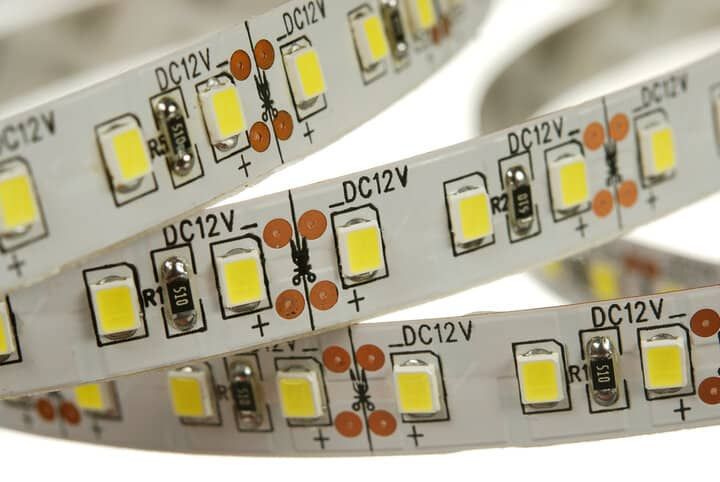
12V lighting is sufficient for most homes, but specific projects — long ceiling runs, big commercial installs, or installations where PSU footprint matters — often justify the move to 24V. Here's each difference in detail.
Cut Points Are More Frequent on 12V Strips
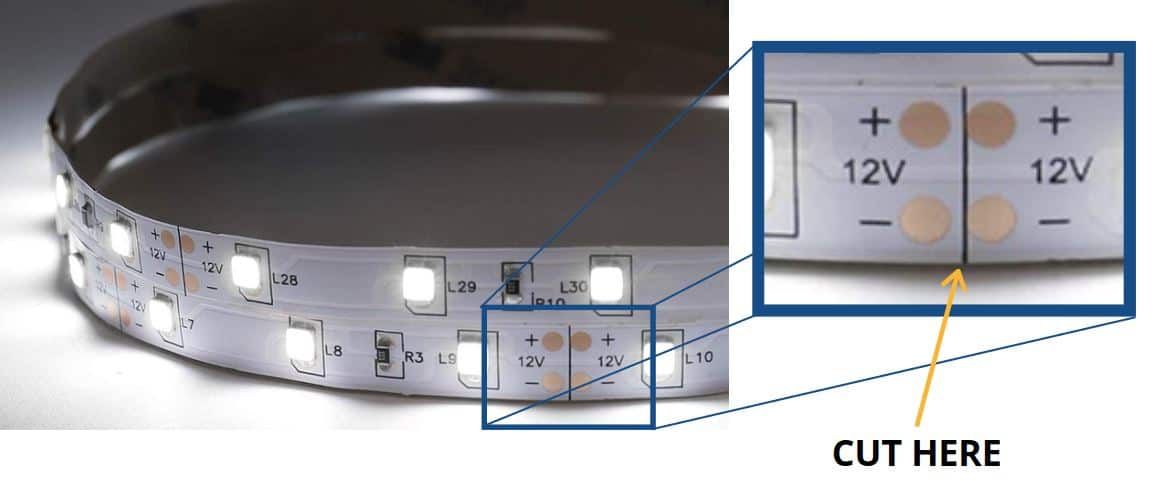
On standard-density strips, 12V circuits group 3 LEDs in series (cuttable every 3 LEDs) while 24V circuits group 6 LEDs (cuttable every 6 LEDs) — so you typically get twice as many cut points on a 12V strip. The actual physical distance between cuts also depends on the strip's LED density (30, 60, or 120 LEDs/m), so check the cut markings printed on your specific strip.
The individual LEDs themselves are the same — only how they're grouped in the strip's circuits differs (3 LEDs per group on 12V, 6 per group on 24V).
If your project involves a lot of corners or perpendicular lines that require frequent cutting, 12V gives you more flexibility — you can cut 12V strips to length more precisely. For long, straight runs, either voltage works.
24V Handles Longer Runs Before Voltage Drop
Voltage drop is when the brightness reduces down the line. As current flows through the strip's copper traces, resistance eats into the supply voltage, leaving less to drive the LEDs at the far end.
Take a typical mid-density strip (around 14.4 W/m) run as a single 20-meter line. It will lose noticeable brightness by the far end on either voltage — but because a 24V strip draws half the current of a 12V strip at the same wattage, the percentage drop on a 24V run is roughly a quarter of the 12V drop.
Most manufacturers recommend single-end feeds of no more than around 5 m for 12V and 10 m for 24V. Beyond that, you need to use power injection — running a second wire from the same PSU to the far end of the strip — to keep voltage consistent across all the LEDs.
For larger installations like a rectangular ceiling, don't loop a single strip back to its starting point. Instead, place the PSU in a corner and connect two shorter strips in parallel from the same supply. This keeps each run within its safe length and avoids visible dimming at the ends.
Lower Current Draw and Thinner Conductors
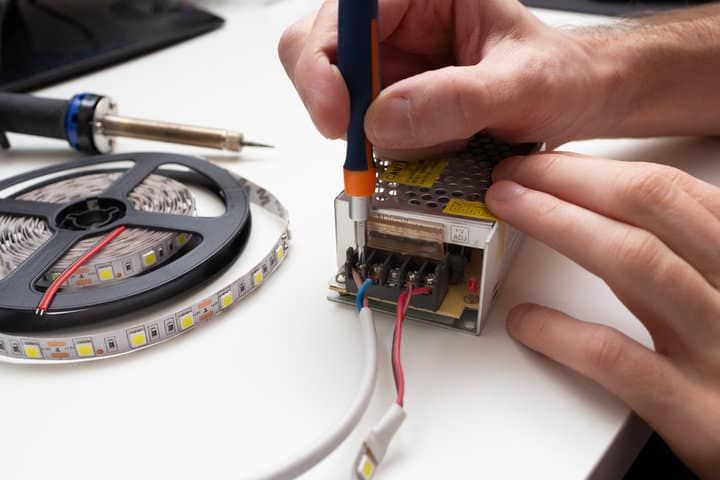
24V strips draw half the current of 12V strips at the same wattage. That has knock-on effects on conductor sizing, voltage drop, and PSU dimensions.
The math is simple: P = V × I (power = voltage × current). For the same 48W of total light output:
| 12V Strip | 24V Strip | |
|---|---|---|
| Power (W) | 48W | 48W |
| Voltage (V) | 12V | 24V |
| Current (A) | 4A | 2A |
Same light output. Half the current. That means less heat in the conductors, less voltage drop along the strip, and the strip can be manufactured with thinner copper traces without overheating or risking electrical fire.
More Compact Power Supplies
A 24V PSU still needs the same wattage rating as a 12V PSU for the same total load — 100W is 100W either way. The size advantage comes from current, not voltage.
Because a 24V system carries half the current, its PSU can use smaller switching transistors, thinner internal conductors, smaller magnetics, and lower-rated rectifiers and capacitors on the secondary side. The result is often a slimmer, lower-profile housing — useful for tight spaces like under-cabinet runs where a bulky brick would spoil the look of the installation.
Dimmer and Controller Compatibility
Most LED strip dimmers, PWM controllers, and smart home modules are voltage-specific. A controller rated for 12V won't work with a 24V strip and vice versa — and many will be damaged if connected to the wrong voltage.
Before buying, check that your dimmer or controller's input voltage range matches the strip you're planning to install. Some controllers are dual-voltage (12–24V), but don't assume — read the spec sheet. The same applies to in-line repeaters, RGB controllers, and any smart home modules sitting between the PSU and the strip.
What About 5V USB-Powered Strips?
5V USB-powered strips also exist and are common for TV bias lighting, desk setups, addressable WS2812 "NeoPixel" projects, and PC builds. They're a separate category with even shorter recommended single-feed runs (typically under 2 m before voltage drop becomes visible) and aren't directly comparable to mains-driven 12V or 24V installations. If you're choosing for a whole-room or commercial install, 12V vs. 24V is the relevant comparison.
IP Ratings Matter More Than Voltage in Wet Areas
For outdoor or wet-area installations like bathrooms, kitchens, and patios, voltage choice is secondary to IP rating. Always verify the strip's IP rating regardless of whether you go with 12V or 24V — look for IP65 for splash resistance, or IP67/IP68 for full submersion or sustained outdoor exposure. A 12V strip with the right IP rating is safer in a wet location than a 24V strip without one.
Are 24V LED Strips Brighter Than 12V?

Design voltage doesn't determine brightness — wattage per meter and LED quality do. A 12V strip and a 24V strip with the same W/m and same LEDs will output the same lumens, provided both are running within their recommended length and not affected by voltage drop.
Brightness in strip lighting is described in lumens per meter (or per foot). A good-quality LED strip should deliver at least 1,500 lumens per meter (around 450 lm/ft). Premium high-density strips can output 2,500–5,000 lm/m, while basic 30–60 LED/m strips often produce only 300–1,000 lm/m.
The number of LEDs per length unit drives brightness and how much power the strip will draw per unit length. The higher the wattage per length, the brighter the strip — regardless of whether it runs at 12V or 24V.
Will 24V LED Strip Lights Work on 12V?
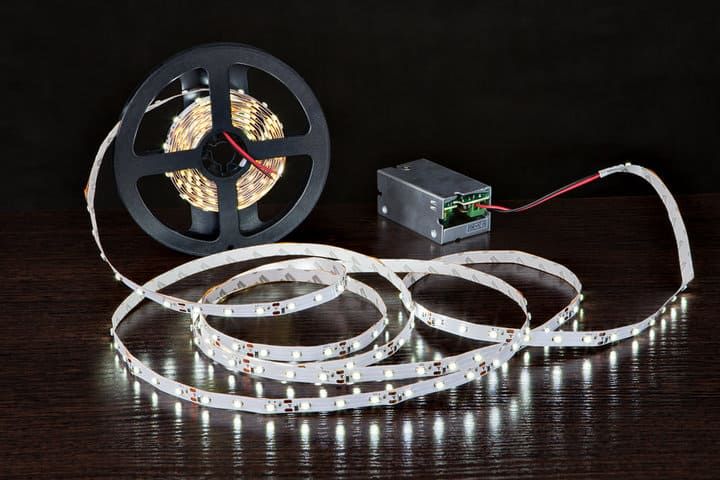
24V LED strips won't work properly on a 12V supply. There isn't enough voltage to drive each circuit group of 6 LEDs in series, so you may get a faint, dim glow — but the strip won't light at its rated brightness. It's not damaging, just non-functional.
If your existing 12V system doesn't quite reach and you were hoping to splice in a 24V strip, it won't work — extend with another 12V section instead, or replace the PSU.
The reverse is far more dangerous: never connect a 12V strip to a 24V supply. 12V strips connected to a 24V PSU will overheat within seconds, instantly burning out LED chips and current-limiting resistors. The strip will be destroyed, and there's a real fire risk if the components ignite or set surrounding materials alight. At the very least, the strip will be damaged beyond use.
Final Word
For most home uses, 12V LED strip lighting is the right call — easier to cut, widely supported by accessories, and more than capable for runs under 5 meters. Step up to 24V if you're running longer than 10 meters in a single line, doing a whole-room or commercial install, or want a more compact PSU.
My rule of thumb: under 5 meters with frequent cuts? 12V is likely sufficient. Over 10 meters or a commercial installation? 24V is the stronger choice. Either way, verify your dimmer or controller is rated for the same voltage, check the IP rating if the strip is going anywhere damp, and start by working out how long your LED strip installation actually needs to be.