
Can You Put LED Strip Lights On Fabric?
That strip peeling off your sofa with a thin layer of fabric fibers stuck to it isn't a cheap-strip problem — it's geometry. Fabric weave gives standard adhesive almost nothing to grip.
 Eugen
EugenEugen Nikolajev
Creator of LED Lighting Info
Hi, I am Eugen. I was always one of those kids who had all sorts of weird lighting gadgets for every occasion.
Now, I want to share my knowledge and experience about lighting with you on LED Lighting Info.
Read my editorial standards
Key Takeaways
LED strips can be placed on fabric, but the self-adhesive tape they ship with isn't strong enough to hold. Double-sided foam mounting tape, fabric glue, or stitching the strips in place all work better. Heat is the bigger concern: fabric is both an insulator and flammable, so cheap or high-density strips should be mounted in an aluminum channel attached to a rigid backing, not directly against the fabric.
LED strip lights are versatile — but not every surface you want to light is rigid and flat. Fabric is a prime example.
If you want to add a glow to the base of your sofa, light up a headboard, or run strips around your car seats, you're dealing with fabric instead of a solid surface — and the rules are different.
Can you put LED strips on fabric, and is it safe?
In this guide, I'll cover:
- Why standard LED adhesive fails on fabric
- Three ways to attach LED strips to fabric (tape, glue, stitching)
- Heat, fire risk, and how to manage them
- Special cases: wearables, curved surfaces, and cable routing
Why standard LED adhesive fails on fabric
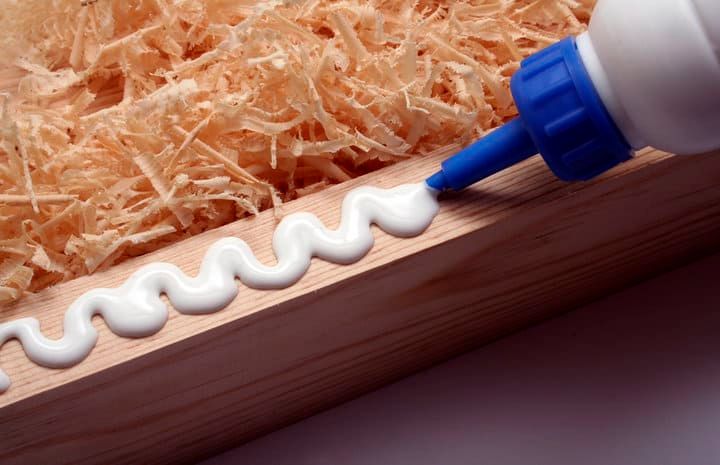
When you buy an LED strip light, it almost always ships with adhesive tape on the back. Peel the backing, press the strip into place, and the adhesive bonds with the surface.
These tapes aren't always strong — especially on cheap strips. They generally work on flat, hard surfaces, provided nothing puts strain on them. (If a controller box hangs off the power cable, don't let it dangle as dead weight pulling on the strip.)
Fabric is a different problem. Standard adhesive bonds to a flat, solid surface. Fabric weave creates tiny gaps and uneven texture, so the tape only contacts a fraction of the surface area. And when the fabric flexes or the strip pulls, individual threads lift away rather than the whole surface holding.
The result: a thin layer of fabric fibers stuck to the strip, while the strip itself falls away from the upholstery.
So yes, you'll usually need a different adhesive — or you'll need to get creative.
How to attach LED strips to fabric
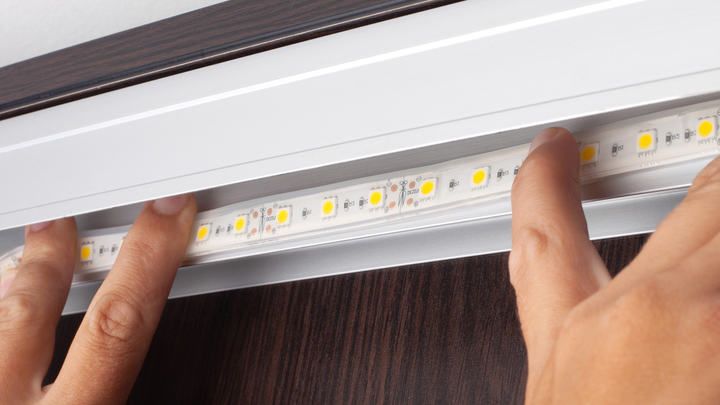
There are three approaches that actually work.
Option 1: Double-sided foam mounting tape
A thicker foam-backed double-sided tape works far better than the strip's stock adhesive. 3M Command sells one popular version (often called "Command tape"), but any quality double-sided foam mounting tape will do.
The foam compresses into the fabric weave and grips more surface area than thin adhesive. Measure the length you need, press the tape onto the fabric, then stick the LED strip to the tape.
For a stronger bond, peel the strip's existing backing too and use both adhesives — the strip's tape sticks to the foam tape, the foam tape grips the fabric.
Pros: removable, won't permanently damage the fabric. Cons: foam tape is thicker than the strip itself, so the LEDs sit slightly proud of the surface. Fine when hidden behind a headboard or sofa back; less elegant on visible installs.
Option 2: Fabric glue
For a flatter bond, use a dedicated fabric adhesive.
Fabric glue is strong and much harder to remove — you'd need rubbing alcohol, and it may discolor the fabric. Only use this method if you don't plan to remove the strip later or resell the item underneath.
Option 3: Stitching or stapling
Fabric is one of the few surfaces where you can mechanically fasten the strip — something you can't easily do on plaster or metal.
Use strong staples or a tough thread. Fishing line works well: it's durable, nearly invisible, and handles heat better than cotton thread (nylon monofilament holds up to roughly 140°C / 285°F of continuous heat, well above the 25–60°C a properly mounted LED strip should reach). Fluorocarbon line is even more heat-resistant if you can find it.
Important: stitch or staple around the strip, never through the PCB. Driving a staple through the conductive board can short the copper traces or damage the LEDs. If your strip has dedicated mounting tabs at the cut points, use those.
Heat, fire risk, and safety

Before committing to any of these methods, there's a safety issue you need to understand: heat.
Quality LED strips run between 25–60°C in normal operation, but high-power and high-density strips routinely run 20–30°C above ambient and can exceed 75°C if they aren't heat-sinked. Most fabrics are good insulators, which traps that heat against the strip — the LEDs degrade faster, the strip's lifespan drops, and the surface temperature climbs.
Fabric is also flammable. Cotton can char and ignite around 210°C, and many synthetic upholstery fabrics melt before they burn. Combined with poor heat dissipation, that's the actual fire-safety concern.
There's a fire risk, though it's typically low — the bigger danger comes from cheap, high-density strips with poor heat dissipation, mismatched power supplies, or overloaded circuits, especially when the strip is pressed against insulating material like fabric. The low DC voltage (usually 12V or 24V) reduces shock risk, but it doesn't eliminate fire risk on its own.
If you're buying cheap strip lights from unknown brands, expect them to run hotter than rated and to have less margin on the power supply.
The best practice is to mount the strip inside an aluminum channel — but the channel itself doesn't stick reliably to fabric either. Aluminum channels are designed to be screwed, clipped, or mounted with VHB tape to a rigid surface, none of which works on fabric. The cleanest workaround is to screw or staple the channel to a rigid backing first (a thin wood strip, foam board, or the frame underneath the upholstery), then position the channel so it sits adjacent to the fabric rather than directly on it. This keeps the LEDs off the insulating fabric and gives the heat somewhere to go.
IP ratings for damp environments
If the fabric might get damp — outdoor cushions, car interiors that pick up condensation, costumes worn against skin — pay attention to the strip's IP rating. IP44 handles occasional splashes, IP65 is rated for outdoor use, and IP67 survives direct submersion. Running a non-rated strip on damp fabric is a recipe for shorts and corroded contacts.
Special cases
Wearables and costumes
For LED strips on clothing or costumes, use battery-powered, low-wattage strips and limit run time. Wearable applications usually involve short bursts, modest power draw, and direct skin contact — all of which are friendlier to fabric than a 60W headboard install. Stitch around the strip (not through it), route wires through seams, and pick a strip with a flexible silicone coating so it doesn't crack with movement.
Curved surfaces and bend radius
LED strips bend, but only so far. Standard flexible PCB strips have a minimum bend radius (often 10–20mm) and can crack the copper traces if wrapped tighter — common when running strips around rounded car seats or sculpted headboards. For tight curves, cut the strip at the marked cut points and reconnect segments with solderable connectors or jumper wire instead of forcing a single strip past its bend limit.
Cable routing
The power cable has to go somewhere. On a sofa or headboard, route the cable through a seam, behind a piping line, or out through an existing gap to the power supply. Avoid pinching the cable between fabric and a frame — chronic pressure on the conductors eventually breaks them, and a broken conductor inside upholstery is hard to find.
Final thoughts
Three methods, three trade-offs:
- Foam mounting tape — quick and removable, but slightly bulky.
- Fabric glue — flat and strong, but permanent.
- Stitch or staple — most secure, just stay clear of the PCB.
My single safety takeaway: use an aluminum channel mounted to a rigid backing whenever you can. If you can't, keep wattage modest, check the strip temperature on the first run, and don't leave high-density strips running unattended pressed against flammable fabric.