
Do Pool Lights Need Transformer?
That spare capacity on your landscape transformer isn't a shortcut — NEC Article 680.23(A)(2) explicitly bans it for any submerged pool fixture, regardless of voltage.
 Eugen
EugenEugen Nikolajev
Creator of LED Lighting Info
Hi, I am Eugen. I was always one of those kids who had all sorts of weird lighting gadgets for every occasion.
Now, I want to share my knowledge and experience about lighting with you on LED Lighting Info.
Read my editorial standards
Key Takeaways
Pool lights designed for 120V mains run straight off household power and need no transformer. Most modern LED pool lights, however, run on 12V and require a pool-rated transformer to step the line voltage down, and to keep the installation safe and code-compliant.
This guide covers how to tell which kind you have, why a landscape transformer won't substitute, where to mount a pool transformer, what wire to run to the fixtures, and the GFCI requirement that's easy to overlook.
Do All Pool Lights Need a Transformer?

Not every pool light needs one. A transformer is an electrical device that steps line voltage down — typically from 120V mains to 12V — so a low-voltage fixture gets the power it needs without the shock risk of household mains.
Mains voltage in the US is 120 volts (in the UK and Europe, 230 volts). That's enough to power most household devices, but it isn't required for modern pool fixtures, many of which work perfectly on 12V. Pool transformers usually offer 12V, 13V, and 14V output taps so you can compensate for voltage drop on longer wire runs and still deliver a true 12V at the fixture. The NEC caps low-voltage contact at 15V, so the upper taps are within code.
Voltage by itself doesn't reduce your electricity bill — you pay for watts, not volts. In practice, though, low-voltage pool lights are almost always LEDs, and a 12V LED pool fixture typically draws 30–70 watts versus 300–500 watts for an older incandescent unit. Switching from incandescent to a low-voltage LED system usually cuts pool-lighting energy use by 80% or more.
That said, not every pool light is a low-voltage one. Many older fixtures, and some current ones, are still designed for mains voltage. The transformer itself isn't what makes a pool safer — the choice of low-voltage fixtures is. The transformer just makes that low-voltage system possible.
Whether you need a transformer comes down to a simple compatibility check:
| Light Type | With Transformer | Without Transformer |
|---|---|---|
| Mains voltage (120V) | Won't work properly — receives only a fraction of rated voltage | Works fine |
| Low voltage (12V) | Works fine | Burns out almost instantly; serious safety hazard |
If you're running low-voltage lights, one transformer is all you need for any fixtures sharing the same circuit — there's no need for a transformer per fixture. Bear in mind, though, that if you're using a timer, every light on that circuit comes on together. Splitting fixtures onto separate schedules means separate circuits, each with its own transformer.
Can I Use a Landscape Transformer for a Pool Light?

Short answer: no. Landscape transformers and pool transformers look similar and do similar work, but they're built to different standards.
If you've installed low-voltage garden lighting, you probably already own a landscape transformer, and it's tempting to use spare capacity for the pool. The NEC explicitly forbids this for any submerged fixture. Article 680.23(A)(2) of the National Electrical Code (2023 edition) states:
Transformers and power supplies used for the supply of underwater luminaires, together with the transformer or power supply enclosure, shall be listed, labeled, and identified for swimming pool and spa use.
The reason is enclosure construction. Landscape transformers are usually shielded by a box that's open or vented at the bottom — fine for the occasional rain shower, but not for the splash exposure around a pool. Pool/spa transformers are listed with sealed, weather-tight enclosures designed to keep water out even when mounted close to a wet environment.
It is technically possible to run a single pool-listed transformer for both pool and landscape lights, provided you don't overload the transformer. In most installations, separate circuits with separate transformers is the cleaner choice.
Where to Place a Pool Light Transformer
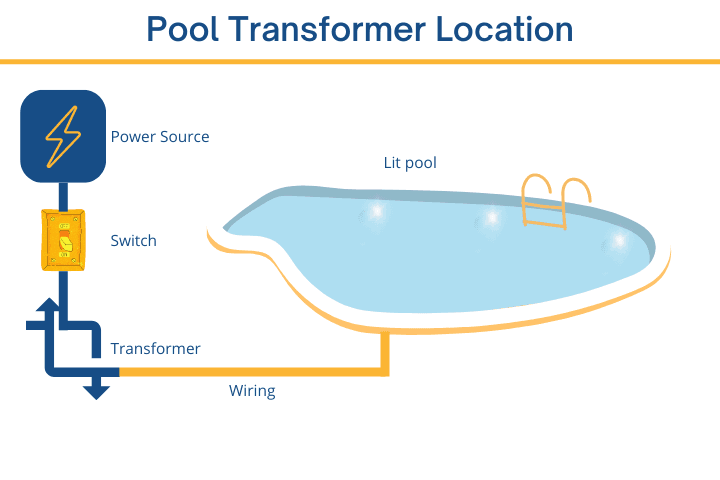
The transformer sits between the circuit breaker (or outlet) and the junction box that feeds the lights. Three rules govern where exactly:
- At least 4 feet from the nearest edge of the pool (per NEC 2023, Article 680.24, for listed pool/spa transformer enclosures). Always check the specific transformer's installation manual — some manufacturers require greater clearance.
- At least 1 foot above grade or deck level, with the wiring compartment facing downward. NEC 680.24 minimums are 4 inches above grade or 8 inches above maximum water level (whichever is greater); manufacturers like Hayward specify 1 foot in their installation manuals to leave a comfortable margin.
- As close to the junction box as those clearances allow, to minimize voltage drop on the low-voltage side.
Wire Gauge and Voltage Drop
Voltage drop is the practical reason that "as close as possible" matters. Every foot of wire between the transformer and fixture loses a small amount of voltage to resistance, and a 12V LED starts visibly dimming below about 11V. For a typical 30–100W pool light load, use this as a starting point:
| Run Length (transformer to fixture) | Recommended Copper Wire | Notes |
|---|---|---|
| Under 50 ft | 12 AWG | Sufficient for most residential installs |
| 50–100 ft | 10 AWG | Keeps drop under 3% at typical loads |
| Over 100 ft | 8 AWG | Reconsider transformer placement or split into two circuits |
If your run is on the long side, switch the transformer to its 13V or 14V tap. The fixture still sees a true 12V after the drop, and the bulb gets the voltage it was designed for. This is exactly why models like the Intermatic PX300, Hayward, and TORK TPX300S include multiple output taps in the first place.
GFCI Protection Is Required
NEC 2023, Article 680.23(A)(3) requires that the branch circuit feeding any underwater pool luminaire be protected by a Ground-Fault Circuit Interrupter. The GFCI sits on the 120V side, ahead of the transformer, and the requirement applies whether the fixture itself is mains-voltage or low-voltage.
A GFCI cuts power within milliseconds when it detects current leaking to ground — for example, through pool water that's reached a damaged fixture or junction. For a pool circuit, that's the difference between a tripped breaker and a serious shock.
On a new installation, the GFCI can be a dedicated breaker at the service panel or a GFCI receptacle upstream of the transformer. On a retrofit, verify that the upstream protection is GFCI before energizing the new fixtures — older installations sometimes aren't, and that's a defect worth correcting first.
Quick Reference Checklist
Before energizing the circuit, run through this list:
- Confirm the fixture's voltage on its label or manual — 120V or 12V.
- 120V mains: no transformer; wire directly through a GFCI-protected circuit.
- 12V low voltage: use a transformer specifically listed for swimming pool and spa use (NEC 2023, 680.23(A)(2)). A landscape-only transformer is not a legal substitute.
- Mount the transformer at least 4 feet from the pool edge and at least 1 foot above grade, wiring compartment facing down.
- Use 12 AWG copper for runs under 50 ft and 10 AWG for 50–100 ft. On long runs, switch the transformer to its 13V or 14V tap.
- Verify GFCI protection on the 120V branch circuit feeding the transformer.