
How To Put Pool Lights On A Timer?
Under NEC Article 680, pool circuits require 12 AWG minimum — but where you place the timer relative to the transformer matters just as much as the wire gauge.
 Eugen
EugenEugen Nikolajev
Creator of LED Lighting Info
Hi, I am Eugen. I was always one of those kids who had all sorts of weird lighting gadgets for every occasion.
Now, I want to share my knowledge and experience about lighting with you on LED Lighting Info.
Read my editorial standards
Key Takeaways
You can install any electrical timer on your lighting circuit, provided it matches the voltage and is housed in a weatherproof enclosure. For low-voltage pool lights, the timer can sit before or after the transformer, line-voltage timers (120V in North America, 230V in the UK, EU, and Australia) are easier to source, which is why most installers wire them upstream of the transformer.
During the summer months, when you're more likely to be using your pool, you don't need the lights on during the day or in the middle of the night when you're asleep. The easiest way to keep them on a sensible evening schedule is with a timer — set it once and the lights switch on and off without your involvement.
This article covers:
- The different kinds of pool light timers you can buy
- How to add a timer to your pool lights
- Where to install the timer on a low-voltage circuit
What Are The Different Types Of Pool Light Timers?
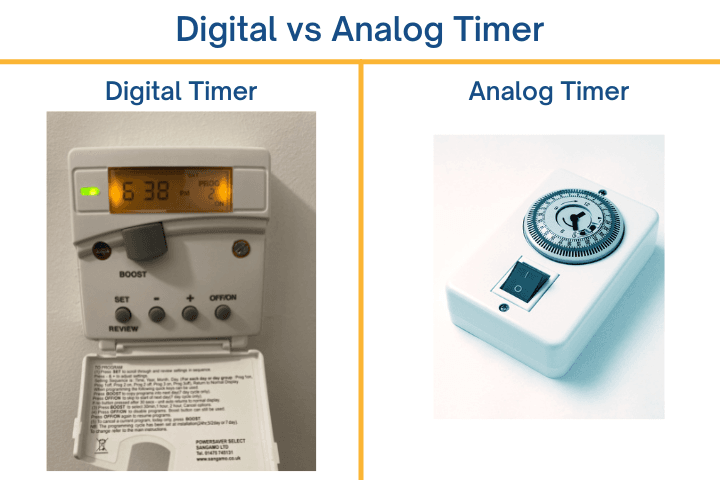
Whenever you buy a timer for any electrical system, you usually have two options — mechanical and digital. The same applies to pool lights, and each has its own strengths.
| Mechanical Timer | Digital Timer | |
|---|---|---|
| Cost | Lower | Higher |
| Ease of use | Intuitive — read the dial | Requires the manual on first setup |
| DST auto-adjust | No (manual reset) | Yes on most modern models |
| Programming flexibility | 30- or 60-minute slots, same every day | Set times to the minute, different schedule per weekday |
| Best for | Set-and-forget simple schedules | Variable schedules and seasonal use |
Mechanical timers use physical switches — typically a rotating dial with toggles representing 30- or 60-minute slots. They're inexpensive and intuitive, but you can't set different schedules for different days, and you'll need to adjust them manually when Daylight Savings starts and ends.
Digital timers replace the dial with a small screen and buttons. You can program them to the minute, set different schedules for different weekdays, and most modern models adjust automatically for Daylight Savings. If you're regularly away on Friday evenings, for example, you can program the lights to stay off those nights. The tradeoff is a higher price and a brief learning curve from the manual.
You don't get dedicated timers just for pool lights — in theory, any timer will do. What matters for outdoor use is the housing: many manufacturers sell timers pre-installed in sealed enclosures rated for outdoor use. You could buy a basic timer and add your own weatherproof box, but the integrated outdoor units from companies like Intermatic — see their range of outdoor mechanical and digital timers — are usually less work.
How To Put A Timer On Existing Pool Lights
Safety note: Pool electrical work is governed by NEC Article 680 in the US, requires GFCI protection, and is typically subject to permit and inspection. The steps below describe the general principle; the actual installation should be done by a licensed electrician.

Wiring a timer into an existing pool light circuit is conceptually simple. Timers work by breaking and completing the circuit on a set schedule, so the timer needs to be wired into the circuit between the main power and the lights. The typical layout is: circuit breaker → timer → light junction box, with the timer wall-mounted in a weatherproof enclosure.
Here's the sequence:
- Switch off the power at the circuit breaker.
- Locate the wire that runs to your lights' junction box.
- Mount the timer on a suitable weatherproof surface within easy reach of the cable.
- Cut the cable near the transformer and strip about half an inch of insulation. Connect the wire from the power source to the LINE terminals, and the wire running to the lights to the LOAD terminals — making sure live, neutral, and ground each go to the matching terminal on both sides.
If the existing cable doesn't have enough slack to land on the timer, splice in new cable sized to match the circuit's amperage rating — 12 AWG minimum for the standard 20A pool circuit under NEC Article 680. (14 AWG is rated only for 15A and is not appropriate here.) Pool circuits also require GFCI protection and specific wire types — THWN or XHHW in RMC, IMC, EMT, or listed MC for wet locations.
Weatherproof the splice properly: use gel- or silicone-filled waterproof wire connectors and either a sealed outdoor junction box or self-fusing silicone tape over the connection. A loose splice in damp soil is a fire and shock risk.
Verify that the timer's amperage and wattage rating meets or exceeds the load on your light circuit — an under-rated timer is itself a fire hazard.
Most pool lighting circuits already have a light switch — without one, the lights would never turn off completely. You have two options:
- Replace the switch with the timer. This is the cleaner choice for digital timers, since you keep full control through programming.
- Add the timer downstream of the switch. The switch acts as a master cutoff, and the timer handles scheduling when the switch is left on.
If you have both a light switch and a digital timer, be aware that timers without battery backup may reset when power is interrupted. Many modern digital timers include a battery (or non-volatile memory) that preserves your programming through outages — check the spec sheet before relying on it.
Should The Timer Be Installed Before Or After The Transformer?
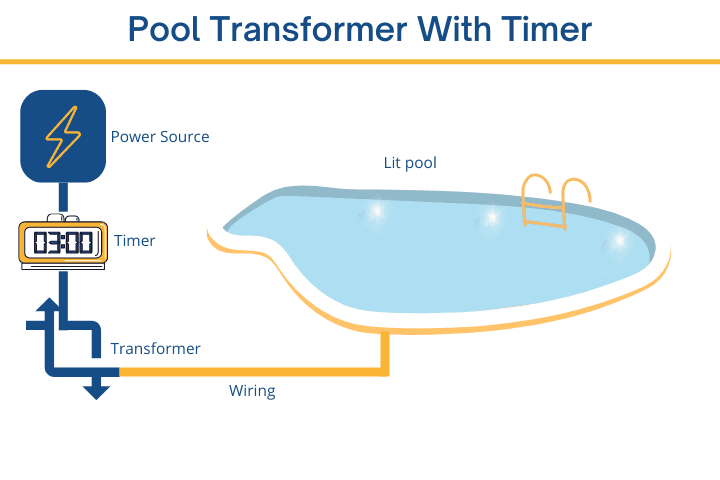
Many modern pool lights are low-voltage and have a transformer wired into the circuit, which raises a fair question: does the timer go before or after the transformer? Both work — what matters is matching the timer to the voltage on its side of the transformer.
| Placement | Voltage on that side | Timer type | Notes |
|---|---|---|---|
| Before transformer | 120V (NA) / 230V (UK, EU, AU) | Standard line-voltage timer | More product options, easier to source |
| After transformer | 12V or 24V | Low-voltage timer (matched to output) | Sits closer to the lights; check transformer output rating |
Before the transformer, the circuit runs at line voltage — 120 volts in North America, or 230 volts in the UK, EU, and Australia. After the transformer, the power is stepped down to a low voltage — typically 12 volts, though some systems use 24 volts because it cuts voltage drop by more than half across longer cable runs. Check your transformer's output rating before buying a low-voltage timer.
If you install a 120V (or 230V) timer after the transformer, it won't see enough voltage to operate. The reverse mismatch is more dangerous: wiring a low-voltage-rated timer onto a line-voltage circuit will damage the timer and creates a serious fire and shock hazard.
Line-voltage timers are the most common and easiest to source, which is why most installers wire them upstream of the transformer. You can also buy a pool-light transformer with a timer built in, which folds both into a single device and saves a wiring step.
Smart Plugs And Pool Automation
If your pool lights plug into a standard outdoor outlet, an outdoor-rated Wi-Fi smart plug or smart timer is a quick middle ground between a basic mechanical timer and full pool automation. They handle scheduling from a phone and integrate with Alexa or Google Home — useful if you want to override the schedule when you're entertaining late or away for the weekend.
For a fully integrated setup, a smart pool automation platform such as iAquaLink can control pool lights from your phone alongside pumps, heaters, water features, and pool/spa switching — but at a much higher price than a standalone timer.
Final Words
In my view, a timer is the cheapest and simplest way to put pool lights on a sensible schedule. The decisions to make are:
- Timer type — mechanical for set-and-forget simplicity, digital for per-day scheduling and Daylight Savings auto-adjust.
- Voltage and placement — match the timer to the side of the transformer it's wired on (line voltage upstream, 12V/24V downstream).
- Housing — an outdoor-rated enclosure or your own weatherproof box.
- Code compliance — GFCI protection and 12 AWG minimum for the standard 20A pool circuit; if you're not confident with NEC Article 680, hire a licensed electrician.
If you want more flexibility than a basic timer offers, a smart plug, smart timer, or full automation platform like iAquaLink covers the same job with phone control and voice integration.