What’s The Difference Between Headlights And Fog Lights?
Switch on your headlights in thick fog and the beam bounces straight back into your eyes — fog lights exist specifically because aimed-low beats aimed-far when visibility collapses.
 Eugen
EugenEugen Nikolajev
Creator of LED Lighting Info
Hi, I am Eugen. I was always one of those kids who had all sorts of weird lighting gadgets for every occasion.
Now, I want to share my knowledge and experience about lighting with you on LED Lighting Info.
Read my editorial standards
Key Takeaways
Headlights are your car's primary forward lights, designed for long-range visibility on dark roads. Fog lights are smaller auxiliary lights mounted low on the bumper that illuminate the road right in front of you without bouncing glare back off fog, rain, or snow. Knowing when to use each — and when not to — keeps you safe and keeps you from blinding the drivers around you.
Below, I'll break down what each type of light does, the laws that govern their use, the practical differences in beam shape and color, and how LED options compare to traditional halogens.
What Are Headlights?
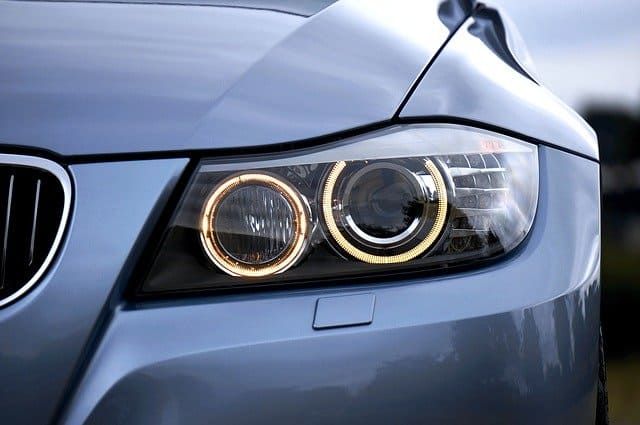
"Headlight" is an umbrella term for the primary forward-facing white lights on a vehicle. Under the federal standard FMVSS 108, a headlamp system includes both a low-beam (the default night-driving setting) and a high-beam (long-range) mode. "Driving lights" is a separate category of auxiliary forward lighting under the same standard, not a synonym for headlights.
Turning on the reflector headlights also activates other required systems: the rear taillights, the parking lights, and the rear license-plate light.
When Headlights Are Required
Every US state requires headlights from sunset to sunrise. Some states, including Tennessee and Georgia, expand the window to 30 minutes before sunset and 30 minutes after sunrise.
Headlights are also required when bad weather drops your visibility — but the legal threshold varies by state, anywhere from 200 feet (Tennessee) to 500 feet (Georgia, Illinois, Massachusetts) to 1,000 feet (California, Texas). Check your state DMV for the exact rule.
In about 42 of the 50 states, the "wipers on, lights on" rule also applies: if continuous wiper use is required by precipitation, your headlights must be on, regardless of time of day.
You can read the rules for using headlights by each state here.
Low Beams vs. High Beams
Low beams are the default setting for night driving. Driver-education materials commonly cite low beams as illuminating roughly 160–250 feet ahead. FMVSS 108 doesn't set a single distance figure — it regulates beam intensity at specific test points and aim — but the practical reach is enough to see pedestrians, signs, and vehicles ahead in normal conditions.
High beams typically illuminate roughly 350–500 feet ahead — about double the reach of low beams. They're meant for rural, dark roads with no oncoming traffic.
Switch to low-beam headlights when within 500 feet of an oncoming vehicle, or within 300 feet of a vehicle you are following (200 feet in some states, such as Virginia). Otherwise, the high-beam glare can blind other drivers.
Most US states also prohibit using high beams in foggy conditions: the intense beam reflects off water droplets and produces glare that reduces visibility for everyone, including you.
Adaptive and Automatic Headlights
Most vehicles built since 2018 include some form of automatic high-beam assist, which uses a forward-facing camera to detect oncoming or leading vehicles and dip the high beams automatically. More advanced adaptive driving beam (ADB) systems, recently approved in the US, can selectively shadow other vehicles while keeping the rest of the road brightly lit. If your car has these systems, you'll usually find a dashboard switch labeled "AUTO" near the headlight stalk.
What Makes a Fog Light a Fog Light?
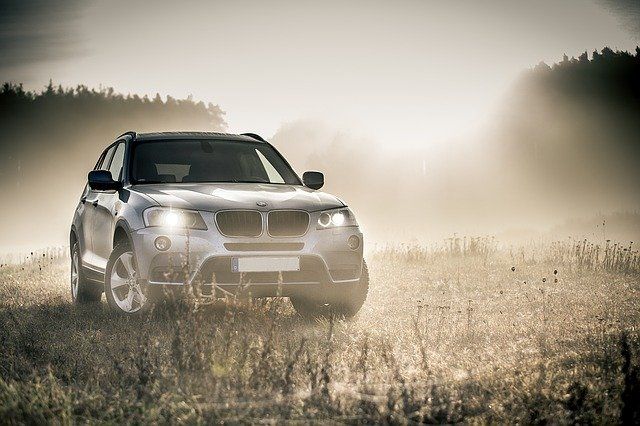
Headlights are designed to throw light far ahead of the vehicle. The problem is that fog, heavy rain, snow, and blowing dust hang in the air right where that beam is aimed. The light hits those particles and bounces straight back into the driver's eyes, making things worse rather than better.
Fog lights solve this by lighting up the road beneath the fog. They're mounted low on the bumper and aimed with a sharp horizontal cutoff, so the beam travels straight forward and slightly down — under the fog layer — without throwing light upward where it can scatter.
Because the beam is wide and low, fog lights can also be useful in non-foggy situations where you want to see what's just off the edge of the road:
- Winding roads where you need to see into curves before your headlights swing around
- Rural roads where animals may step out from the shoulder
- Residential areas with heavy pedestrian activity
- Tight parking lots and driveways at night
Fog lights are required to be either white or selective yellow (amber). Yellow is traditional in European markets — and some drivers prefer it because shorter wavelengths scatter less in fog — but white is also widely used. The beam itself tends to be wide and rectangular to cover a broad horizontal slice of road close to the car.
Rear Fog Lights
Rear fog lights — common in Europe, rare in the US — sit behind the back bumper and mark your vehicle's position to drivers behind you in low visibility. Unlike front fog lights, they don't have a sharp cutoff; they light up evenly. They're red, like brake lights, and bright enough that drivers behind you can mistake them for braking. Use them only in genuinely poor visibility and turn them off the moment conditions clear.
When Not to Use Fog Lights
Running fog lights in clear weather is discouraged — and in some states it's illegal. The Louisiana State Police have publicly reminded drivers to keep fog lights off in clear conditions to avoid being ticketed.
State laws often regulate not just when fog lights can be used, but how they must be installed. Minnesota law (Minn. Stat. §169.56), for example, allows up to two front fog lamps mounted between 12 and 30 inches above the road, and the high-intensity portion of the beam must not project above 4 inches below the lamp center at 25 feet — effectively limiting glare even in clear weather.
The biggest nuisance comes from drivers who swap stock fog lamps for unregulated, high-output bulbs that throw light in every direction. That's why most countries restrict fog-light use to genuinely poor visibility — using them as decorative driving lights blinds oncoming traffic without doing anything to help the driver.
Does My Car Have Fog Lights?
Many drivers aren't sure whether their vehicle has factory fog lights. Three quick checks:
- Look on the dashboard or stalk for a separate switch with a fog-light icon (a sideways lamp with horizontal lines and a wavy line through them — green for front, amber for rear).
- Inspect the front bumper below the headlights for small round or rectangular lenses, usually set into the corners.
- Check the owner's manual under "Lighting" or "Exterior Controls" — fog lights are typically a trim-level option rather than standard on base models.
LED vs. Halogen Fog Lights
Most factory fog lights from the early 2000s and earlier were halogen. Newer vehicles increasingly use LED — and LED upgrade kits are a popular aftermarket swap. The differences:
- Color temperature: Halogens output a warm 3000K–3500K (yellowish-white). LEDs are typically available in 3000K (selective yellow, best penetration in fog) or 6000K (cool white). For genuine fog, lower color temperatures cut glare more effectively.
- Power draw: A pair of halogen H11 fog bulbs draws roughly 110W combined. LED equivalents typically draw 30–50W, easing load on the alternator.
- Lifespan: Halogen bulbs last around 1,000 hours. Quality LEDs are rated for 30,000–50,000 hours.
- Beam pattern: This matters more than the bulb itself. A drop-in LED bulb in a halogen-designed fog housing can scatter light upward and create the very glare a fog lamp is meant to avoid. For best results, match LED bulbs to a housing designed for them, or replace the entire assembly.
Key Differences
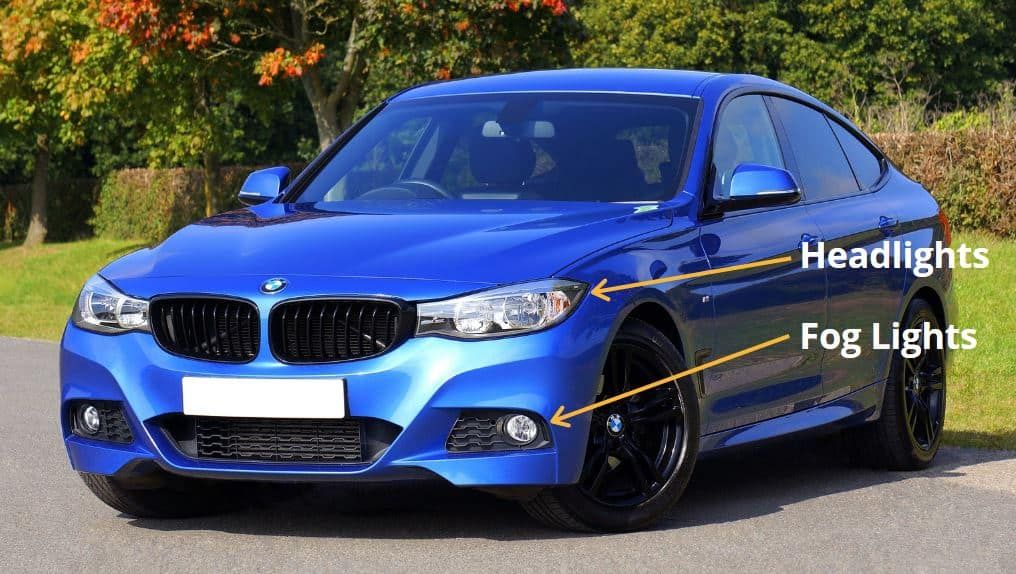
Here's a side-by-side comparison of how the two lights differ in purpose, position, and legality. Always check your local state laws for specifics.
| Attribute | Headlights | Fog Lights |
|---|---|---|
| Purpose | Long-range forward illumination for general night driving | Short-range, low illumination beneath fog, rain, or snow |
| Mounting position | Centered at the front of the car, around eye level | Below the front bumper (rear fog lights mount behind the rear bumper) |
| Beam shape | Long, focused projection — low beam reaches ~160–250 ft, high beam ~350–500 ft | Wide, flat, rectangular beam with a sharp horizontal cutoff |
| Legal color options | White only | White or selective yellow (amber); rear fogs are red |
| Federally required in US | Yes — required equipment under FMVSS 108 | No — front and rear fog lights are auxiliary |
| Required in EU | Yes | Rear fog light: yes. Front fog lights: optional. |
| Ideal use condition | Sunset to sunrise; any time visibility drops | Heavy fog, rain, snow, or dust where headlights cause glare |
| When use is prohibited | High beams within 500 ft of oncoming traffic or 300 ft of a leading vehicle; in fog | In clear conditions in many states; rear fogs in non-low-visibility driving |
Are Fog Lights Mandatory?
In the US, fog lights — front and rear — are classified as auxiliary lighting, so they aren't mandatory. Base trims often ship without them, and they're commonly offered as a dealer-installed option or higher-trim feature. Europe is stricter: a rear fog light is required equipment on every passenger vehicle.
Can You Use Fog Lights as Daytime Running Lights?
This question usually comes up in one of two scenarios: a vehicle with no factory Daytime Running Lights (DRLs), or a vehicle whose DRL system has failed and needs a stopgap before repair. The short answer is that the two lights are not interchangeable, but they may substitute for each other in narrow situations.
Almost all new cars in the US come with Daytime Running Lights (DRLs). They make your vehicle visible to oncoming traffic and to drivers ahead of you in their rearview mirrors, and they stay on whenever the engine is running, even with the headlights off.
DRLs are typically automatic — sometimes implemented as dimmed parking lights, sometimes as the slim LED strips framing the main projector headlights and taillights.
If your DRLs aren't working, leaving the front fog lights on during the day is a reasonable temporary substitute for visibility purposes — they'll signal your position to other drivers until you can get the DRLs repaired. It's not an ideal long-term setup.
Going the other direction — using DRLs as a substitute for fog lights — doesn't work. DRLs aren't bright enough, aren't aimed correctly, and don't have the wide low beam pattern fog lights need to cut through fog or heavy rain. If your fog lights are out and you need to drive in low visibility, switch on the regular low-beam headlights. In severe fog or heavy rain, it's worth waiting for conditions to improve or for repairs to be made.
The Bottom Line
The decision rule is simple: low beams are your default whenever you're driving in the dark. High beams are for empty rural roads with no oncoming or leading traffic, and they should drop the moment another vehicle comes into range. Fog lights are for genuinely poor visibility — fog, heavy rain, blowing snow — where headlights would only make things worse, and they should be off any other time.
State laws differ on the specifics — when headlights are required, how far oncoming traffic triggers the low-beam switch, whether fog lights are legal in clear weather — so it's worth a quick look at your state's DMV page to make sure you're covered.
Do you regularly drive in fog or on unlit rural roads?