Are Low Beams And High Beams Headlights The Same Thing?
Older cars used one dual-filament bulb per side for both beams; most modern vehicles reversed that and split into two separate single-beam bulbs. Separating the jobs means each beam can be tuned independently.
 Eugen
EugenEugen Nikolajev
Creator of LED Lighting Info
Hi, I am Eugen. I was always one of those kids who had all sorts of weird lighting gadgets for every occasion.
Now, I want to share my knowledge and experience about lighting with you on LED Lighting Info.
Read my editorial standards
Key Takeaways
High beam and low beam are two distinct beams of light with two distinct jobs. Most modern vehicles use a separate single-beam bulb (or LED/HID emitter) for each function. Many older vehicles — and some current ones — instead use a single dual-filament bulb that produces both beams.
Flicking the high-beam stalk feels simple from the driver's seat, but low beams and high beams are engineered for two very different jobs — and the way they're built and wired varies a lot between vehicles. Here's how they actually differ, when each one belongs on, and how to tell what's behind your own headlight lens.
Low vs High Beam Headlights: Key Differences
Both beams are mandatory equipment on the front of your car, but you use them in different situations. Low beams handle regular night-time driving. High beams come on only when the road ahead is especially dark and there's no other traffic to dazzle.
Whether your low beams stay on when you switch to high beams depends entirely on the vehicle. On some cars — many Fords and Mazdas, for example — both filaments stay lit when you pull the stalk. On others, like many GM trucks, the low beams cut out the moment the high beams activate. There's no universal rule; it's a wiring choice the manufacturer made, and there are even DIY guides for rewiring vehicles whose low beams cut off.
Cars that use a single bulb with two filaments work differently — they switch between filaments rather than running both at once. Only one filament is lit at a time, because running both would generate too much heat for the bulb assembly to handle safely.
Wattage varies by bulb type and technology. Standard halogen low beams (H7, H11) draw about 55 W. Halogen high beams range from 55 W (H1) to 65 W (H9). HID/xenon systems run at around 35 W, while LED headlights typically use just 20–30 W for low beam and 30–45 W for high beam.
The point of a low beam is to light the road close to the car — roughly five car lengths ahead — without blasting drivers and pedestrians coming the other way. The bulb is housed (and on dual-filament bulbs, shielded) so the light angles down onto the road instead of straight forward. A high beam ignores those limits and shines bright and far for maximum visibility.
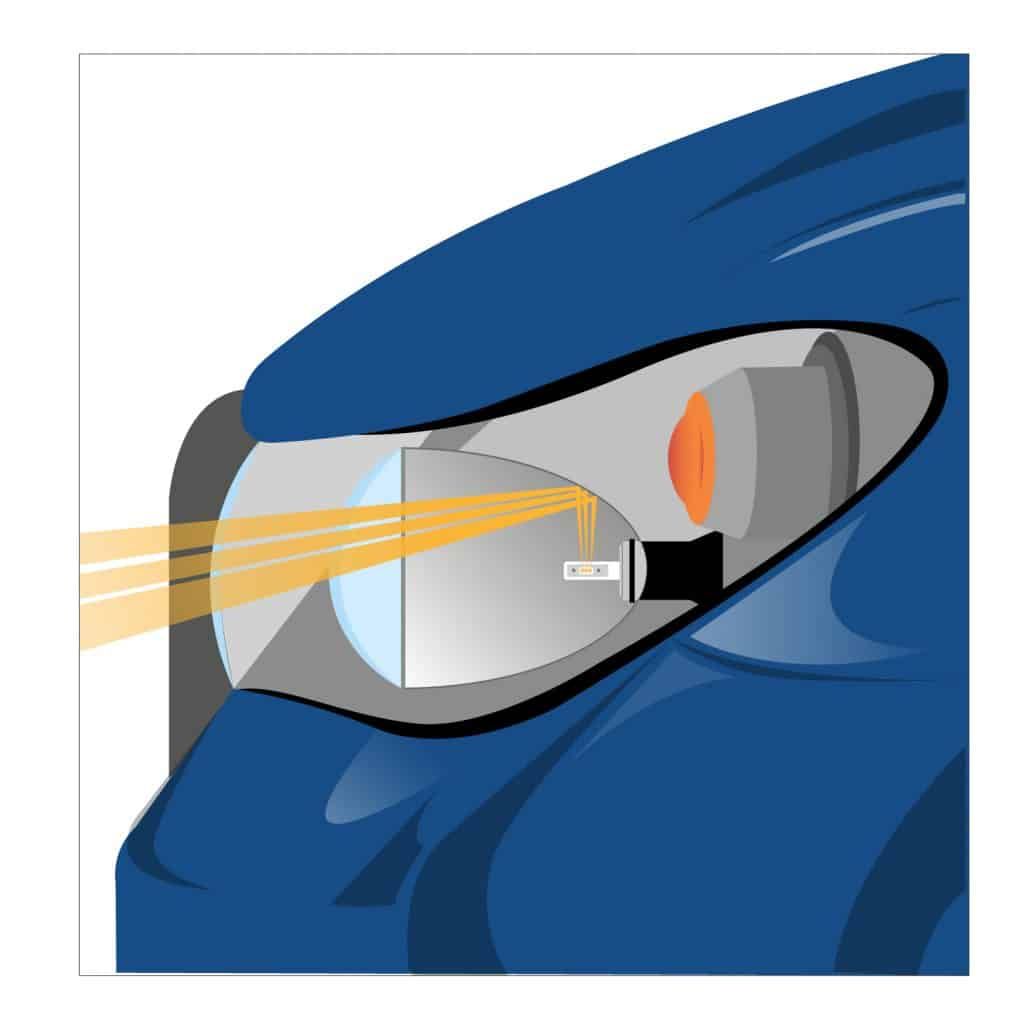
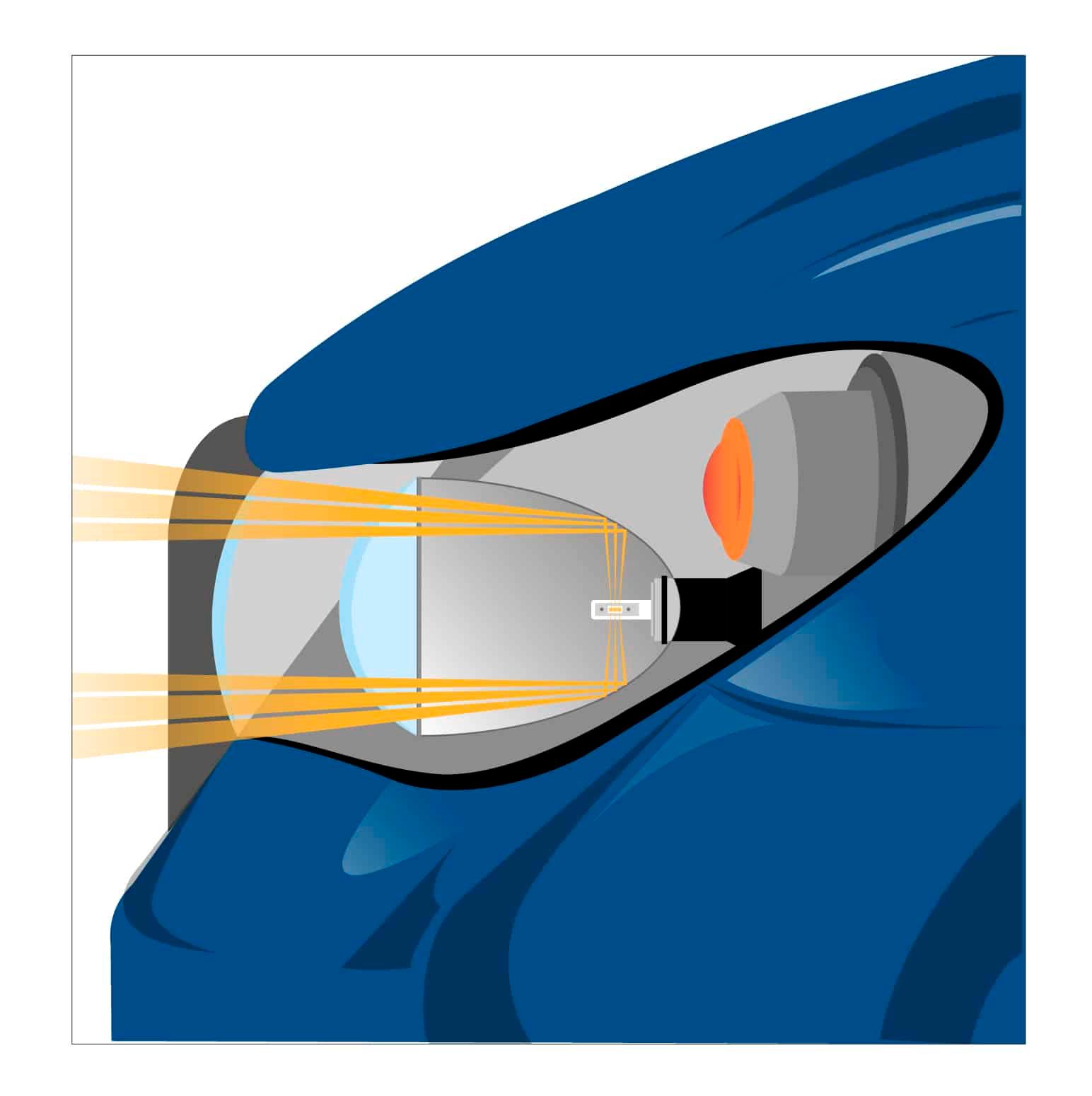
The two close-up images below show what's happening inside a dual-filament bulb in each mode. In low-beam mode, the upper filament is lit and a small metal shield beneath it blocks downward light, so only the upward-bound rays bounce off the upper portion of the reflector and angle down onto the road. In high-beam mode, the lower filament lights up and projects directly forward.
Out on the road, the difference is just as obvious. The next two photos show the same stretch of road under each beam — the low beam pools light close to the car and biases toward the shoulder you're driving on, while the high beam reaches much farther and spreads more evenly across both lanes.
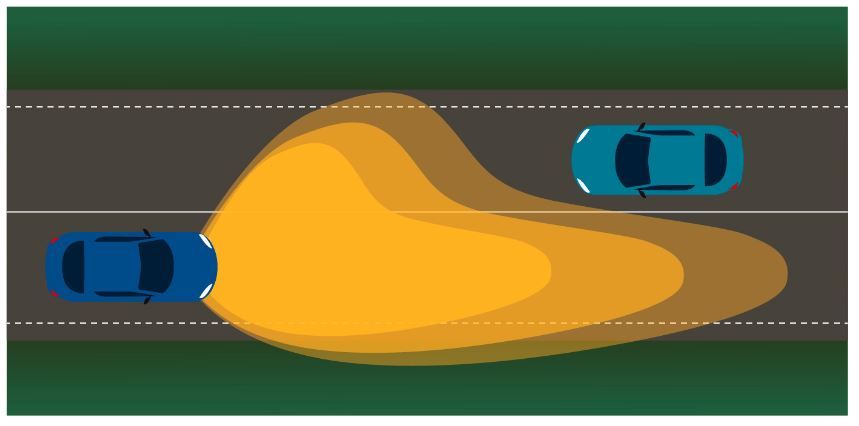
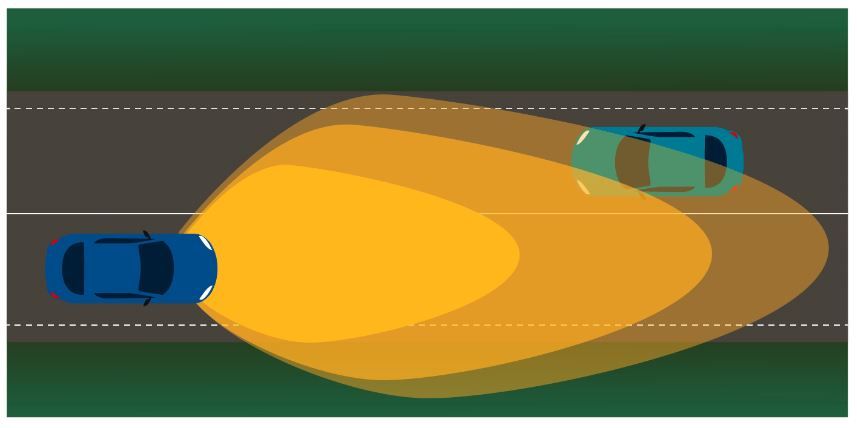
That asymmetric low-beam pattern — brighter on the driver's shoulder, dimmer toward oncoming traffic — is intentional. It's also exactly why high beams need to come off as soon as you see another vehicle: they reach across both sides of the road and into the eyes of anyone coming the other way.
The table below sums up the practical differences between the two beams.
| Low Beam Headlights | High Beam Headlights |
|---|---|
| Dipped beam angled downward onto the road | Beam projected straight ahead |
| Daily running light for city roads and busy highways | Used mainly on open freeways and dark rural roads with no nearby traffic |
| Shorter range — illuminates the road close to the car | Longer range — much brighter and reaches farther down the road |
| Halogen ~1,000–1,500 lm; HID ~3,000+ lm; LED 3,000–6,000+ lm | Halogen ~1,500–1,800 lm; HID ~3,000+ lm; LED 3,000–6,000+ lm (some over 10,000) |
| Lights up roughly 150–200 feet ahead | Lights up roughly 250–350 feet ahead |
| 12 V system; halogen 45–55 W, HID ~35 W, LED 20–30 W | 12 V system; halogen 55–65 W, HID ~35 W, LED 30–45 W |
When Are High and Low Beams Used?
When to use high beams
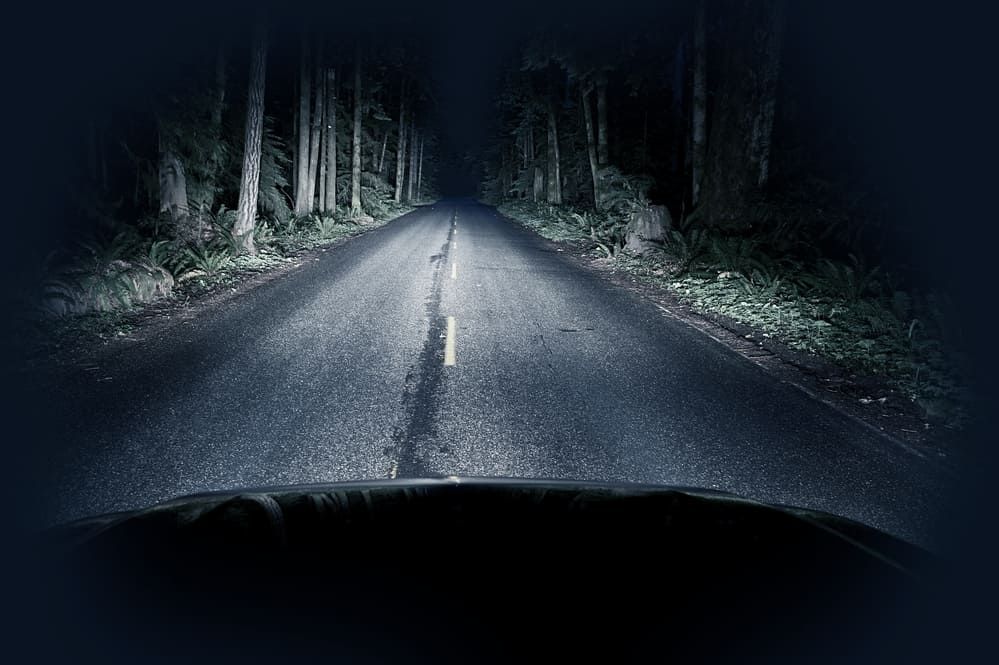
High beams give you maximum visibility, but they can also blind oncoming drivers and reach the rearview mirror of any car you're following. Use them on wide, open highways and on dark rural roads with no nearby traffic. Drivers also occasionally flash high beams once or twice to signal another driver — for example, to indicate it's safe to pass.
Most US states require you to dim high beams in two situations:
- When approaching an oncoming vehicle — typically within 500 feet.
- When following another vehicle — typically within 200–300 feet, depending on the state. California and Minnesota set the limit at 200 feet; Washington uses 300 feet.
When to use low beams
Low beams handle regular night-time driving. In most US states, headlights are legally required from sunset to sunrise and during conditions of reduced visibility — rain, fog, snow, or anything that drops visibility below roughly 500 to 1,000 feet. In 42 states, headlights are also required any time your windshield wipers are in continuous use. Specific rules vary by state, so check your local laws.
Low visibility: rain, fog, and snow
It's tempting to flip on high beams when visibility drops, but that's the wrong move. The straight-ahead high beam reflects off every droplet of rain, fog, or snow in the air and builds a bright wall of glare in front of the car. You won't see through it — and neither will anyone else.
Use fog lights if your car has them. Fog lights work better than headlights in poor visibility because they're mounted lower (so they shine under the fog or precipitation rather than into it), they cast a wider, flatter beam, and they have a sharp upper cutoff that limits how much light bounces back at you. If you don't have fog lights, stick with low beams — they're not perfect, but they reflect far less glare than high beams do.
Auto high beam assist
Many newer vehicles include an automatic high-beam system (often called Auto High Beam Assist, IntelliBeam, or a similar manufacturer-specific name). A forward-facing camera detects oncoming or leading headlights and dips your high beams automatically, then turns them back on when the road is clear. The same dimming-distance rules above still apply — they just happen without you flicking the stalk. If your car has it, the icon usually looks like the standard high-beam symbol with an "A" next to it.
How Single-Bulb Dual-Beam Headlights Work
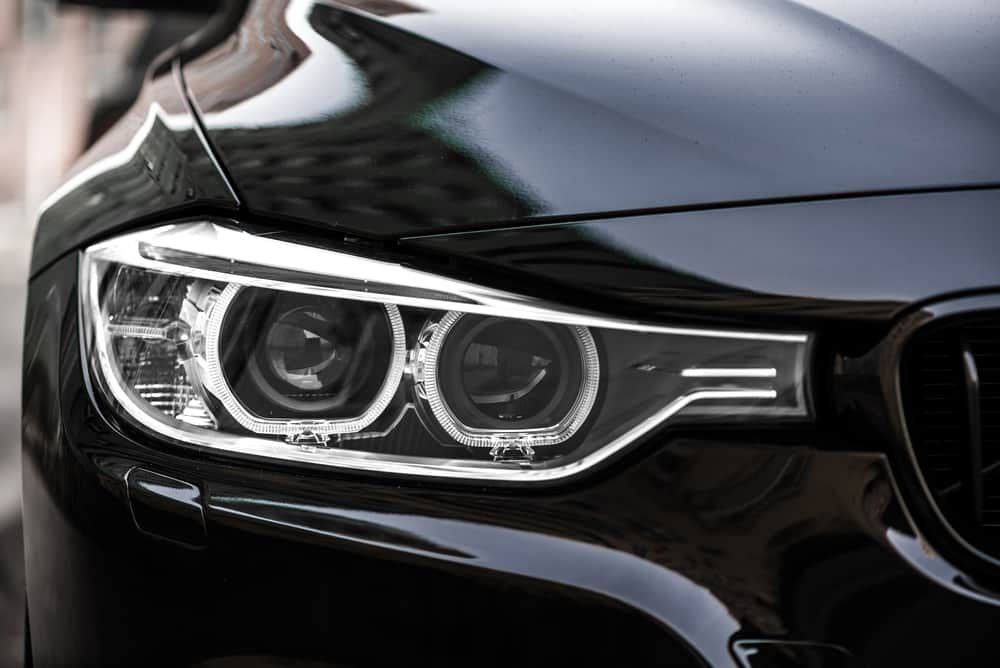
The history here is the opposite of what many people assume. Older vehicles commonly used a single dual-filament bulb per side that produced both low and high beams — H4, 9004, and 9007 are classic examples. Most modern vehicles have moved the other way, using two separate single-beam bulbs per side (for example, H7 paired with H1, or H11 paired with H9), so each beam can be optimized independently. Modern LED and HID assemblies often have separate emitters for each function for the same reason.
When a single bulb has to handle both jobs, it does so with two filaments inside the same envelope, switching between them:
- Low beam: The upper filament lights up. A small metal shield sits beneath it and blocks downward-bound light, so only rays heading upward reflect off the upper portion of the reflector and angle down onto the road. That shield is what creates the sharp horizontal cutoff line you see on a properly aimed low beam — and it's what keeps glare out of oncoming drivers' eyes.
- High beam: The upper filament switches off and the lower filament lights up. With no shield in front of it, light projects straight forward off the full reflector and reaches much farther down the road. Only one filament runs at a time — running both would build up too much heat for the bulb.
Common dual-filament bulbs include H4, 9004, and 9007. (H1, sometimes lumped in with this group, is actually a single-filament bulb used as either a low beam or a high beam — never both.) Dual-filament bulbs typically cost more than single-beam bulbs, and you can't just swap two single-beam bulbs for one dual-filament bulb — the headlight assembly's wiring and reflector geometry are entirely different.
Note: HID (xenon) and LED headlights don't use filaments at all — they produce light through a gas-discharge arc or semiconductor, respectively. The same low-beam/high-beam logic still applies, but the mechanics inside the bulb or module are completely different.
How to Tell Which Bulbs Your Car Uses
Counting the bulbs you can see through the headlight lens isn't a reliable test. Modern headlight assemblies often pack in fog lights, daytime running lights, turn signals, position lights, and multiple LED modules alongside the actual low- and high-beam bulbs. The most reliable way to find out is to check your owner's manual or look up your vehicle in a bulb cross-reference guide — that will tell you exactly which bulb sizes serve which function.
If you have dual-beam halogen bulbs and want more output, drop-in LED replacements are widely available and produce noticeably more light per watt. See Can You Use LED Headlights In Reflector Housing? and Do LED Bulbs Work In Projector Headlights? before you buy — housing type matters more than wattage.
The Bottom Line
Three things are worth keeping in mind:
- Low and high beams are designed for different jobs — low beams for everyday driving with a downward cutoff that protects oncoming traffic; high beams for empty roads where reach matters more than glare.
- Dim your high beams not just for oncoming cars (within ~500 feet) but also when you're following another vehicle (within 200–300 feet, depending on state).
- In rain, fog, or snow, never use high beams. Use fog lights if you have them, low beams if you don't.
Knowing what's actually inside your headlights — and which bulbs your specific car uses — makes any upgrade or replacement straightforward. When in doubt, the owner's manual is faster and more reliable than counting bulbs through the lens.