
What Is The Difference Between A19 And A21 Light Bulbs?
An A21 won't always fit where an A19 lived — the extra width and length can press against a tight fixture, turning a simple swap into a fire-safety problem.
 Eugen
EugenEugen Nikolajev
Creator of LED Lighting Info
Hi, I am Eugen. I was always one of those kids who had all sorts of weird lighting gadgets for every occasion.
Now, I want to share my knowledge and experience about lighting with you on LED Lighting Info.
Read my editorial standards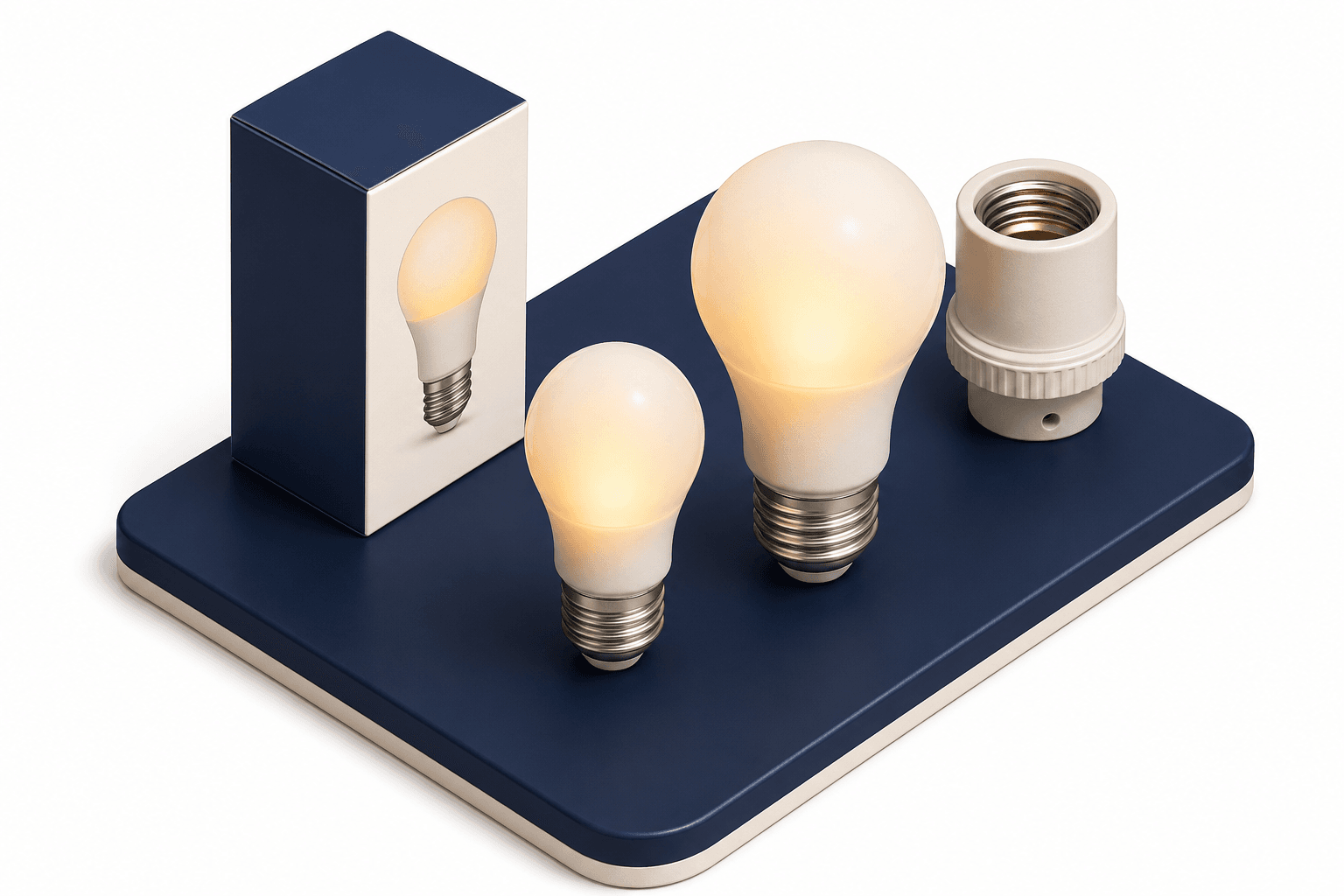
Key Takeaways
The difference between A19 and A21 bulbs is their size. A19 bulbs measure 2.375 inches in diameter, while A21 bulbs measure 2.625 inches. Both usually have the same E26 Edison screw base in North America. In the UK and Commonwealth countries, A-series bulbs are commonly available with B22 bayonet bases or E27 screw bases instead.
A19 and A21 are among the most common household bulb sizes — and while they look nearly identical, the difference matters depending on your fixture.
Once you understand light bulb codes, things get a little simpler, so let’s explore:
- What A19 and A21 mean in detail
- Whether they’re interchangeable
- A19 and A21 base sizes
What Does A19 And A21 Mean?

Light bulb codes split into two camps: one describes the base (how the bulb connects to the fixture) and the other describes the bulb’s shape and size.
Base codes
Base codes generally start with an E, a B, or a GU:
- E-type (Edison screw) — the bulb screws into the fixture. E26 is the standard residential base in the US; E27 is its 220–240V counterpart used across most of the rest of the world.
- B-type (Bayonet) — two pins that you push in and twist to lock. B22 is the standard residential base in the UK, Ireland, Australia, New Zealand, and India.
- GU-type — common on spotlights, with two pins set a specific distance apart (10 mm for GU10, 5.3 mm for GU5.3). GU10 bulbs twist to lock; GU5.3 bulbs push into place.
After the letter, the number refers to either the base diameter or the distance between the pins, in millimeters.
Note: a plain ‘G’ on its own is a shape code, not a base code — it stands for ‘globe’ and refers to round, decorative bulbs often used on bathroom vanity bars.
Shape and size codes
Any other letter/number code on the packaging describes the bulb’s shape and size. The most common are A and C, but there are many others.
‘A’ bulbs are commonly said to stand for ‘arbitrary’ — meaning the conventional, generic bulb form — and they’re the typical rounded pear shape you associate with a classic light bulb. ‘C’ is candle-shaped, starting wider before tapering to a point.
For A-series bulbs, the number after the letter is the diameter in eighths of an inch. So an A19 is a rounded pear-shaped bulb with a diameter of 19 eighths of an inch, or 2 3/8 inches. Bulb base measurements are given in millimeters, while A-bulb shape measurements are given in eighths of an inch.
While the code refers specifically to the bulb’s width, A-series bulbs also have a standard length. An A19 is typically about 4.1 to 4.3 inches (~110 mm) tall, while an A21 is typically 5 to 5.3 inches (~135 mm). Here’s how the two compare side by side:
| Bulb | Base | Diameter | Max Length | LED Lumens (typical) | LED Wattage (typical) |
|---|---|---|---|---|---|
| A19 | E26 (US) | 2 3/8” (60 mm) | ~4.1–4.3” (~110 mm) | 450–1600 lm | 5–15W (40–100W equiv.) |
| A21 | E26 (US) | 2 5/8” (66.7 mm) | ~5–5.3” (~135 mm) | 1600–2600 lm | 15–25W (100–150W equiv.) |
Are A19 And A21 Bulbs Interchangeable?
In theory, yes. The shape codes don’t refer to the base, and most A19 and A21 bulbs use the same E26 base, so the electrical connection is identical.
The catch is the rest of the fixture. Any housing designed for an A21 will easily accept an A19, since the A19 is smaller in both diameter and length. A fixture sized for an A19, however, may not have the clearance to accommodate an A21 — the larger bulb can be too wide or too tall.
Pendant lights are usually fine, but other bulb housings may not have the space. Even when using LED bulbs that don’t generate anywhere near as much heat as older bulbs, you still need air around all sides of the bulb for heat dissipation. An A21 pressed against the sides of a tight fixture is a fire-safety risk.
Check for an enclosed-fixture rating
If you’re putting a bulb into a covered or sealed fixture — globe ceiling lights, recessed cans with lenses, sealed outdoor fixtures — look for an Enclosed Fixture Rated label on the LED bulb’s packaging. Trapped heat damages the LED driver, and using a bulb that isn’t rated for enclosed fixtures can dramatically shorten its life and void the manufacturer’s warranty, even if the bulb physically fits.
Brightness: A21 usually outputs more lumens
A21 bulbs generally produce more light than A19 bulbs, though there’s overlap. As a rough guide, A19 LEDs typically range from 450 to 1600 lumens (the equivalent of a 40W to 100W incandescent), while A21 LEDs commonly run from 1600 to 2600 lumens (100W to 150W equivalent).
When replacing a bulb, always check the lumen rating on the package and use that — not the shape code — as your guideline for brightness. Wattage equivalence varies between brands.
A19 And A21 Bulb Base Sizes

Pretty much all A19 and A21 light bulbs use the same base size — an E26 screw fixture, which is standard across most US residential lighting.
In countries with 220–240V mains (most of Europe, Asia, Africa, and Oceania), the equivalent base is the E27. It uses the same nominal diameter as E26 but has longer threads and stricter contact-separation requirements suited to higher voltage. The two are largely physically interchangeable, but E26 bulbs should not be used in E27 sockets on 240V mains for safety reasons. In the UK and Commonwealth countries, the B22 bayonet is also widely used.
Here’s a quick rundown of some common bulb shapes and the bases they use in the US and Europe:
| Bulb Size | US base size | UK / Europe base size |
|---|---|---|
| A bulbs (A15–A23) | E26 | E27, or B22 (UK/Commonwealth) |
| C and CA bulbs | E12 or E26 (depending on size) | E14 or E27 (depending on size) |
| MR spotlights | GU5.3, GU10 (also GU4 for smaller MR11) | Same as US |
If a light bulb is considered a ‘standard’ size, it will have an E26 base in the US.
E12 bases are reserved for smaller bulbs in candelabras and other small fixtures, and spotlights typically use GU push-pin or twist-lock connectors.
Final Words
Choose an A19 for most lamps, ceiling fixtures, and table lamps where standard brightness is enough. Choose an A21 when you want more output and the fixture has the room to fit it.
The single most important thing to check is fixture clearance — measure the housing before buying — and, for any covered or sealed fixture, confirm the bulb is enclosed-fixture rated. Get those two right, and the rest is just a matter of picking the lumen output you want.