GU5.3 Vs GU10 Bulbs: Are They Compatible?
GU5.3 and GU10 look identical from the front, but the numbers in their names are the pin spacing in millimetres — and that gap is exactly why one won't fit the other's holder.
 Eugen
EugenEugen Nikolajev
Creator of LED Lighting Info
Hi, I am Eugen. I was always one of those kids who had all sorts of weird lighting gadgets for every occasion.
Now, I want to share my knowledge and experience about lighting with you on LED Lighting Info.
Read my editorial standards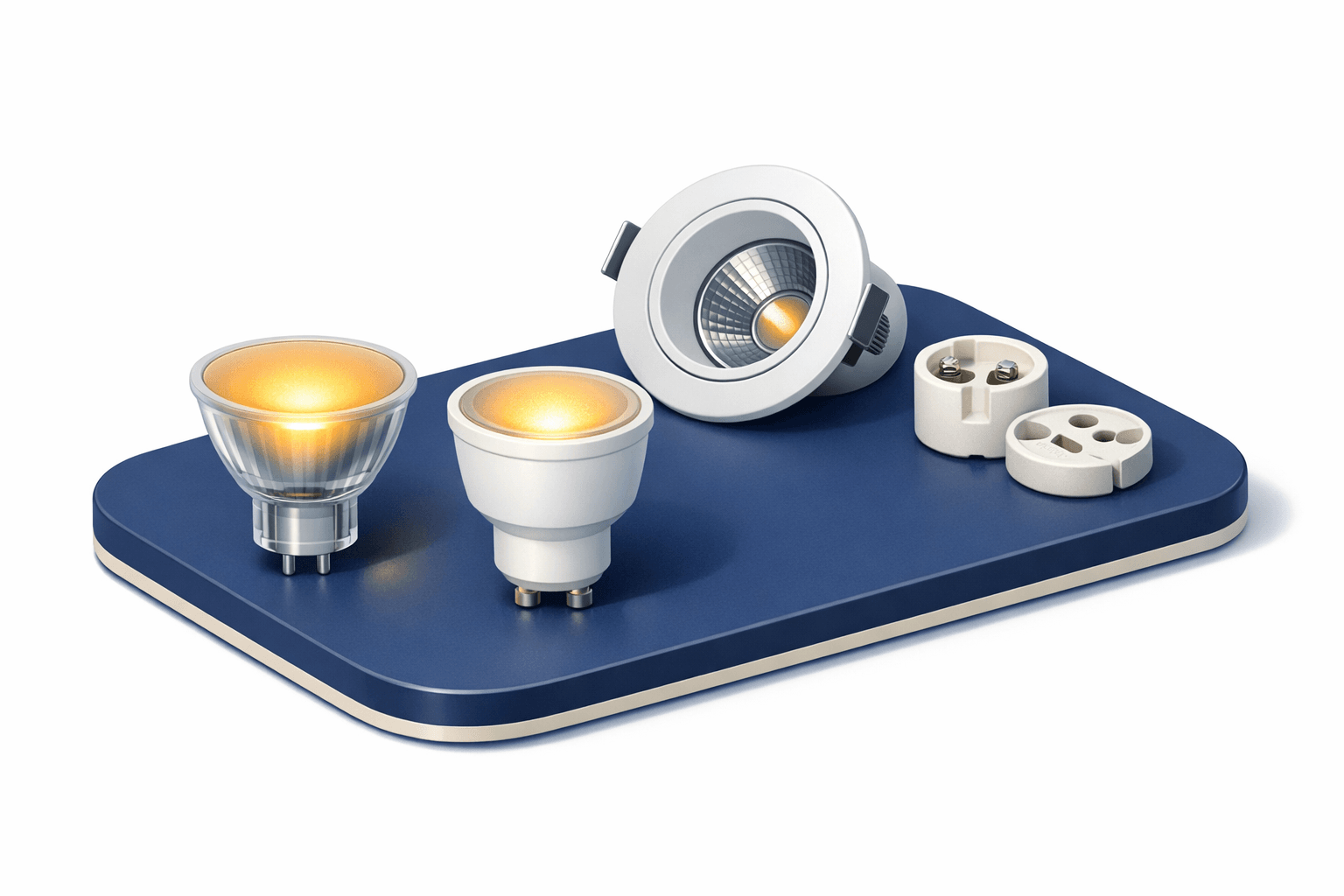
Key Takeaways
GU5.3 and GU10 bulbs have different pin types — GU5.3 is push-fit and runs on 12 V through a transformer, while GU10 is twist-and-lock and runs directly on mains voltage. They are not interchangeable, and GU10 is the simpler choice for new installs.
Recessed spotlights fill most modern kitchens and bathrooms, and the two bulbs you'll see on the shelf are GU5.3 and GU10. They look almost identical — so which one belongs in your fitting?
In this article I'll cover:
- What GU actually stands for
- The main differences between GU5.3 and GU10
- Whether MR16 and GU5.3 bulbs are the same
- Dimmer, transformer and IP-rating considerations
What Is The GU Bulb Type?
Every bulb base is identified by a letter-and-number code. You've probably seen E14 on a small screw-fit lamp, or — if you're in the UK — B22 on a bayonet bulb.
These codes follow the IEC 60061 standard and describe the style of the bulb base and the pin or thread spacing in millimetres.
G indicates a pin-type base — the letter is a historical holdover from "glass," the original bulb material. GU specifies a base that locks into its fitting, typically via a twist-lock or retaining clip, and the number after the letters is the pin-to-pin spacing in millimetres. The popular claim that "U" stands for "universal" is common in consumer guides, but it isn't part of the IEC 60061 standard.
You may also see bases labelled GX5.3, GX53 or GX24. GU5.3 and GX5.3 happen to share the same pin diameter and spacing and are generally cross-compatible, but other GX variants have different pin configurations and won't fit a GU holder — always match the exact base code.
Plenty of bulb types use a two-pin G-family base — including G4 and G9 capsule lamps, G13 T8 fluorescent tubes and GU24 bases common in North America — but for recessed spotlights the two dominant options are GU5.3 and GU10.
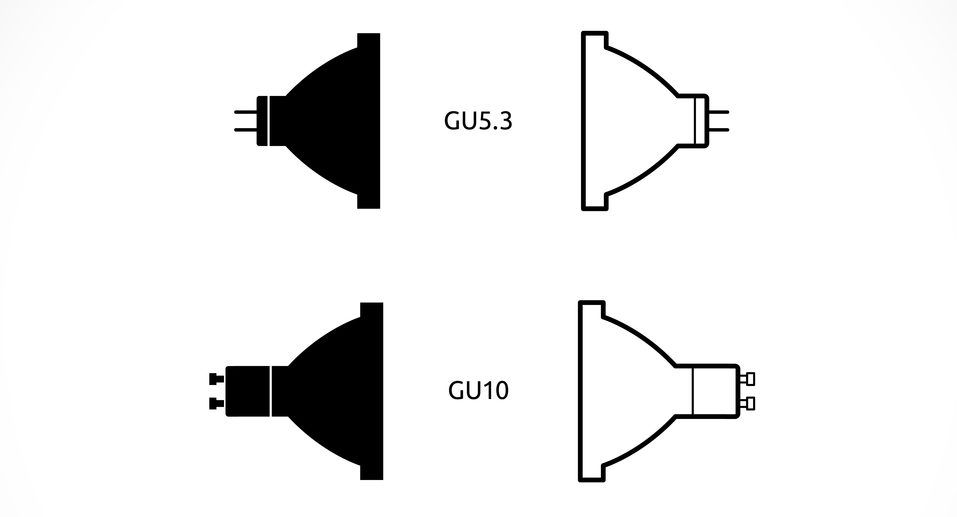
From the front, GU5.3 and GU10 look nearly identical: both are around 50 mm across with a multifaceted reflector. The pins on the back are where they differ.
What Are The Main Differences Between GU5.3 and GU10?
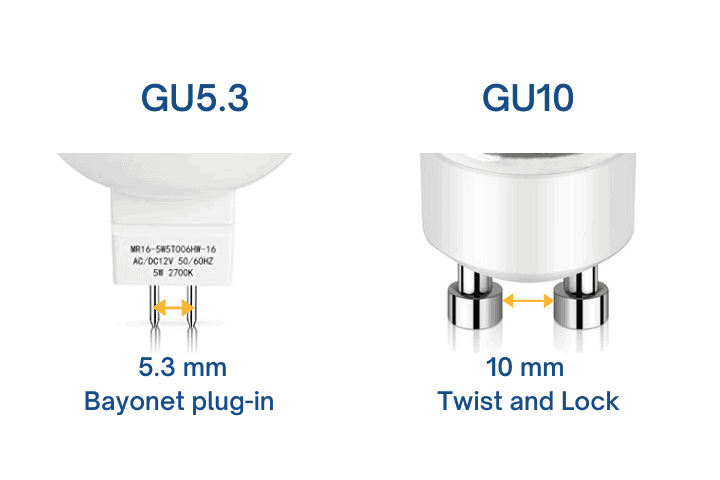
The most obvious difference is the pins. GU5.3 uses two slim push-fit pins 5.3 mm apart — you push the bulb straight into the fitting. GU10 uses two thicker pins 10 mm apart, each ending in a small disc that twists and locks into the socket so the bulb can't fall out of a ceiling recess.
Here's how they compare across the specs that actually affect which one you should buy:
| Feature | GU5.3 (MR16) | GU10 |
|---|---|---|
| Pin type | Push-fit | Twist & lock |
| Pin spacing | 5.3 mm | 10 mm |
| Voltage | 12 V DC | 230–240 V AC (UK/EU), 120 V (US) |
| Transformer required | Yes | No |
| Bulb diameter | 50 mm | 50 mm |
| Typical depth | 45–50 mm | 50–58 mm |
| Dimmer type | Depends on transformer | Trailing-edge (LED-rated) |
| IP-rated options | Available | Available |
| Smart-bulb ecosystem | Limited | Broad |
Bulb Depth and Retrofit Fit
Some older GU10 smart LEDs were noticeably longer than non-smart versions. The original Philips Hue GU10, for example, was 72 mm deep — long enough to hang below a standard downlight recess. Philips redesigned it in 2019 down to 58 mm, which matches a typical non-smart GU10, so current-generation Hue GU10s drop into existing fittings without modification.
Voltage and Power Draw
GU5.3 bulbs run on 12 V DC. GU10 bulbs run directly on mains voltage — 240 V in the UK, nominally 230 V across most of Europe, and 120 V in North America. Bulbs are manufactured for specific voltages, so buy a GU10 rated for your local mains; they are not cross-regional.
A lower voltage doesn't automatically mean less power. Power (watts) equals voltage multiplied by current, so a 12 V GU5.3 drawing higher current can consume the same wattage as a 240 V GU10. And because the transformer also uses power, a GU5.3 setup can actually draw slightly more at the wall than an equivalent GU10.
Transformers: Magnetic vs Electronic
Every GU5.3 fitting needs a transformer to step mains down to 12 V. There are two kinds, and the distinction matters when swapping halogen for LED:
- Magnetic (wirewound) transformers are the older type, typically paired with halogen GU5.3. Many have a high minimum load and will cause LED bulbs to flicker, buzz or refuse to start because an LED draws far less current than the halogen it replaced.
- Electronic transformers are smaller, lighter and have a much lower minimum load. Look for one explicitly labelled "LED-compatible" and check the rated range (e.g. 1–60 W) covers the total LED load on that circuit.
If you're retrofitting halogen GU5.3 downlights with LED and they flicker or won't start, the transformer is the first thing to replace. GU10 avoids the problem entirely — no transformer in the circuit.
Dimmer Compatibility
LED spotlights are dimmable, but only with the right dimmer and bulb combination:
- GU10 LEDs need a trailing-edge (sometimes called "LED-rated") dimmer. Older leading-edge dimmers designed for incandescent and halogen loads often buzz, flicker or fail to reach a full dim range on LED.
- GU5.3 LEDs depend on the transformer. Dim the 230 V side of an electronic transformer with a trailing-edge dimmer rated for that specific transformer, and confirm on both the bulb and transformer datasheets that the combination is validated — otherwise flicker is almost guaranteed.
Always check the bulb packaging — many budget LED spotlights are explicitly non-dimmable.
IP Ratings for Bathrooms and Kitchens
Both GU5.3 and GU10 fittings come in IP-rated versions for bathrooms. The Ingress Protection rating has two digits; the second is water resistance. UK bathroom zones set the minimums:
- Zone 0 (inside the bath or shower): IP67, and 12 V SELV only — so GU5.3.
- Zone 1 (directly above the bath, up to 2.25 m): IP45 minimum, IP65 in practice.
- Zone 2 (0.6 m horizontally from zone 1): IP44 minimum.
- Outside the zones: no specific IP required; IP20 is typical.
GU5.3 at 12 V has an edge in zone 0 because the low voltage is inherently safer, but the IP rating of the fitting is the real safety boundary — not the bulb voltage alone.
Installation
⚠️ Safety first: Mains wiring should be carried out by a qualified electrician. In the UK, any new lighting circuit and virtually any electrical work in a bathroom — or a new circuit in a kitchen — is notifiable under Part P of the Building Regulations, and must be done by a registered competent person or signed off by Building Control.
GU10 fittings wire into a standard lighting circuit at mains voltage with no transformer. GU5.3 fittings additionally need a transformer wired on the mains side, usually clipped above the ceiling or integrated into the luminaire.
Are They Interchangeable?
No. The holders are physically different — GU5.3 is push-fit into 5.3 mm-spaced sockets; GU10 twists into 10 mm-spaced sockets with locking discs — and even if you forced a swap, the voltage mismatch would end badly. A 12 V GU5.3 bulb on a mains circuit fails instantly; a mains GU10 on a 12 V transformer simply won't light.
It's the same as asking whether an E14 and an E27 bulb are interchangeable just because they're both Edison screw — they aren't, because the screw thread diameters (14 mm and 27 mm) are different.
When you replace a bulb, read the exact code on the old one — don't just look for "GU" and hope for the best.
Related: What Is The Difference Between BR30 and PAR30?
Are MR16 and GU5.3 the Same Thing?
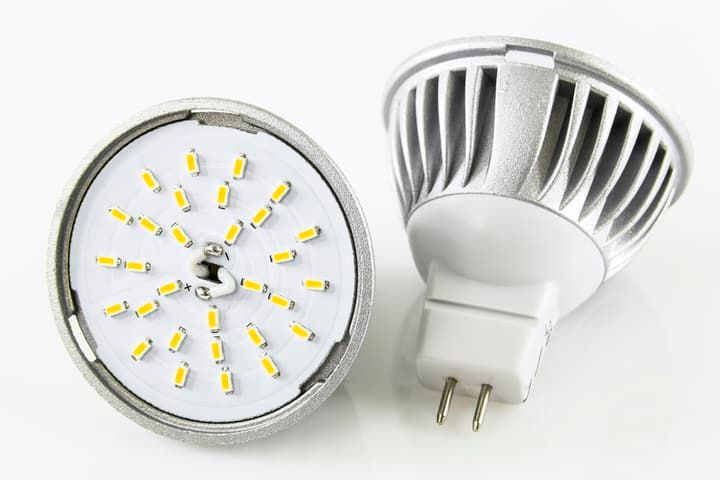
Shopping for spotlights, you'll also see bulbs labelled MR16. Is that a third option?
Not really — though the relationship is more nuanced than most guides admit. MR16 is a shape designation, not a base type. MR stands for Multifaceted Reflector, and the number gives the reflector diameter in eighths of an inch: MR16 is 16⁄8″ (2 inches, about 50 mm), MR11 is around 35 mm, and MR8 is 1 inch. Without the faceted reflector, a spotlight would spread into more of a floodlight.
MR16 lamps are made with two different bases:
- MR16 with a 12 V GU5.3 push-fit base — the classic low-voltage halogen spotlight and its LED successors.
- MR16 with a mains-voltage GU10 twist-lock base — sold openly by Philips, GE and Osram, often listed explicitly as "MR16 GU10."
Colloquially, "MR16" is often used as shorthand for the 12 V GU5.3 version, but that's a convention, not a rule. If a listing says "MR16," always confirm the base code before buying.
Also read: Are B11 and E12 Bulbs Interchangeable?
Smart Bulb Compatibility
If you want colour-changing or voice-controlled spotlights, GU10 has a far broader smart ecosystem. Philips Hue, WiZ, LIFX, IKEA Tradfri, Innr and most other smart-lighting brands all make GU10 bulbs in white and full-colour variants.
GU5.3 smart options exist but are comparatively rare — largely because the 12 V transformer in the circuit complicates the radio and dimming behaviour. If a smart spotlight is a priority on a new install, choose GU10.
Which Should You Choose?
For most new installs in the UK and Europe, GU10 is the simpler and more flexible choice. A quick decision guide:
- New installation: choose GU10 — no transformer, cheaper wiring, wider bulb selection.
- Retrofit where transformers already exist: stick with GU5.3, and swap old magnetic transformers for LED-compatible electronic ones if you get flicker.
- Shower zone 0: GU5.3 at 12 V is the practical pick for the IP67 SELV fittings required there.
- Smart home: GU10, by a wide margin.
- Budget: GU10 bulbs and fittings are generally cheaper because there's no transformer in the bill of materials.
Final Words
GU5.3 and GU10 look similar but are electrically and mechanically distinct — don't mix them. Before buying a replacement, read the exact code printed on the old bulb or stamped on the holder. For new installs, GU10 is simpler, cheaper and has a far better smart-lighting selection; GU5.3 remains the right answer for 12 V wet-zone fittings and for retrofits where the transformers are already in place.
If you're planning new circuits, two pieces of homework pay off before you buy bulbs: make sure the dimmer is trailing-edge and confirm your fitting type, and — for GU5.3 — size the transformer to the total LED wattage on the circuit with headroom to spare.
FAQ
Can I use a GU5.3 bulb in a GU10 fitting?
No. The pin spacing, pin shape and voltage are all different. GU5.3 has 5.3 mm push-fit pins and runs on 12 V; GU10 has 10 mm twist-lock pins and runs on mains. A GU5.3 bulb plugged into a mains GU10 circuit would fail instantly.
Does GU10 need a transformer?
No. GU10 runs directly on mains voltage — 240 V in the UK, nominally 230 V in most of Europe, and 120 V in North America. Only GU5.3 needs a transformer to step mains down to 12 V.
Why do my GU5.3 LEDs flicker?
Almost always the transformer. Older magnetic transformers sized for halogens have a high minimum load that LED bulbs can't meet. Replace it with an LED-compatible electronic transformer sized to your total LED wattage.
Is MR16 the same as GU5.3?
Not quite. MR16 is a shape — a multifaceted reflector about 50 mm across. MR16 lamps are made with both GU5.3 (12 V) and GU10 (mains) bases. Colloquially "MR16" often means the GU5.3 version, but the base code is what you need to match when buying.
What IP rating do I need in a bathroom?
Under UK zoning: IP67 and 12 V SELV in zone 0 (inside the bath or shower), IP65 in zone 1 (directly above the bath up to 2.25 m), and IP44 in zone 2. Outside the zones, standard IP20 is acceptable.
Are GU10 LEDs dimmable?
Only if both the bulb and the dimmer are compatible. GU10 LEDs need a trailing-edge dimmer; a leading-edge dimmer designed for incandescent or halogen loads will often buzz or flicker. Check the bulb packaging for "dimmable" — many budget GU10 LEDs are not.