What Is An E26 Bulb?
A19 and E26 aren't two names for the same thing — one describes the bulb's shape, the other its base, measured in completely different units on the same bulb.
 Eugen
EugenEugen Nikolajev
Creator of LED Lighting Info
Hi, I am Eugen. I was always one of those kids who had all sorts of weird lighting gadgets for every occasion.
Now, I want to share my knowledge and experience about lighting with you on LED Lighting Info.
Read my editorial standards
Key Takeaways
E26 refers to the bulb's base, how it connects to the light fitting. It's an Edison base, also known as a screw-type bulb, measuring 26mm in diameter. It fits any screw socket of the same diameter.
E26 is one of the most common light bulb codes you'll see on packaging in the US — but what does it actually tell you?
In this article I'll cover:
- What "E26" actually tells you about a bulb
- E26 vs E27: can you actually swap them safely?
- Why an A19 bulb isn't the same as an E26
What Does E26 Mean?
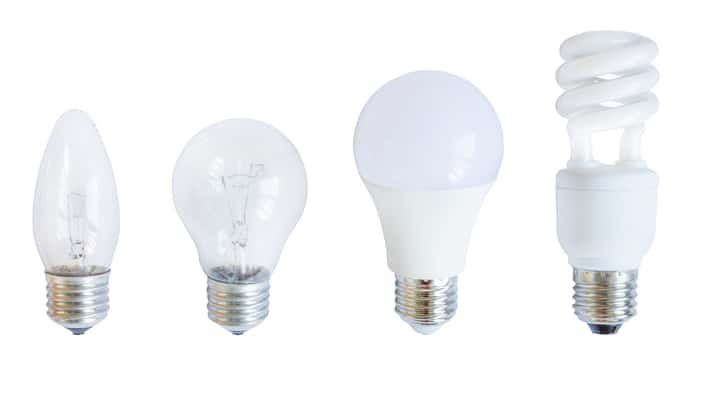
The base is the section at the bottom of a bulb that holds it in the fixture and connects it to the circuit. Different fixtures use different base types, so you need to buy whichever base matches your socket.
Every base code is made up of one or two letters followed by a number:
E (base type — Edison screw) + 26 (thread diameter in mm) → E26
One important thing to know up front: E26 is a base standard, not a bulb technology. The same E26 socket accepts incandescent, halogen, CFL, and LED bulbs interchangeably. An LED E26 is a direct drop-in replacement for an old incandescent E26 in the same fixture. The code also says nothing about wattage, brightness (lumens), or color temperature — those are separate specs printed elsewhere on the box.
What the letter means
The letter refers to the type of base. The "E" in E26 stands for Edison — a base threaded to work in a screw fitting. It's named after Thomas Edison, who in 1879 developed the first commercially practical incandescent bulb along with the screw socket that still bears his name. (Earlier inventors including Humphry Davy and Joseph Swan had demonstrated working incandescent lamps before him — Edison's breakthrough was making one durable and mass-producible.)
Other base-type letters you'll see include bayonet bulbs (designated "B" for single-contact types like B22, or "BA" for double-contact types like BA15d) and pin-base bulbs (G, GU, or GX, depending on the pin type).
What the number means
The number is a measurement in millimeters that describes the width of the connector. What's actually being measured depends on the base type — with a screw-type Edison bulb, it's the outside diameter of the threaded base (so an E26 base is 26 mm across). With pin-type bulbs, the number is the distance between the pins, not the width of the whole base.
Once you know that, it's easy to work out the base of your light bulb. If you're trying to measure one without proper tools: a US quarter is about 24.3 mm across, so an E26 base will be just slightly wider than a quarter. Calipers across the threads give you a precise reading; a ruler held against the base gets you close enough — anything in the 26 mm range is an E26.
Other Edison base sizes
E26 is by far the most common Edison base in North America, but it isn't the only one. You'll also see:
- E12 — the small candelabra base used in chandeliers, night lights, and decorative fixtures
- E17 — an intermediate size, common in appliance bulbs and some pendant fixtures
- E39 — the mogul base used in high-wattage commercial bulbs and street lamps
E26 vs E27: What Is The Difference?
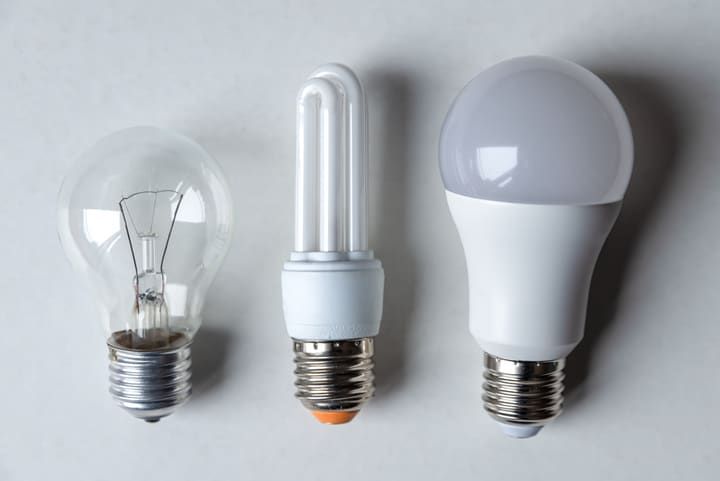
Despite the name suggesting a 1 mm size difference, E26 and E27 thread diameters are actually defined to overlap — both fall between roughly 26.05 mm and 26.45 mm — so the two are mechanically interchangeable. The real differences are in screw length, insulator height, and the voltage the bulbs are rated for.
Both cap types are defined in IEC 60061-1 ("Lamp caps and holders together with gauges for the control of interchangeability and safety"). Within that standard, the E26 cap is specified on sheet 7004-21A-2, and the E27 cap on sheet 7004-21.
| Feature | E26 | E27 |
|---|---|---|
| Primary region | North America | Europe |
| Typical voltage rating | 120V (some commercial: 120–277V) | 220–240V |
| Thread diameter | ~26.05–26.45 mm | ~26.05–26.45 mm |
| Minimum screw length | ≥19.56 mm | ≥22 mm |
| Insulator cap height | ~3.25 mm | ~5 mm |
| IEC 60061-1 sheet | 7004-21A-2 | 7004-21 |
| Mechanical fit | Interchangeable with E27 | Interchangeable with E26 |
Strictly speaking, the E26/E27 designation describes only the mechanical base. The actual voltage rating depends on the bulb's internal driver or filament, not the cap itself. But the E27 standard does mandate a taller insulator and a longer screw than E26 — specifically to provide safer separation between live and neutral contacts at higher voltages. That's also why E27 bulbs tend to look slightly longer in the base.
In practice, this means E26 bulbs sold in North America are typically rated for 120V (or 120–277V for many commercial LEDs), while E27 bulbs sold in Europe are typically rated for 220–240V. Always check the printed voltage rating on the bulb itself before swapping one in.
Because the threads fit, you can physically screw an E26 into an E27 socket or vice versa — but you need to be careful about voltage:
- 240V E27 bulb → 120V E26 socket: usually fine. The bulb is underpowered and runs dim or doesn't light at all, but it can't draw more current than its rated design allows, so it isn't a fire hazard.
- 120V E26 bulb → 240V E27 socket: dangerous. The bulb is hit with twice its rated voltage, which can cause instant burnout, shattering, or an electrical fire.
The asymmetry isn't logical sleight of hand — it's basic electrical physics. Under-volting a bulb just makes it dim; over-volting it overdrives the filament or driver.
Related: Do I Need 2700K Or 3000K Bulb?
What Is The Difference Between A19 And E26 Light Bulbs?
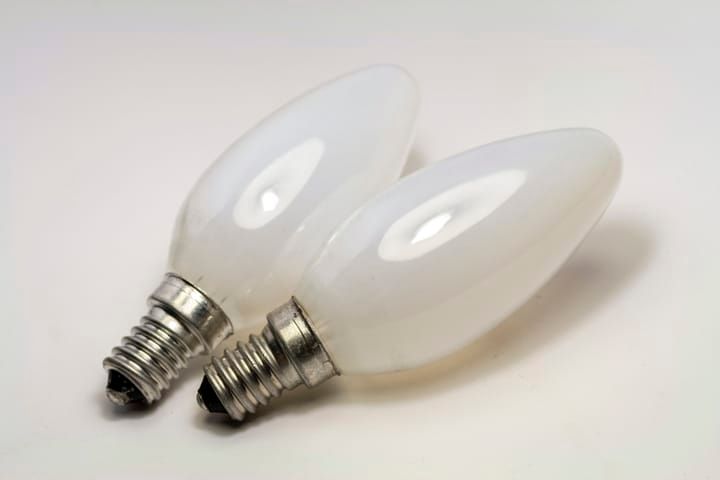
When I listed base-type letters earlier (E, B/BA, G/GU), I deliberately left out "A". That's because A19 describes the bulb's overall shape and size, not its base. There is no base type designated "A" — the letter refers to the main body of the bulb, the glass envelope or resin housing around the light source.
The "A" is widely said to stand for "arbitrary" — meaning the default, classic rounded bulb shape most people picture when they think of a light bulb. That etymology is industry shorthand rather than something formally defined in the ANSI C78.20 standard that specifies the shape itself.
The "19" refers to how many eighths of an inch wide the bulb is at its widest point — so an A19 bulb is 19/8 inches (about 2 3/8 inches, or roughly 60 mm) wide. Yes, that means bulb bases are measured in metric millimeters while bulb casings are measured in eighths of an inch — two different units for two different things on the same bulb.
Almost all A19 bulbs sold in the US have an E26 base, although the reverse isn't true — plenty of other bulb shapes and sizes also use the E26 base.
Also read: What Are Diffused LED Bulbs?
E26 at a Glance
- E26 describes only the bulb's screw base — a 26 mm Edison thread. It says nothing about wattage, brightness, color temperature, or whether the bulb is LED, incandescent, or CFL.
- E26 is the North American standard; E27 is the European equivalent. The two are mechanically interchangeable, but E27 bulbs are typically rated for 220–240V and E26 for 120V — so always check the printed voltage before swapping one in.
- A19 and E26 describe different things. A19 is the bulb's shape and size; E26 is its base. Most A19 bulbs sold in the US happen to have an E26 base, but the two specs aren't interchangeable terms.