Can LED Lights Cause Fire?
Wood can start breaking down at just 77°C — well within the range of a recessed LED fixture with nowhere to vent heat. The bulb isn't usually the problem; the installation is.
 Eugen
EugenEugen Nikolajev
Creator of LED Lighting Info
Hi, I am Eugen. I was always one of those kids who had all sorts of weird lighting gadgets for every occasion.
Now, I want to share my knowledge and experience about lighting with you on LED Lighting Info.
Read my editorial standards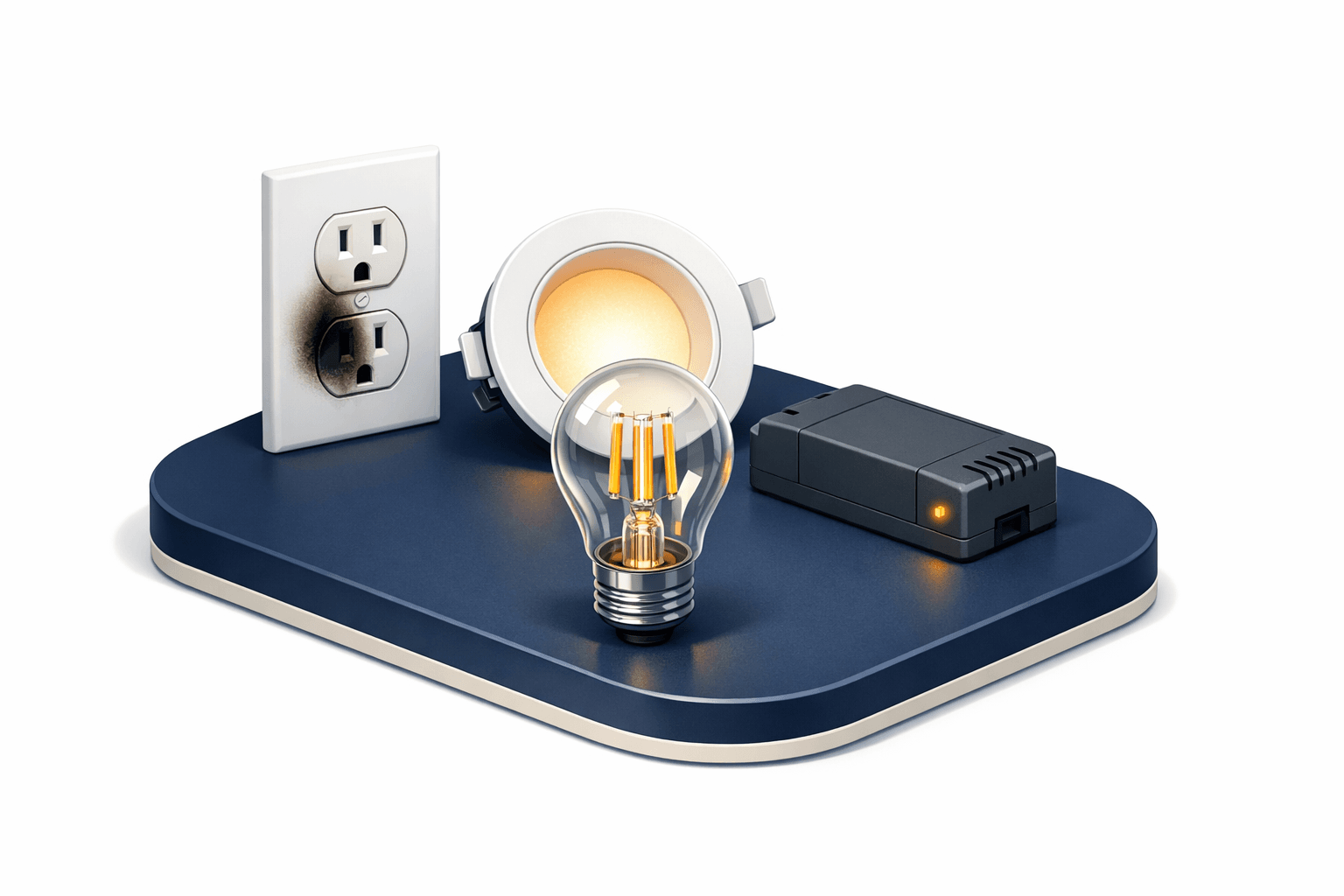
Key Takeaways
LED lights don’t get hot enough to start a contact fire, though they do get hot to the touch. Most LED-linked fires trace back to faulty wiring, overloaded fixtures, or wattage mismatches — not the bulbs themselves. Older incandescent and halogen bulbs run hot enough to ignite materials on their own.
Did you know that electrical problems are one of the most common causes of house fires?
According to NFPA data covering 2015–2019, US fire departments respond to about 32,620 home fires per year involving electrical distribution and lighting equipment — causing 430 deaths and $1.3 billion in property damage.
Wiring and related equipment account for 68% of these fires, with arcing serving as the heat source in nearly three-quarters of them. Lamps, fixtures, and bulbs themselves are a smaller share
I’ve always looked at light bulbs as self-contained — if something goes wrong, they pop and the room goes dark. Could modern LEDs really be contributing to those fire figures?
Do LED Lights Get Hot Enough To Start A Fire?
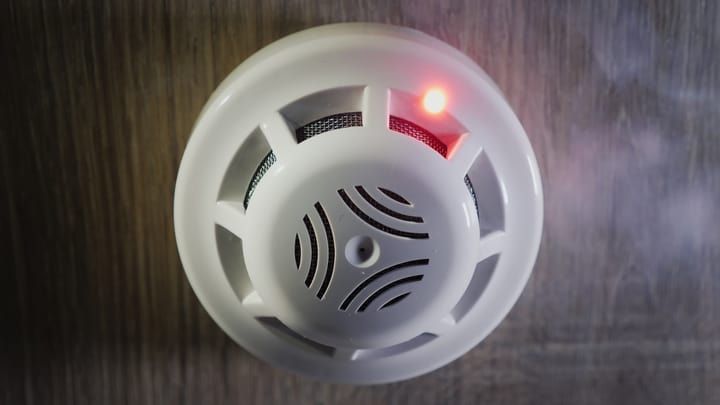
When used correctly, LED bulbs typically run at around 30–60°C (86–140°F) at the housing for low-wattage residential models. They can get hotter at the base, where the driver sits — typically up to about 80–85°C (176–185°F). That’s still well below the temperature needed to start a contact fire with most household materials.
Wood is generally cited as autoigniting at around 250–300°C, but prolonged exposure to much lower temperatures — as low as ~77°C (170°F) over time — can cause it to gradually decompose and eventually ignite. This process, called low-temperature ignition, is why heat buildup inside enclosed or recessed fixtures matters even at modest temperatures.
Fiberglass itself is non-combustible — the glass fibers don’t burn and only melt around 540°C (1,000°F). However, faced fiberglass batts have a kraft paper or foil backing that is flammable, which is why building codes require it to be covered. A fixture in direct contact with exposed kraft facing is the realistic risk in attic or recessed installations.
By comparison, traditional incandescent bulbs reach surface temperatures of around 90–260°C depending on wattage. Halogen bulbs run dramatically hotter — tubular halogens can reach 500–650°C (970–1,200°F). The U.S. Consumer Product Safety Commission has linked tubular halogens to torchiere-lamp fires, which is why modern halogen fixtures are required to have protective grilles.
LED Lights Fire Hazards
Of the four hazards below, faulty wiring is by far the most consequential — arcing accounts for 73% of fires involving electrical distribution and lighting equipment, according to NFPA's latest data
The most common ways an LED setup can turn into a fire risk:
| Hazard | What to do |
|---|---|
| Poor heatsink or blocked airflow letting heat build up around the driver | Choose quality LED bulbs, install them with no obstructions, and only use enclosed-rated bulbs in glass or sealed fixtures. |
| Faulty wiring causing electrical arcing | Listen for buzzing or watch for flickering. If you spot signs of trouble, switch off power at the breaker and inspect the fixture wiring — or call an electrician. |
| Wattage mismatch between bulb and fixture | Check the maximum wattage printed on the fixture label and stay under it. Smaller fixtures like chandeliers often have stricter limits. |
How to spot a quality LED bulb
Most LED fire risks come down to build quality. Look for one of three certification marks on the packaging: UL Listed (or UL Recognized), ETL Listed, or Energy Star. UL and ETL marks confirm the bulb has been tested for electrical and fire safety by an independent lab. Energy Star adds performance and lifetime testing on top. If a bulb has none of these labels, leave it on the shelf — unbranded imports are the most common source of failed drivers and overheated bases.
Recessed downlights and IC ratings
Recessed (can) lights installed in insulated ceilings are one of the most commonly cited LED fire risks. Older non-IC fixtures need a minimum clearance from insulation; if insulation is packed against them, the heat has nowhere to go. Look for an IC-rated (Insulation Contact) fixture, which is built to be safely covered with insulation. If you’re replacing a halogen downlight with an LED retrofit, double-check that both the housing and the new lamp are rated for direct insulation contact.
Dimmer compatibility
Pairing a non-dimmable LED with a dimmer switch — or using the wrong type of dimmer (leading-edge versus trailing-edge) — can overload the driver, cause buzzing, and lead to premature failure. Use only LED bulbs explicitly labelled “dimmable,” and pair them with an LED-compatible dimmer. Many manufacturers publish compatibility lists for their dimmers; checking that list before you buy avoids most problems.
Can Leaving An LED Light On At Night Cause A Fire?
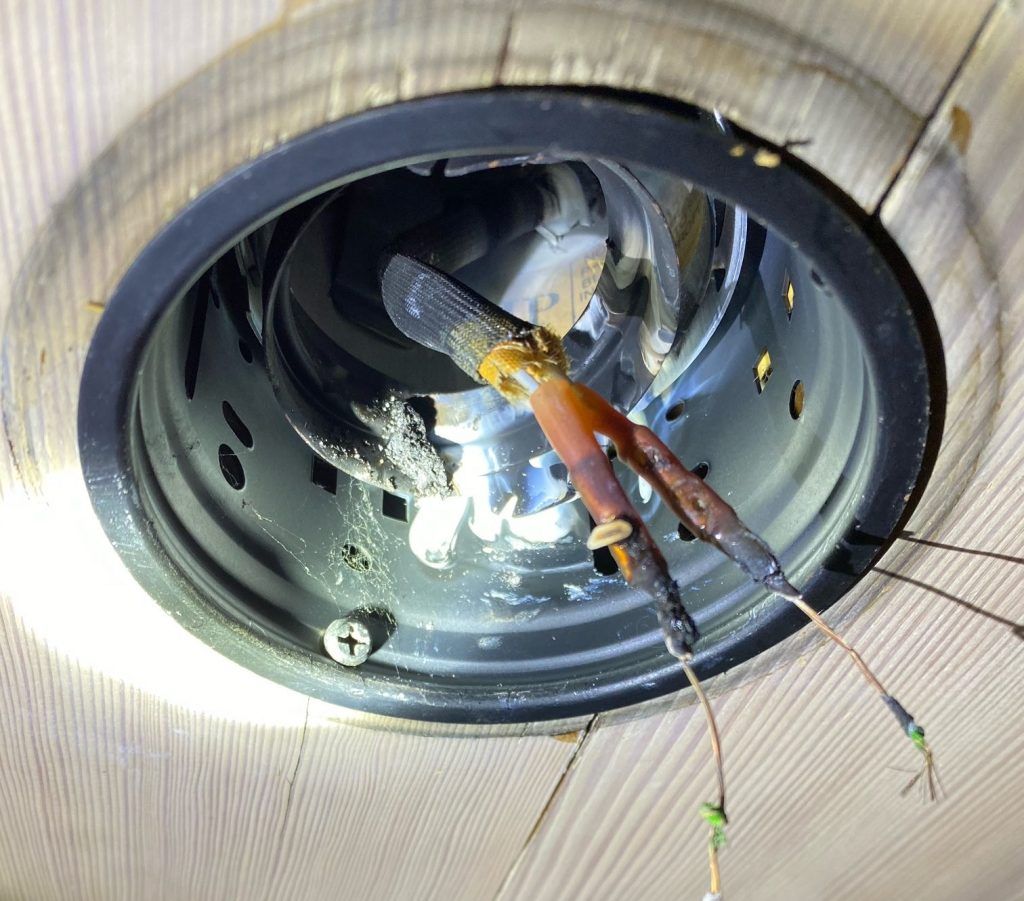
An LED light left on overnight should not cause a fire. Installed correctly, in a fixture with secure wiring, it won't reach a temperature that ignites household materials.
(NFPA data shows that while only 23% of electrical fires occur overnight, those fires cause over half of all fatalities — likely because people are home and asleep when fires start. The risk isn't the LED itself; it's the household members not being awake to detect a wiring fault.)
That said, leaving any bulb on continuously shortens its lifespan. To extend the life of your LEDs (and trim your power bill), use timers or motion sensors for lights you don’t need running constantly. Motion sensors are especially useful for outdoor lights, and a smart timer can save money on your utility bills by keeping indoor lights off when nobody needs them.
For cost and lifespan, leaving lights on for more than around 12 hours at a stretch is wasteful. From a pure fire-safety standpoint, however, LEDs are the safest common household bulb to leave on for 24 hours at a time — they produce far less heat and contain no filament or mercury. CFLs can also run for long stretches but come with their own restrictions around recessed and dimmable fixtures. The 12-hour guideline is about efficiency, not safety.
Are LED Strips a Fire Hazard?
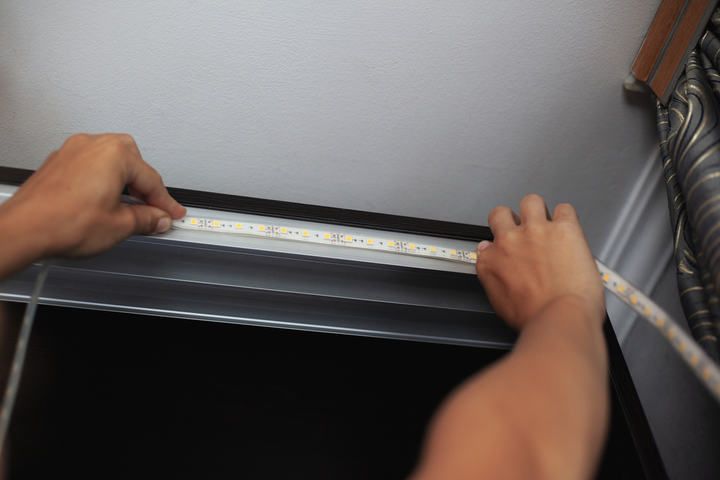
LED strip lights carry a slightly higher fire risk than bulbs, mostly because they often lack a built-in heatsink and rely on a separate power supply. Installed correctly with the right power supply, however, they shouldn’t be a hazard.
Strips themselves don’t run much hotter than an LED bulb. The chips are smaller, but there are many more of them, so the total heat output evens out.
Placement is the real issue. Strips are often tucked into recesses or under furniture for an indirect glow, which can hinder airflow and trap heat against the back of the strip. Without a way for that heat to dissipate, it builds up to levels that can damage the adhesive and, in extreme cases, scorch nearby surfaces.
Power supply overload is the other common problem. Chaining multiple strips onto a single transformer can easily exceed the supply’s rated wattage. Choose a power supply with at least 20% more capacity than the combined wattage of your strips — so if your strips draw 50W in total, use a 60W (or larger) supply.
FAQ
Can LED Lights Catch Fabric On Fire?
LED lights will only ignite fabric if there’s a fault with the wiring or the heatsink. Most fabrics autoignite between roughly 300°C and 500°C, well above the operating temperature of a working LED. (Fabrics can catch fire at lower temperatures if exposed to a flame or spark, so the practical risk is electrical arcing in faulty wiring, not the bulb’s surface heat.)
Are Smart Bulbs A Fire Hazard?
Smart bulbs are no more of a fire hazard than ordinary LED bulbs and don’t run any hotter. If anything, the ability to switch them off remotely makes them slightly safer — there’s no excuse to leave a fixture on when you’re out of the house or already in bed.
Can A Burned Out LED Bulb Cause A Fire?
In the typical failure mode, no. When an LED reaches end of life, the driver fails open and the circuit breaks, so no current flows. The exception is a short-circuit failure inside the driver, which can cause arcing and overheating — rare in quality bulbs, more common in unbranded imports. Either way, remove a blown bulb from the socket and replace it with a working one.
Can Turning Lights On And Off Cause A Fire?
Switching LEDs on and off has a negligible effect on degradation compared to traditional bulbs and won’t cause a fire. Inrush current does stress the driver slightly each time, but the effect is far smaller than the thermal cycling that wore out incandescent filaments. With older bulbs, frequent switching was a real problem because the filament repeatedly heated and cooled.
Can LED String Lights Catch Fire?
String LED lights — including festive and decorative ones — can catch fire if they’re used with the wrong power supply. Some are designed for mains voltage (typically 120V in the US and Canada, or 220–240V in the UK, EU, and most of the rest of the world); these are called line voltage string lights. Others are low voltage (12V or 24V) and need an external transformer.
Power cord failures are also more common with string lights, especially if pets chew the cables — broken insulation can cause arcing and a much higher fire risk.
Key Takeaways
- LEDs are the coolest-running common bulb type and rarely cause fires on their own.
- Most LED-linked fires trace back to faulty wiring, blocked airflow, wattage mismatches, or cheap unbranded products — not the LEDs themselves.
- Buy bulbs that carry UL, ETL, or Energy Star marks, use IC-rated fixtures for insulated ceilings, and pair dimmable LEDs with LED-compatible dimmers.
- For LED strips, leave at least 20% headroom on the power supply and avoid trapping the strip against fabric, foam, or other heat-sensitive surfaces.
Following these steps keeps your setup well clear of the NFPA fire statistics cited at the start. For a related risk, see my guide on why LED bulbs sometimes fail with a pop or flash — and how to prevent it.
DISCLAIMER: While this article aims to be accurate, it is for general information only. You should not rely on the material as the basis for any decision. The author is not liable for any damage caused by lighting.