
How To Check Color Temperature Of LED Light?
That three-digit code on your bulb — say, 827 or 955 — quietly tells you both the color temperature and color accuracy in one number, and most people walk right past it.
 Eugen
EugenEugen Nikolajev
Creator of LED Lighting Info
Hi, I am Eugen. I was always one of those kids who had all sorts of weird lighting gadgets for every occasion.
Now, I want to share my knowledge and experience about lighting with you on LED Lighting Info.
Read my editorial standards
Key Takeaways
You can determine the color temperature of an LED bulb by reading the Correlated Color Temperature (CCT) rating:
- You'll see the temperature in Kelvins, typically between 2700K and 6500K for residential bulbs (specialty bulbs can go higher).
- It may also be presented as a 3-digit number, likely beginning 7, 8, or 9, incorporating the Color Rendering Index.
- You may find it printed on the bulb; otherwise, check the packaging or the online product description for the bulb model.
Choosing the wrong color temperature is the most common reason LED lighting feels "off" — and the fix is usually a quick check of a number printed on the bulb or its packaging.
In this guide, I'll cover:
- How to measure the color temperature of your LED bulbs
- Whether there is a correlation between color temperature and brightness (lumens)
- Common mistakes to avoid when picking bulbs for different rooms
How To Measure Color Temperature?

Measuring the Kelvin rating of an LED light yourself is impractical without a specialist meter. The easier path is to check whether the rating is printed on the bulb or its packaging.
Most light bulbs list their color temperature on the bulb or packaging — in the U.S., the FTC requires it on the "Lighting Facts" label for general-service bulbs. Off-brand bulbs from online marketplaces sometimes omit this information, so check the product listing carefully before buying. If you've thrown the packaging out, search the bulb model number online and the spec sheet should turn up the rating.
The lower the Kelvin number, the more yellow-orange the shade of white; higher numbers give a bluer, cooler light. This is called the Correlated Color Temperature rating, and it's a standardized way to describe how cool or warm a bulb's light appears.
Understanding the Warm-to-Cool Color Spectrum
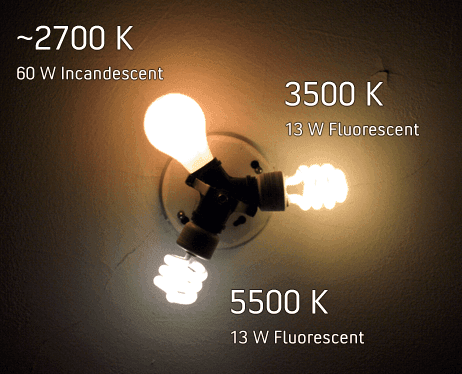
Bulbs labeled "warm white" sit around 2700K–3000K — the yellowish, incandescent-like glow most people associate with cozy living rooms. Above 3000K, the light shifts toward neutral. The chart below summarizes how each range typically appears and where it works best:
| CCT Range | Color Appearance | Common Use Case |
|---|---|---|
| 2200K–2700K | Warm amber/yellow | Bedrooms, restaurants |
| 2700K–3000K | Warm white | Living rooms, hospitality |
| 3000K–3500K | Soft white | Bathrooms, accent lighting |
| 3500K–4500K | Neutral white | Kitchens, offices |
| 4500K–5500K | Cool white / daylight | Garages, workshops |
| 5500K–6500K | Cool daylight / blue | Task lighting, displays |
A few common points of confusion: 5000K is generally classified as "daylight," not "pure white" — it has a crisp, slightly blue cast similar to midday sun. The phrase "pure white" most often refers to bulbs in the neutral 3500K–4500K range. And true candle- or fire-like reds and oranges sit well below 2000K, so don't expect a 3500K bulb to read as orange.
Color Rendering Index Scale
There is a second scale that affects how a bulb's light looks, called the Color Rendering Index (CRI). CRI measures how accurately a light source renders colors compared to a natural reference (such as sunlight or a perfect blackbody radiator).
CRI is reported on a 0–100 index — not a percentage. An 800-series bulb has a CRI of around 80, and a 900-series bulb has a CRI of 90 or higher. The closer to 100, the more faithfully the bulb renders colors. Below ~80, colors start to look noticeably washed out or shifted.
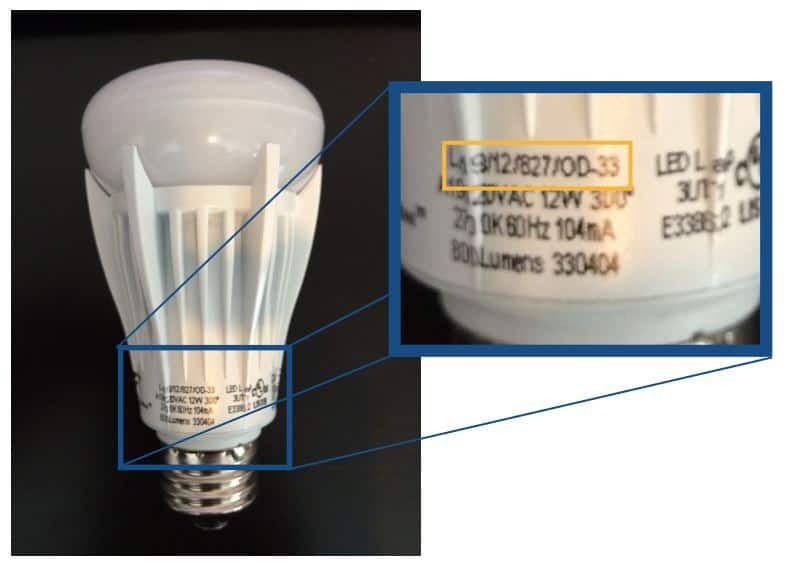
The reason this matters when reading a bulb's specs is that some manufacturers combine CRI and CCT into a single 3-digit code on the packaging. The first digit is the CRI tier (typically 7, 8, or 9 on modern bulbs); the last two digits are the color temperature in hundreds of Kelvin.
Code: 8 27
      │  └── CCT: 2700K (warm white)
      └────── CRI: 80+ (good quality)
So a 727 bulb is a CRI 70+ bulb at 2700K — adequate but not great color accuracy in a warm-white tone. A 955 bulb is CRI 90+ at 5500K — excellent color accuracy in a crisp white close to natural midday sunlight.
When CRI 90+ Actually Matters
For most general lighting — hallways, garages, utility areas — a standard 80+ CRI bulb is fine. Pay extra for 90+ CRI in rooms where seeing true colors matters:
- Kitchens — to judge meat doneness, fresh produce, and ingredients accurately
- Bathrooms and vanities — for makeup, skin tone, and grooming
- Closets and dressing areas — to match clothing colors before leaving the house
- Art studios, retail displays, and photography setups
Do Apps To Measure Light Temperature Work?
Smartphone apps can roughly estimate the brightness of a room using the camera or ambient light sensor, but they aren't reliable for measuring color temperature. Phone camera sensors are tuned for photography, not colorimetry, and the results vary wildly between devices.
If you need real numbers, a dedicated color temperature meter (some pair with a smartphone app) is the only practical way to verify a bulb's CCT yourself. For everyday use, the printed rating on the bulb or packaging is more than enough.
Color Temperature vs Lumens: Is There Correlation?

Color temperature and lumens are completely independent. Lumens measure brightness; CCT measures the visual hue of the light. You can buy a dim warm-white bulb, a dim cool-white bulb, a bright warm-white bulb, or a bright cool-white bulb — every combination exists.
Both numbers matter, and they have to be chosen together for a room to feel right. Two quick examples:
- Kitchen: aim for cool white (around 4000K) at high lumens (800–1100 per bulb in a multi-bulb fixture). Cool light keeps you alert; high lumens let you safely chop, cook, and read recipes.
- Bedroom: aim for warm white (2700K–3000K) at low lumens (around 400–600). Warm light cues the brain to wind down, and lower brightness keeps the room from feeling like a workspace at night.
Get the CCT wrong and the room feels off — a cool-white bedroom will keep you awake; a dim warm kitchen makes prep work harder than it needs to be.
Common Mistakes to Avoid
Mixing different color temperatures in the same room
Putting a 2700K bulb next to a 4000K bulb in the same fixture or room is the fastest way to make a space look unintentional. The eye notices the contrast immediately — one source reads yellow, the other reads almost greenish-blue by comparison. Pick a single CCT for each room (or each functional zone) and stick with it. If you're replacing a single burnt-out bulb, match the existing CCT — don't grab whatever's on sale.
Ignoring how wall color interacts with CCT
Cool-toned grays, blues, and crisp whites tend to look harsh under warm 2700K bulbs — the wall color and the light disagree. Warm beiges, creams, and wood tones can look muddy or sallow under cool 5000K+ bulbs. As a rule of thumb, pair warm-painted rooms with warm bulbs (2700K–3000K) and cool-painted rooms with neutral-to-cool bulbs (3500K–4500K). Test one bulb before committing to a whole fixture.
Smart Bulbs and Tunable White
If picking a single CCT feels too restrictive — or you want different lighting for different times of day — tunable-white smart bulbs solve the problem in software. Most major brands (Philips Hue, LIFX, Wiz, Govee, and others) offer bulbs that span roughly 2200K to 6500K, controlled from a phone app or a voice assistant.
Common ways tunable white gets used in practice:
- Cool, bright light in the morning to wake up; warm, dim light in the evening to wind down
- A single fixture that doubles as task lighting (4000K, full brightness) and ambient lighting (2700K, dimmed) depending on the activity
- Automated schedules that mimic natural daylight progression — useful in rooms that don't get much sun
The trade-off is cost: tunable smart bulbs run several times the price of a fixed-CCT bulb. They're worth it for living rooms, bedrooms, and home offices where lighting needs change throughout the day. For closets, garages, and utility spaces, a plain fixed-CCT bulb is fine.
Quick Reference: Choosing the Right CCT by Room
If you only remember one thing from this guide, make it this: warm light to relax, cool light to focus, and don't mix the two in a single space. Here's a room-by-room shortcut:
| Room | Recommended CCT | Why |
|---|---|---|
| Bedroom | 2700K | Warm, sleep-friendly tone |
| Living room | 2700K–3000K | Cozy, hospitality feel |
| Bathroom / vanity | 3000K–4000K (90+ CRI) | Accurate skin tone for grooming |
| Kitchen | 3500K–4000K | Alert, neutral light for prep work |
| Home office | 4000K | Focused, fatigue-resistant |
| Garage / workshop | 5000K | Crisp daylight for detail tasks |
FAQ
Is 5000K a 'pure white' or a 'daylight' bulb?
Industry convention treats 5000K as daylight, not pure white. It has a crisp, slightly blue cast similar to midday sunlight. "Pure" or neutral white usually refers to the 3500K–4500K range.
What does the 3-digit code on a bulb (like 827 or 965) mean?
The first digit is the CRI tier (8 means CRI 80+, 9 means CRI 90+) and the last two digits are the color temperature in hundreds of Kelvin. So 827 = CRI 80+ at 2700K (warm white). 965 = CRI 90+ at 6500K (cool daylight).
Can I use a phone app to measure color temperature?
Not reliably. Phone cameras are tuned for photography, not color measurement, and results vary widely between devices. Use the rating printed on the bulb or packaging, or buy a dedicated color temperature meter if you need precise numbers.
Is it okay to mix bulbs of different color temperatures in one room?
Generally no — the contrast between, say, a 2700K and a 4000K bulb is obvious to the eye and makes a space look unintentional. Pick one CCT per room or functional zone and match any replacement bulbs to the existing ones.
Does a higher CRI always mean a better bulb?
It means more accurate color rendering, which matters in kitchens, bathrooms, dressing rooms, and any space where seeing true colors counts. For hallways, garages, and general lighting, a standard 80+ CRI bulb is perfectly adequate.