
Do LED Bulbs Have Gas In Them?
Unlike incandescents or CFLs, LED bulbs contain zero gas — light comes entirely from electrons crossing a semiconductor junction, a process called electroluminescence.
 Eugen
EugenEugen Nikolajev
Creator of LED Lighting Info
Hi, I am Eugen. I was always one of those kids who had all sorts of weird lighting gadgets for every occasion.
Now, I want to share my knowledge and experience about lighting with you on LED Lighting Info.
Read my editorial standards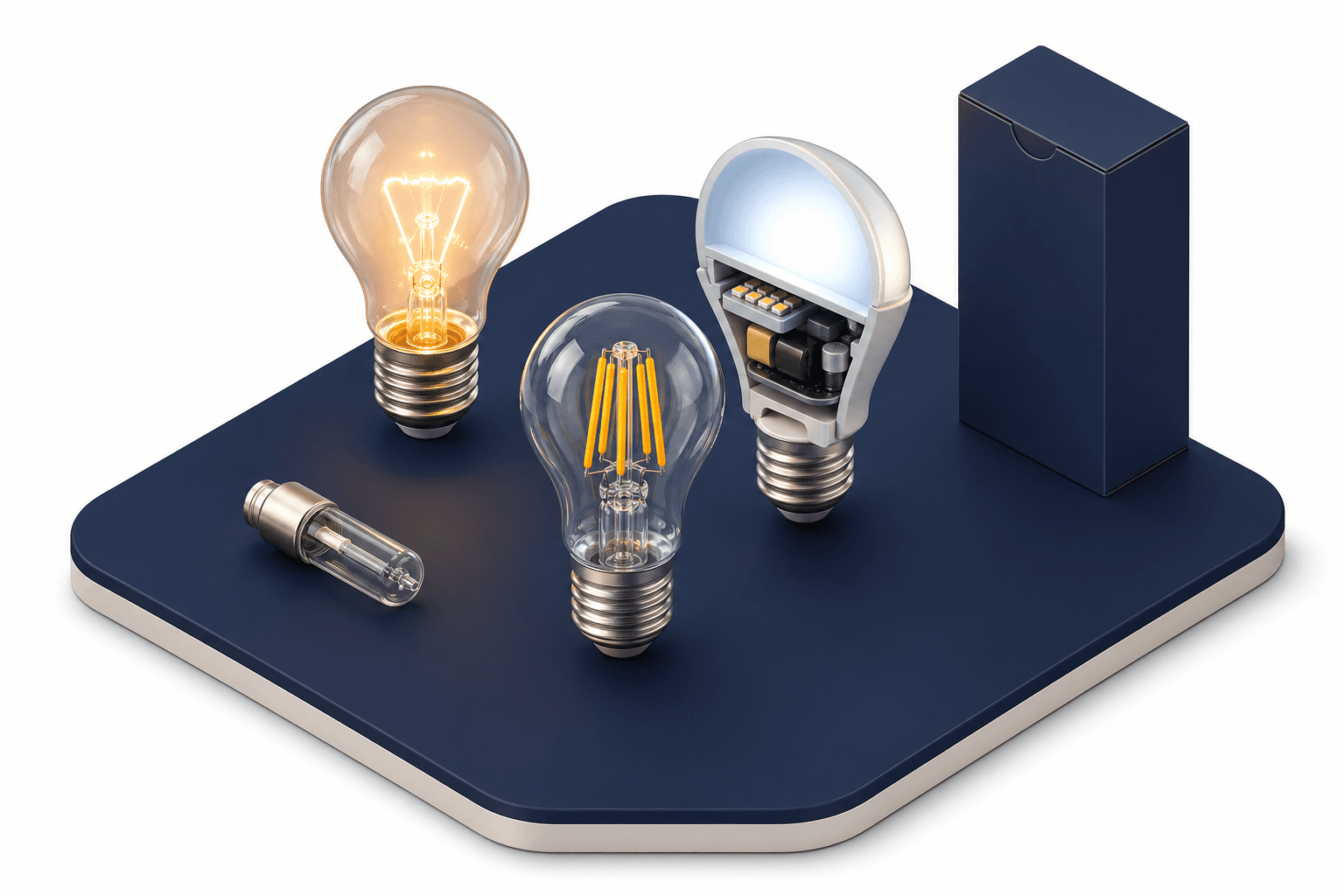
Key Takeaways
No — unlike incandescent, halogen, and fluorescent bulbs, LED bulbs contain no gas. Here's why that matters for safety, disposal, and choosing the right bulb for your home.
Is There a Gas In LED Bulbs?

While most traditional bulbs are filled with gas to function or extend their lifespan, LED bulbs contain none. Functionally, an LED works electronically rather than thermally or chemically. A small driver circuit at the base of the bulb converts mains AC into the low-voltage DC current the semiconductor diode needs to operate.
Here's how an LED actually produces light:
- Electricity flows into the semiconductor diode at the heart of the bulb.
- Electrons cross the p-n junction and release energy as they change state.
- That released energy is emitted as photons — a property called electroluminescence.
- In most white LEDs, those photons hit a phosphor coating over a blue diode that converts the light into a broader white spectrum.
No gas is involved at any stage. That said, a broken electronic should still be handled with care. LED bulbs contain small amounts of metals such as lead, nickel, copper and arsenic. Under U.S. federal standards most LEDs do not classify as hazardous waste, but under stricter state rules — notably California's — many LEDs do exceed hazardous-waste thresholds. Always check your local disposal regulations before throwing LEDs in the regular trash.
On the bright side, LED bulbs continue to work even if the glass or plastic dome covering the diode is broken or removed. Useful, if a little unsightly.
What Types of Bulbs Are Filled With Gas?
Incandescent bulbs were once the most commonly used. They produce light by passing electricity through a tungsten filament inside a glass body until the filament glows white-hot.
In higher-wattage incandescent bulbs the most common gas fill is a mixture of argon and nitrogen — roughly 93% argon and 7% nitrogen. Low-wattage bulbs (typically under about 25 W, including many nightlights and small indicator bulbs) are usually evacuated instead, since at low filament temperatures gas conduction would waste more heat than the gas saves by suppressing tungsten evaporation. Premium bulbs sometimes use krypton or xenon for slightly better efficiency.
The gas slows the evaporation of tungsten from the hot filament, extending the bulb's life. Argon, helium, neon, krypton and xenon are all noble gases — they don't react with the heated tungsten. Nitrogen isn't a noble gas, but it's added because it has a higher breakdown voltage than argon and helps prevent arcing between parts of the filament.
Halogen
Halogen bulbs are upgraded incandescents. They contain the same noble-gas fill plus a small amount of a halogen — typically a bromine or iodine compound — that vaporizes when the bulb is hot.
The halogen cycle works in the bulb's favor: as tungsten evaporates from the filament, it reacts with the halogen vapor and is redeposited back onto the filament. That means the bulb lasts longer and stays brighter over its lifetime than a standard incandescent.
Halogen bulbs also run at a higher filament temperature than standard incandescents — roughly 2,900–3,200 K versus 2,700 K — which gives a whiter light and a modest efficiency gain, typically 10–30% more lumens per watt. The bigger advantage of the halogen cycle, though, is filament longevity, not raw brightness.
The trade-off is heat. Halogen filaments run hot enough that ordinary glass would soften, so the envelope is made of quartz. A switched-on halogen bulb is dangerously hot to the touch — and a fire hazard if it contacts flammable material like curtains, pillows or duvets.
In 2019, a tragic incident in the UK saw a child's halogen lamp knocked over, igniting the lampshade. Keep halogen bulbs well clear of fabric, and consider switching to LEDs in any room where curtains, bedding or soft furnishings are nearby.
Which Gas Is Used In Fluorescent Tube Lights?
Fluorescent tube lights (FTLs) are long, straight tubes that cast very little shadow — which is why offices, hospitals and warehouses use them widely. The CFL, or compact fluorescent lamp, is the spiral-shaped sibling that uses an electric ballast.
Both fluorescent tubes and CFLs are filled with a small amount of inert gas — typically argon, sometimes krypton — together with a tiny dose of mercury (a few milligrams, present as liquid or as a solid amalgam pellet in modern CFLs). When the lamp is switched on, some of the mercury vaporizes and the discharge through the gas excites the mercury atoms to emit ultraviolet light. The inside of the glass is coated with a phosphor that converts that UV into the visible light you see.
Uncoated tubes are used to produce ultraviolet "black" lights.
Each fill gas has a characteristic discharge color. In an uncoated tube you'd see roughly:
- Helium — Pinkish-orange
- Neon — Red-orange
- Argon — Violet (or blue-violet)
- Krypton — Whitish / pale lavender
- Xenon — Blue-lavender
Contact with the mercury vapor inside a broken fluorescent bulb is extremely harmful, even though the quantity is small. CFLs and fluorescent tubes must be disposed of as hazardous waste.
Mercury is a toxic heavy metal that can cause severe damage to the brain, nervous system, kidneys, lungs and other vital organs. Pregnant women, infants and young children are especially at risk.
Thankfully, mercury-laden fluorescents are steadily disappearing from the market, replaced by LED bulbs that are safer, non-toxic and far more energy-efficient.
How the Four Bulb Types Compare
| Bulb Type | Gas Used | Key Safety Risk | Disposal | Avg. Lifespan |
|---|---|---|---|---|
| Incandescent | Argon + nitrogen (vacuum in low-wattage bulbs) | Heat, glass shards | Regular trash | ~1,000 hours |
| Halogen | Noble gas + halogen compound (bromine or iodine) | Very hot surface, fire risk near fabric | Regular trash | ~2,000–4,000 hours |
| CFL / Fluorescent | Argon (sometimes krypton) + mercury vapor | Mercury exposure if broken | Hazardous waste; recycle at retailer or municipal facility | ~8,000–10,000 hours |
| LED | None — semiconductor diode | Trace metals (lead, nickel, arsenic) | Varies by state; many places treat as hazardous waste | ~15,000–25,000 hours |
How to Dispose of Each Bulb Type Safely
- Incandescent and halogen bulbs can usually go in the regular trash — there's no toxic gas or mercury inside. Wrap broken glass in paper before binning to protect waste handlers.
- CFLs and fluorescent tubes must never go in the trash. Take them to a hardware store, big-box retailer (most accept them free) or your municipal hazardous-waste facility. If a CFL breaks indoors, follow the EPA's cleanup guidance — air out the room, scoop fragments onto stiff paper, and seal everything in a glass jar.
- LED bulbs vary by jurisdiction. Federal rules generally allow regular-trash disposal, but many states — California in particular — treat them as hazardous waste due to trace metals. Check your local rules; many recyclers and big-box stores will accept LEDs.
Final Words
The lighting industry has moved a long way from gas-filled bulbs. Incandescents waste energy as heat, halogens run dangerously hot, and CFLs leak toxic mercury when they break. LEDs sidestep all three problems: no gas, no filament, no mercury — just a semiconductor diode and a small driver circuit, often lasting 15,000 hours or more.
In my experience, the simplest move is to retrofit any remaining halogens or CFLs with LEDs as they fail. You'll cut your energy bill, lower your fire risk, and quietly remove a small but real source of mercury from your home.