
Do LED Bulbs Have Polarity?
A 9V battery connected backward can permanently kill a common indicator LED — its reverse breakdown threshold is often just 5V. That quiet failure is why polarity checks matter before any LED hits a circuit.
 Eugen
EugenEugen Nikolajev
Creator of LED Lighting Info
Hi, I am Eugen. I was always one of those kids who had all sorts of weird lighting gadgets for every occasion.
Now, I want to share my knowledge and experience about lighting with you on LED Lighting Info.
Read my editorial standards
Key Takeaways
Most LEDs have polarity. They have a positive and a negative connection, and they need to be wired into your circuit in the correct direction or they won't light. The big exception is standard household LED bulbs that run on AC mains, which contain an internal driver and don't require you to manage polarity at all.
If you're using LEDs, you might be unsure of which way to wire them up. Does it matter which way the LED is connected, the way it does when you install a battery?
There's a lot of conflicting information out there about LEDs and polarity. In this article, I'll cover:
- When polarity matters and when it doesn't
- How to identify the positive and negative legs of an LED
- What happens if you don't wire an LED correctly
What About Household LED Bulbs?
If you're asking about a standard screw-in (E26/E27), GU10, or bayonet LED bulb that runs on mains AC, you don't need to worry about polarity. These bulbs contain an internal driver with a bridge rectifier that converts AC to the DC the LED chip needs, so they work no matter which way they're installed.
Edison sockets do follow a polarity convention — the center contact is hot and the threaded shell is neutral — but that's a wiring safety convention, not a functional requirement for the bulb to light.
Polarity does matter in a few other cases:
- Bare through-hole LEDs (the two-legged components used in DIY electronics)
- LED strips, which run on DC and won't light if connected backward
- Low-voltage DC bulbs in RV, marine, and automotive applications that lack a built-in bridge rectifier
- Some MR16 LED bulbs running on DC transformers
The rest of this article covers polarity in those cases — primarily individual through-hole LEDs.
Why LEDs Have Polarity
A diode is an electrical component that allows current to flow in one direction only. An LED — short for Light Emitting Diode — is no exception. It only emits light when current flows from anode to cathode.
The two legs of an LED are the anode (positive) and the cathode (negative). For the LED to light, the anode must connect to the positive side of the supply and the cathode to the negative side.
LEDs are also DC components. Mains-powered fixtures only work because a driver circuit converts AC to DC before the chip ever sees current. If you're wiring an LED directly to a supply, that supply needs to be DC.
How To Identify The Positive And Negative Leg Of An LED
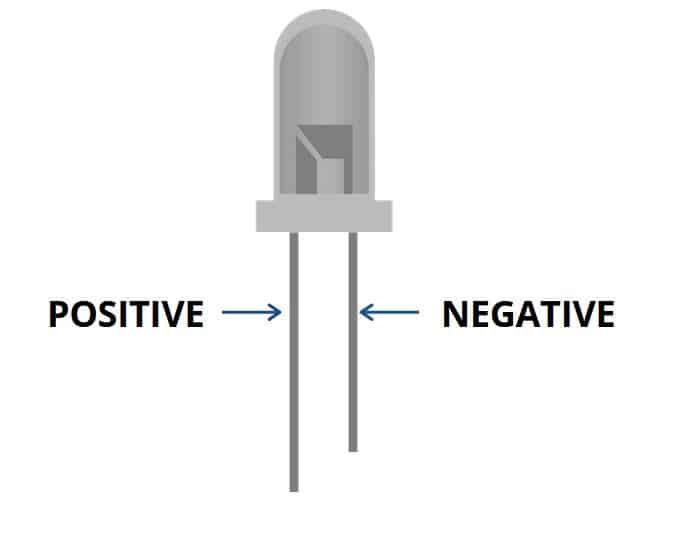
Several methods work — start with the easiest and fall back to the others if the LED has been modified or trimmed.
- Check leg length — On a fresh LED, the longer leg is the anode (+) and the shorter leg is the cathode (−).
- Look for the flat edge — The LED's epoxy housing has one flat side. The flat edge sits closest to the cathode (−); the rounded side is closest to the anode (+).
- Inspect the internal plates — Look into the dome. The larger metal element (the cup or anvil that holds the LED die) is the cathode; the thinner post connected by a bond wire is the anode.
- Test with a coin cell — Pinch the LED legs against the two faces of a CR2032 coin cell. If it lights, the leg on the (+) face is the anode; if not, flip it. A coin cell's high internal resistance keeps current low enough that the risk of damaging the LED is very low — though not zero, especially with high-brightness or low-forward-voltage types.
- Use a multimeter — Set the meter to diode mode and touch the red (positive) probe to one leg and the black (negative) probe to the other. The LED lights only when the red probe is on the anode.
What Happens If You Wire An LED Backwards?
If you wire an LED into a circuit backward, the diode blocks current and the LED simply doesn't light. In a standard 3–5V hobby circuit with a current-limiting resistor, briefly reversing an LED is unlikely to cause damage.
Higher voltages are a real risk, though. Common 3mm and 5mm indicator LEDs typically have a manufacturer-rated reverse breakdown voltage of only about 5V. Connect a 9V battery the wrong way around and you can exceed that rating and permanently damage the part. Anything more than a few volts in reverse should be treated as potentially destructive.
Reverse-bias damage isn't always visible. The LED may simply fail to light when reconnected the right way. Occasionally you'll see physical signs — a darkened die, a burned spot, or a cracked package — but a quietly killed LED is more common.
Reverse-Polarity Protection
If reversed wiring is a real possibility — for example, in a project a beginner might assemble — you can protect the LED with a regular silicon diode such as a 1N4148 or 1N4007. Place the protection diode in parallel with the LED, oriented in the opposite direction (the protection diode's anode to the LED's cathode, and vice versa).
When the supply is connected correctly, the protection diode is reverse-biased and does nothing. When the supply is reversed, the protection diode conducts and clamps the reverse voltage across the LED to about 0.7V — well below the LED's breakdown rating.
This is sometimes loosely called a "reverse diode," but it's distinct from a flyback diode (also known as a freewheeling, snubber, or catch diode), which protects circuits from voltage spikes when an inductor's current is interrupted. Same component, different job.
Final Words
Polarity matters for individual LEDs, LED strips, and low-voltage DC bulbs, but not for standard mains-powered household bulbs — those handle it internally. When you do need to identify polarity, the leg length and flat edge are the quickest checks; a coin cell or multimeter covers the cases where those clues have been lost.
Take a moment to confirm polarity before wiring up an LED. It's a quick check that can save you from chasing a circuit fault that's really just a flipped component.