
How To Remove A G9 Light Bulb Stuck In Socket
Halogen G9s don't just burn out — they weld themselves in. Repeated heating cycles oxidize the pins until the base is effectively fused to the socket.
 Eugen
EugenEugen Nikolajev
Creator of LED Lighting Info
Hi, I am Eugen. I was always one of those kids who had all sorts of weird lighting gadgets for every occasion.
Now, I want to share my knowledge and experience about lighting with you on LED Lighting Info.
Read my editorial standards
Key Takeaways
The fastest way to remove a stuck G9 bulb is to pull it straight out with steady force, adding a gentle rocking motion if it resists. If the bulb is welded in or broken, shut off the breaker, cover the fixture with a bag, snap off the remaining glass, and pull the base out with needle-nose pliers.
Stuck G9 bulb? You're not alone — these tiny push-fit capsules are notorious for gripping their sockets, especially after years of running hot. This guide covers four removal methods (from a simple finger-pull to safely extracting a welded-in base), plus what to check before buying the LED replacement.
What Is A G9 Bulb?
"G9" describes the base: two looped wire pins spaced 9 mm apart that push straight into the socket. You'll find G9 bulbs in chandeliers, decorative wall sconces, bathroom vanity fixtures, under-cabinet puck lights, and accent lamps — and sometimes inside appliances like microwaves and range hoods. Before shopping for a replacement, confirm your bulb has this two-pin base with 9 mm spacing. G4 (4 mm) and GY6.35 (6.35 mm) bases look similar but are not interchangeable.
Why G9 Bulbs Get Stuck
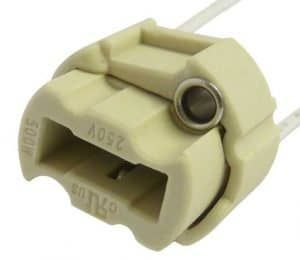
G9 bulbs are small and fiddly. A typical halogen capsule is only about 4–4.5 cm long and 1.2–1.4 cm wide; LED replacements are usually a bit longer, often 5–6 cm, because they need room for a driver and heat sink (compact "ceramic base" models exist but vary by manufacturer). That leaves very little to grip — especially in the recessed fixtures G9s are most often used in.
Two things make them resist removal. First, the pins are held by spring-tensioned contacts, so older bulbs can feel cemented in place. Second, halogen G9s run hot — repeated heating cycles can oxidize the pins and contacts, effectively welding the base in place when the bulb finally burns out.
⚠️ Safety First: Switch off the circuit at the breaker — not just the wall switch — and confirm the fixture is de-energized with a non-contact voltage tester. Let a halogen G9 cool for at least 15 minutes before touching it — they reach well over 300°C in use and can cause burns. Wear cut-resistant gloves if the bulb is broken or you plan to break it. Never spray WD-40 or other flammable aerosols inside an electrical fixture.
How To Remove A Stuck G9 Bulb
Work through these methods in order. Start with the least invasive and only escalate if the bulb refuses to come out.
Method 1: Pull Straight Out With Your Fingers
G9 bulbs are push-fit — there is no twist and no click. With the breaker off and the bulb cool, grip the glass capsule firmly and pull straight out along the axis of the pins (usually downward, though some fixtures are horizontal or upward-facing). Most bulbs come out with steady, even force.
Method 2: Rock And Wiggle While Pulling
If a straight pull won't shift it, the pins may be slightly bent or the contacts oxidized. Apply steady pressure along the pin axis and rock the bulb in small side-to-side motions as you pull. Avoid twisting hard — G9 pins bend easily, and a broken pin left in the socket is a bigger problem than a stuck bulb.
Method 3: White Vinegar For A Lightly Corroded Base
With the breaker confirmed off, dab (do not spray) a small amount of white vinegar onto the base where the pins enter the socket, using a cotton swab. Wait a few minutes for the acid to break down light oxidation, then retry Method 2. Wipe away any excess with a dry cloth before restoring power. If you see visible corrosion inside the socket itself, stop and have an electrician inspect the fixture — vinegar inside a damaged socket is an electrical hazard.
Method 4: Broken Or Welded Bulb — Bag And Pliers
If the bulb has fused to the socket or the glass has already shattered, this is the last resort. You will need:
- Cut-resistant gloves
- Safety glasses
- A thick plastic bag or old towel
- Needle-nose pliers
- Double-check the breaker is off and test the socket with a non-contact voltage tester.
- Cover the fixture with a plastic bag to contain flying glass.
- Tap the glass envelope firmly through the bag to break it away from the base.
- Carefully remove the bag, vacuum any loose fragments, then grip the exposed metal base with needle-nose pliers and pull straight out along the pin axis.
- Inspect the socket before installing a new bulb. If the contacts are blackened, melted, or bent, replace the fixture rather than the bulb.
Do not use WD-40 or other flammable aerosol lubricants inside a light fixture. WD-40 is petroleum-based with a propane/butane propellant; its own safety data sheet warns against use near heat or ignition sources, and its residue leaves an oily film that attracts dust and compromises electrical contacts. If a lubricant is genuinely needed on a cold, de-energized socket, use a dielectric silicone grease rated for electrical use.
Replacing Your G9 Bulb With An LED
Why Switch To LED
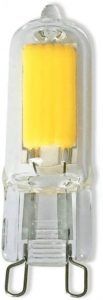
Halogen G9 capsules are rated for around 2,000 hours (some premium versions reach 3,000), while G9 LEDs typically last 15,000–25,000 hours — roughly 10× longer. LEDs also draw 80–90% less energy for the same light output and run far cooler, which reduces the oxidation that welds halogens into their sockets in the first place.
Unlike halogen bulbs, LEDs are not damaged by skin oils, so you can handle them without gloves.
Choosing The Right Brightness
Brightness is measured in lumens, not watts. To match the halogen you're replacing, look at the lumen output on the packaging — the LED wattage will be much lower for the same light.
| Halogen G9 wattage | Approximate lumens | Equivalent LED wattage |
|---|---|---|
| 25 W | 200–240 lm | 2.5–3 W |
| 40 W | ~400 lm | 3.5–4.5 W |
| 60 W | ~700 lm | 5–6 W |
| 75 W | ~1,300 lm | 7–9 W |
Check Fixture Compatibility
- Size — LED G9s typically run 5–6 cm long, slightly taller than halogen capsules. Measure the clearance inside the glass cover before buying, or look for a compact ceramic-base model.
- Dimmer compatibility — not every G9 LED is dimmable, and even dimmable models can flicker on older triac dimmers designed for halogen loads. Check both the bulb packaging and the manufacturer's dimmer compatibility list.
- Minimum load — some halogen-era dimmers and low-voltage transformers need a minimum wattage to operate correctly. If a single LED causes flickering or buzzing, the driver isn't necessarily faulty — the fixture may need a different bulb or a modern LED-rated dimmer.
- Maximum wattage — the fixture's printed max refers to halogen wattage. A 2.5 W LED will never exceed a 40 W rating, so this is almost never a constraint.
Replacement Steps
- Switch off the circuit at the breaker and let the fixture cool for at least 15 minutes.
- Remove the glass cover — either unscrew its retaining ring or release the spring clip that holds it in place.
- Remove the old bulb using one of the methods above.
- Align the two looped pins of the new LED with the socket holes. Orientation is not polarized — if it won't seat, rotate 180° and try again.
- Push straight in until the base is fully seated. The fit is friction-based — there is no click or snap, and forcing past resistance will bend the pins.
- Refit the glass cover, restore power at the breaker, and test.
FAQ
Can I use WD-40 to free a stuck G9 bulb?
No. WD-40 is petroleum-based with a flammable propellant, and its own safety data sheet warns against use near heat or ignition sources. It also leaves an oily residue that compromises electrical contacts. For a cold, de-energized socket, use a dielectric silicone grease rated for electrical contacts instead — but in most cases a firm straight pull (or the bag-and-pliers method for broken bulbs) is safer and more effective.
Do G9 bulbs click or snap into place?
No. G9 bulbs are push-fit and held by spring tension inside the socket. The pins slide straight in until the base is fully seated — there is no detent, click, or snap. If you feel resistance, stop and check alignment rather than forcing it; the pins bend easily.
Are halogen and LED G9 bulbs the same size?
The base (9 mm pin spacing) is identical, but the overall length differs. A halogen G9 capsule is typically 4–4.5 cm long, while most LED replacements are 5–6 cm because they need room for a driver and heat sink. If your fixture has a tight glass cover, measure the internal clearance before buying, or look for a compact ceramic-base LED G9.
Why does my new G9 LED flicker?
Most often it's a dimmer mismatch. Older triac dimmers designed for halogen loads don't always work with LEDs, even dimmable ones. Check that the bulb is rated as dimmable, that your dimmer is LED-compatible, and that the circuit meets the dimmer's minimum load (some halogen-era dimmers won't operate with just one or two low-wattage LEDs).
Do I need to turn off the power to change a G9 bulb?
Yes. Switch off the circuit at the breaker — not just the wall switch — and verify with a non-contact voltage tester before touching the fixture. This is especially important if the bulb is broken or you plan to break it, since exposed pins in a live socket are a shock hazard.
Final Thoughts
Match the method to the bulb's condition: a firm straight pull handles most intact bulbs, a rocking motion or a dab of vinegar frees lightly stuck ones, and the bag-and-pliers technique is reserved for broken or fused bulbs after you've killed the circuit at the breaker. In every case, power off, patience, and the right grip beat brute force.
Once the old halogen is out, a decent G9 LED will typically outlast it by an order of magnitude and keep the fixture cool enough that you're unlikely to face the same stuck-bulb problem again. If you run into a fixture that flickers or refuses to dim with the new LED, it's almost always the dimmer or transformer — not the bulb — that needs attention.