
What Is A Foot Candle Measurement?
Double the distance between a bulb and a surface, and illuminance drops to one-quarter — not one-half. That gap between lumens (what the bulb produces) and foot-candles (what actually lands on your desk) is why brighter bulbs don't always fix dim rooms.
 Eugen
EugenEugen Nikolajev
Creator of LED Lighting Info
Hi, I am Eugen. I was always one of those kids who had all sorts of weird lighting gadgets for every occasion.
Now, I want to share my knowledge and experience about lighting with you on LED Lighting Info.
Read my editorial standards
Key Takeaways
A foot-candle is a measurement of light intensity on a surface. Instead of measuring the light at the source, it measures the brightness of the space being lit. One foot-candle equals one lumen of light spread evenly across one square foot of surface area.
Bulb packaging tells you lumens, but lumens alone don't tell you whether a room is actually well lit. The light has to travel from the bulb to a surface, and along the way, distance, direction, lampshades, and obstacles all change how much of it lands where you need it.
Foot-candles measure what actually arrives.
In this article I'll cover:
- What a foot-candle is
- The difference between foot-candles and lumens
- How to measure foot-candles
- What to do if your reading is too low
What Is A Foot-Candle?
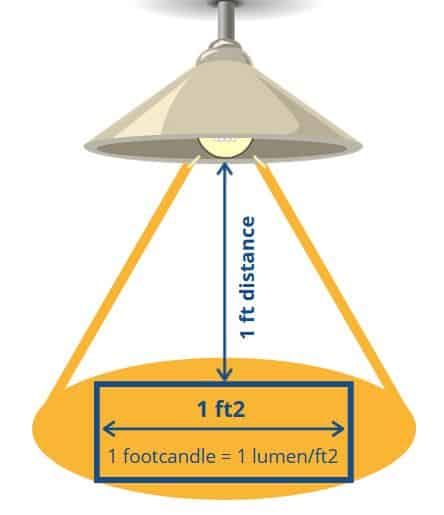
A foot-candle is an imperial measurement of how intense light is on a surface. The metric equivalent is the lux. Foot-candles are still widely used throughout the US, where imperial measurements remain standard.
Two related terms are worth keeping straight: luminous flux (measured in lumens) is the total amount of light a bulb produces, while illuminance (measured in foot-candles or lux) is how much of that light actually lands on a given surface. Lumens describe the bulb; foot-candles describe what your countertop, desk, or floor receives.
Foot-candles are written in full or abbreviated as "fc" or "lm/ft²" — lumens per square foot. The unit is straightforward: one foot-candle equals one lumen of light distributed over one square foot of surface.
Lux uses the same idea but measures across a square meter instead of a square foot. Because a square meter is roughly 10.76 times larger than a square foot, one foot-candle equals approximately 10.76 lux. To convert foot-candles to lux, multiply by 10.76; to convert lux to foot-candles, divide by the same number.
What Is The Difference Between Foot-Candles And Lumens?
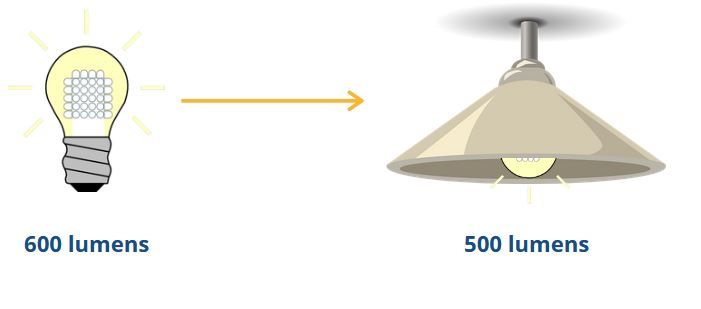
The easiest way to explain the difference is with an example. Imagine you've just bought a brand-new LED bulb to fit in your home. Say it's rated at 6W — it's likely to generate roughly 400–600 lumens of brightness, though modern high-efficiency LEDs can push that closer to 800 lumens or more.
Once installed, the bulb produces that amount of light pretty consistently. Now add a lampshade to the fitting. Has the brightness of the bulb itself changed? No — it's still producing the same number of lumens. But the amount of light reaching the rest of the room has dropped, because the shade has redirected and blocked part of it. The area directly under the bulb may be unaffected, but overall foot-candles around the room go down.
Here's another quick example. Most smartphones let you switch on the flash as a torch. Turn it on, hold it just above your desk, then move the phone up and down. The flash stays just as bright, but the surface gets dimmer the further away you hold it.
That drop-off has a name: the inverse square law. Doubling the distance between a light source and a surface cuts the illuminance to roughly one-quarter — not one-half, as you might expect. Triple the distance, and you're left with about one-ninth. Lumens stay constant; foot-candles fall off fast as you move the light away.
The point is that, when planning the lighting for a room, it's not just a case of buying brighter bulbs. Where the fittings are placed, how they're directed, and what stands between them and the surface all matter.
Obstacles don't have to be permanent, either. If you're designing a kitchen, think about how often you'll be standing at a countertop prepping meals. Without you blocking the light, the foot-candles might be sufficient — but if the fixture is set back too far, your shadow can make the work surface noticeably darker.
A light closer to the wall keeps foot-candles more consistent, which is why spotlights are popular in kitchens — they sit closer to where you actually work and direct light downward.
Beam angle matters here too. A narrow-beam spotlight (around 15–25°) concentrates lumens into a smaller pool, producing high foot-candles directly underneath but very little spill to the sides. A wide flood (60° or more) spreads the same lumens over a larger area, giving lower peak foot-candles but more even coverage. For a kitchen counter, narrower beams put more light on the task; for a living room, wider beams keep the whole space lit.
How to Measure Foot-Candles
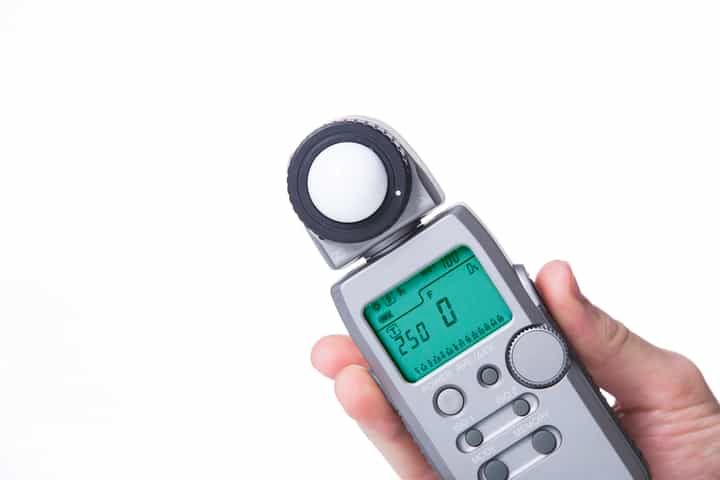
The standard tool for measuring foot-candles is a handheld light meter. Basic models for white-light readings are widely available on Amazon, typically in the $25–$60 range. Most give you the option of reading in lux or foot-candles, so you don't need to do the conversion yourself.
To take a reading:
- Switch on the lights you want to measure and let them stabilize.
- Set the meter to foot-candles (fc).
- Place the sensor flat on the surface you want to measure — don't hold it in mid-air, as the reading will be inaccurate.
- Stand clear so your body isn't casting a shadow on the sensor.
- Read the value and, if you're checking a larger area, take readings at several points and average them.
Choose your measurement surface based on the room. In an office or dining room, measure light on the desk or table. In commercial buildings, check the floor so any potential trip hazards are visible. For a sporting venue like a tennis court, measure the playing surface so line calls aren't disputed because of poor lighting.
Smartphone lux meter apps also exist and are free, but they rely on the phone's ambient light sensor — accuracy varies a lot between devices and they're rarely calibrated. They're fine for a rough comparison between two spots in the same room; not for design decisions or compliance work.
Check out my guide on using a lux meter for more information.
How Bright Is 5 Foot-Candles?
5 foot-candles is roughly the brightness of a dimly lit restaurant or a moonlit outdoor space — enough to navigate safely and recognize faces, but nowhere near enough for reading, cooking, or detailed work. You'd expect it in a hallway, a corridor, or general store circulation areas.
The Illuminating Engineering Society (IES) publishes a handbook with recommended foot-candle levels for different spaces. A few commonly cited targets:
| Space Type | Recommended Foot-Candles |
|---|---|
| Corridor / Hallway | 5–10 fc |
| Bedroom | 10–30 fc |
| Office | 30–50 fc |
| Kitchen (task areas) | Up to 75 fc |
| Professional Laboratory | 75–120 fc |
| Parking Garage | 5–10 fc |
These are general targets — exact recommendations vary by IES Handbook edition and the specific visual task. Use them as starting points, then adjust based on the actual work happening in the space.
What To Do If Your Foot-Candle Reading Is Too Low
If a measurement comes in below the target for the space, you have several options before resorting to a full re-wire:
- Swap in a higher-lumen bulb that fits the existing fixture — the easiest fix when the fitting is fine but the bulb is underspec'd.
- Add task lighting (under-cabinet strips, a desk lamp, a pendant over the counter) close to where the work happens. Because of the inverse square law, moving a light closer is far more effective than making it brighter from a distance.
- Reposition existing fixtures so they're closer to the surface or aimed more directly at it.
- Switch to a narrower beam angle if a fixture is wasting light on walls or ceilings instead of the work surface.
- Lighten surrounding surfaces. Pale walls, ceilings, and worktops reflect light back into the room; dark matte finishes absorb it. A coat of light paint can lift overall illuminance noticeably.
- Add fixtures if the room is large or has dim corners — multiple modest lights almost always beat one very bright one for evenness.
Final Words
Between Watts, Lumens, Kelvins, foot-candles, and lux, there's a lot to weigh when planning lighting. For more on the others, see my guide to Kelvins and Lumens.
Foot-candles and lux are the most useful measurements for understanding whether a space is genuinely well lit, rather than just well-bulbed. Pair an inexpensive light meter with the IES targets above, and you have an objective way to judge whether a room needs brighter bulbs, better-placed fixtures, or just a coat of lighter paint.