
How To Illuminate Outdoor Waterfall?
Submerged lights in murky water don't illuminate a waterfall — they just create a dull glow at the base while the rocks and cascade vanish into darkness. Clear water changes everything.
 Eugen
EugenEugen Nikolajev
Creator of LED Lighting Info
Hi, I am Eugen. I was always one of those kids who had all sorts of weird lighting gadgets for every occasion.
Now, I want to share my knowledge and experience about lighting with you on LED Lighting Info.
Read my editorial standards
Key Takeaways
Waterfalls can be illuminated from various angles, underwater lights pointing up best highlight the water flow, uplights above the water level emphasize the feature's height, and downlights are more subtle. Colored lights are great for highlighting bubbles.
Most pond owners under-light their waterfalls — the cascade disappears at dusk and the feature stops earning its keep. Standard pool lights aren't designed to showcase moving water, and lighting a waterfall like a single object usually looks artificial.
Here's how to light a waterfall properly so the cascade, the splash zone, and the surrounding rocks each read clearly at night.
In this guide, I'll cover:
- The ideal positioning for waterfall lights
- How to choose the right fixtures (IP rating, voltage, solar vs. wired)
- General principles for illuminating any water feature
What Is The Ideal Positioning For Waterfall Lights?
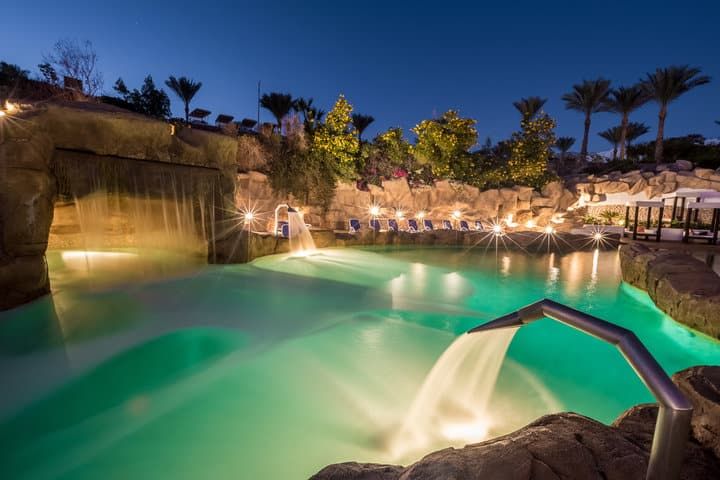
When you think about lighting a waterfall, break it down into different elements. Trying to light the whole feature as one object produces a flat, artificial result.
A waterfall consists of three main areas:
- The top, where the water comes over the edge
- The cascading water
- The surface, where the waterfall lands
Where to focus the light depends on the type of waterfall you have.
For a rocky, multi-level feature made up of several small cascades, the priority is not the very top but gently illuminating the rocks and highlighting the cascading water along the way.
For a contemporary waterfall with a laminar-flow sheet of water — where water moves in a smooth, unbroken sheet rather than turbulently — focus on lighting the top. The light will glow gently through the sheet on its way down.
The three positioning options
Every waterfall lighting setup uses one or more of three positions: downlighting, uplighting, or submerged. Pick based on the type of waterfall and the clarity of the water.
You aren't limited to one option. The common approach is to pair either downlighting or uplighting with submerged lighting — but only if your water is clear. If the pond is murky, stick to either uplighting or downlighting from above the surface.
How To Highlight Waterfall Air Bubbles?
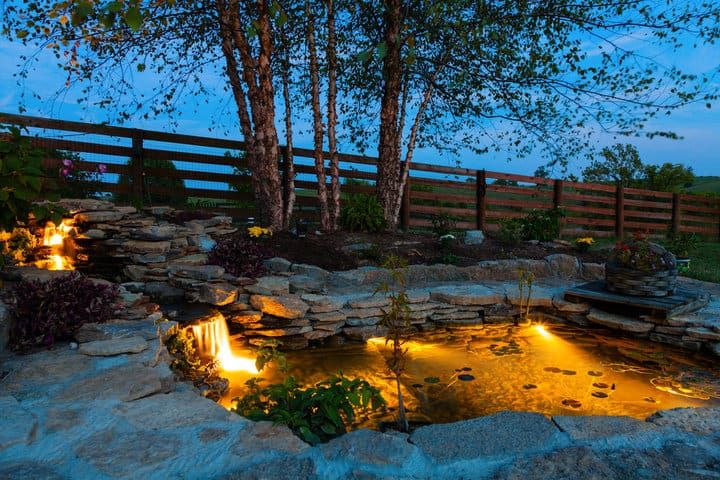
Depending on the speed of your waterfall, you may have a nice bubbling effect where the water hits the surface — and that splash zone is an excellent place to focus light.
Bubbles refract and scatter light, giving a gentle glow that sparkles thanks to the constantly moving surface. Aim a light directly at the spot where the waterfall meets the pond to get the effect.
If your pond is clear, light it from below — that also picks up the sub-surface bubbles. If the water isn't clear, or the waterfall is swift and churning the surface, use low-level lights above the water aimed at a shallow angle so they catch the splash zone.
Colored lights help. Blue or green accentuates bubbles more clearly than plain white while still feeling natural — and green specifically penetrates freshwater further than blue, which matters in slightly cloudy water.
Choosing The Right Lights
Before placing fixtures, get the hardware right. Three specs matter for outdoor water feature lighting: ingress protection rating, voltage, and power source.
IP ratings and waterproofing
The IP (Ingress Protection) rating tells you how well a fixture resists water. The two digits represent solids and liquids — for waterfall lighting, the second digit is what matters.
Rule of thumb: IP65 minimum for anything outdoors near a water feature, and IP68 required for any fixture that lives below the waterline. Mixing those up is the most common reason DIY pond lighting fails within a season.
Low-voltage vs. line-voltage
Outdoor water feature lights are almost universally 12V low-voltage systems. They run from a transformer that steps mains power down, which makes the wiring around the pond far safer to work with and considerably less risky if a cable is ever damaged. Line-voltage (120V/230V) fixtures around water generally require a licensed electrician, GFCI-protected circuits, and conduit. For most homeowners, low-voltage is the only sensible option.
Solar vs. wired
Solar pond lights are popular because they install in minutes with no wiring — drop them in and they charge during the day. The trade-off is output: solar units are dimmer, depend on the previous day's sun, and dim out before sunrise. They work well as accent or splash-zone lights but rarely as the primary illumination on a feature waterfall.
Wired low-voltage systems give consistent output, can be dimmed, and pair with timers and smart controls. For a permanent installation on a feature you want to look the same every night, wired is the better choice.
Waterfall Lighting Inspiration
Modern waterfalls
Using downlights from an elevated position to light the start of the waterfall reinforces the contemporary design and creates a clear view of the sheets of water and the reflection on the surface.
Downlighting also suits modern features with a gentle raindrop-effect cascade, not just full laminar sheets.
Rocky waterfalls
For rocky features, multiple smaller lights spread across the cascade work better than one bright source. They showcase both the streaming water and the rocky landscape, picking out texture as the water moves over each ledge.
Position enough fixtures to cover the full feature. Relying only on submerged uplighting under the pond surface leaves pockets of light at the base and washes out the rest — the rocks above the water disappear into darkness.
How To Illuminate A Water Feature?
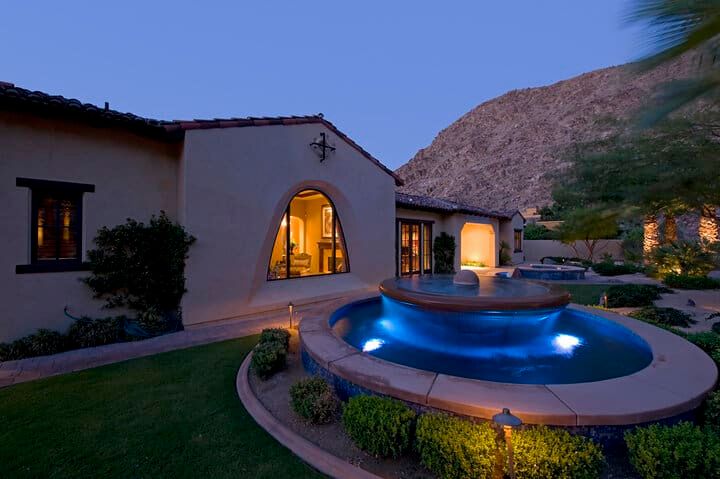
Whether it's a waterfall or any other water feature, the same handful of principles apply. Water features vary too much for a single recipe, so use these as a checklist when planning the layout.
Set the mood
Decide whether the feature is the centerpiece or part of a wider landscape. If it's the centerpiece — say, a fountain — use uplighting to put the focus on it. If it's part of a broader design, use downlighting for a soft glow that reflects off the water's surface.
Mix in some uplighting for uneven surfaces like a rocky waterfall. Downlighting alone over rocks just creates dark shadows.
Use enough lighting
Water — especially moving water — diffuses light in many directions, including up into the air. So your lighting will be less effective than the raw lumen output suggests.
Plan for more fixtures than you think you need, but don't overdo it — too much light flattens the contrast and spoils the mood.
Experiment first
Before committing to a permanent installation, try the fixtures in different positions. Supplement with a handheld torch to preview the effect of an extra light before buying one.
Even when the theory feels solid, test a few layouts after dark — water is unpredictable, and the best result is rarely the first one you try.
Consider pond life
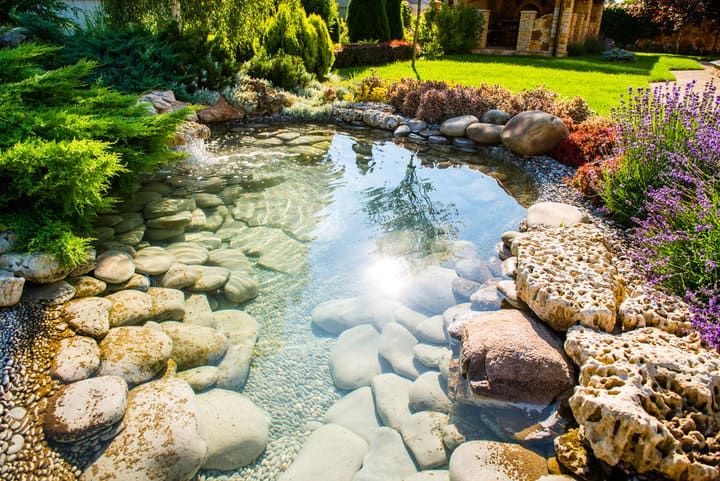
If you have plants or fish in the pond, lighting choices affect them. Two concerns: position and duration.
On position — avoid lighting up the spots where fish shelter. Brightly lit fish are easy prey for herons, raccoons, and other predators, particularly if there's a nearby perch a bird could use. Keep a mix of lit areas and dark refuges so the fish have somewhere to hide around the rest of the pond.
On duration — prolonged artificial light disrupts fish circadian rhythms and can encourage algae overgrowth by extending the effective photoperiod for the pond's plant life. Run pond lights for an evening window rather than dusk till dawn.
Use a timer or smart control
Put the system on a timer or smart plug so the lights run for a few hours after dark and switch off overnight. That solves both the wildlife concern above and the energy bill — there's rarely anyone outside watching the pond at 3 a.m.
Maintain your lighting system
Install fixtures so they can be removed and replaced — never cement or permanently bond a light in place. Water feature fixtures take more punishment than dry-landscape lights, and one will eventually fail.
Inspect any light close to moving water regularly. Look for cracked lenses, fogged glass (a sign of water ingress past the seal), corroded contacts, and frayed cable insulation. Clean off mineral deposits and algae buildup on the lens — both quietly cut the output.
Quick Recap
Three positions, three principles:
- Downlighting suits modern sheet waterfalls; uplighting suits rocky multi-level features; submerged lighting picks out bubbles — but only in clear water.
- Use IP65+ above water, IP68 below, and stick to 12V low-voltage for safety.
- Use enough fixtures, mix positions to avoid flat shadows, and put the system on a timer to protect the pond's wildlife.
| Position | Best for | Avoid when |
|---|---|---|
| Downlighting (from above, shining down) | Modern sheet waterfalls; gentle glow on the surface; reading the cascade from the top down | Rocky, multi-level features used alone — downlights create deep shadows between the rocks |
| Uplighting (above water, shining up) | Rocky waterfalls; emphasizing height; lighting surrounding stonework | Flat, modern sheet waterfalls where you mainly want a soft top-down glow |
| Submerged (underwater, shining up) | Highlighting the splash zone and sub-surface bubbles; combining with down- or uplighting | Murky or cloudy water — the light is absorbed and only highlights the turbidity |
| Rating | What it means | Use it for |
|---|---|---|
| IP65 | Protected against water jets from any direction | Above-water uplights and downlights exposed to splash and rain |
| IP67 | Protected against temporary immersion (up to ~1 m for 30 minutes) | Fixtures very close to the water line that may get briefly submerged |
| IP68 | Protected against continuous immersion | Anything sitting permanently underwater |
FAQ
What IP rating do I need for waterfall lights?
IP65 is the minimum for any fixture exposed to splash and rain above the waterline. Use IP67 for lights right at the water's edge that may get briefly submerged, and IP68 for any fixture that sits permanently underwater. Mixing these up is the most common cause of early failure in DIY pond lighting.
Are 12V low-voltage waterfall lights safer than mains-powered ones?
Yes. 12V low-voltage systems run from a transformer that steps mains power down, which makes them far safer to install around water and much less hazardous if a cable is ever damaged. Line-voltage outdoor lighting around water typically requires a licensed electrician, GFCI protection, and conduit — for most home pond installs, low-voltage is the only sensible option.
Do solar pond lights work well for waterfalls?
Solar works well as accent or splash-zone lighting because installation is just dropping the units in — no wiring. The trade-off is brightness and consistency: solar units are dimmer than wired equivalents, depend on the previous day's sun, and tend to fade before sunrise. For a feature waterfall you want to look the same every night, a wired low-voltage system is the better choice.
Why does my submerged pond light just light up the murk?
Suspended particles in cloudy water absorb and scatter light, so a submerged fixture ends up illuminating the turbidity rather than the feature behind it. If your pond water isn't clear, skip submerged lights and stick to uplighting or downlighting from above the surface — the cascade and surrounding stonework will still read clearly.
Will pond lighting harm my fish?
Lighting itself doesn't hurt fish, but two things to watch: don't light up the spots where they shelter (predators like herons spot lit fish easily), and don't run lights all night (prolonged artificial light disrupts fish circadian rhythms and can drive algae growth). A timer that gives you a few hours of evening light then switches off solves both issues.