
Do Pond Lights Affect Fish?
Even 1 lux of artificial light at night — about the brightness of a single candle — is enough to suppress melatonin and throw a fish's circadian rhythm off. A timer fixes most of that in one step.
 Eugen
EugenEugen Nikolajev
Creator of LED Lighting Info
Hi, I am Eugen. I was always one of those kids who had all sorts of weird lighting gadgets for every occasion.
Now, I want to share my knowledge and experience about lighting with you on LED Lighting Info.
Read my editorial standards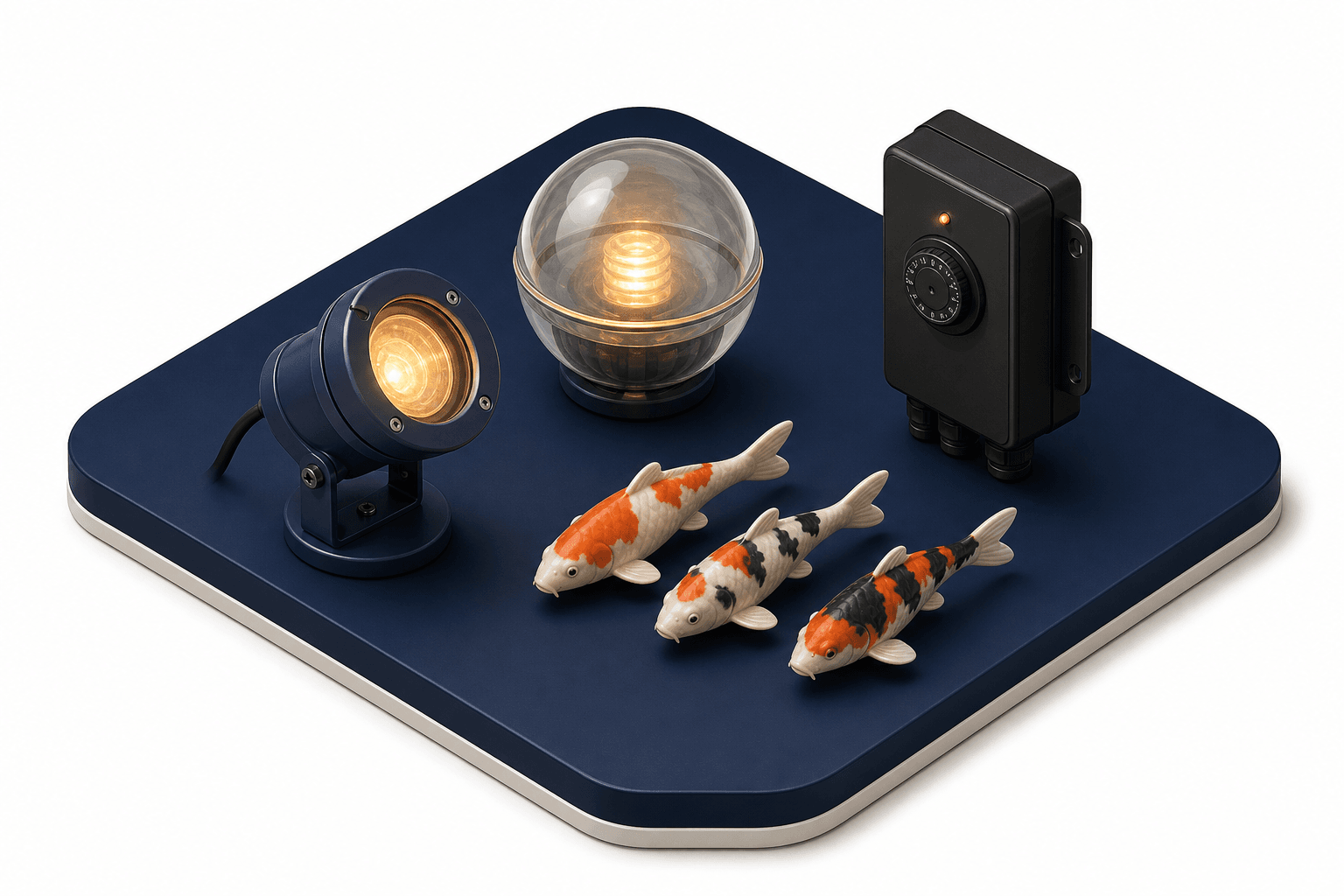
Key Takeaways
Pond lights are OK to use with fish, provided they are switched off at night to maintain the day/night cycle. They shouldn’t warm the water, run constantly, or be so bright that they illuminate the entire pond and remove every shaded hiding spot.
Pond lights create a beautiful night-time display, but if you keep fish, a few key factors can mean the difference between a relaxing pond and a stressful one for your fish.
So is it OK to have pond lights if you’re keeping fish, or will you cause them problems?
Are Pond Lights Bad For Fish?
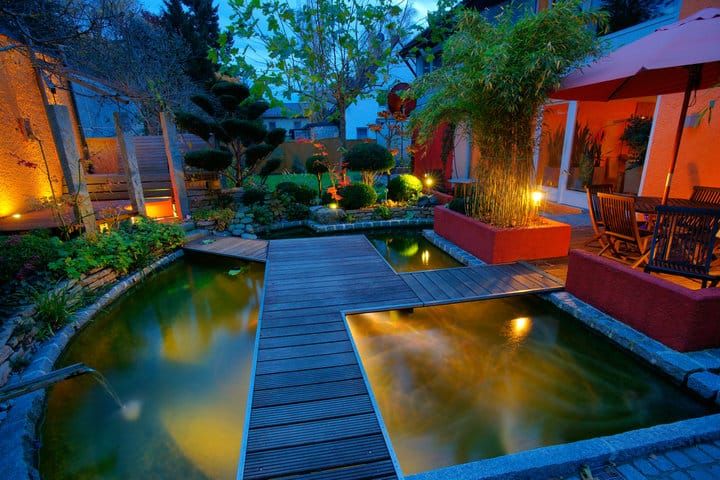
There are a few different ways pond lights can be harmful for your fish if you don’t use the right type or don’t set them up correctly.
Disrupted day/night cycles
Like most other animals, fish need a period of darkness to rest and to keep their internal clock in sync. Research on artificial light at night shows that even low-intensity light (around 1 lux) can suppress melatonin and disrupt circadian rhythms in fish. Leaving pond lights on through the night, or having the lights on in your bedroom, produces the same kind of stress.
If you install pond lights, make sure you can switch them off easily — ideally on a timer, so you don’t have to rely on your memory every night.
Heat from older fixtures
Halogen fixtures emit roughly 80% of their energy as heat, and a bank of submerged halogens can warm a small pond. Modern submerged LED pond lights run at 1–10 W and emit only 10–20% of their energy as heat — far too little to meaningfully change the temperature of even a small pond. If you’re using LEDs, water temperature is essentially a non-issue.
Loss of hiding spots
Some fish are wary in well-lit, exposed water. If you light up the entire pond, your fish lose the dark zones they would naturally retreat to, and chronic stress can show up as poor appetite or disease.
Visibility to predators
A brightly-lit pond may make fish more visible to nocturnal mammalian predators such as raccoons or foxes — like a neon sign at an all-you-can-eat buffet. The evidence here is more anecdotal than scientific (most pond predators, including herons in the UK and Europe, hunt at dawn, dusk, or in daylight), but providing dark hiding zones is sound practice either way.
Algae growth
While pond lights are artificial, they can still help certain forms of algae to grow faster. That said, lighting is a contributing factor, not the root cause — algae blooms are primarily driven by excess nutrients (nitrogen and phosphorus) from fish waste, overfeeding, runoff, or decaying plant matter. Good water chemistry matters far more than lighting choices for algae control.
Do LED Lights Hurt Fish Eyes?
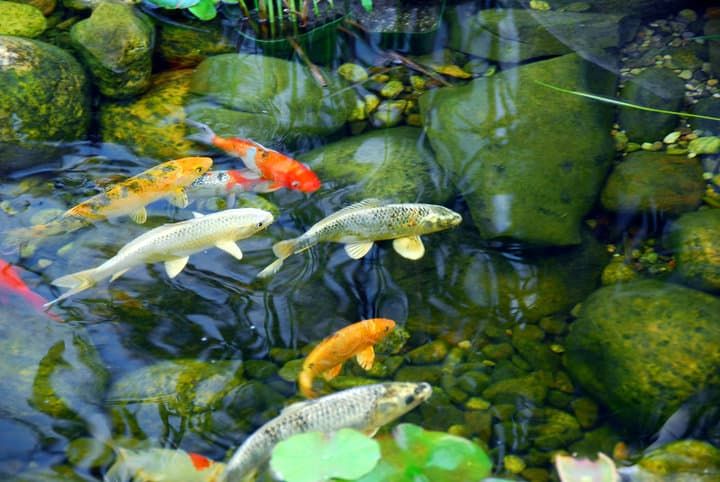
Fish are more tolerant of color variation than some animals, but they are far from indifferent to it. Goldfish and koi are tetrachromatic — they have separate cone cells for red, green, blue, and ultraviolet light — and studies show their cones are highly sensitive even at very low light levels. Brightness and duration matter most, but warm-toned, lower-intensity lighting tends to be less disruptive than bright, blue-rich sources.
LED lights won’t hurt fish eyes provided they aren’t too bright. The water itself helps: it absorbs and scatters incoming light, attenuating intensity with depth — short (UV) and long (red/IR) wavelengths drop off quickly, while blue-green penetrates the deepest. As long as you haven’t deliberately picked the brightest fixtures you can find, your fish should be fine.
Submersible vs. Above-Water Pond Lights
Where you place the fixture changes how it affects your fish.
Submersible LED pond lights sit inside the water. Their output is absorbed and scattered quickly with depth, so the visible reach is shorter than the wattage suggests. They’re ideal for highlighting features like waterfalls, fountain bases, or aquatic plants from below — but they put light directly into the fish’s living space, so keep wattages low and aim them away from areas where fish rest.
Above-water spotlights and path lights stay dry, illuminate the surface and surrounding landscape, and reflect rather than penetrate the pond. They’re generally less disruptive to fish at the same brightness, but glare on the water surface can still spook them — angle the beam across or along the pond rather than straight down.
Electrical Safety: IP Ratings to Look For
Any lighting in or near a pond needs an appropriate ingress protection (IP) rating. The numbers tell you what the fixture is sealed against:
- IP68 — fully sealed for continuous submersion. This is the minimum rating for any light that sits underwater.
- IP67 — sealed against temporary immersion. Acceptable for fixtures that may briefly submerge but live mostly above water.
- IP65 or higher — protected against water jets and rain. Suitable for pond-edge spotlights and path lights.
Always run pond lighting on a low-voltage transformer (12 V or 24 V is standard) and protect the circuit with a residual-current device (RCD) or ground-fault circuit interrupter (GFCI). If you’re unsure, hire a qualified electrician — water and mains voltage are a serious combination.
How To Prevent Pond Lights From Bothering Fish

Fish and pond lights are perfectly compatible if you set things up thoughtfully:
- Install a timer on the circuit so the lights automatically switch off at night, preserving the day/night cycle and limiting the extra light that can fuel algae.
- Use LED bulbs rather than halogens. They’re much longer-lasting and emit far less heat, so they won’t affect water temperature.
- Design shaded zones into the pond layout. Don’t light the entire pond — leave dark areas where fish can retreat.
- Only run lights during the hours you’re actually outside enjoying the pond. There’s no benefit to leaving them on once you’ve gone inside.
- Add a pond cover or netting if predators are a real concern. It’s less aesthetic, but it works.
What Is The Safe Cycle To Turn The Lights On?

In the wild, daylight varies with latitude and season. Tropical species experience roughly 12 hours of daylight year-round, while temperate pond fish like koi and goldfish are adapted to seasonal variation — from as little as 8 hours of daylight in winter up to 16+ in summer. Diminishing daylight is in fact a key cue that triggers torpor in koi and goldfish as the water cools.
Try to match your lighting schedule to the natural cycle for the season rather than imposing a fixed 12-hour day. As a practical rule of thumb, aim for 8–10 hours of unbroken darkness each night. In high summer, when natural twilight is short, set the lights to switch off by around 11pm and leave the pond dark until morning.
Koi in particular are sensitive to sudden light changes — consider a dimmer or a smart timer that ramps the lights up and down gradually rather than snapping them on and off.
What About Solar Pond Lights?
Solar-powered pond lights are popular because they don’t need wiring or a transformer, and they typically run dusk-to-dawn automatically. They’re generally fish-friendly because their built-in batteries usually run flat well before sunrise, naturally limiting how long the pond stays lit.
The trade-offs: brightness varies with how much sun the panel got that day, and the cheaper units have no off switch — so on a long summer evening they’ll happily light the pond for hours after you’ve gone inside, which works against the day/night cycle. Look for models with a manual switch or a timer override if you want full control.
Final Words
Pond lights and fish coexist happily as long as you respect the basics: the right fixture, the right placement, and — most of all — the right schedule.
Stick to low-voltage LEDs with the right IP rating, leave shaded zones in the pond layout, and keep the wiring safe. None of that matters, though, if the lights run all night.
If you only make one change, put your pond lights on a timer. It’s the single most impactful thing you can do for your fish’s wellbeing — everything else is fine-tuning around that one decision.