
Does Leaving Porch Lights Deter Burglars?
A porch light left on all night can actively help a burglar — illuminating their workspace and signaling "no one home" to anyone watching the darkened house behind it.
 Eugen
EugenEugen Nikolajev
Creator of LED Lighting Info
Hi, I am Eugen. I was always one of those kids who had all sorts of weird lighting gadgets for every occasion.
Now, I want to share my knowledge and experience about lighting with you on LED Lighting Info.
Read my editorial standards
Key Takeaways
Leaving porch lights on all night isn't a reliable deterrent on its own, burglars can use the light to scout entry points just as easily as a neighbor can spot them.
Motion-activated lights, programmable timers, and dusk-to-dawn sensors are more cost-effective, and the strongest deterrent is a visible camera combined with cues that the home is occupied.
Porch lights feel reassuring when you arrive home at night — but do they actually deter burglars, or could they be helping them case the house?
Plenty of homeowners assume an overnight porch light keeps intruders away. The evidence is more nuanced — and in some cases, the light is doing the opposite of what you'd hope.
There are a few things to weigh before deciding whether to leave your lights on overnight:
- How much it actually costs to run them all night
- Whether overnight porch lighting runs into light-pollution rules
- How effective they are at deterring burglars
How Much Does It Cost To Keep A Porch Light On All Night?
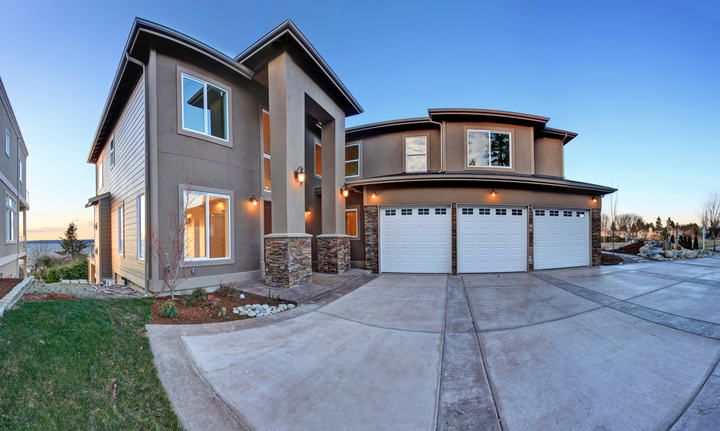
It's worth knowing what overnight porch lights actually cost, because that sets the budget for whichever deterrent strategy you choose.
For these calculations, I'll assume a U.S. residential electricity rate of about $0.17 per kWh (EIA, 2025). Typical rates run $0.15–$0.18 depending on your state, so adjust if yours is higher or lower. Most porches have one or two fixtures – a single sconce or a sconce-pair flanking the door – but the table below scales the cost to four fixtures for larger covered porches; divide by two or four to match your setup.
Halogen bulbs are no longer sold for general residential use in the U.S. – federal efficiency standards effectively phased them out in August 2023 – so any new porch bulb you buy today will almost certainly be LED. Older fixtures may still hold halogen or incandescent bulbs until they burn out, so I'm comparing both.
| Porch light | Cost for 4 lights (12 hours) | Cost for 4 lights for 1 month | Cost for 4 lights for 1 year |
|---|---|---|---|
| Halogen – 30W per bulb (legacy fixtures only) | $0.24 | $7.44 | $89.35 |
| LED – 8W per bulb | $0.065 | $1.99 | $23.83 |
Even with energy-efficient LEDs, that's roughly $24 a year to keep four porch lights running through the night for no real security benefit. Drop the runtime to a couple of hours of actual use – when you're coming or going – and you cut most of that out automatically with a motion sensor, timer, or dusk-to-dawn photocell.
Want to run the math on your own setup? Add up the wattage of all your bulbs, divide by 1,000 to convert to kilowatts, then multiply by your hourly use and your electricity rate. For example:
- Four 8W LED bulbs: 32W total → 0.032 kW
- Hourly cost at $0.17/kWh: 0.032 × $0.17 ≈ $0.005
- Nightly cost (12 hrs): ~$0.065
- Annual cost (every night): ~$24
Modest in absolute terms — but only worth paying if the lights are actually deterring something. Whether they are is the next question.
Are There Light Pollution Rules To Worry About?
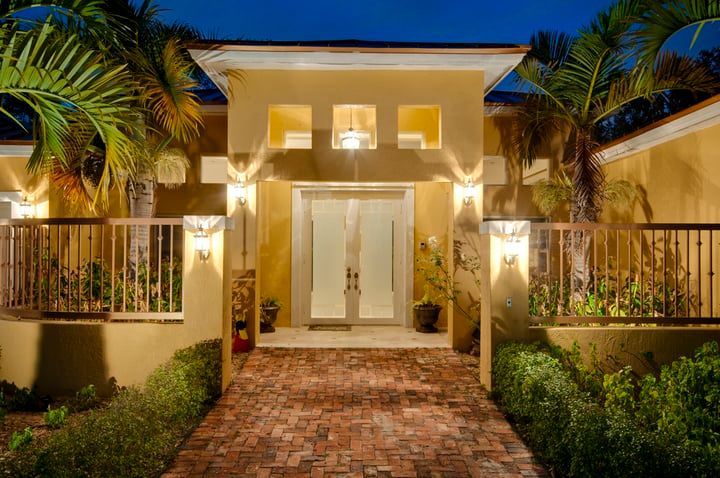
There aren't safety regulations specific to porch lighting, but most U.S. states have some form of light-pollution or 'dark sky' statute, and many municipalities add stricter rules on top of those (NCSL overview).
In practice, the rules that affect porch lights work like this: shielded fixtures that direct light downward are almost always allowed; uplights and unshielded bulbs that spill onto a neighbor's window may be limited by brightness or curfew. If you're using a wall-mounted sconce, make sure the bulb isn't directly visible from a neighbor's property – that's the most common complaint that prompts a code-enforcement call.
Do Porch Lights Actually Stop Burglars?
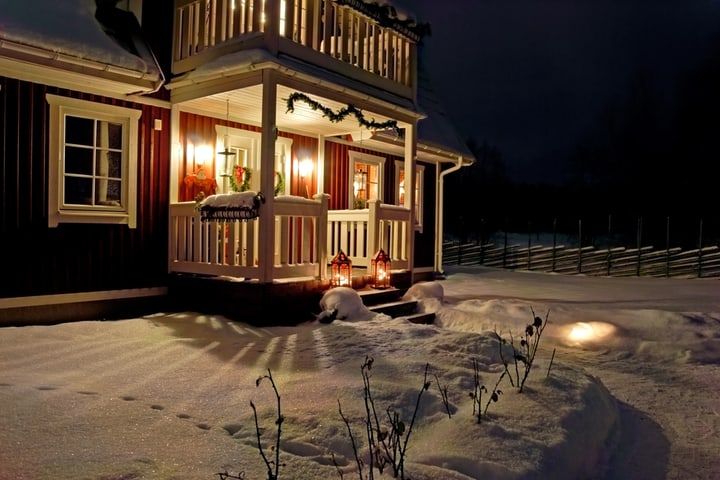
The popular argument is that an overnight porch light makes a burglar easier to spot or gives the impression someone is home. The data complicates both claims.
Roughly half of residential burglaries occur during daylight hours, when homes are most likely to be unoccupied (BJS; FBI UCR). For most break-ins, a porch light is simply irrelevant – burglars are working in plain daylight, not the dark.
For the night-time half, an always-on porch light can actively help a burglar. It illuminates the workspace – making trip hazards visible, highlighting weak windows and door frames, and signaling "no one home" when the rest of the house has been dark for hours.
Motion-activated lights
A motion-activated porch light is a better trade-off. The sudden change in light does two useful things:
- Forces the burglar to reconsider – they can't tell whether a sensor tripped or someone inside flipped the switch.
- Draws neighbors' attention in a way that a constant light doesn't.
Running cost is also a fraction of always-on, since the light only triggers for a few minutes at a time.
Timers, photocells, and smart lighting
Between "always on" and "motion only," there are a few options worth considering:
- Programmable timers switch porch and interior lights on and off in patterns that mimic occupancy – far more convincing to a burglar than a single always-on bulb.
- Dusk-to-dawn photocells turn the porch light on at sunset and off at sunrise, so you're not paying for daytime hours and don't have to remember the switch. Same modest deterrent value as always-on, at lower cost.
- Smart bulbs or smart switches add randomization and remote control on top of timers. You can fake occupancy from a vacation, vary the on/off pattern night to night, and tie lights to motion sensors or camera triggers.
Cameras, signage, and placement
Visible cameras and signage are among the deterrents that surveys of convicted burglars cite most often, alongside cues that someone is home – a car in the driveway, interior lights on timers, audible TV or music. Pair lights with a camera and a window sticker in a prominent spot, and you cover the strongest combination available to a homeowner.
Placement matters as much as brightness. Point lights at what the camera is looking at – not into the lens, which causes glare and washes out faces. Shielded downlights at entry points work best. For the bulb itself, 800–1100 lumens (roughly equivalent to a 60–75W incandescent) is bright enough for a camera to capture a recognizable face without floodlighting your neighbors.
Also read: Do Yard Lights Keep Animals Away?
Final Words
On their own, porch lights aren't a reliable deterrent. Ranked roughly by cost-effectiveness and deterrent value, here's how the options stack up:
- Visible cameras plus occupancy cues (interior lights on timers, a car in the driveway, posted signage). The strongest combination per surveys of convicted burglars – and you get a recording if a break-in does happen.
- Motion-activated porch lights. Cheap to run, attention-getting, and genuinely ambiguous to a burglar.
- Timer or dusk-to-dawn photocell, especially paired with randomized interior lights. Modest deterrent, low cost.
- Always-on porch light alone. The most expensive option and arguably the worst signal – a porch lit all night while the rest of the house stays dark reads "no one home" to anyone watching.
Whatever combination you choose, knowing your neighbors amplifies all of it. A watchful neighbor recognizes an unfamiliar vehicle in your driveway in a way that no light or camera can – which is the real value of joining a local watch group or simply introducing yourself when someone new moves in.