What Is The Difference Between Halogen And LED Light Bulbs
Since August 2023, halogen bulbs have been banned from U.S. manufacture, import, and sale — the question is no longer halogen vs. LED, but which LED and how soon.
 Eugen
EugenEugen Nikolajev
Creator of LED Lighting Info
Hi, I am Eugen. I was always one of those kids who had all sorts of weird lighting gadgets for every occasion.
Now, I want to share my knowledge and experience about lighting with you on LED Lighting Info.
Read my editorial standards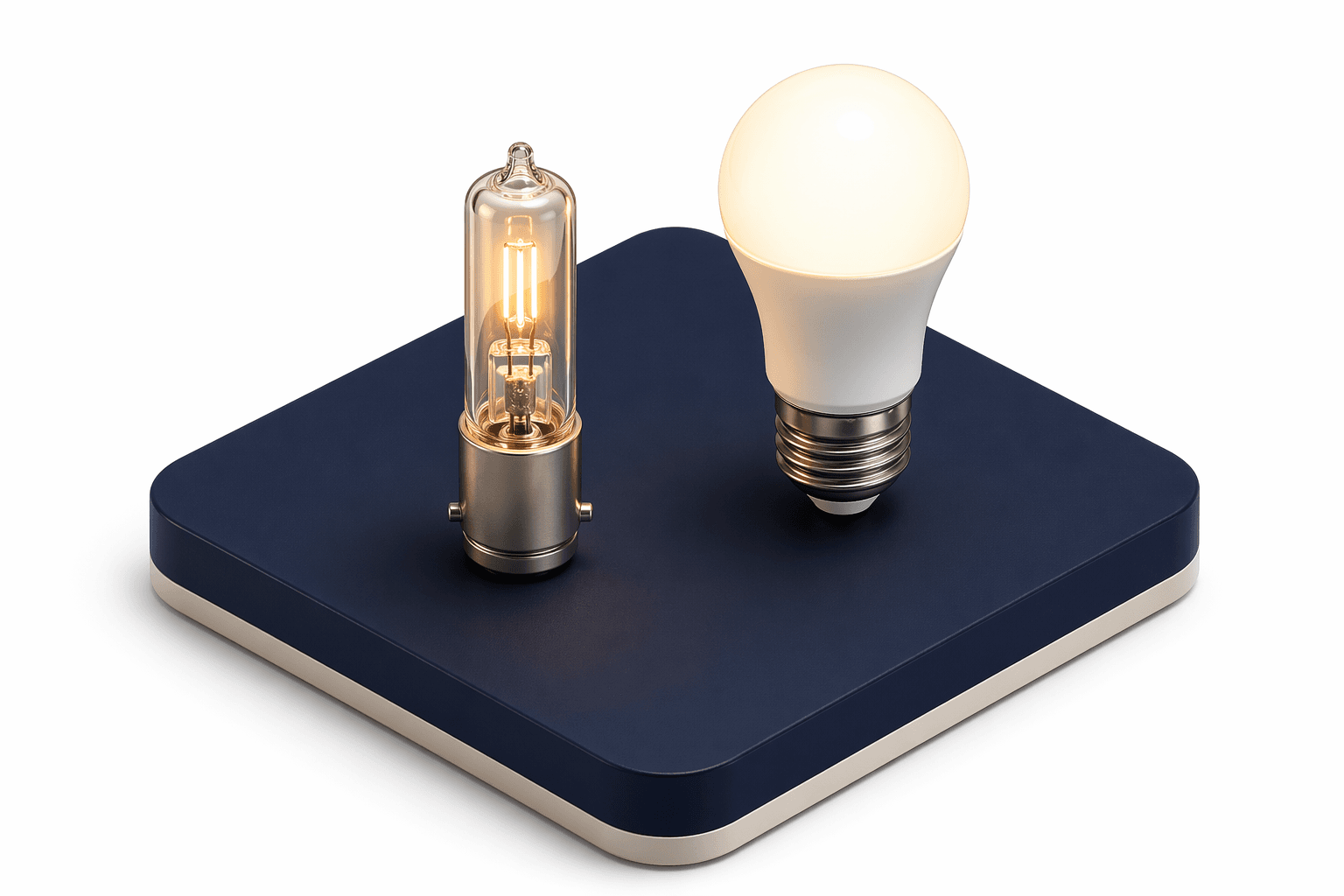
Key Takeaways
Halogens use roughly 5-8 times more power than LEDs for the same light output, run at much higher surface temperatures (250°C+), and last around a tenth as long (1,000-2,000 hours vs 15,000-25,000 hours). LEDs are more flexible on color temperature, emit negligible UV/IR, and now have direct retrofit replacements for almost every halogen base type.
Halogen bulbs were the natural successor to the incandescent — but their reign is already over. The U.S. banned the manufacture, import, and retail sale of most general-service halogen and incandescent lamps in August 2023 under new Department of Energy efficacy standards, and the EU completed its halogen phase-out the same year.
Both regulators landed on the same threshold: 45 lumens per watt. Halogens deliver 16-24 lm/W. Modern LEDs deliver 100-150 lm/W, with high-efficiency products exceeding 200 lm/W.
If you still have halogens in service, replacing them with LEDs is no longer a question of if, but of which bulbs and how soon. Below is the practical comparison — efficiency, brightness, color, dimming, heat, lifespan, and retrofit compatibility.
How Halogen and LED Bulbs Work
Halogen Bulbs
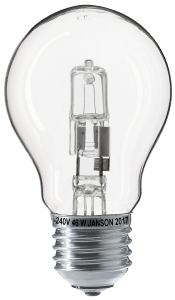
A halogen bulb is a refined incandescent. Current passes through a tungsten filament until it glows white-hot, emitting both heat and visible light. The capsule around the filament is filled with a halogen gas — usually iodine or bromine — under pressure.
In a traditional incandescent, the filament slowly evaporates and deposits tungsten on the inside of the glass, blackening the envelope and shortening the bulb's life. The halogen gas reverses that process: it carries evaporated tungsten back to the filament in a chemical cycle, prolonging filament life and keeping the bulb's casing clear. The result is roughly double the lifespan of a comparable incandescent — about 1,000-2,000 hours versus 750-1,000 hours.
LED Bulbs
An LED — light-emitting diode — is a semiconductor device. As electrons move across the diode's p-n junction, they release energy in the form of photons, which are visible light. There is no filament to burn out and no glass envelope full of gas. The bulb is a chip, a driver circuit, and a heatsink wrapped in a familiar bulb-shaped enclosure.
LEDs reach full brightness instantly, are unaffected by frequent on/off cycling, and tolerate vibration in ways that filament bulbs cannot. The trade-off is that the chip and driver electronics produce heat that has to be conducted away through a metal heatsink — which is why most LED bulbs feel substantial in the hand and have ribbed bases.
Which Is Brighter: LED or Halogen?
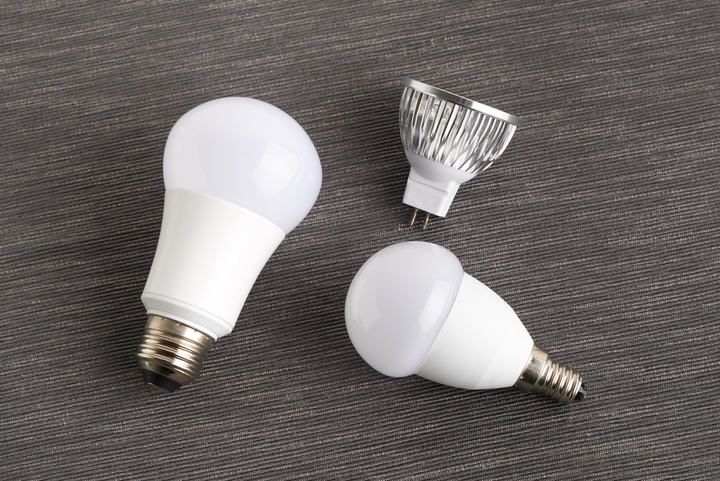
Wattage is no longer a measure of brightness. The relevant measure is lumens — the total amount of visible light emitted by a source. The higher the lumen rating, the brighter the bulb.
An 18W halogen produces roughly 270-360 lumens. An 18W LED produces 1,800-2,400 lumens — five to seven times the light for the same input power. A modern LED can replace a 40W halogen using just 5-7W of energy.
The reason is efficacy. Halogens convert most of their input energy into heat: only about 10-15% of the energy a halogen radiates is in the visible spectrum. LEDs convert roughly 30-50% of input energy directly into visible light, and dissipate most of the remainder as heat through the heatsink rather than radiating it forward through the bulb's surface.
| Halogen wattage | Halogen lumens | Equivalent LED wattage | LED lumens |
|---|---|---|---|
| 18W | ~300 lm | 3W | ~300 lm |
| 40W | ~600 lm | 5-7W | ~600 lm |
| 60W | ~900 lm | 8-10W | ~900 lm |
| 80W | ~1,200 lm | 11-13W | ~1,200 lm |
| 100W | ~1,500 lm | 14-17W | ~1,500 lm |
Color Temperature
Color temperature, measured in kelvin (K), describes how warm or cool a light appears. Lower numbers are warmer (yellow/amber); higher numbers are cooler (blue/white).
Halogens are not fixed but they are limited: most halogen lamps fall between 2,700K and 3,000K — a warm white that is slightly cooler than the ~2,700K of traditional incandescents. LEDs are made in everything from 2,000K candle-amber to 6,500K daylight blue, so finding a color temperature that matches a room's purpose is straightforward.
| Color Temperature | Description | Best For |
|---|---|---|
| 2,000-2,200K | Amber / candlelight | Decorative, ambient mood lighting |
| 2,700K | Soft warm white | Bedrooms, living rooms, table lamps |
| 3,000K | Warm white | Hallways, dining rooms |
| 4,000K | Neutral white | Kitchens, bathrooms, offices |
| 5,000K | Cool white | Garages, utility rooms |
| 6,000-6,500K | Daylight | Workshops, task lighting, retail |
Power Consumption and Cost
When shopping, the spec to read is "equivalent wattage" — a comparative number that uses an old incandescent as the baseline. A bulb labeled "60W equivalent" is as bright as a 60W incandescent regardless of what it actually draws. The actual draw is listed separately: a typical 60W-equivalent LED uses about 8-10W; a 60W-equivalent halogen still draws around 30-40W.
For the same light output, an 80W halogen and a 17W LED produce roughly the same lumens. The halogen pulls more than four times the power for that brightness.
Worked example: an office with 30 bulbs running 9 hours a day at $0.13/kWh.
- 80W halogen each: 7,884 kWh/year → ~$1,025/year
- 17W LED each: 1,675 kWh/year → ~$218/year
- Annual savings from switching: ~$810
At that rate, the higher upfront cost of a quality LED pays for itself within a month and continues to save through the rest of the bulb's life — typically more than a decade. To plug your own numbers in, use my calculator.
Dimmer Compatibility
Dimming was once a real point in halogen's favor: any standard wall dimmer worked because halogens are simple resistive loads. LEDs are not — they contain a driver circuit, and the driver determines how the bulb responds to a dimmer.
Today, LED-compatible dimmers (ELV trailing-edge, MLV leading-edge for retrofits, and 0-10V for commercial) are widely available and standard at hardware retailers. The basic rules: buy a bulb labeled "dimmable," pair it with an LED-rated dimmer, and check the dimmer's load range — many LED-rated dimmers have a minimum load that a single small LED bulb may not meet.
An incompatible pairing typically shows up as flickering, audible buzz from the dimmer or bulb, a narrow dim range that snaps to off well above the dimmer's minimum, or pop-on behavior where the bulb won't fade in smoothly. If your LEDs aren't dimming smoothly, the dimmer is almost always the cause.
Heat, UV, and IR

Halogens are essentially small radiant heaters with a visible-light bonus: their bulb surfaces routinely exceed 250°C. They also emit significant ultraviolet and infrared radiation. UV from halogens fades fabrics and artwork over time — which is why museums and high-end retail moved away from them. IR is why halogen display cases warm up the food they're meant to show off. In rooms with many halogens (small retail, restaurant kitchens), the cumulative heat raises ambient temperature and adds to cooling costs.
LEDs emit negligible UV and IR. They still produce heat — at the chip and driver — but it's conducted into the heatsink rather than radiated forward. That changes what is feasible: enclosed fixtures, fabric-near accent lighting, and refrigerated display cases all become viable in ways they were not with halogens.
One caveat: in a fully enclosed fixture with no airflow, an LED's heatsink can saturate and the driver electronics will overheat and fail early. If the fixture is enclosed, look for a bulb explicitly rated for enclosed-fixture use.
Lifespan
A standard halogen bulb is rated at 1,000-2,000 hours. A standard LED bulb is rated at 15,000-25,000 hours, with premium products reaching 50,000 hours. At three hours of daily use, a 2,000-hour halogen lasts under two years; a 25,000-hour LED lasts more than 22. The replacement labor savings alone are meaningful in commercial settings.
Retrofit Compatibility
Most halogens have direct LED replacements in matching bases. A few details matter:
- GU10 (mains-voltage spotlights): straight swap. Pull the halogen, push in an LED with the same base. Check the dimmer rating if the fixture is dimmable.
- G9 and G4 (capsule lamps): direct swap, but inspect heat clearance — some fixtures were designed around halogen's heat radiating up; LED capsules in tight enclosures can overheat their drivers.
- MR16 / GU5.3 (low-voltage 12V spotlights): the gotcha. These run from a magnetic or electronic transformer originally sized for halogen loads. Many electronic transformers have a minimum load (e.g., 20W) that a 5W LED can't satisfy, causing flicker. Either replace the transformer with an LED driver or use MR16 LEDs explicitly designed to work with halogen transformers.
- B22, E27, E14 (standard household screw and bayonet bases): direct swap. The vast majority of halogen general-service lamps in these bases have one-to-one LED replacements.
LED Lights Pros and Cons
- 5-8x more efficient than halogens for the same light output.
- Lasts 15,000-25,000 hours versus 1,000-2,000 for halogens.
- Available across 2,000-6,500K — match any room or task.
- Negligible UV and IR — safe near fabrics, art, and food.
- Instant-on with no warm-up; tolerates frequent on/off cycling.
- Direct retrofit replacements exist for nearly every halogen base type.
- Higher upfront cost per bulb (recovered quickly through energy savings).
- Dimming requires a matching LED-rated dimmer; cheap pairings can flicker or buzz.
- Driver electronics can fail early in fully enclosed fixtures without an enclosed-rating.
- Low-voltage MR16 setups may need their halogen transformer replaced with an LED driver.
- Color rendering varies — cheap LEDs can have low CRI and unflattering color reproduction.
Final Verdict
LEDs win on efficiency, lifespan, color flexibility, and safety around fabrics and food. Halogens used to win on price-per-bulb and dimmer simplicity, but neither advantage holds up: LED bulbs pay back their price difference within months of typical use, and LED-rated dimmers are now the default at any hardware store.
If any halogens are still in service, replace them on failure. For high-use locations — kitchens, offices, retail spaces — replacing them now is usually justified by the energy savings alone within 6-12 months. Match the LED to the existing base type, confirm the dimmer is LED-rated if applicable, and check for an enclosed-fixture rating if airflow around the bulb is restricted.
FAQ
Are halogen bulbs still legal to buy?
In the US, the manufacture, import, and retail sale of most general-service halogen and incandescent lamps was prohibited in August 2023 under DOE efficacy standards. The EU completed its halogen phase-out the same year. Specialty halogens (oven, appliance, projector, certain stage lights) are exempt and remain available.
Can I put an LED in any halogen fixture?
Usually yes, with caveats. Mains-voltage halogens (GU10, E27, B22) accept direct LED replacements. Low-voltage MR16/G4 setups may need their transformer replaced or you'll see flicker, since the LED's draw is often below the transformer's minimum load. If the fixture is fully enclosed, choose a bulb rated for enclosed-fixture use to avoid early driver failure.
Why does my LED flicker when dimmed?
Either the bulb isn't rated dimmable, the dimmer isn't LED-compatible, or the dimmer's minimum load is higher than the bulb's draw. Pair a dimmable LED with an LED-rated trailing-edge (ELV) or universal dimmer, and confirm the dimmer's load range covers the total wattage of all bulbs on the circuit.
Do LEDs really last 25,000 hours?
Quality LEDs do. Cheap LEDs typically fail at the driver — a small electrolytic capacitor inside the base — long before the chip itself wears out. The chip is rated for tens of thousands of hours; the driver determines actual bulb life. Look for products with longer warranties (5+ years) as a proxy for driver quality.
Do LEDs save money even when the halogen is cheaper to buy?
Yes, in nearly every real use case. The energy savings from a single LED replacing a 60W-equivalent halogen recoup the price difference within months of typical use. The longer the daily run-time, the faster the payback.
What color temperature should I pick to replace a halogen?
For a perceptually identical replacement, pick 2,700K-3,000K. That matches the warm white of a typical halogen. If a slightly cleaner, more neutral look is preferred, 3,500K-4,000K is a common upgrade for kitchens and offices.