
Why Do My Turn Signals Blink Fast With LED Lights?
LED turn signals draw so little current that your car's flasher circuit reads it as a burned-out bulb — and panics. That single mismatch is behind every hyper-flash, and it has three straightforward fixes.
 Eugen
EugenEugen Nikolajev
Creator of LED Lighting Info
Hi, I am Eugen. I was always one of those kids who had all sorts of weird lighting gadgets for every occasion.
Now, I want to share my knowledge and experience about lighting with you on LED Lighting Info.
Read my editorial standards
Key Takeaways
The fast blinking of LED turn signals is called hyper-flashing. It happens because LED bulbs draw far less current than the incandescents the flasher circuit was designed for. The fix is straightforward: an LED-compatible flasher relay, load resistors, or CAN-bus-ready LED bulbs.
If you're thinking about upgrading your existing filament or halogen turn signals to something brighter, you'll find that LED turn signal bulbs are now relatively inexpensive and let you upgrade at a low cost.
However, while fitting LED turn signal bulbs is a great idea, they come with their own set of challenges.
Here's what I'll cover:
- How common LED turn signals are on new cars
- What actually causes the hyper-flash
- Three ways to fix it, and which one suits which kind of vehicle
Are LED Turn Signals Common on New Cars?
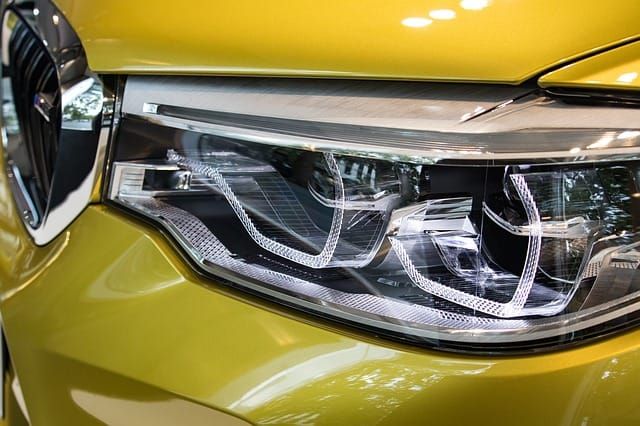
Manufacturers were quick to replace HID and halogen bulbs in vehicle headlights with more efficient LEDs. They were slower with turn signals, but that's changed.
Today, LED turn signals are standard or optional equipment across most major manufacturers — Audi, BMW, Mercedes-Benz, Volvo, Tesla, Toyota, Ford, Hyundai, Kia, and Volkswagen all ship LED indicators on a wide range of models. Audi pioneered sequential "dynamic" LED indicators on the A8 over a decade ago, and adoption is now broad enough that LED turn signals are common across mainstream and luxury segments alike.
If you're reading this, you're most likely retrofitting LEDs into a vehicle that originally shipped with incandescent turn signals — and that's where hyper-flashing comes in.
The benefits of LED turn signals over incandescents are real: a much faster on/off response (which gives following drivers slightly more reaction time), far longer service life, and in many cases brighter output as well.
In fact, some dual-function LED bulbs can even "switchback" between white and amber. They drop into dual-filament sockets like 1157, 3157, or 7443, and use independent LED circuits for the running-light (white) and turn-signal (amber) functions. Note that switchback bulbs only work in sockets that already have two separate circuits — they aren't compatible with single-function turn-signal sockets.
The downside of cheap LEDs is that many use brittle solder joints which can crack under the vibration of automotive use, especially on vehicles with stiff suspension.
And if your car wasn't designed for LEDs, you'll get hyper-flashing — your aftermarket LED turn signals blink much faster than your stock incandescent bulbs did. The good news is that it's an easy fix.
Read more: Do LED Headlights Blind Approaching Drivers?
Why Do LED Turn Lights Hyper Flash?
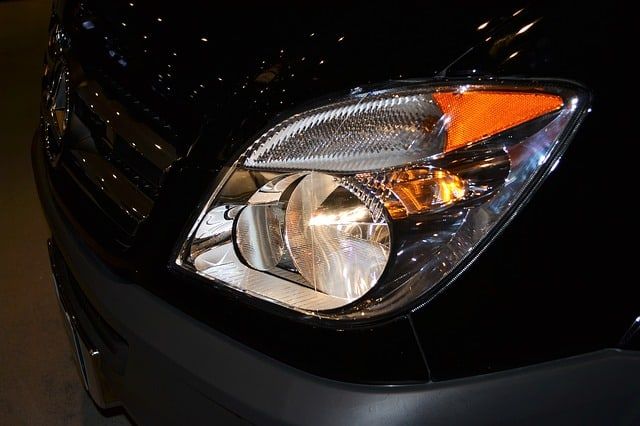
Hyper-flashing happens because the flasher circuit in your car was designed around the electrical load of an incandescent bulb — and an LED draws much less current than that. The exact mechanism depends on how old your vehicle is.
Older vehicles: bimetallic flasher relays
On older vehicles, the turn-signal flasher uses a bimetallic strip that relies on the heat generated by an incandescent bulb's current draw to set the flash rate. An LED's much lower current means the strip cycles much faster than designed, producing the rapid hyper-flash.
Modern vehicles: electronic flashers and the BCM
On newer vehicles, an electronic flasher module or the Body Control Module (BCM) monitors current electronically and interprets the low draw as a burned-out bulb. It flashes rapidly as a warning, and on CAN-bus-equipped cars often raises a "bulb out" fault on the dash as well.
How to tell if your car has CAN-bus
As a rough guide, most vehicles built after 2008 in the EU and after 2010 in North America are CAN-bus equipped. Many post-2005 vehicles already integrate flasher control into the BCM rather than using a discrete plug-in relay, which means there's no flasher unit to swap out.
Is hyper-flashing actually harmful?
Mostly it's just annoying. The faster cycling doesn't damage the LED bulb, and the additional current draw is negligible. The real problem is functional — a hyper-flashing turn signal can fail a state safety inspection, and other drivers may not register it as a turn indicator. So while there's no mechanical reason you have to fix it, you should fix it before driving the car much.
Also read: Why Do My LED DRLs Flicker?
How To Fix Hyper Flashing Turn Lights
To return your turn signals to a normal cadence, there are three practical fixes:
- Replace the flasher relay with an LED-compatible one
- Install load resistors that mimic the incandescent's current draw
- Use CAN-bus-ready LED bulbs that include built-in load matching
Each has tradeoffs around difficulty, cost, and compatibility with modern vehicles. Here's a closer look at each.
Installing an LED Flasher Relay
Swapping the flasher relay for an LED-compatible one is the easiest fix when it's an option. The flasher units are small circular or square boxes with metal prongs that plug into the same socket the stock flasher came out of. Brands like Dewhel (Amazon) sell inexpensive direct-fit modules.
These LED-compatible flashers work with both LED and incandescent bulbs, so a mixed setup (LEDs in the rear, incandescents up front, for example) is no problem.
The catch: many post-2005 vehicles don't have a discrete plug-in flasher relay at all. Flash control is integrated into the BCM, fuse box, or steering-column module, and there's no flasher unit to swap. If your car works that way, you'll need a load resistor or CAN-bus-compatible LED bulb instead.
If you do have a discrete flasher relay, compare the pin diagram of your stock unit against the replacement before ordering — pinouts vary.
Related: Can LED Bulbs Be Used In Tail Lights?
Installing LED Load Resistors
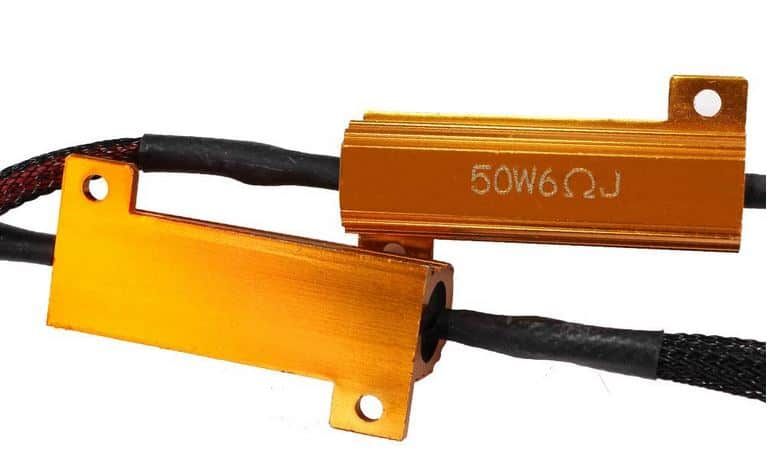
Unlike the plug-and-play flasher relay, load resistors require some wiring. The industry-standard part for 12V automotive turn signals is a 50-watt, 6-ohm resistor — the 50W refers to the resistor's heat-dissipation capacity, and 6 ohms is the resistance value chosen to mimic the roughly 2-amp draw of a standard 21W incandescent turn-signal bulb. Kits like the Huiqados (Amazon) 7443/7444/T10 resistor pack include everything you need.
If your vehicle runs a 24V system — common on heavy trucks and some commercial vehicles — you'll need a resistor rated for 24V, not the standard 12V part.
Each LED bulb gets its own resistor, wired in parallel with it. The basic install:
- Disconnect the battery before working on any wiring.
- Locate the wiring behind the turn-signal socket. Each LED bulb — front and rear — needs its own resistor.
- Wire one resistor in parallel with each LED bulb: connect one resistor lead to the positive (signal) wire and the other lead to chassis ground or the negative bulb wire.
- Mount the resistor onto a bare metal surface, away from plastic trim, wiring harnesses, and carpet. Resistors run hot when the signals are on for any length of time.
- Reconnect the battery and test each indicator. The flash rate should return to normal.
You can also buy vehicle-specific resistor kits with pre-terminated leads if you'd rather skip splicing into the factory harness.
Using CAN-bus-Compatible LED Bulbs
The cleanest fix is to start with LED bulbs that already include built-in load resistors and CAN-bus decoder circuitry. They draw enough current to keep the BCM happy and don't trigger hyper-flash or bulb-out warnings on most vehicles.
When shopping, the spec that actually matters is whether the bulb is explicitly listed as CAN-bus compatible (or "no error code") for your bulb size — 1156, 1157, 3157, 7443/7444, and so on. Beyond that, most LED bulbs are similar; differences are mostly in LED chip quality, aluminum housings for heat dissipation, and projector-style optics.
As one example, Lasfit's CANBUS 7443/7444 LED bulbs are designed to work without separate load resistors and include built-in flicker prevention. CAN-bus-ready bulbs cost more per unit than naked LEDs plus resistors, but they're plug-and-play.
Comparing the Three Fixes
| Fix Method | DIY Difficulty | Cost | Wiring Required | Works on Modern CAN-bus Vehicles |
|---|---|---|---|---|
| LED Flasher Relay | Easy (plug-in) | Low ($10–30) | None | Only if vehicle has a discrete flasher relay |
| Load Resistors | Moderate | Low ($5–15 per bulb) | Yes — parallel-wired at each bulb | Yes |
| CAN-bus LED Bulbs | Easy (plug-in) | Higher ($20–50 per bulb) | None | Yes |
Will Load Resistors Hurt My Fuel Economy?
A common worry is that load resistors defeat the energy-efficiency reason for switching to LEDs in the first place. Strictly speaking, that's true — the resistor burns the "saved" current as heat, and the alternator (and therefore the engine) does see a slightly larger load when resistors are wired in.
In practice, the effect is far below anything you'd ever measure. Turn signals are intermittent, the resistor only draws roughly the same ~21W an incandescent would have, and total accessory load is a small fraction of total engine output. Real-world fuel-economy impact: zero.
And the actual reasons to choose LED turn signals — faster on/off response, longer service life, and brighter output — aren't undone by adding a load resistor.
Are White LED Turn Signals Street-Legal?
In the US, FMVSS 108 (the federal regulation governing vehicle lighting) requires turn signals to emit amber light, both front and rear. Many other jurisdictions have similar requirements. White LED turn signals — and aftermarket bulbs that aren't DOT-marked — may fail safety inspection or earn you a fix-it ticket.
Switchback bulbs are designed around exactly this rule: they emit white only as a daytime running or parking light, and switch to amber whenever the turn signal is active. Single-color white bulbs are fine for DRLs or position lights, but not for turn indicators. Always check that any LED replacement is marked DOT/SAE-compliant for the function you're using it in.
Which Fix Is Right for You?
If your vehicle has a discrete plug-in flasher relay (typically pre-mid-2000s), replacing it with an LED-compatible flasher is the cheapest, fastest fix and works across mixed LED/incandescent setups.
If your vehicle's flashing is controlled by the BCM (most cars built since the mid-2000s), you have two options. Load resistors are cheaper but require wiring at every bulb. CAN-bus-compatible LED bulbs cost more but are completely plug-and-play.
Whichever route you take, hyper-flashing is fixable in an afternoon — and once it's sorted, your turn signals will look and respond the way LED indicators were meant to.