
Do LED Headlights Blind Other Drivers?
A 2024 RAC survey found that 11% of drivers dazzled by oncoming headlights take six seconds to recover — enough to cover 40 car lengths blind. That's the real cost of a poorly fitted LED retrofit.
 Eugen
EugenEugen Nikolajev
Creator of LED Lighting Info
Hi, I am Eugen. I was always one of those kids who had all sorts of weird lighting gadgets for every occasion.
Now, I want to share my knowledge and experience about lighting with you on LED Lighting Info.
Read my editorial standards
Key Takeaways
Good quality LED headlights, installed correctly, are bright but not blinding. If your LEDs are dazzling other drivers, the cause is almost always one of four things: a poor-quality bulb, a misaligned beam, an upside-down installation, or uneven vehicle weight.
LED headlights are bright — significantly brighter than the halogen bulbs they replaced. That improves visibility in poor driving conditions, but it can also cross the line into glare for oncoming drivers.
Plus, with the lifespan and efficiency advantages of LED bulbs, there are many reasons to switch to them.
A 2024 RAC survey of 2,000 UK drivers found that 11% of those dazzled by oncoming headlights take six seconds or more to recover their vision — long enough to cover roughly 160 metres (about 40 car lengths) at 60 mph.
So, do LED headlights blind other drivers?
The four main reasons LED headlights blind other drivers:
- Poor quality or off-road-only bulbs
- Incorrect beam direction or incompatibility with the OEM reflector
- Bulb installed upside down
- Uneven vehicle weight distribution
Can LED Headlights Blind Approaching Drivers?
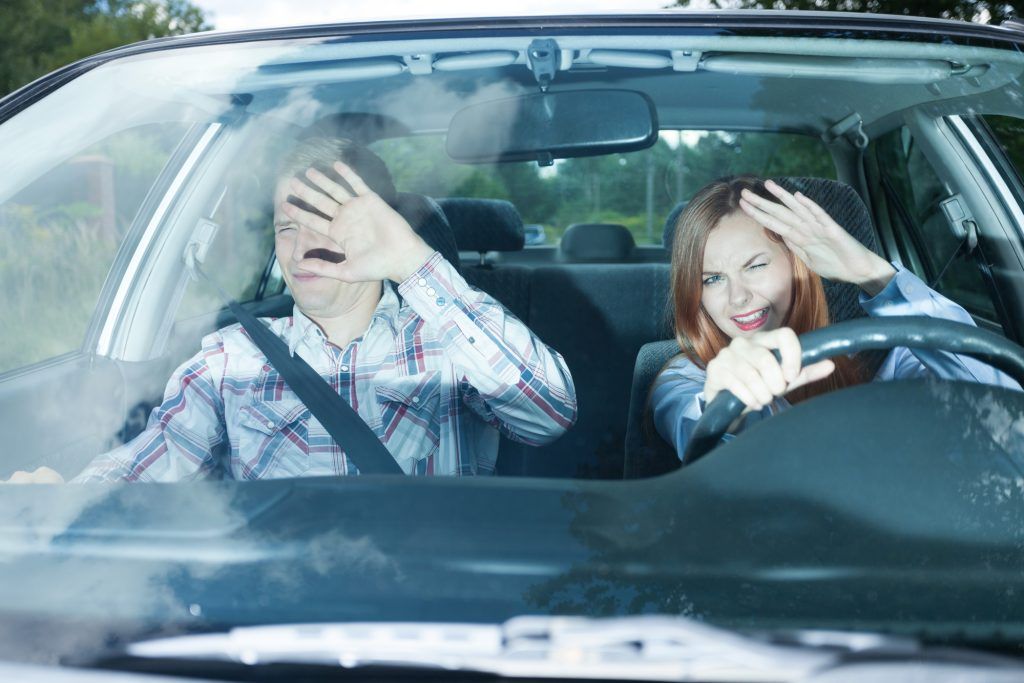
Yes, LED headlights can blind approaching drivers — but that doesn't mean every LED setup will. The causes fall into two camps: bulb-related issues (cheap or poorly-designed bulbs) and human error (incorrect installation or aim). Always buy from a reputable brand and check the bulb is correct for your vehicle.
Adaptive LED Headlights vs. Aftermarket Retrofits
Most of the glare problems covered in this article apply to aftermarket LED retrofits — bulbs swapped into a housing originally designed for halogen. Modern OEM systems behave very differently. Adaptive driving beam (ADB) and matrix LED setups use cameras and individually-controlled LED segments to automatically dim or shape the beam around oncoming vehicles. If your car was factory-fitted with adaptive LEDs, the advice below largely doesn't apply — issues there are usually sensor or calibration faults, not bulb design.
It also matters whether your housing is a projector or a reflector. Projector housings use a lens to focus the beam and tend to handle LED retrofits relatively well. Reflector housings rely on a precisely-shaped bowl behind the bulb, and an LED's flat-emitter geometry can scatter light in ways the reflector wasn't designed for — which is why aftermarket LEDs in reflector housings are far more likely to glare.
Why Are LED Headlights Too Bright?
Not all LED headlights are too bright. The ones that are tend to fall into two groups: bulbs that have been made poorly, and bulbs that aren't designed to be road headlights in the first place.
In both cases, you'll generally find them labelled "for off-road use only" on the packaging — meaning they haven't passed the safety standards required to be road-legal, or they're sold purely for show vehicles.
In the UK, fitting non-compliant LED retrofits in halogen-spec housings is a common cause of MOT failure under the headlamp aim and condition checks. If you're swapping bulbs, the safest route is an OEM-approved LED upgrade from an established brand like Philips or Osram.
Online retailers don't always disclose road-legal status, so shop carefully and stick with trusted brands from reliable stores.
Unoptimized Light Direction
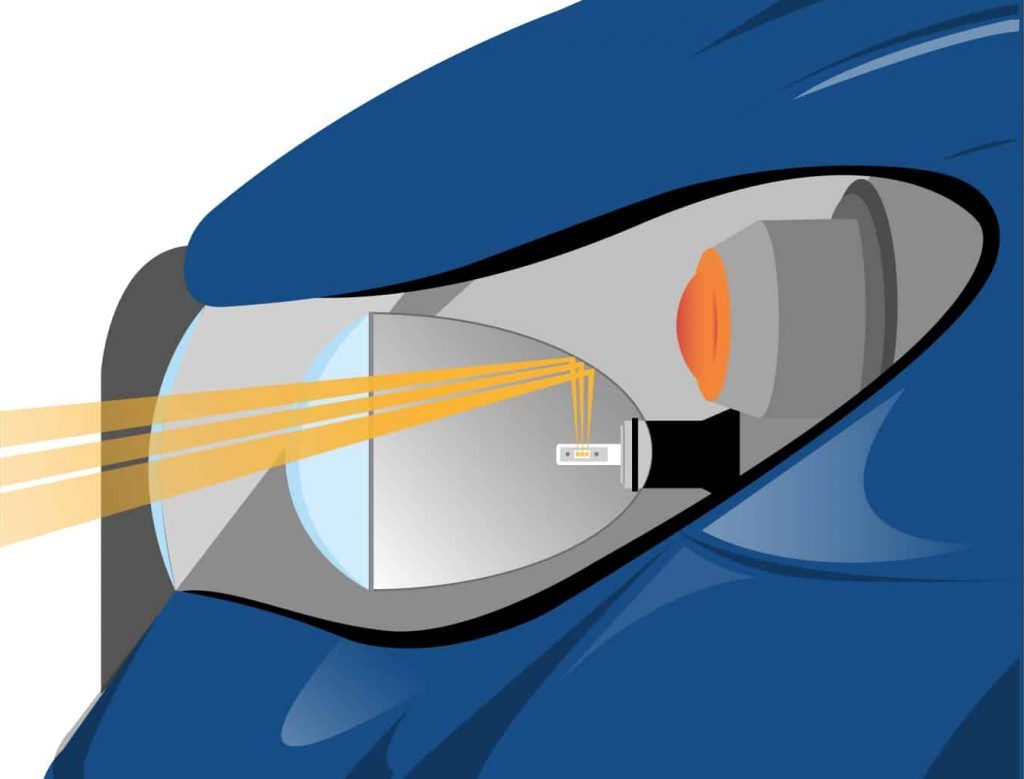
An off-brand bulb can put light where it shouldn't be — instead of falling on the road, the beam can shine straight into the eyes of an oncoming driver.
There's a simple wall test you can do to check headlight aim. You'll need a flat wall, level ground, and some tape or a marker.
- Park 25 feet (7.6 m) from a flat wall on level ground.
- Mark the centre of each headlight on the wall with tape.
- Switch on your low beams.
- Check that the brightest part of each beam — the "hot spot" — sits roughly 2 inches below your marks.
- If the hot spot is at or above the marks, the beams are aimed too high.
Low beams are designed to drop slightly over distance to avoid dazzling oncoming drivers, which is why the hot spot should fall just below the headlight centreline on the wall. If it's consistently too high — and you're sure the bulbs are installed correctly (covered below) — they may not be optimised for your housing and will need replacing.
Also check that the bulbs are compatible with your vehicle. LED bulbs aren't generic. The wrong one won't work consistently with your OEM reflector, which is another reason the beam can end up misdirected.
Also read: Will LED Headlights Void Warranty?
Poor Quality Bulbs
The other problem with badly-made bulbs — or LEDs that aren't safe to be used as road headlights at all — is sheer brightness. Cheaper brands often advertise their LEDs as "ultra-bright" or "the brightest you can buy." Avoid them. Good quality LED headlights are bright enough already; this isn't a competition. Reflections and the impact on other drivers matter.
Aim for around 2,000–4,000 lumens per LED headlight. By comparison, a typical halogen headlight bulb puts out roughly 1,000–1,500 lumens, so a quality LED is generally 1.5× to 3× brighter depending on which halogen it's replacing — and can also be brighter than HID in some setups, while producing less stray light when the optics are properly matched.
Read more: Do LED Bulbs Work In Projector Headlights?
It's also important not to confuse lumens and Kelvins. Lumens measure brightness; Kelvins measure colour temperature. Cool-white automotive LEDs typically sit between 5000K and 6500K, with around 6000K being a popular aftermarket choice. Most OEM LED headlights run a little warmer — closer to 4300K–5800K — for better visibility in rain and fog.
While both lumen and Kelvin specs run into the thousands, they describe completely different things. Don't let similar-looking numbers fool you — and avoid any LED advertising more than around 6,000 lumens, which is well past anything road-legal.
Installation and Usage Errors That Cause Glare
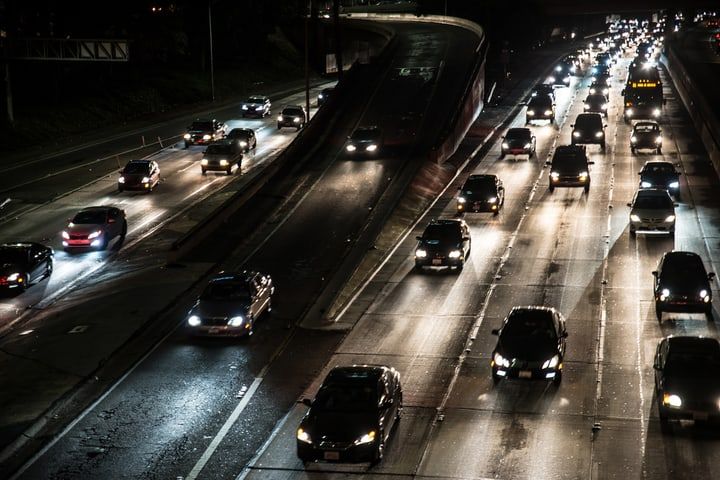
There are other potential causes of LED headlight glare that aren't the bulb's fault — they're driver errors.
Installing the Bulb Upside Down
It's surprisingly easy to install an LED headlight upside down if you aren't paying attention. But it can completely mess with the direction of the beam, causing it to reflect incorrectly and potentially blind oncoming drivers.
It can also mean a low beam shines as bright as a high beam. In the US, most state laws require drivers to dip from high to low beam within 500 feet of an oncoming vehicle (and 200–300 feet when following one). The UK Highway Code (rules 113–116) doesn't specify a distance — it simply requires drivers to dip headlights so they don't dazzle other road users. Either way, an upside-down bulb will inadvertently put you in breach.
The diodes should be aligned horizontally — on the sides of the bulb at the 3 and 9 o'clock positions — with any shield at the bottom. Some bulbs may need a slight rotation to fine-tune the cutoff line, so check the beam against a wall after installing. If the bulb was sold for a left-hand-drive market, the shield orientation can differ; check the manufacturer's instructions before fitting.
Uneven Weight Distribution
The other human error is less common but easy to overlook: weight distribution.
Many drivers assume a car is already evenly weighted. Because the driver always sits in the front, the vehicle stays roughly flat. But that assumption breaks down when carrying a heavy load — particularly in trucks and estates.
Too much weight in the back of a vehicle causes it to sit lower, which angles the front upwards. The difference may be only a few millimetres at the headlight, but the angle change is amplified over distance — oncoming drivers see a noticeably brighter beam.
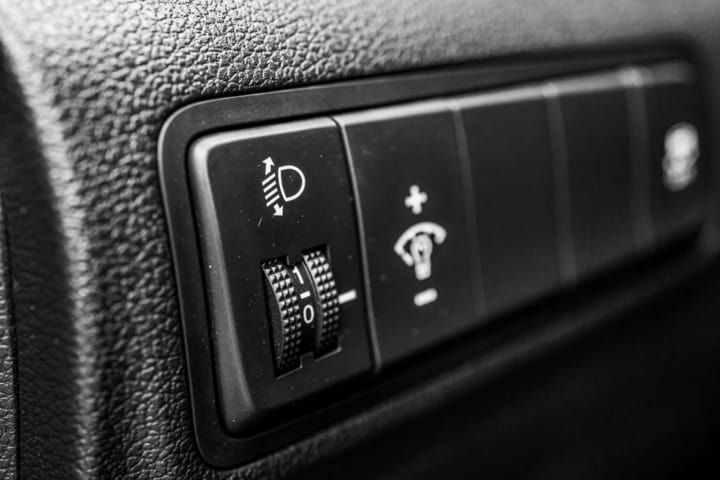
Many European cars and larger vehicles include a manual headlight leveler — a small dial with numbers and a headlight icon — to compensate. The higher the number, the lower the beam is aimed.
Headlight Leveling Dial Guide
Manual headlight levelers are standard on European vehicles (and required by EU/UK regulations on cars with certain headlamp types) but uncommon on US-market vehicles. Settings vary by manufacturer, so always check your owner's manual — the table below shows the typical mapping, but it's not universal.
| Setting | Load Condition |
|---|---|
| 0 (lowest) | Driver only / front seats occupied, no luggage |
| 1 | All seats occupied, no luggage |
| 2 | All seats occupied, full luggage load |
| 3 (highest) | Driver only, full luggage load (or towing) |
Don't forget to adjust the dial when you're carrying a heavy load in the back, and run the wall test again if you're not sure the new setting is right.
Final Words
LED headlights have many advantages over older bulbs — but quality and correct installation matter just as much as raw output.
Don't be tempted by adverts for the brightest bulbs without doing your research. Brighter isn't always better, and too bright can be genuinely dangerous to other road users.
FAQ
Will aftermarket LED headlight bulbs fail an MOT in the UK?
Retrofitting LED bulbs into halogen-spec housings that weren't type-approved for LEDs is a common cause of MOT failure. The lamp must produce a clear cutoff, the correct beam pattern, and the right colour temperature — and most cheap LED retrofits fail at least one of those checks. OEM-approved LED upgrade kits from brands like Philips and Osram are the safest route.
Are projector or reflector housings better for LED bulbs?
Projector housings handle LED retrofits more forgivingly because the lens focuses the beam and tames stray light. Reflector housings rely on the bulb sitting in a precisely-designed bowl, and an LED's flat-emitter geometry often scatters light in directions the reflector wasn't designed to control — which is the most common cause of glare from aftermarket LEDs.
What are adaptive (matrix) LED headlights?
Adaptive driving beam (ADB) and matrix LED systems are factory-fitted headlights that automatically reshape or dim the beam around oncoming vehicles using cameras and individually-controlled LED segments. They reduce glare without the driver having to manually toggle high beams.
How can I tell if my LED headlights are aimed correctly?
The simplest check is the 25-foot wall test described above: park 25 feet from a flat wall on level ground, mark the centre of each headlight on the wall, and switch on the low beams. The brightest part of each beam should sit roughly 2 inches below the marks. If you're not confident, most garages can perform a precision aim using a beam-setter.
What lumen output should I look for in an LED headlight bulb?
Around 2,000–4,000 lumens per bulb is the usable range for road driving. A typical halogen puts out 1,000–1,500 lumens, so a good LED is 1.5× to 3× brighter without crossing into glare territory. Anything advertised over 6,000 lumens is almost certainly not road-legal and should be avoided.