
Are Floor Lamps Safe For Children?
Even modest light levels as low as 5 lux can suppress an infant's melatonin — which makes the floor lamp in the corner more consequential than it looks.
 Eugen
EugenEugen Nikolajev
Creator of LED Lighting Info
Hi, I am Eugen. I was always one of those kids who had all sorts of weird lighting gadgets for every occasion.
Now, I want to share my knowledge and experience about lighting with you on LED Lighting Info.
Read my editorial standards
Key Takeaways
Floor lamps can be safely used in a child's room with the proper precautions. Lamps should either be placed out of reach, behind other furniture, or anchored to a wall hook. Certain lamps with wide, heavy bases may be OK without these measures, but cords must always be hidden, and the bulb should be an LED so it runs cool to the touch.
Whether you're expecting your first child and planning your first nursery, or your child has asked for a themed bedroom makeover, one of the first things to think through is lighting.
In a nursery or child's bedroom, lighting has to balance safety, sleep support, and parental practicality — which makes the choice more nuanced than most rooms in the house.
One option you may consider is a floor lamp (or two), but are they safe for children?
In this article, I'll cover:
- Whether it's safe to use a floor lamp in a nursery
- Age-specific guidance from newborn through toddler
- The right brightness, color temperature, and bulb type for a child's room
- A step-by-step guide to childproofing an existing floor lamp
- How to choose an anti-tip floor lamp
Is It Safe To Put A Floor Lamp In A Nursery?
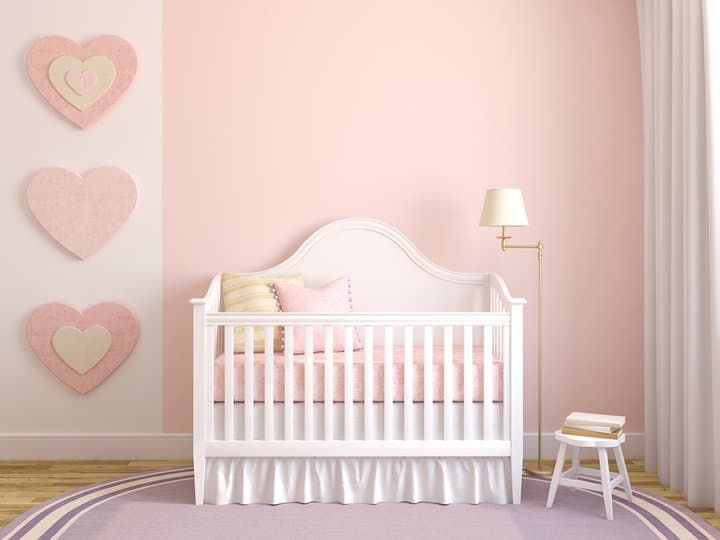
When setting up a nursery, you need to strike a balance between the needs of the child and that of the parents. It's the baby's room, but the parents will spend a lot of time there too — soothing, feeding, and changing — so the lighting has to work for everyone.
It's worth noting that a table lamp placed on a high dresser or shelf is often actually safer than a floor lamp, because it can be kept entirely out of a baby's reach. Floor lamps stand at child level and can be pulled, climbed, or knocked into — so they require extra precautions to be used safely.
Floor lamps are generally safe in a nursery while the baby is in their first few months and not yet mobile. As soon as they start crawling and pulling up to stand, a floor lamp becomes a hazard unless you've appropriately child-proofed it — especially with younger toddlers, who love to pull, bite, chew, and grab onto anything.
A toppled lamp can strike a child or break, sending broken glass and exposed wiring across the floor. Damaged cords or unprotected plugs can also create a risk of electric shock. Provided you take the proper precautions — and I'll walk you through those below — a floor lamp can be used in a nursery safely.
Age-Specific Floor Lamp Guidance
The risk a floor lamp poses changes dramatically as your child develops. Use this as a quick reference:
| Age | Mobility | Floor Lamp Guidance |
|---|---|---|
| 0–6 months | Not mobile | Any safe placement is fine; focus on warm, dim lighting and a stable base |
| 6–18 months | Crawling, pulling up to stand | Must be anchored to wall or furniture; cord must be hidden; bulb must be cool-running (LED) |
| 18 months – 3 years | Walking, climbing, curious | Full child-proofing essential: anchor, hide cord, cover plug, or move the lamp out of the room |
| 3 years+ | Understands basic instructions | Standard precautions; teach not to touch or pull on the lamp |
What Brightness Is Best For A Child's Room?
Floor lamps are a good choice for a child's bedroom because they're less harsh than a pendant light in the center of the ceiling. A pendant sits directly above the baby when they're lying on their back in the cot, while a floor lamp can be placed off to the side, washing the room with softer, indirect light.
Still, you need to choose the right bulb and the right lamp. Ideally, look for one with a shaded or diffused bulb rather than an exposed one. A shade also offers a small amount of protection if the lamp is knocked over.
Brightness (lux and lumens)
In terms of bulb brightness, the lumens you need depend on the size of the room. General bedroom guidance from CIBSE is around 100 lux, but a nursery needs more nuance: aim for 100–200 lux during daytime play and feeding, and drop well below 20 lux at night — ideally with a dim red or amber nightlight. Even modest light levels (as low as 5 lux) can suppress an infant's melatonin and disrupt sleep.
To estimate the daytime total, multiply the length and width of the nursery in meters to get the area, then multiply that by 100 to get the maximum lumens needed across all lights in the room. For example, a 3m × 4m nursery = 12m² × 100 = 1,200 lumens total.
For night feeds, a floor lamp with a dimmer switch or a smart bulb you can dial down from your phone is invaluable. You get enough light to navigate the room without flooding it and waking the baby.
Color temperature
Light color matters too. Avoid bright white or daylight bulbs (5000K or higher) — they're rich in blue wavelengths that suppress melatonin and can disrupt an infant's sleep. Aim for a soft white bulb in the 2700K–3000K range, which gives a warm, calming glow that's gentler on your baby's eyes and won't interfere with their sleep cycles.
Bulb type (heat matters)
Stick to LED bulbs. They stay cool to the touch, unlike halogen or incandescent bulbs, which reach surface temperatures hot enough to burn skin on contact and can scorch fabric if knocked against a shade. LEDs also use far less energy and last years longer — there's no good reason to put anything else in a child's room.
How To Child-Proof An Existing Floor Lamp
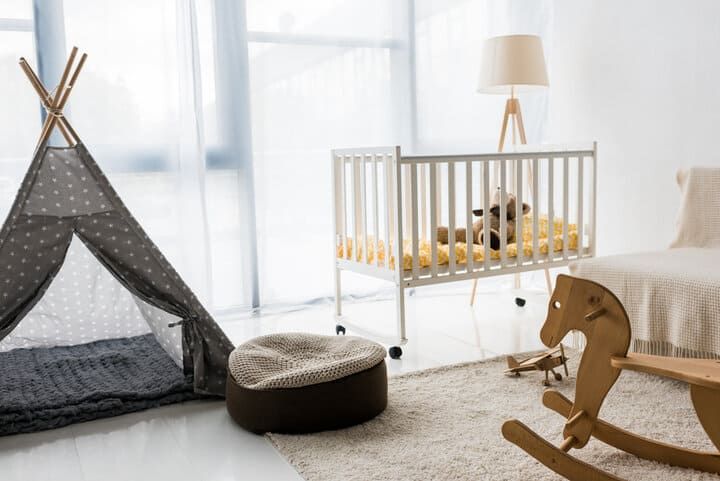
Child-proofing a floor lamp comes down to three jobs: stabilize it so it can't be tipped, secure the cord so it can't be pulled or wrapped around, and cover the plug so curious fingers can't reach the connectors. Work through these in order.
Step 1: Stabilize the base
Start with a lamp that has a wide, solid base. The wider the base, the harder it is to topple — but watch the weight. A lamp heavy enough to be unliftable but still light enough to tip is the worst combination, because a falling weight that size can cause real injury.
Where possible, position the lamp behind other furniture so it physically can't be reached. If that's not possible, anchor it to a wall stud or sturdy piece of furniture using a cable tie or a length of clear nylon thread tied to a wall hook. Done well, the anchor is barely visible.
Step 2: Secure the cord (and prevent strangulation)
Loose or dangling cords are a strangulation hazard — small children can wrap them around their necks. Keep cords anchored tight to the lamp pole and the wall, never trailing across the floor where a child could grab them or become tangled.
If the cord hangs loose from the bulb housing, bind it close to the central pole with cable ties. Many floor lamps already route the cable through the fixture, with the cord exiting at the base. From there, run it directly to the nearest wall and use cable clips to keep it tight against the baseboard until it reaches the outlet. Don't cover a long cord with a rug — that's a fire risk, not a safety fix.
Once you reach the outlet, keep the cord pinned vertically with a self-adhesive cord channel so there's no loose loop dangling within reach. Alternatively, sidestep the problem entirely with a cordless, battery-powered floor lamp.
Step 3: Cover the plug
Once a child can grip and pull, they can yank a plug out of the wall and reach the exposed pins. Plug covers solve this with a clip that locks over both the outlet and the plug. Follow the manufacturer's instructions — most install in under a minute.
Bonus: Check safety certifications
Whatever lamp, plug cover, or cord accessory you buy, check it carries the right safety mark for your region — UL listed in the US and Canada, CE or UKCA marked in the UK and EU. Cheap, uncertified electrical accessories are exactly the wrong place to save money in a child's room.
How To Select An Anti-Tip Floor Lamp
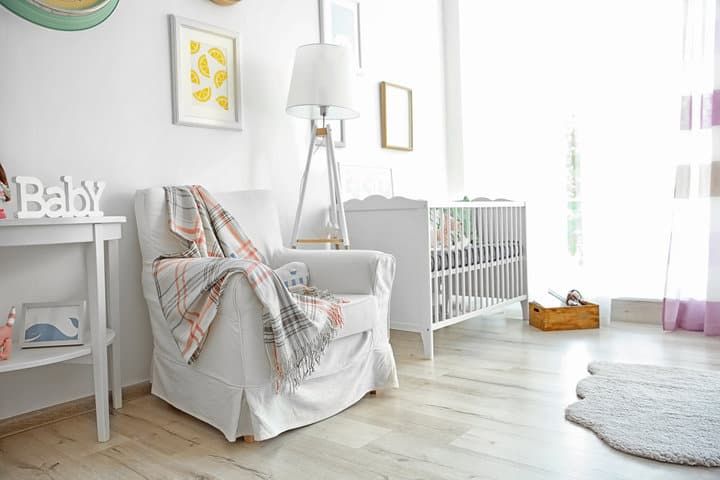
Floor lamp designs vary widely, and some are far harder to tip than others. When choosing one for a child's room — or anywhere children will spend time, since they aren't confined to their own bedrooms — pick a shape that resists toppling.
Avoid square or tripod lamps. They're sturdy if you grab them from a corner, but pull them toward a flat side of the base and they topple easily.
The best lamps have a large flat base with a slim pole rising from the center. Something like this brushed nickel lamp or this wooden arc lamp is a good choice. When a crawling baby or standing toddler pulls on the pole from low down, the pressure pushes the flat base into the floor instead of tipping it over. You'd need leverage from much higher up to topple it — and by the time your child is tall enough for that, they should know better.
Some lamps have the pole at the edge of a flat base, like this overhanging floor lamp. These are easier to tip from the pole side but much harder to tip from the far side. If you're placing a lamp in a corner with the pole tucked in, this style is very difficult for a child to pull down.
Quick Safety Recap
If you only do three things:
- Hide the cord. Run it tight to the pole, along the baseboard, and into a cord channel. A dangling cord is the single biggest hazard in this list — it's both a strangulation risk and a tipping risk.
- Anchor the lamp. Place it behind furniture, secure it to a wall hook, or choose a model with a wide flat base. A lamp that can't tip can't fall on your child.
- Use a soft-white LED. 2700K–3000K supports sleep and stays cool to the touch — far safer than halogen or incandescent bulbs, which can burn.
Final Words
If you're worried about putting a floor lamp in a nursery, that's a good sign — it means you're aware of the potential hazards. You don't need to avoid them entirely, though. With the right bulb, a stable base, and a properly managed cord and plug, a floor lamp is a perfectly safe and often better-suited choice than a harsh overhead pendant for a child's room.
My rule of thumb: if I can't pull it over or tug the cord loose with one hand, neither can a toddler.