
Can You Use LED Light Bulb In The Microwave?
That microwave bulb sits behind a perforated metal mesh acting as a Faraday cage — the radiation bouncing around inside the cavity never actually reaches it.
 Eugen
EugenEugen Nikolajev
Creator of LED Lighting Info
Hi, I am Eugen. I was always one of those kids who had all sorts of weird lighting gadgets for every occasion.
Now, I want to share my knowledge and experience about lighting with you on LED Lighting Info.
Read my editorial standards
Key Takeaways
Yes — LED bulbs are safe to use in a microwave oven, and they're the best replacement choice. The bulb sits outside the cooking cavity, behind a metal mesh that acts as a Faraday cage and blocks the microwaves from ever reaching it. For most North American microwaves, look for a 3–5W LED with an E17 intermediate base, rated for enclosed fixtures.
You're staring at a burnt-out microwave bulb and wondering whether the cheap LED replacement on the shelf will actually work in there — or whether the microwaves will fry it the moment you hit start.
The short answer is good news, and the long answer is a quick crash course in how the inside of your microwave is built.
Are Bulbs Exposed To Microwaves?
It looks like the bulb shines into the cooking cavity, so the natural assumption is that it must be in there with the food. It isn't.
The bulb is mounted just outside the main cavity, tucked behind a perforated metal mesh or grill. Light passes through the holes so you can see your food cooking, but the bulb itself sits in its own compartment, separated from the cooking space.
Because of that physical separation, the bulb is not exposed to the microwave radiation inside the oven. It is isolated from the rays that could otherwise have heated the LED.
Will An LED Bulb Get Hot In A Microwave?
The bulb is not in the path of the microwaves themselves, but a microwave oven still produces heat — so the bulb does warm up a little. Most of that warmth comes from two sources: residual heat conducted through the cavity wall, and steam escaping from the food being heated.
On many models, the cooling fan also pushes warm air past the bulb compartment on its way to the outside vents, which can raise the bulb's temperature further. Layouts vary by manufacturer, so this is more pronounced on some microwaves than others.
None of this is enough to cook the bulb, but it does mean the compartment runs warmer than a typical lamp socket. That's why bulb selection matters — more on the right specs further down.
Related: Can LED Bulbs Be Used In Ovens?
Can Microwaves Interfere With An LED Bulb?
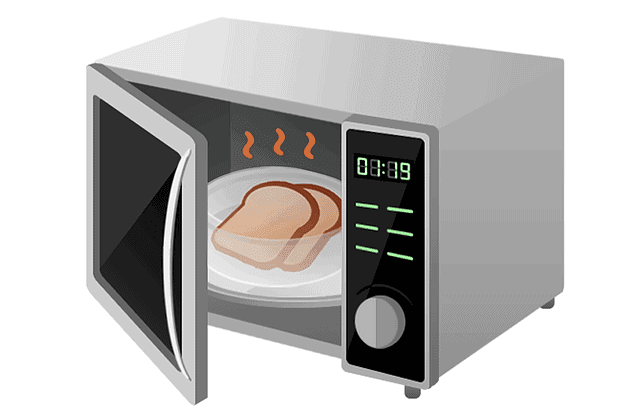
The cooking cavity is built from steel coated with a baked-on white enamel or powder finish. The metal walls reflect microwaves, bouncing them around inside the cavity so the food is heated efficiently.
Microwave ovens heat food through a process called dielectric heating: the alternating electromagnetic field at 2.45 GHz causes polar molecules in the food — mostly water — to rotate as they try to realign with the field, about 2.45 billion times per second. The friction between those rotating molecules is what produces heat. You can read a more detailed walkthrough on how microwave ovens work.
So how does a perforated metal mesh, with visible holes, keep those microwaves out of the bulb compartment? It comes down to wavelength. Microwaves at 2.45 GHz have a wavelength of roughly 12 cm (about 4.8 inches), while the holes in the mesh are only 1–2 mm across — far smaller than the wave can fit through.
The mesh therefore acts as a Faraday cage: it blocks the microwave radiation while letting visible light pass through unimpeded. The same principle is at work in the wire mesh layered into the microwave's door, which is why you can watch your food cooking without the radiation leaking into the kitchen.
The result: once the microwaves are bouncing around inside the cavity, the bulb is safely tucked behind a Faraday cage and the radiation never reaches it.
Is It Safe To Use LED Bulbs In A Microwave?

LEDs are not just safe in a microwave — they are the best of the three common bulb types you might consider. Each alternative has a real drawback in this specific environment.
CFLs contain a small amount of mercury vapor — typically 3–5 mg per bulb. If a CFL breaks, even in the bulb housing behind the mesh, you're dealing with mercury and broken glass that need careful cleanup, and the EPA recommends ventilating the area before handling the debris. LED bulbs contain no mercury, so they avoid that hazard entirely.
Incandescent bulbs use a thin tungsten filament that is fragile under repeated mechanical stress. Now think about how often a microwave door is yanked open and slammed shut in an average household — that's a lot of vibration and shock for a delicate filament. LEDs are solid-state with no filament to break, which is why they tend to outlast both alternatives in this fixture.
Here is how the three bulb types compare for use in a microwave light compartment:
| Feature | LED | CFL | Incandescent |
|---|---|---|---|
| Typical wattage | 3–5W | 9–13W | 25–40W |
| Lifespan | 15,000+ hours | 8,000–10,000 hours | 1,000–2,000 hours |
| Mercury content | None | 3–5 mg per bulb | None |
| Vibration resistance | Excellent (solid-state) | Moderate (glass tube) | Poor (filament breaks) |
| Warm-up time | Instant, full brightness | Slow (30–60 seconds) | Instant |
| Microwave-environment risk | None of note | Mercury release if broken | Filament fatigue from door slams |
What LED Bulb Should You Buy For Your Microwave?
"Any LED bulb" is not quite the right answer. The bulb compartment in a microwave is small, runs warmer than a typical lamp, and uses a less common base size. Before you order a replacement, check four things:
- Base type: Most North American microwaves use an E17 intermediate base — smaller than a standard E26 lamp base, larger than a candelabra E12. Pull the existing bulb and check the markings on the metal cap before buying.
- Wattage equivalent: Match the original bulb's output. A 25W or 40W incandescent equivalent is typical, which translates to roughly 3–5W in an LED — usually around 200–450 lumens.
- Physical size: Microwave bulb compartments are tight. LEDs with bulky aluminum heatsinks at the base may not physically fit even when the base type is correct. Measure the compartment, or take the old bulb to the store, before committing.
- Temperature rating: Look for an LED rated for enclosed fixtures and a higher ambient temperature. A standard LED rated only to about 45°C ambient may degrade faster in the warm bulb compartment.
Some manufacturers sell LEDs marketed specifically for appliance use. There is no special standard behind that label — it generally just means the bulb hits the spec checklist above (small footprint, intermediate base, enclosed-fixture rated). If a generic LED meets those four criteria, it will work the same.
Here is one example of an LED bulb on Amazon commonly used to replace incandescents in microwave lights, with bright white output.
How To Replace The Microwave Bulb
Access depends on the style of microwave. Before doing anything, unplug the appliance from the wall.
- Newer / built-in (over-the-range) models: Remove the top panel to expose a small trapdoor over the bulb. Unscrew the old bulb and screw in the new one — no internal access required.
- Older / standalone countertop models: Remove the entire outer casing to reach the bulb holder. This exposes the high-voltage capacitor, so the safety steps below apply.
If you're working on the second style, only swap the bulb. Do not attempt to repair other internal components.
⚠️ Safety Warning: Even after a microwave is unplugged, the internal high-voltage capacitor can hold a charge of 2,000 volts or more — enough to be lethal to touch. The capacitor must be safely discharged before any work that exposes it. If you are not trained for that procedure, call a qualified appliance technician rather than improvising.
Also read: Can You Use LED Bulbs In Range Hoods?
Final Words
A burnt-out microwave bulb is the right moment to switch to an LED. The radiation never reaches the bulb compartment, the lower wattage runs cooler, and the solid-state design shrugs off the door slams that wear out filament bulbs. As long as you match the base size, wattage equivalent, physical footprint, and temperature rating, you'll likely never think about that bulb again.
FAQ
What size LED bulb fits in a microwave?
Most North American microwaves use a small E17 intermediate base bulb, typically rated 25–40 watts (incandescent equivalent) or 3–5W as an LED. Pull the original bulb first and check the base markings, and measure the bulb compartment for clearance — LEDs with large heatsink bases may not physically fit even when the socket is correct.
Can I use any LED bulb in a microwave light?
Not quite. Choose an LED rated for enclosed fixtures and a higher ambient temperature, since the bulb compartment runs warmer than a typical lamp. A standard LED rated only to about 45°C ambient may degrade faster in that environment, and an oversized bulb may not fit the compartment at all.
Why does my microwave bulb keep burning out?
Frequent failures usually trace back to vibration from the door slamming, heat buildup from the cooking cavity, or a marginal voltage feed. Switching from an incandescent to an LED resolves the vibration issue, since LEDs are solid-state with no filament to fatigue.
Is a CFL safe to use in a microwave instead of an LED?
It works, but it's the weaker choice. CFLs contain a small amount of mercury vapor — typically 3–5 mg per bulb — which becomes a cleanup hazard if the bulb breaks. LEDs contain no mercury, use less energy, and last longer in the warm, vibration-prone bulb compartment.
Do microwaves leak through the bulb mesh?
No. Microwaves at 2.45 GHz have a wavelength of about 12 cm, while the holes in the protective mesh are only 1–2 mm across. The mesh acts as a Faraday cage that blocks the radiation while letting visible light pass through — the same principle used in the door window.