Can You Use LED Bulbs In Range Hoods?
That range hood socket runs 120V just fine with a standard LED — the built-in driver handles the conversion, no external hardware needed. The real spec to check is heat tolerance, not voltage.
 Eugen
EugenEugen Nikolajev
Creator of LED Lighting Info
Hi, I am Eugen. I was always one of those kids who had all sorts of weird lighting gadgets for every occasion.
Now, I want to share my knowledge and experience about lighting with you on LED Lighting Info.
Read my editorial standards
Key Takeaways
Yes, LEDs can absolutely work in a range hood, but only if you match the base type, choose a bulb rated for heat and humidity, and confirm your fixture is compatible. The good news: most new range hoods on the market today ship with LED lighting standard, and a wide range of LED replacements are sold specifically for older hoods.
Range hood bulbs take a beating. Heat, steam, grease, and vibration all hit them harder than almost any other fixture in the home, and they burn out faster because of it.
If you've been replacing the same incandescent or halogen bulb every few months, you're probably wondering whether a long-lasting LED can take its place — and whether you can just change the bulb without rewiring anything.
Below, I'll walk through what makes range hood lighting tricky, why most modern LEDs handle it fine, and exactly what to check before you buy a replacement.
What Are The Problems With Range Hoods?
Range hood bulbs deal with four conditions you don't typically find in normal household fixtures: heat, humidity, grime, and vibration. Each one stresses bulbs in a different way, and a good replacement has to handle all four.
| Factor | Why It's a Problem | What to Look For in a Bulb |
|---|---|---|
| Heat | Degrades LEDs and shortens lifespan; oil cooking can push cooktop temperatures past 300°C | High Tc rating, solid heat sink, range-hood-rated |
| Humidity | Steam can corrode metal contacts and damage electronics | IP44 or higher ingress protection rating |
| Grime | Aerosolized oil deposits create hot spots that can shatter glass | Sealed or easy-clean lens, shatterproof construction |
| Vibration | Fan motors transmit constant low-level vibration that can damage filaments and loose components | Solid-state LED with no fragile filament, vibration-resistant rating |
Heat
Steam from boiling water leaves the pan at 212°F (100°C), and high-heat cooking like frying or searing can push cooktop-level temperatures well above that. The air reaching the hood canopy is cooler than the source — diluted as it mixes with kitchen air on the way up — but bulbs still need solid heat tolerance, especially during prolonged cooking sessions or when working with hot oil.
Humidity
Steam carries water droplets that can corrode metal bulb contacts and damage internal electronics over time. This is why an IP rating matters — it tells you how well the bulb is sealed against moisture ingress.
Grime
Cooking releases tiny aerosolized oil particles that get carried upward by steam and hot air, settling on cooler surfaces — including the hood's lights. Oil deposits create localized hot spots, which can crack glass and stress the bulb's components.
Vibration
The mechanical fan that gives a range hood its job also transmits constant low-level vibration into the bulb sockets. That movement can loosen connections and break delicate filaments. LEDs have an inherent advantage here — there's no filament to fail — but cheap LEDs with poorly soldered drivers can still fail early.
Are LEDs Safe To Use in A Range Hood?
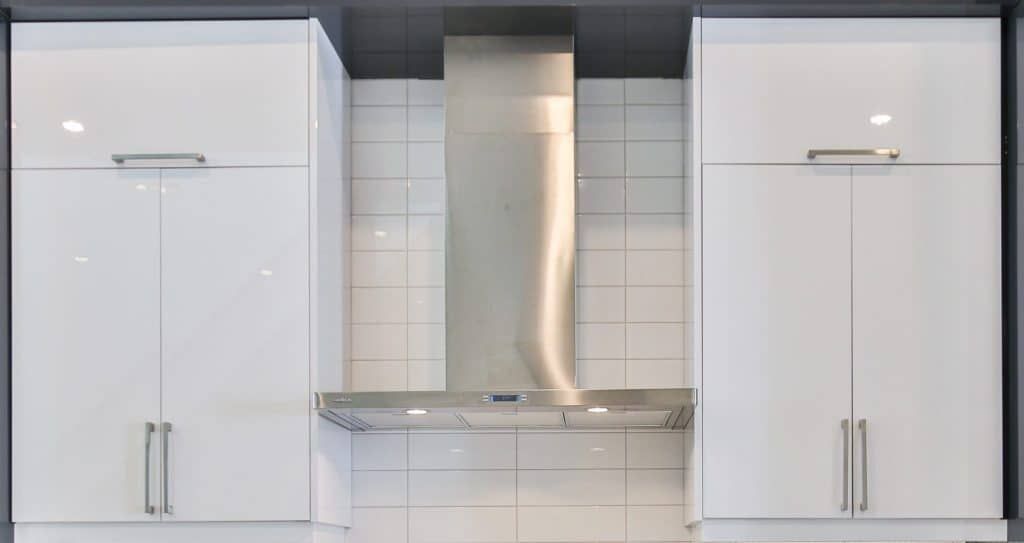
Most modern range hoods are LED compatible, and replacing a burned-out bulb with an equivalent LED is generally safe and straightforward. Swapping a consumable bulb in its existing socket is normal user maintenance — not a modification — and under U.S. consumer protection law (the Magnuson-Moss Warranty Act), a manufacturer can't void your warranty for a like-for-like bulb replacement. Adding an external driver or rewiring the fixture is a different story; that kind of change can affect coverage.
The voltage myth
There's a common misconception that LEDs can't handle 120V mains and need a separate driver. This conflates two different things. Individual LED chips do operate at very low voltage — typically 2 to 3.6V DC — but screw-in LED replacement bulbs (E26 base, the standard household type) include a built-in driver that converts 120V AC down to whatever the LEDs need. A standard LED appliance bulb will work fine in a 120V range hood socket without any external hardware.
The driver concern only applies to low-voltage fixtures — like 12V MR16 systems with a magnetic transformer — where the existing transformer may not be LED-compatible. If your range hood uses a standard 120V socket (which the vast majority do), you can ignore the voltage question entirely.
The real concern is heat
What you actually need to watch for is heat tolerance. LEDs perform poorly at high temperatures — excess heat increases the rate of lumen degradation and shortens the bulb's lifespan. A range hood LED needs adequate heat management — usually a metal heat sink at the base — and a maximum operating temperature high enough to handle prolonged cooking.
This is especially important if the bulbs sit inside an enclosed fixture. Enclosed lenses do a better job of keeping steam and grease off the bulb, but they also trap heat. Look for an LED rated for enclosed fixtures specifically — the packaging will say so.
Check Your Bulb Base Type First
Before you start shopping, pull the existing bulb and identify its base. This is the most common reason people end up returning replacement bulbs — the base doesn't fit the socket. Range hoods commonly use one of these:
- E26 / E27 — standard medium screw base, same as most household lamps
- E12 — candelabra screw base, smaller than E26
- G8 / G9 — small bi-pin bases, common in halogen-style hood capsules
- GU10 — twist-and-lock base used in some recessed-style hood lights
The base type is usually printed on the existing bulb or in the hood's manual. Once you know it, the rest of the spec hunt gets much easier.
How To Select An LED Bulb For A Range Hood
If you want the simplest path, just buy an LED that's marketed specifically as range-hood-compatible — like this pack of 4 on Amazon. The manufacturer has already accounted for heat, vibration, and humidity. If you'd rather evaluate options on your own, here's what to check on the spec sheet:
- Base type and dimensions – Match what came out of the socket. A correct base is non-negotiable; check overall length and diameter too, since a too-large bulb may not fit the housing.
- Heat management – Look for a metal heat sink at the base and a maximum operating temperature listed on the box (the higher, the better). Avoid the cheapest no-name LEDs — they tend to skimp on heat dissipation.
- IP rating – IP44 or higher protects against splashes and steam. This is the spec to look for if your hood sits close to the cooktop or you cook with a lot of steam.
- Vibration resistance – Avoid LEDs with thin glass envelopes; opt for shatterproof or vibration-resistant models, especially if your hood's fan is powerful.
- Wattage equivalency – LEDs use far less power for the same light output. Roughly: 25W incandescent ≈ 3–4W LED, 40W ≈ 5–7W LED, 60W ≈ 8–10W LED. Check the lumen output on the spec sheet to confirm — aim for at least 400–500 lumens per bulb for kitchen task lighting.
- Color Rendering Index (CRI) – CRI 80 is the residential standard and works for general use, but for a range hood — where you need to see your food clearly and judge whether meat is properly seared or vegetables are caramelizing rather than charring — an LED with CRI of 90 or higher is ideal.
- Color temperature – I recommend somewhere in the 4,000K–5,000K range for a balanced white color. This range gives you crisp, neutral light that renders food colors accurately — without the orange cast of warm bulbs (which can make food look more cooked than it is) or the harsh blue tint of pure daylight bulbs at 6,500K.
Also read: Can LED Bulbs Be Used In Ovens?
Final Words
LEDs work well in range hoods as long as you get three things right: match the base type, choose a bulb rated for heat and humidity (IP44+, with a real heat sink), and stick with reputable brands rather than the cheapest option on the shelf. A standard 120V LED replacement does not need an external driver, and swapping a bulb in its existing socket won't void your warranty.
Get those right and your new bulbs should outlast the incandescents or halogens they replaced by years — with lower energy use and better color rendering for the food on your stovetop.