
Do LED Bulbs Have Filaments?
Those glowing "filaments" inside a retro LED bulb aren't wires at all — they're narrow tubes packed with tiny LED chips, mimicking the look without any of the heat.
 Eugen
EugenEugen Nikolajev
Creator of LED Lighting Info
Hi, I am Eugen. I was always one of those kids who had all sorts of weird lighting gadgets for every occasion.
Now, I want to share my knowledge and experience about lighting with you on LED Lighting Info.
Read my editorial standards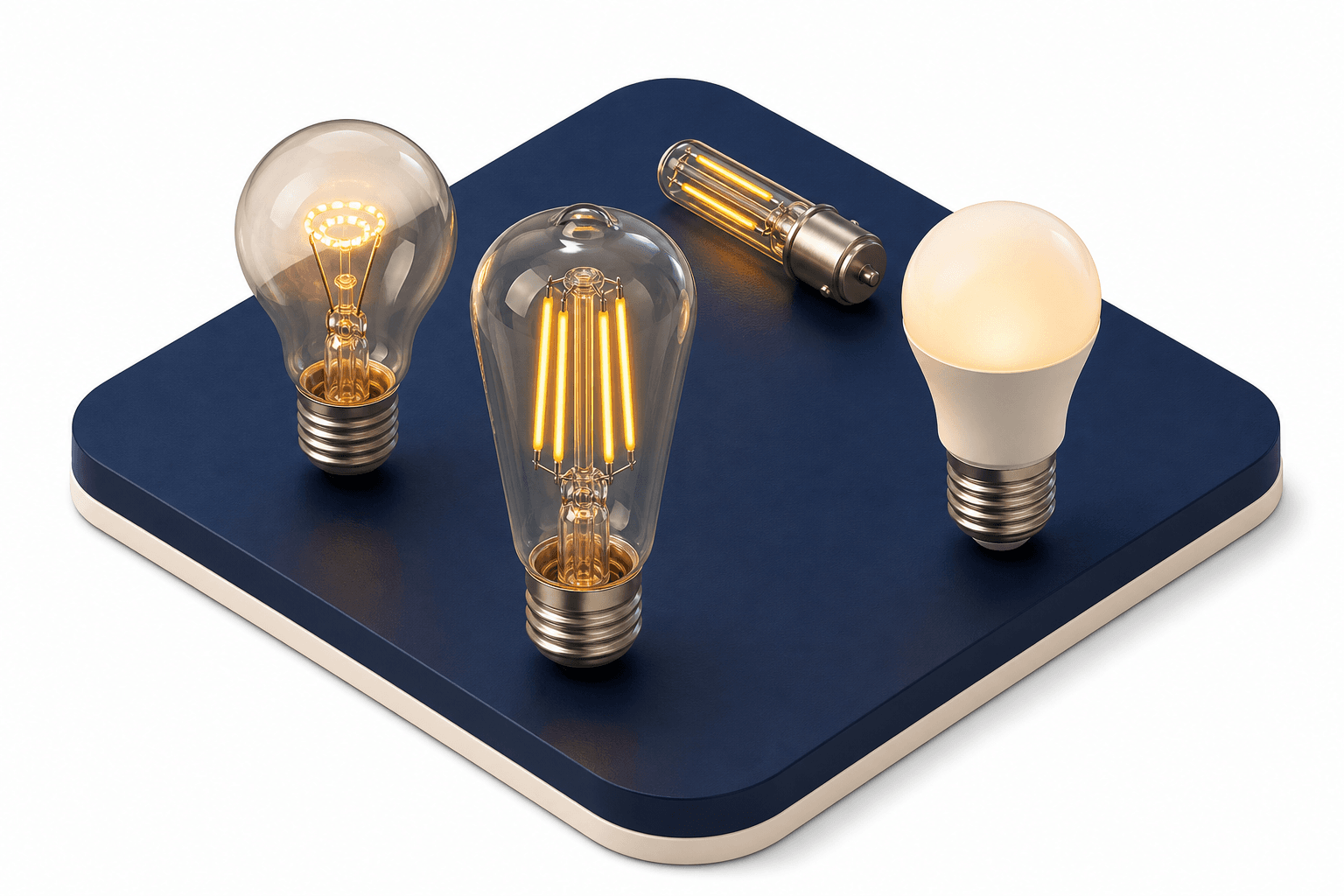
Key Takeaways
Generally, LED light bulbs don’t have filaments. The light is created by a light-emitting diode, which is a semiconductor. Some LED bulbs look like they use a filament, but this is a design choice only.
Most people know that older light bulbs need a filament to work – a tiny wire heated to a high temperature until it emits light.
So now that LED bulbs are becoming more popular, people want to know more about how they work – and whether they also use a filament.
Do LED Bulbs Require Filament To Work?
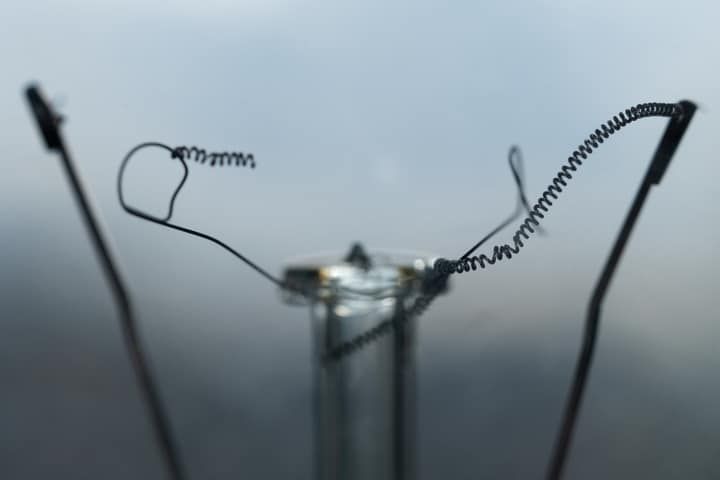
LED light bulbs never need a filament to work because they instead use light-emitting diodes to generate light. The filament creates light in an older incandescent bulb, but LEDs are completely different technology.
To make the comparison clear, here’s how incandescent bulbs work first.
In an incandescent bulb, the current is passed through the wire filament to heat it to the temperature that produces light, usually between approximately 4,200 and 4,900 degrees Fahrenheit (2,300–2,700°C) for a typical tungsten filament.
Most of that energy ends up as heat rather than light, which is why LED bulbs are far more efficient.
LEDs instead make use of a semiconductor chip. These chips are made of two layers of semiconductor material — one rich in negatively charged electrons, the other in positively charged “holes” (spaces where electrons could sit).
When current flows through, electrons and holes meet at the junction between the two layers and release energy as photons — and it’s those photons that are the light source.
There’s no super-heating any thin wire filament. Instead, current passing through a chip emits light directly.
Some LED light bulbs have a single chip, but most use multiple chips to direct light better around a room.
The material within the semiconductor determines the wavelength of the photons emitted, which in turn determines the color of the light.
So RGB light bulbs use chips that emit the right wavelengths for red, green and blue, with other colors created by combining these in different amounts.
Why Do Some LED Bulbs Have Filament?

Now that you know LED light bulbs don’t need filaments, does that mean none of them have one?
Strictly speaking, the original definition of a filament refers to a thin wire heated to incandescence by an electric current — so LED “filaments” aren’t filaments in that traditional sense.
So what are the “LED filament light bulbs” you can buy in many homes and DIY stores or on any decent electrical retailer website?
They’re LED bulbs designed to look like filament bulbs, either to style a home in a cozy or retro way, or to add a particularly industrial feel to lighting and décor.
Instead of being a wire, these ‘filaments’ are narrow tubes lined with small LED chips.
They work the same as a regular LED light bulb — it’s the chips lighting up. But because those chips sit inside thin tubes within the bulb, the result looks like a filament glowing.
Because the light is contained within these thinner tubes, most LED filament bulbs use multiple ‘filaments’ inside them or feature intricate spiral designs.
That’s to make sure there’s enough light being generated — an LED bulb with a single tube replicating one small, thin wire wouldn’t put out much light, leaving you with limited uses for the bulb.
Color temperature: filament LEDs go warm
Because the whole point of a filament-style LED is to mimic the look of an old incandescent, filament LEDs are almost always tuned to a warm white color temperature — typically 2,200K to 2,700K. That number is what you’ll see on the packaging in Kelvin (K).
Lower Kelvin numbers (around 2,200K–2,700K) look warm and amber, like a candle or a vintage bulb. Mid-range (3,000K–4,000K) looks neutral white. Higher numbers (5,000K–6,500K) look cool or daylight-white. If you pick a filament LED labelled 5,000K, you’ll lose the retro effect entirely — the visible filaments will glow a clinical white instead of that cozy amber.
Are LED Filament Bulbs Dimmable?
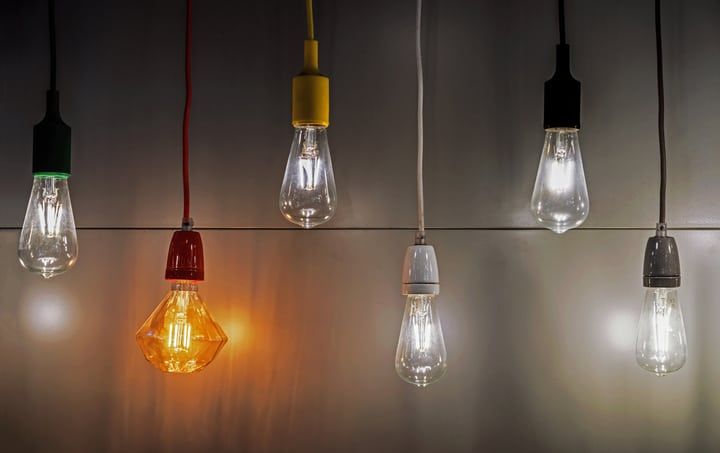
Not all LED bulbs are dimmable. It depends on the driver, which is the component in a bulb that controls the current delivered from the mains to the light-emitting chip.
All LEDs need a driver to control that current and prevent it getting overloaded — LEDs are pretty sensitive.
It’s the driver that determines whether an LED bulb can be dimmed.
Some aren’t compatible with dimming, while others are — though they sometimes have a minimum dimming threshold of 10% or so, which means you can dim the bulb from full brightness down to 10% but no lower than that.
So back to the original question — are LED filament bulbs dimmable? The same answer applies: it depends on the driver.
Some LED filament bulbs are dimmable and others aren’t. Whether the bulb is a filament style or a standard LED is irrelevant on its own.
If you intend to use your LED filament bulb on a circuit with a dimmer switch, check the packaging or the online store listing to confirm it’s dimmable.
It’s also worth noting that smart bulbs from brands like Philips Hue, which sells its own range of LED filament bulbs, are dimmable via the smartphone app.
Do Filament LEDs Consume More Energy Than Normal LEDs?
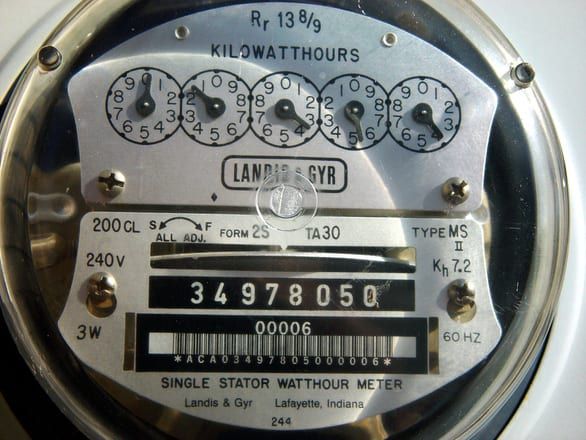
By now, you should be getting the idea that LED filament bulbs are essentially the same as regular LED bulbs — it’s just the configuration of the LED chips, whether they illuminate the whole bulb casing or sit inside the small ‘filaments’.
That said, there is a small efficiency trade-off worth knowing about. Mass-market LED filament bulbs commonly land in the 70–90 lumens-per-watt range, while top-tier modern filament LEDs and many standard A-shape LEDs run higher. The gap has closed considerably in recent years — Energy Star–certified filament bulbs have been measured above 120 lm/W — but at retail you’re typically paying a small efficiency premium for the retro look.
What matters most is the amount and quality of the LED chip used, which varies for filament and standard LED bulbs anyway.
To compare bulbs at a glance, look at four numbers on the packaging:
| Spec | What It Means |
|---|---|
| Wattage (e.g., 4.5W) | Actual energy consumed by the bulb |
| Equivalent Wattage (e.g., 40W) | Brightness compared to an incandescent bulb |
| Lumens (e.g., 470 lm) | Total light output |
| Lumens per Watt (lm/W) | Efficiency score — higher is better |
Make sure you’re checking the actual wattage, because many LED bulbs also advertise an equivalent wattage — the brightness compared to an incandescent. So a 4.5W LED bulb with an ‘equivalent 40W’ rating uses 4.5 watts but is as bright as a 40-watt incandescent.
To work out a bulb’s efficiency, divide its lumens by its watts. A filament LED rated at 470 lumens and 4.5 watts gives 470 ÷ 4.5 ≈ 104 lumens per watt — though typical retail LED filament bulbs more commonly fall in the 70–90 lm/W range.
Lifespan: still a huge win over incandescent
Even with a small efficiency premium for the retro look, filament LEDs (like standard LEDs) typically last 15,000 to 25,000 hours. A traditional incandescent bulb lasts roughly 1,000 hours. So a filament LED still lasts 15 to 25 times longer than the incandescent it’s impersonating, while using a fraction of the power.
Final Words
Now you know that LED filament bulbs are essentially a style choice. They don’t work the same as proper incandescent filament bulbs — they cleverly use LED tech to deliver a look that’s a little more retro.
Otherwise, they’re just LED bulbs.
So the choice is yours: the modern frosted-glass look of a regular LED bulb, or a lamp that would look amazing with a more industrial-style one.