
Is LED Light Monochromatic?
That single-color LED still emits a band 20–70 nm wide — narrow enough to look pure, broad enough to fail a spectrometer test. The laser is the real monochromat.
 Eugen
EugenEugen Nikolajev
Creator of LED Lighting Info
Hi, I am Eugen. I was always one of those kids who had all sorts of weird lighting gadgets for every occasion.
Now, I want to share my knowledge and experience about lighting with you on LED Lighting Info.
Read my editorial standards
Key Takeaways
LED light is not monochromatic. Each LED emits a narrow band of wavelengths — typically 20 to 70 nm wide — centered on a peak wavelength, which technically makes it polychromatic. That said, LEDs sit far closer to single-wavelength than incandescent or fluorescent sources do.
An LED bulb looks like it's putting out one clean color. So is LED light actually monochromatic — a single, pure wavelength? Strictly speaking, no. And the answer matters more than it sounds, especially if you care about color rendering, grow lights, photography, or stage lighting.
In this article, you will learn:
- What monochromatic actually means
- How monochromatic and polychromatic light differ
- How wavelengths shape the colors LEDs produce
- Why this matters for practical lighting choices
What Does Monochromatic Mean?
Monochromatic means a single color or one color only. The Greek roots are direct: monos (one) and khroma (color).
Scientifically, monochromatic light is light of a single wavelength. Since color is the result of different wavelengths, monochromatic light shows up as exactly one color with no spread.
True monochromatic light is rare in everyday life. A room decorated entirely in red is not monochromatic in the scientific sense — even subtly different red shades cover a range of wavelengths.
The opposite of monochromatic is polychromatic: light made up of multiple wavelengths. White light is a common example — it contains a mix of visible wavelengths blended together. Sunlight is polychromatic too, spanning UV, visible light, and infrared (the rainbow you see when sunlight passes through a prism or raindrops).
Laser light, by contrast, is highly monochromatic. Its energy is concentrated in an extremely narrow band of wavelengths, far closer to a single wavelength than any LED can manage. (Even a laser has a small spectral width in practice — perfect monochromaticity doesn't exist outside theory.)
Monochromatic vs. Polychromatic at a Glance
It helps to think of light sources on a spectrum from strictly single-wavelength to broadband, with LEDs sitting in a useful middle ground:
| Light type | Wavelength behavior | Examples |
|---|---|---|
| Monochromatic | Single wavelength (or extremely narrow band) | Lasers |
| Narrow-band polychromatic | Narrow band, roughly 20–70 nm wide | Single-color LEDs (red, blue, green) |
| Broadband polychromatic | Wide range of wavelengths blended together | Sunlight, incandescent bulbs, white LEDs |
Is LED Monochromatic Or Polychromatic?
LED light is not monochromatic. Even when an LED looks like a single color, its output is a narrow band of wavelengths — visible the moment you put it under a spectrometer.
A spectrometer splits light into its component wavelengths and plots intensity against wavelength. The graph below shows the spectral output of an LED.
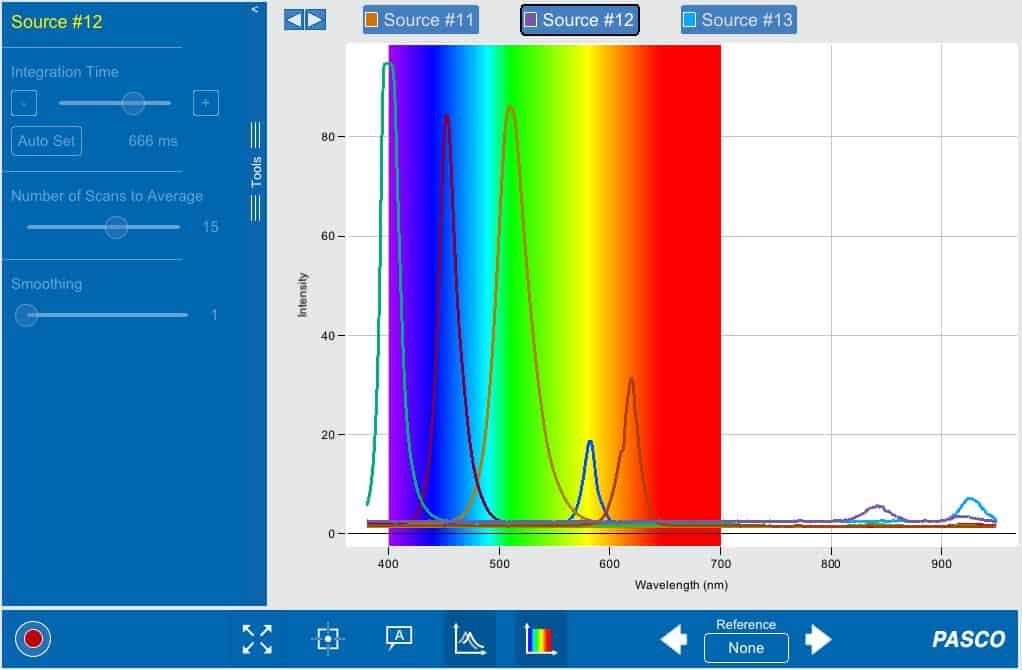
Notice the clear peak with measurable spectrum width on either side. A perfectly monochromatic source would show a single vertical line on this graph — an LED never does.
This is where the term narrow-band polychromatic becomes useful. LEDs sit between the strict monochromatic ideal (lasers) and broadband polychromatic sources (sunlight, incandescent bulbs). They are polychromatic by definition, but with a much tighter spectral footprint than most other light sources.
In casual conversation, people will still call a single-color LED "monochromatic" — and for most practical purposes that's fine. The strict scientific definition only matters when spectral precision does, like in laser interferometry, certain photonics work, or scientific instruments.
How Many Wavelengths Do LEDs Emit?
The color of an LED is measured in nanometers (nm) and identified on datasheets by its peak wavelength — written as λp. The semiconductor materials inside the LED determine that peak.
Visible-light LEDs emit between roughly 400 and 700 nm. Each LED produces a narrow band, typically 20–70 nm wide, centered on its peak. Specialty UV LEDs (around 280–405 nm) and infrared LEDs (commonly 850 or 940 nm) sit outside the visible range, but those are different products from the LEDs found in general lighting, indicators, displays, and RGB strips.
Different colors correspond to different wavelength bands across the visible spectrum:
| Wavelength (nm) | Color |
|---|---|
| 380 – 450 | Violet |
| 450 – 485 | Blue |
| 485 – 500 | Cyan |
| 500 – 565 | Green |
| 565 – 590 | Yellow |
| 590 – 625 | Orange |
| 625 – 700 | Red |
The takeaway: different semiconductor materials (and combinations of them, sometimes paired with phosphor coatings) produce different peak wavelengths — and that's what determines the color of light an LED emits.
How White LEDs Work
Most white LEDs in everyday bulbs aren't producing white light directly. They use a blue LED chip coated with a yellow phosphor. The blue light excites the phosphor, which re-emits a broader yellowish glow. Mixed with the leftover blue, the eye perceives the combination as white.
These are called phosphor-converted white LEDs, and they're the clearest illustration that LEDs aren't monochromatic. Their output spectrum shows a sharp blue peak alongside a broad phosphor bump — definitively polychromatic.
RGB white LEDs work differently — they combine separate red, green, and blue emitters. They are more tunable, but generally have lower color rendering quality than phosphor-converted whites for everyday lighting.
How Many Colors Can LEDs Produce?

You'll often see the figure "16.7 million colors" associated with RGB LEDs. That number is real, but it's a property of the digital controller, not the LEDs themselves.
Standard 24-bit RGB controllers assign 256 brightness levels to each of the three channels: 256 × 256 × 256 ≈ 16.7 million combinations. Higher bit-depth controllers (30-bit, 36-bit) can address more steps. The actual range of colors any RGB LED can reproduce depends on the spectral output of its specific red, green, and blue emitters and the chosen color space.
For context, 16.7 million already exceeds the roughly 10 million colors the human eye can distinguish — so most of those steps are imperceptible.
Most colors people commonly see can be reproduced by mixing red, green, and blue light in different proportions — known as the RGB model. RGB primaries can't reproduce every visible color (saturated cyans, certain greens, and spectral violet fall outside the sRGB gamut), but the model covers most of what people commonly see.
Combining red, green, and blue at appropriately balanced intensities produces white light. The exact mix that looks "white" depends on the color space (sRGB, DCI-P3, Rec. 709) and the specific LEDs being used.
RGB vs CMYK — and Why It Matters for LEDs
LEDs use additive color (RGB) — colors are made by adding light to a black starting point. This is fundamentally different from subtractive color (CMYK), the model used by printers, where pigments subtract wavelengths from a white starting point.
CMYK stands for cyan, magenta, yellow, and key (black). In theory, overlapping cyan, magenta, and yellow at full strength absorbs all visible light and produces black. In practice, real-world inks aren't pure enough — overlapping all three produces a muddy dark brown rather than true black. That's why CMYK printing adds a separate K (key/black) channel: it delivers true black, crisper text, faster drying, and uses less ink than layering three colors at full strength.
Two reasons this matters for LED lighting. First, color accuracy: an LED illuminating printed material affects how those CMYK colors appear, which is why color rendering index (CRI) matters in galleries, print shops, and retail. Second, displays: LED-backlit screens use RGB to recreate images that may have originated as CMYK prints, and the two models can never perfectly match.
Why This Matters in Practice
For most everyday lighting, the monochromatic-or-not question is academic. In a few applications, it's very practical:
- Photography and video: accurate color rendering depends on the breadth of the spectrum, not just the peak. Narrow-band LEDs can leave skin tones or fabrics looking off — high-CRI lights matter.
- Grow lights: plants respond to specific wavelengths (around 660 nm red and 450 nm blue). Narrow-band LEDs can be tuned precisely for photosynthesis efficiency.
- Stage and architectural lighting: saturated single-color LEDs are useful precisely because they're narrow-band — the color stays pure across distance and surface.
- Color rendering at home: full-spectrum white LEDs render colors more naturally than cheap phosphor blends. If color accuracy matters, look for bulbs rated CRI 90 or above.
Final Words
LED light is not monochromatic in the strict scientific sense. Each LED emits a narrow band of wavelengths centered on a peak, technically making it polychromatic — but in the much narrower "narrow-band polychromatic" middle ground between lasers and sunlight. White LEDs go further still, combining a blue emitter with phosphor (or three separate RGB emitters) to produce visibly broadband output.
Whether the distinction matters depends on what you're using the light for. For everyday illumination, it doesn't. For photography, growing plants, color-critical work, or stage lighting, the spectral shape of an LED is the difference between accurate color and disappointment — and worth paying attention to on the datasheet.
FAQ
Are any LEDs truly monochromatic?
No. Even single-color LEDs emit a narrow band of wavelengths typically 20–70 nm wide centered on a peak. The closest source to true monochromatic is a laser, and even lasers have a small finite linewidth in practice.
What's the difference between λp and λD on an LED datasheet?
λp (peak wavelength) is where the emission spectrum reaches its highest intensity — a physical measurement. λD (dominant wavelength) is the wavelength a person would perceive — the human eye's response shifts the perceived color slightly from the physical peak, so the two values can differ.
Why does an LED look like one color if it's polychromatic?
Because the wavelength band is narrow enough — and the eye's three cone types pool wavelengths into broad color categories — the band registers as a single perceived color. The polychromatic nature only becomes visible under a spectrometer.
Are white LEDs monochromatic?
No. Phosphor-converted white LEDs combine a blue LED chip with a yellow phosphor coating; RGB white LEDs combine three separate emitters. Both produce broadly polychromatic output by design — that's how they look white to the eye.
How does this affect color rendering (CRI)?
CRI measures how accurately a light source renders colors compared to natural light. Narrow-band LEDs can have low CRI because they're missing chunks of the spectrum, which makes some colors look dull or off. Full-spectrum white LEDs (typically phosphor-converted with extra phosphors) achieve CRI 90+ and render colors more faithfully.