
Are LED Strip Lights Allowed In Dorms?
Some schools — Seton Hall among them — explicitly ban LED strip lights in residence halls, and your housing handbook may name them alongside extension cords. Check before you buy, not after.
 Eugen
EugenEugen Nikolajev
Creator of LED Lighting Info
Hi, I am Eugen. I was always one of those kids who had all sorts of weird lighting gadgets for every occasion.
Now, I want to share my knowledge and experience about lighting with you on LED Lighting Info.
Read my editorial standards
Key Takeaways
It depends on your school. LED strip lights are a popular way to add color and personality to a dorm, but some universities allow them with conditions, and a growing number, especially those with strict fire-code compliance, explicitly prohibit them in residence halls. Before you buy, check your residence handbook or fire safety policy in writing.
Living in a dorm is similar to renting in that you've signed an agreement (usually a housing license, not a true lease) committing to leave the room in its original condition. That means no permanent damage to walls, no unauthorized electrical modifications, and no items that conflict with the school's fire safety rules.
In this guide I'll cover what to check before you buy, the real risks (fire and wall damage), how to choose a safe strip and power supply, and how to install one without losing your deposit.
Can You Install LED Strip Lights In Dorms?

Most US college housing agreements are license agreements rather than traditional leases — students don't typically have the legal protections of tenants under state landlord-tenant law, and the school can reassign rooms or enforce conduct rules at its discretion. The practical effect for LED strip lights is the same either way: you've agreed to leave the room as you found it, and to follow the school's safety rules.
Some schools — including ones with strict fire-code compliance like Seton Hall University — explicitly prohibit LED strip lights in residence halls. Don't assume "discretion" is enough; the answer at your school may be a hard no, even if your roommate's friend has them at another college.
Before buying, check your housing license or residence handbook for these common clauses:
- Restrictions on adhesive wall fixings (some schools ban anything other than removable putty or pre-approved hooks).
- Wattage or amperage limits on personal electrical devices.
- An explicit list of prohibited items in the fire safety policy — LED strip lights are increasingly named alongside string lights, halogen lamps, and extension cords.
- Rules about modifying or covering existing fixtures.
If the handbook is ambiguous, ask your residence coordinator in writing (email is fine) and keep their reply. If you want to learn more about the basics first, read my full guide to LED strip lights.
What To Look For When You Buy
The single biggest factor in whether a strip is safe in a dorm is what you buy in the first place. Cheap, uncertified strips are the ones most likely to overheat or fail. Use this checklist:
- Look for a recognized safety mark on both the strip and the power adapter — UL or ETL in the US, CE in the EU. This is the most important purchase-time signal that the product isn't a counterfeit running over its rated current.
- Most consumer strips run on 12V or 24V DC and ship with a matched plug-in adapter. Keep that adapter and don't substitute one with a different voltage — a 24V supply on a 12V strip will burn it out almost immediately.
- Check that the adapter's wattage rating exceeds the strip's total draw with about 20% headroom. Sizing the supply at ~80% of its rated capacity leaves room for thermal margin.
- Don't extend a strip beyond the maximum length printed on the spool — long runs need a second power feed or a higher-current supply.
The Real Risks Of LED Strips In Dorms
Fire and overheating
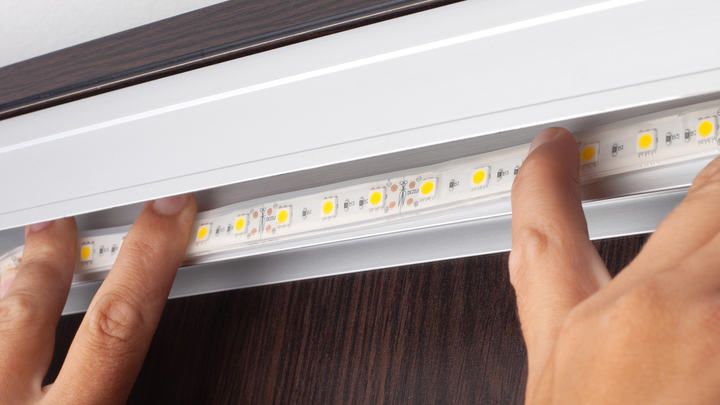
LED strips are generally safe when used correctly, but the risk isn't zero — especially for budget strips popular with students. Cheap or uncertified strips often use undersized copper traces and are over-driven beyond their rated current to look brighter, which makes them run hot. Low-quality drivers can output unstable voltage that pushes the strip past its rated limits. Heat accumulates when strips are coiled, folded sharply, run behind beds or curtains, or installed in any enclosed space without airflow. The NFPA tracks campus-housing fires as a distinct category, and several universities ban strip lights in residence halls for exactly this reason.
To minimize the fire risk: choose strips and power supplies with a recognized safety mark (UL/ETL/CE), avoid coiling or folding the strip sharply, don't bury it behind soft furnishings, match the supply voltage exactly to the strip, and don't run more strip length than the supply is rated for.
Wall and paint damage
There are several ways to install strip lights, and the wrong choice can pull paint off the wall, leave sticky residue, or damage drywall. Damage means losing your deposit and potentially being billed for repairs.
Always test the adhesive before committing. Apply a small piece of the strip's tape to a hidden corner, leave it for 48–72 hours, then peel it off and check whether it leaves marks or removes paint. It's far easier to spot the problem now than when you're packing up to remove all your LED strips at the end of the year.
Paint matching for small repairs
Most dorm rooms are painted with a washable latex finish — typically eggshell or satin — chosen because it stands up to scrubbing while still hiding imperfections. If you're patching a small spot, match both the color and the sheen of the existing paint; rolling a glossy paint over an eggshell wall (or vice versa) will leave a visibly different patch even if the color is identical. Match the type of paint carefully — semi-gloss is generally only used on trim, doors, and wet rooms in institutional settings.
Losing your deposit
Damage to walls, fixtures, or paintwork can mean losing some or all of your housing deposit and being billed for the repair. Treat the test patch and the choice of adhesive as cheap insurance against a much more expensive end-of-year bill.
How To Mount Strip Lights Without Damaging Walls
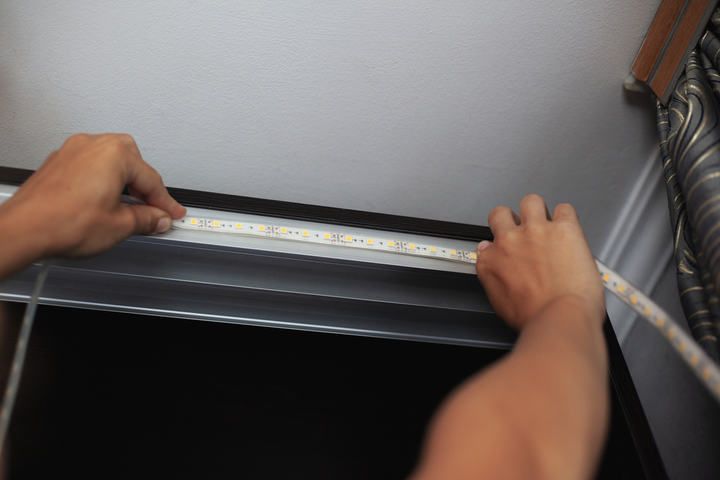
Once you've confirmed strips are allowed and the adhesive doesn't pull paint, follow these steps to install your strip lights cleanly. Pick a location with airflow — don't run the strip behind a headboard pressed against the wall, inside a closed cabinet, or under fabric.
- Clean the wall with a damp cloth and dry it thoroughly. Adhesive bonds poorly to dust, oil, or moisture.
- Test a small piece of the strip's tape in a hidden corner. Wait 48–72 hours, then peel it to check whether it pulls paint or leaves residue.
- Unplug the strip from its power supply before cutting. Even at low DC voltage, cutting a live strip can short the contacts or damage the driver.
- Measure the run with a ruler or tape, then cut to size using sharp scissors precisely on the marked copper cut points (a small line or scissor icon every 1–2 inches). Cutting between the marks breaks the circuit and disables that section permanently.
- Peel one side of the double-sided tape and press it firmly to the wall with even pressure, keeping the line straight.
- Peel the other side of the tape and attach the LED strip, working slowly along the run.
- Reconnect the power supply and test before committing the rest of the run.
If the included tape doesn't hold, double-sided mounting tape or removable adhesive clips are usually a safer choice than swapping for stronger industrial tape, which is more likely to pull paint when removed.
Alternatives If Strips Aren't Allowed
If your school bans strip lights or your walls won't tolerate adhesive, you still have options:
- Mount strips on a corkboard or pinboard. Many dorms include one as standard wall hardware — it's an ideal surface that won't be damaged by adhesive, and it can be removed at move-out without touching the wall.
- LED string lights. These are cheap, energy-efficient, and can be wrapped around furniture or a mirror without strong adhesive. (Avoid old-style incandescent mini-string lights — they get hot and are themselves a documented dorm fire hazard.)
- Battery-powered LED strips. For dorms with the strictest rules about electrical modifications or outlet usage, battery-powered strips are an increasingly available fallback that doesn't require a wall outlet at all.
- Mount strips around furniture instead of walls — bed frames, shelves, the underside of a cabinet, or the back of a desk. Just leave enough airflow around the strip.
Final Words
LED strip lights can be a safe, affordable way to make a dorm feel like yours — but only if your school allows them and you buy a properly certified product. Check your residence handbook in writing first, choose strips and power supplies with a UL/ETL/CE mark, match the supply voltage exactly, give the strip airflow, and test the adhesive on a hidden patch before committing. Get those right, and you'll keep your deposit and avoid the fire-safety category your school's housing office cares most about.
For more on choosing, cutting, and installing strip lights, read my full guide to LED strip lights.