
How To Choose In-Ground Pool Lights?
At typical pool usage, an LED pool light lasts over 60 years — you'll gut the whole pool long before the bulb gives out. That changes how you think about upfront cost.
 Eugen
EugenEugen Nikolajev
Creator of LED Lighting Info
Hi, I am Eugen. I was always one of those kids who had all sorts of weird lighting gadgets for every occasion.
Now, I want to share my knowledge and experience about lighting with you on LED Lighting Info.
Read my editorial standards
Key Takeaways
Choosing in-ground pool lights comes down to your pool’s size, shape, finish, depth, and special features. LEDs use less electricity than halogen or incandescent and last 30,000–50,000 hours versus roughly 1,000 hours for incandescent.
For a typical rectangular pool up to about 20 ft wide, divide the length in feet by 8 and round up to get the number of fixtures.
Installing hardwired, submersible pool lights is genuinely complex — but the results are worth the effort.
Whether you’re fitting lights as a new pool is built or retrofitting an existing one, there’s a lot of drilling work to lay the necessary conduits and ensure lights are grounded, with all metal pool components properly bonded.
The last thing you want is to finish the work and realize you’ve installed too few lights or positioned them in a way that looks wrong. Get this right at the planning stage.
Here’s what’s covered below:
- How to choose the right pool lights
- How much electricity pool lights use
- Safety and electrical code basics
- Alternatives to recessed pool lights
How To Choose Pool Lights?
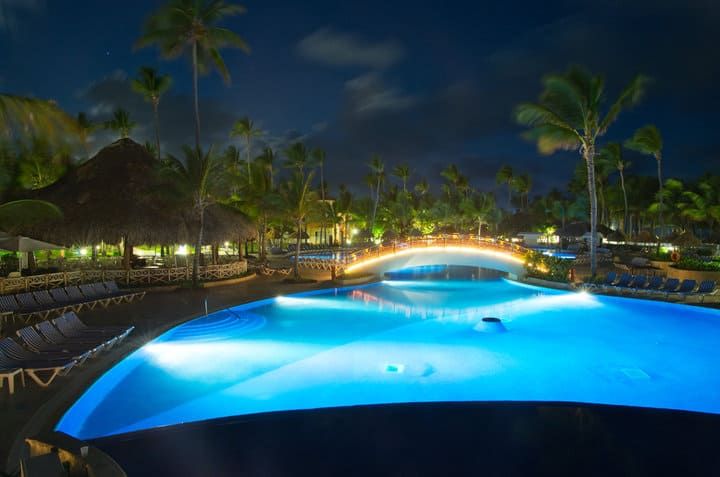
Five factors drive pool light selection — size, shape, finish, depth, and special features — and two more affect installation: niche type and voltage. Here’s how each one shapes your choices.
Size
Pool size affects the number of fixtures more than the type. Most pools are rectangular or longer along one side — square and perfectly circular pools are rare, so lights on one long wall are usually enough as long as they’re powerful enough to reach the opposite side.
The widely used rule, drawn from Jandy’s design guide, is to divide the pool length in feet by 8 and round up. For a 30-foot pool, 30 ÷ 8 = 3.75, so install four lights. This rule works well for typical rectangular pools up to about 20 ft wide; wider pools may need lights on both long walls, and very low-output fixtures may need closer spacing.
Space them equally. Divide the pool length by the number of lights to get the gap (30 ÷ 4 = 7.5 ft), then place the first light at half that distance from the edge (3.75 ft) and step 7.5 ft between each remaining fixture. That gives an even glow along the wall.
Shape
Rectangular pools are straightforward. Curved and right-angle pools need more planning.
Jandy’s design guide tells planners to map placement assuming a 60° beam spread — that figure represents the highest-intensity arc of most niche-mounted LED fixtures, not a universal product spec. Actual LED pool lights sold today range from narrow 15° spotlights to 120° floods, so check the spec sheet for your specific fixture. Wider beams (90°–120°) are especially useful for curved pools, since they cut the number of lights you need.
For right-angle pools, run lights along one long wall and add an extra fixture opposite the widest section to balance coverage.
Jandy is a major pool light manufacturer, and their lighting design guide is useful for non-standard shapes too.
Finish
Finish affects brightness, not fixture type. A lighter plaster or quartz finish reflects more light, so you need fewer lumens. A dark plaster, pebble, or vinyl finish absorbs more, so plan for higher output or an extra fixture.
Depth
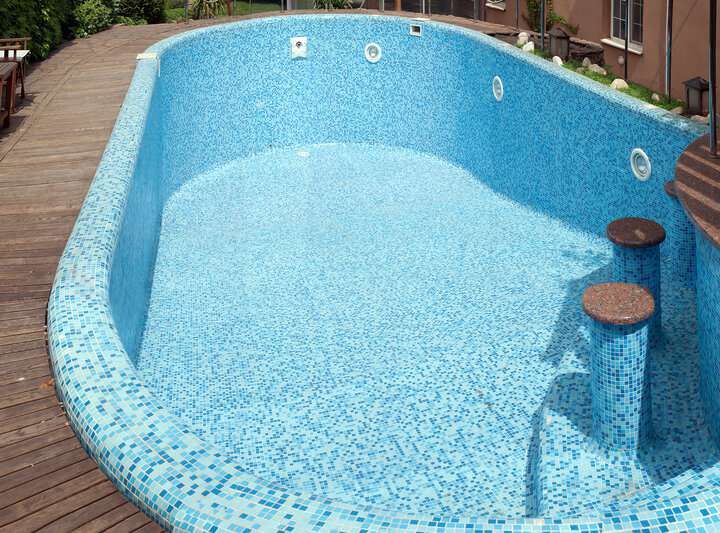
Depth has a negligible impact on fixture choice for most pools — if lights are installed correctly and the pool isn’t unusually deep, they’ll illuminate to the floor.
Depth matters at shallow areas — steps, tanning ledges, lounging zones — where a full-output light placed too close becomes harsh. Reduce brightness in those spots, or switch to strip lighting tucked under the edge.
Features
Special features change placement. A waterfall pairs well with strip lighting along the top edge. A central island or tanning shelf casts shadows, so add fixtures on both sides of the obstruction. Common non-rectangular shapes need this kind of adjustment:
- Kidney and free-form pools: place fixtures along the longer outside curve so beams sweep across the deepest section without aiming straight at swimmer eye level.
- L-shaped pools: treat each leg as its own rectangle and apply the length-÷-8 rule separately to each leg.
- Roman or grotto pools with rounded ends: add one fixture aimed back toward the bowed end to fill the curve, plus the standard run along the straight wall.
- Infinity / vanishing-edge pools: position lights so beams travel away from the spillway, otherwise the lit water column makes the disappearing edge less convincing at night.
Niche Type: Wet vs. Dry
Wet niche fixtures sit submerged in a stainless or plastic housing mounted in the pool wall, with the lens facing into the water. Dry niche fixtures keep the bulb housing behind a sealed lens, separated from pool water — service happens from the dry side. Wet niche is the standard for residential pools today; dry niche is more often found in commercial or competition pools. The two are not interchangeable, so decide before pouring concrete or cutting the shell.
Voltage: 12V vs. 120V
Most recessed pool lights run at 12V AC, fed by a transformer mounted near the equipment pad. Some fixtures run direct at 120V. Low-voltage 12V is the default for new residential installs because the transformer drops shock risk, and the National Electrical Code requires it within certain distances of the pool edge. Match the transformer’s rated wattage to the total load on the circuit, and confirm fixture voltage before ordering replacement lamps.
Color-Changing & Smart Controls
RGB and RGBW LED pool lights cycle through preset colors or hold a single shade, and most modern fixtures support wall-switch toggles, dedicated remotes, or smartphone apps. Higher-end systems integrate with pool automation platforms (Pentair IntelliCenter, Hayward OmniLogic, Jandy iAquaLink) and sync color shows across multiple lights, water features, and the spa. If color and scene control matter, choose the control method first — a wall-switch toggle is universal but limited, while app or automation control needs a Wi-Fi-bridged hub.
How Many Lumens Should Pool Lights Be?
There’s no regulation on brightness for residential pool lights. The National Electrical Code Article 680 has a full chapter on pool lighting, but it covers safe wiring — not luminosity.
The CDC’s Model Aquatic Health Code (2023, 4th Edition, §4.6.1.5.1) specifies that underwater lighting shall be no less than 8 initial rated lumens per square foot of pool water surface area. It applies to public pools, but it’s a useful floor for private ones: a 30 × 15 ft pool works out to 3,600 lumens (length × width × 8).
In practice, most private pools only need a gentle glow. Jandy’s 2018 design guide gives recommendations by LED wattage rather than lumens:
| Pool Width (Colored Lights) | Pool Width (White Lights) | Recommended Bulb Wattage (LEDs) |
|---|---|---|
| Up to 12 feet | Up to 16 feet | 6 |
| 12 – 20 feet | 16 – 24 feet | 12 |
| 20+ feet | 24+ feet | 24 |
Some larger pool lights from other brands draw closer to 40 watts. They often don’t list raw luminosity but instead advertise as 300-watt halogen equivalents.
How Much Electricity Do Pool Lights Use?
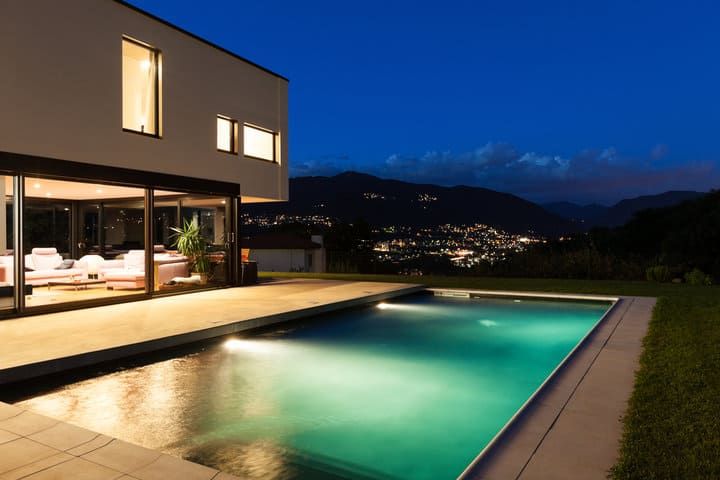
Modern LED pool lights use very little electricity — even wide pools usually need only 24-watt fixtures per Jandy’s figures above.
Halogen and incandescent screw-in pool bulbs have been largely phased out under the U.S. DOE general service lamp efficacy standards, in force since August 2023. Most still in service are legacy fixtures; for new installs and most replacements, LED is effectively the only mainstream choice today.
Here’s how the three bulb types compare at roughly equivalent pool-fixture output, priced at $0.18 per kWh (close to the U.S. residential average as of 2026):
| Bulb Type | Wattage (approx. pool-fixture equivalent) | Hourly cost (at $0.18 per kWh) | Yearly cost (500 hrs = 5 hrs × 100 days) | Typical lifespan |
|---|---|---|---|---|
| LED | 40 watts | < $0.01 | $3.60 | 30,000–50,000 hrs |
| Halogen | 300 watts | $0.05 | $27.00 | 2,000–5,000 hrs |
| Incandescent (legacy) | 500 watts | $0.09 | $45.00 | ~1,000 hrs |
Lifespan compounds the LED advantage. A pool light run 5 hours a day, 100 days a year, sees 500 hours of use annually. At that pace, an incandescent bulb lasts 2 years, halogen 4–10 years, and LED 60+ years — you’re far more likely to renovate the pool than replace the bulb.
Safety & Code Compliance
In the U.S., the National Electrical Code Article 680 governs pool wiring. Every pool light install needs to meet these basics:
- GFCI protection: All pool light branch circuits must be on a Ground Fault Circuit Interrupter. Non-negotiable for new installs.
- Low voltage near the pool: Lights within certain distances of the pool edge must run at 12V via a transformer rather than direct 120V mains.
- Equipotential bonding: All metal components within 5 ft of the pool — ladders, handrails, fixture niches, rebar, deck reinforcement — must be bonded together with at least a #8 AWG solid copper conductor.
- Permits and inspection: Most jurisdictions require a permit and a final electrical inspection. Skipping it can void homeowner’s insurance if a claim ever involves the pool.
If any of that is unclear, hire a licensed electrician with pool experience. The cost of a code violation around a pool is electrocution, not just a fine.
What Are Other Pool Light Alternatives?
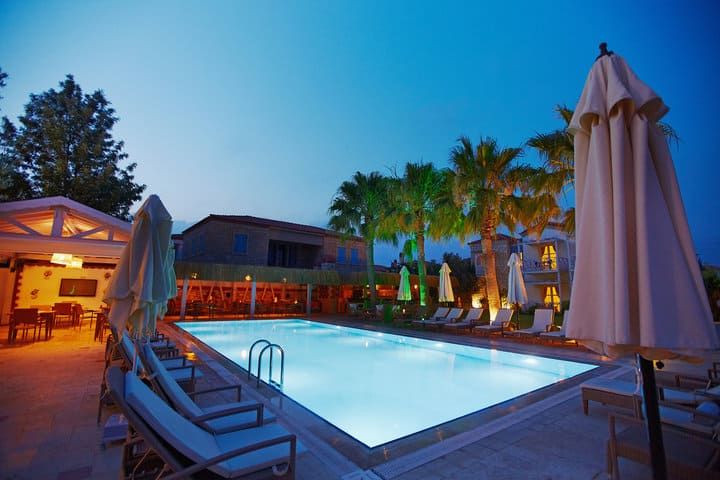
Recessed in-wall fixtures are the default because they’re easy to maintain once installed, give a gentle glow that fills the pool safely, and stay out of the way when you swim. The alternatives below trade some of that for easier installation.
| Alternative | Install effort | Lights the water? | Safety value | Maintenance |
|---|---|---|---|---|
| Battery-powered submersible | Low — drop in, no wiring | Yes (moderate) | Good | Recharge every few uses |
| Pool coving strip lighting | Medium — needs waterproof channel | Edges only | Excellent (edge marking) | Low; replace strips every few years |
| Overhead (floodlights / string) | Medium — needs mounted fixtures | Surface only | Good (deck), limited underwater | Low |
| Floating lights | None — drop in | Edges and surface | Moderate | Recharge or solar; remove before swimming |
Battery-Powered Pool Lights
Battery-powered pool lights work like regular pool lights but skip the hardwiring, which makes them an easier retrofit for an existing pool.
Battery life varies widely by product. Cheap AA-powered float lights may last only a few hours, while mid-range rechargeable submersibles with 2,600–4,000 mAh batteries run 8–24 hours at full brightness and 100+ hours dimmed. Expect to recharge every few uses rather than daily, but they still don’t match the convenience of hardwired fixtures.
Pool Coving Strip Lighting
Waterproof strip lighting along the pool’s coving or the underside of the pool edge throws a perimeter glow and highlights edges at night for safety. Strip lighting alone doesn’t illuminate the water — pair it with a couple of submerged fixtures if you want to avoid a dark pool center.
Overhead Lighting
Overhead options — floodlights or string lights — light the pool from above. Floodlights work for general safety, but depending on beam angle you may need several, and they don’t reach below the water surface.
String lights are charming but should supplement pool lights, not replace them.
Floating Lights
Floating lights sit on the water’s surface and throw enough light to mark pool edges. They have to be battery-powered (no cable into the water), so you’re recharging them or relying on solar — and solar often doesn’t bank enough charge for bright output. They also have to be cleared out before swimming, so treat them as a novelty or accent.
Final Words
When planning pool lights, work the decision in this order:
- Pick fixture type — wet niche LED is the right answer for the vast majority of new in-ground residential pools.
- Map placement using the length-÷-8 rule for typical rectangles, or a top-down sketch with beam angles for curved or feature-heavy pools.
- Match wattage to pool width per Jandy’s recommendations, accounting for finish darkness.
- Decide on color and control — plain white, RGB on a wall switch, or full app-controlled scene system.
- Confirm voltage (almost always 12V), transformer sizing, GFCI protection, and bonding with your electrician before any concrete or shell work is done.
Nail those five at the planning stage and the install — and the look of the pool at night — will fall into place.
FAQ
Can I install pool lights myself?
You can handle minor work like swapping a bulb in an existing wet niche fixture if the circuit is GFCI-protected and de-energized. New niche installs, transformer wiring, and bonding work should be done by a licensed electrician familiar with NEC Article 680 — pool wiring carries enough risk that most jurisdictions require a permit and final electrical inspection.
How long do LED pool lights last?
Quality LED pool lights are rated for 30,000–50,000 hours, compared to roughly 1,000 hours for incandescent and 2,000–5,000 for halogen. At 500 hours of use per year (5 hours × 100 days), that's 60+ years for LED — you'll renovate the pool before replacing the fixture.
Do pool lights need to be on a GFCI?
Yes. The U.S. National Electrical Code Article 680 requires that all pool light branch circuits be protected by a Ground Fault Circuit Interrupter. Combined with low-voltage 12V transformer wiring (required near the water) and proper equipotential bonding of all metal components, GFCI protection is the core safety layer for pool lighting.
What's the difference between wet niche and dry niche pool lights?
Wet niche fixtures sit submerged in a stainless or plastic housing in the pool wall, with the lens facing into the water. Dry niche fixtures keep the bulb housing behind a sealed lens, isolated from the pool water — service happens from the dry side. Wet niche dominates residential installs; dry niche is more common in commercial or competition pools. They aren't interchangeable, so the choice has to be made at construction.
Are incandescent pool lights still legal?
Most general-service incandescent and halogen lamps have been effectively phased out under the U.S. DOE's 45 lumens-per-watt efficacy rule, fully enforced since August 2023. Some niche pool fixtures fall under specialty exemptions, so existing legacy fixtures can typically still be serviced — but for new installs and most replacements, LED is the practical default.