
What Does Low Voltage Lighting Mean?
Low voltage doesn't save energy — watts do, and older 12V halogen MR16 lamps ran at 50W or 75W each. The efficiency win you're thinking of comes from the LED, not the voltage.
 Eugen
EugenEugen Nikolajev
Creator of LED Lighting Info
Hi, I am Eugen. I was always one of those kids who had all sorts of weird lighting gadgets for every occasion.
Now, I want to share my knowledge and experience about lighting with you on LED Lighting Info.
Read my editorial standards
Key Takeaways
Low voltage lights run on a much lower voltage than your mains power, usually 12V or 24V, stepped down by a transformer.
That lower voltage makes them safer to handle, easier to install yourself, and naturally pairs with LED technology for efficient, long-lasting lighting.
Whether you're planning a new landscape lighting setup in your garden, or you want to add some accent lighting to a bookshelf and can't work out how to wire it, you'll likely end up looking at low voltage options.
But what exactly is low voltage lighting?
- Which lights are considered low voltage
- The differences between line voltage and low voltage landscape lighting
- The advantages and disadvantages of low voltage lighting
What Is Considered Low Voltage Lighting?
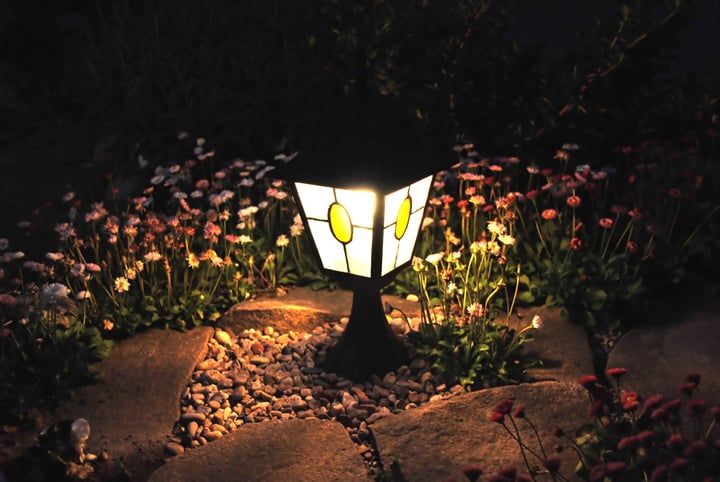
Mains (or "line") voltage in the US is a nominal 120V – the standard set by ANSI C84.1, with a normal operating range of about 114V to 126V. Other regions use higher mains voltages, but the principle is the same: low voltage lighting runs well below that, typically at 12V or 24V, with a transformer stepping the mains supply down.
The National Electrical Code is more specific. NEC Article 411, which governs low voltage lighting in the US, covers systems operating at 30V AC (or 60V DC) and below, with stricter 15V AC / 30V DC limits where wet contact is likely. So when an electrician calls a fixture "low voltage," they mean it falls inside those code limits.
If you tried to install a low voltage light on a line voltage circuit, you'd destroy the bulb on contact and potentially create a fire hazard.
The other direction is less dramatic: a line voltage bulb on a low voltage circuit generally just won't work – the bulb can't draw enough power to light properly. That's not dangerous in the way overvoltage is, but you should still match bulbs and fixtures to the system they're installed in.
Common low voltage lighting categories include landscape lights, LED strip lighting, under-cabinet and accent lighting, and many recessed downlight systems. Indoor LED fixtures often have a small driver built into the housing, so they accept mains power at the wall but run the LEDs themselves on low voltage internally.
Line Voltage vs. Low Voltage Landscape Lighting
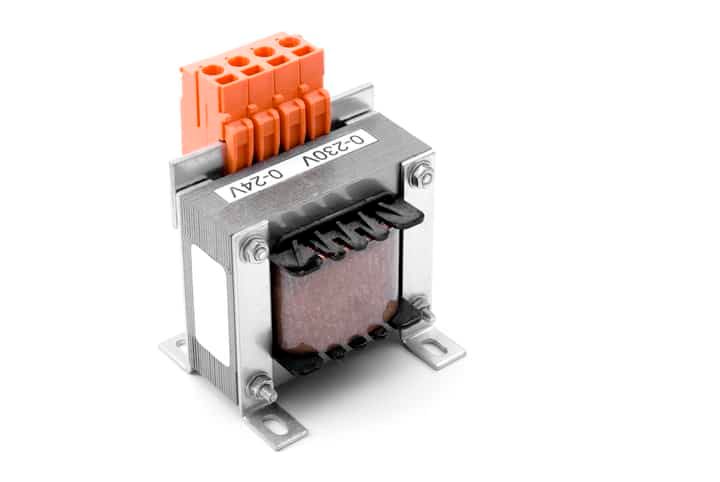
For outdoor landscape lighting, low voltage is almost always the better option: it's safer around damp ground, easier to install without a permit, and pairs naturally with LED fixtures. Here's how the two approaches compare side by side:
| Aspect | Line Voltage (120V) | Low Voltage (12V / 24V) |
|---|---|---|
| Voltage at the fixture | 120V mains | 12V or 24V via transformer |
| Shock hazard | Significant – can cause serious injury or death | Below OSHA's 50V guarding threshold; far lower risk in dry conditions |
| Installation complexity | Conduit, permits, and often a licensed electrician | DIY-friendly; cables can be buried just under the surface |
| Voltage drop concern | Negligible over typical residential runs | Significant on long runs or undersized wire |
| Energy efficiency | Depends entirely on the bulb | Typically paired with LEDs; usually efficient |
| Transformer required | No | Yes – separate, or built into the fixture |
| Typical residential use | Indoor fixtures, security floodlights, some patio lights | Landscape paths, accent lighting, strip lights, deck lights |
Low voltage landscape lights need a transformer – just like any other low voltage system – but unlike many indoor fixtures, the transformer isn't built in. You install a separate transformer that takes the 120V mains supply, steps it down, and feeds the low voltage cable run out to the fixtures.
Most landscape transformers are weather-rated for outdoor wall mounting, and ideally sit as close to the lighting zone as possible – the shorter the cable run, the less voltage drop you'll fight.
Choosing and sizing a transformer
Landscape transformers are commonly rated at 150W, 300W, 600W, 900W, and 1200W. Add up the wattage of every fixture on the run, then size up: best practice is to load a transformer to no more than 80% of its rated capacity, which gives headroom for inrush current and prevents the thermal cutoff from tripping. A 300W transformer therefore comfortably runs about 240W of lamps.
Features worth looking for on a quality unit:
- Built-in timer and/or photocell so the lights run on their own schedule
- Multiple voltage taps (12V, 13V, 14V, 15V) – useful for compensating for voltage drop on long runs
- Thermal cutoff and short-circuit protection
- Multiple independent zones if you're lighting several areas
On the input side, the transformer needs to plug into a GFCI-protected 120V outlet. That part is line voltage – if there isn't already a suitable outdoor outlet nearby, getting one installed is the job that may need a licensed electrician.
Wire gauge
On 12V systems, 12 AWG low voltage landscape cable is the common default for runs under about 100 feet. For longer runs or heavier loads, step up to 10 AWG. Thicker wire has lower resistance, which means less voltage lost between the transformer and the far end of the run.
Are all landscape lights low voltage?
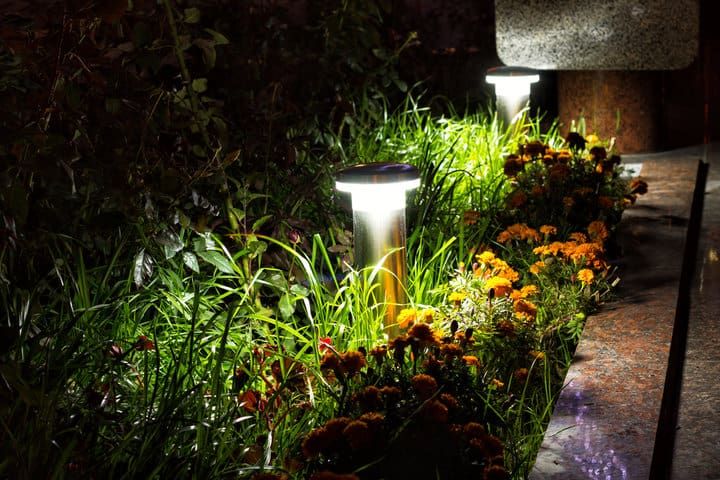
Most residential landscape lighting runs on low voltage – most commonly 12V, though 24V systems are also widely sold and are increasingly common on larger or commercial installations, where the higher voltage tolerates longer cable runs with less drop.
If the cable becomes damaged outdoors, a low voltage system is much less likely to cause a serious incident than a buried 120V line would. That's not a reason to be careless – damaged wiring still needs repairing – but it changes the stakes of a fault.
The exceptions are mostly sheltered fixtures: some wall-mounted patio lights, porch lights, and security floodlights run on line voltage because they're attached to the house and wired into the existing 120V circuit. Generally, though, it's rare to install 120V lighting out in the yard itself.
To check whether a fixture is low or line voltage, inspect the bulb or the label – it should be marked 12V, 24V, or 120V.
Advantages of Low Voltage Lighting
Energy efficiency (with an asterisk)
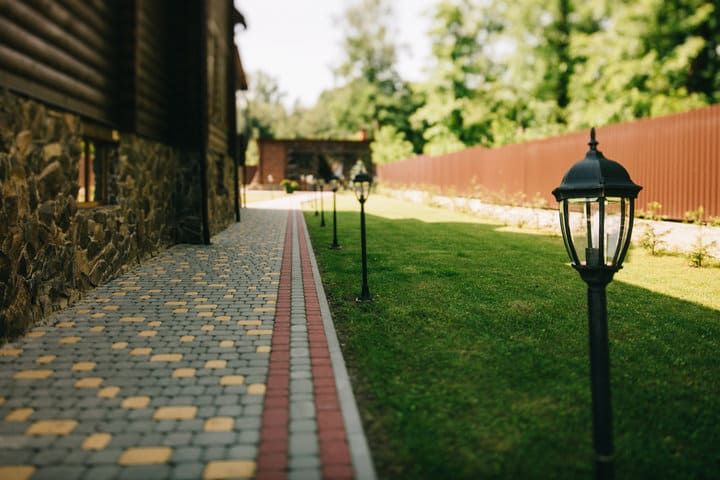
Low voltage by itself doesn't save energy – energy is measured in watts, not volts. A 9-watt bulb draws 9 watts whether the circuit is 12V or 120V. And "low voltage" has never automatically meant "low wattage": older 12V halogen MR16 and PAR36 bulbs were commonly sold at 35W, 50W, and even 75W per lamp, which is why landscape transformers are sized at 300W, 600W, and beyond.
What's changed is that almost every modern low voltage fixture is built around LEDs, which are inherently efficient. So in practice, choosing a low voltage system today usually means choosing LED lighting – and you'll use less energy than an equivalent halogen setup. The savings come from the LED, though, not from the lower voltage.
Safety
Low voltage circuits are meaningfully safer to work around than line voltage. 12V sits well below OSHA's 50V threshold for required guarding of energized parts, and under dry-skin conditions a 12V circuit typically can't push enough current through the body to cause electrocution.
That said, "low shock risk" isn't "no risk":
- Wet skin drops your body's resistance sharply – NEC tightens its low-voltage limits in wet locations for exactly this reason.
- High-current 12V sources – landscape transformers, car batteries – can still cause serious burns or arc flash if shorted across a low-resistance path.
- The 120V primary side feeding the transformer is absolutely still hazardous.
Always disconnect power before working on any wiring. It's 'safer' – not 'safe'.
The same lower-stakes profile is why low voltage is so well suited to outdoor and damp locations: a fault in a buried cable or a cracked fixture body is a problem to fix, not a household emergency.
Flexibility and movability
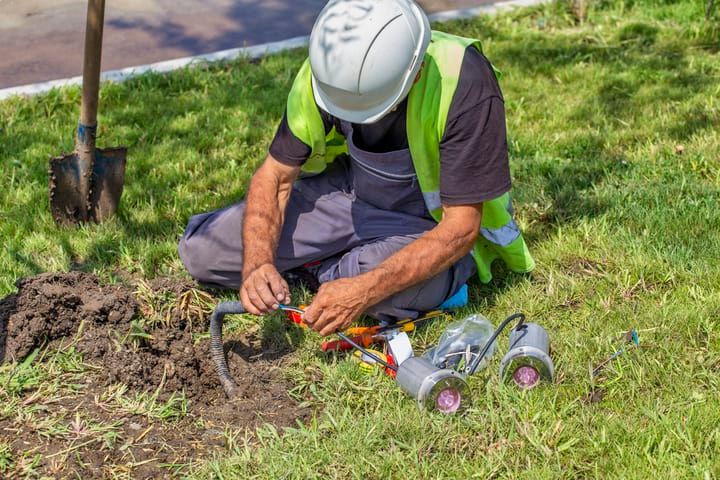
Low voltage cable rarely needs to be buried inside walls or deep underground. Landscape cable typically sits a few inches under turf or mulch, and indoor low voltage runs (under cabinets, behind shelving, along ceiling coves) are usually surface-mounted or tucked into shallow channels.
That means the system is far less permanent than a hard-wired 120V installation. If you redesign your garden, want to move a fixture, or change a planting bed, repositioning the lights is straightforward – at worst, a bit of digging.
Lower installation cost
For DIY landscape lighting, low voltage is usually the cheaper option. The fixtures themselves can cost more per unit than basic 120V floodlights, but the install is far simpler: no conduit, no buried 120V cable, no inspection or permit in most jurisdictions, and (usually) no electrician needed beyond getting a GFCI-protected outdoor outlet installed for the transformer to plug into.
Disadvantages of Low Voltage Lighting
Voltage drop
Think of voltage drop like a garden hose: a nozzle connected straight to the tap delivers strong pressure, but run that same nozzle through 50 feet of hose and the pressure at the far end drops noticeably. The same thing happens in a lighting cable.
Every wire has some resistance, and the longer the run – or the more current the lights draw – the more voltage is lost along the way. The drop is small in absolute terms, but on a 12V circuit a 1–2V loss is a much larger percentage than the same drop would be on a 120V line. So it shows up as visibly dimmer lights at the far end of the run, or fixtures that won't fire up at all.
You can manage voltage drop in several ways:
- Use thicker cable (10 AWG instead of 12 AWG) on long runs.
- Wire fixtures in parallel, or in a hub-and-spoke layout, rather than one long daisy chain.
- Use a multi-tap transformer and feed the run from the 13V, 14V, or 15V tap to compensate.
- Place the transformer as close as possible to the lighting zone.
Limited load per transformer
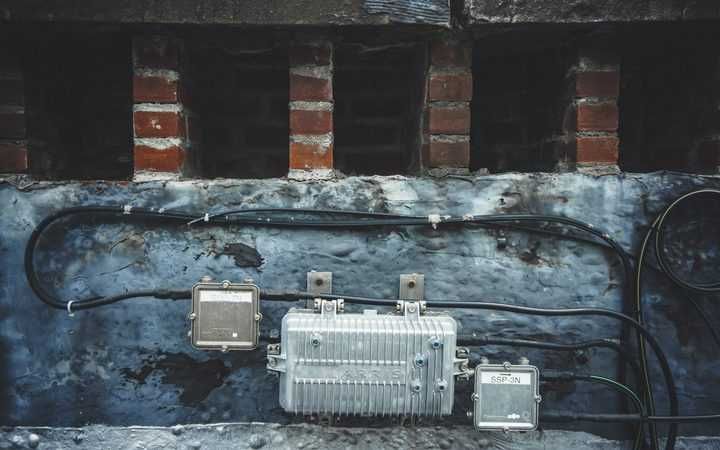
On a line voltage circuit, you can add another light fixture and it just works. A low voltage system, by contrast, is capped by its transformer.
Push the total load beyond the rated wattage (or beyond the recommended 80% loading ceiling) and you'll see one of three failure modes: the lights flicker, the transformer's thermal cutoff or breaker trips, or in the worst case the unit is permanently damaged. Expansion always has to factor in whether the existing transformer has headroom – or whether the next fixture means upgrading to a bigger unit.
LED drivers vs. magnetic transformers
Modern low voltage LED systems often use electronic (switching) drivers rather than the heavier magnetic transformers traditionally used with halogen lighting. Electronic drivers are smaller, cooler, and more efficient – but they're more particular about what they're paired with:
- Some have a minimum load and behave erratically when run far below their rated wattage.
- Many require an ELV (electronic low voltage) or LED-compatible dimmer; standard incandescent dimmers usually cause flicker or buzzing.
- Magnetic dimmers pair with magnetic transformers, and the two systems are not interchangeable.
Before buying a dimmer for a low voltage installation, check the driver or transformer spec sheet for its compatible dimmer types – that one line will save you a lot of debugging.
Final Thoughts
Low voltage lighting earns its place in landscape, accent, and strip lighting because the lower shock risk, simpler installation, and natural pairing with LEDs all line up in your favor. It isn't automatically energy-saving on its own – that comes from the LED bulb, not the voltage – but in practice, the two go together almost every time.
For outdoor work specifically, low voltage is the default residential choice, with 12V the dominant standard and 24V common on larger or commercial runs. Plan around voltage drop, size your transformer with at least 20% of headroom, use the right wire gauge for the distance, and the system will run reliably for years.