How To Protect Outdoor Lights From Rain?
A plain IP67 light handles immersion but fails a pressure-jet test — and since ratings don't stack, you need a dual-rated fixture like IP65/IP67 if you want both.
 Eugen
EugenEugen Nikolajev
Creator of LED Lighting Info
Hi, I am Eugen. I was always one of those kids who had all sorts of weird lighting gadgets for every occasion.
Now, I want to share my knowledge and experience about lighting with you on LED Lighting Info.
Read my editorial standards
Key Takeaways
Buy fixtures with an appropriate IP rating for the location, seal every connection, shield outdoor sockets with a weatherproof cover, and put the entire circuit on GFCI protection. Lights under a covered porch still need to be watertight — wind-driven rain finds its way in.
Electricity and water are a dangerous combination — and outdoor lighting puts them in close proximity. Unless you live in a desert, your fixtures will get rained on, so you need to choose and install them with that in mind.
How do you protect outdoor lights from the rain?
Here is what this guide covers:
- Whether outdoor lighting is waterproof by default
- How to waterproof outdoor lighting and the circuit behind it
- How to seal sockets, connectors, and buried cable
- Whether patio and Christmas lights can be used in the rain
Is Outdoor Lighting Waterproof?
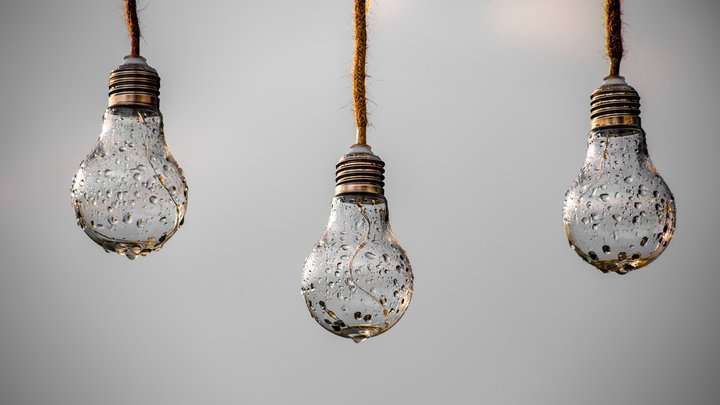
Outdoor fixtures are not automatically waterproof — you need to verify the IP rating on the box.
IP stands for Ingress Protection, the IEC 60529 standard that grades how well an enclosure resists solids and water. It is typically a two-digit code (sometimes with an X substituted when one of the two protections wasn’t tested — e.g., IPX4).
The first digit covers solid particles (dust); the second covers water. For outdoor lighting, the water digit is the one that matters. It runs from 0 (no protection) to 9 — with the highest level, IPX9K, denoting resistance to close-range, high-pressure (~1,160–1,450 psi) water jets sprayed at 80°C (176°F). The K suffix denotes the high-temperature, high-pressure jet test defined under ISO 20653.
| Second Digit | Protection Level |
|---|---|
| 0 | No protection |
| 1 | Vertical dripping water |
| 4 | Splashing water from any direction |
| 5 | Low-pressure water jets |
| 6 | High-pressure water jets |
| 7 | Temporary immersion up to 1 m for 30 min |
| 8 | Continuous immersion beyond 1 m |
| 9K | Close-range, high-temperature, high-pressure jets |
Note that IPX7 and IPX8 ratings are not cumulative with IPX5/IPX6 — a fixture must be dual-rated (e.g., IP65/IP67) if you want both jet resistance and immersion resistance. A plain IP67 light is rated for immersion but not for high-pressure jets.
My rule of thumb: IPX4 is acceptable for sheltered or hanging fixtures; for fully exposed locations choose IP65 or higher; for ground-level or potentially submerged fixtures (decking, path, pond), use IP67.
How To Waterproof Outdoor Lights
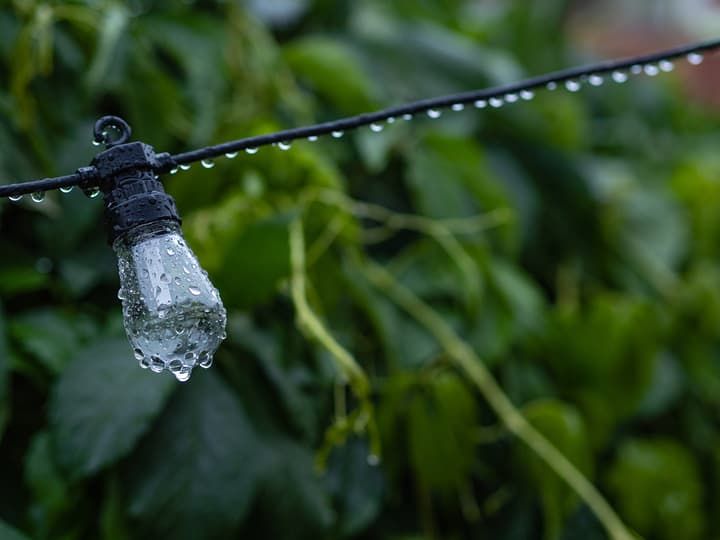
Whether you’re buying landscape lights, string patio lights, or porch lights, match the IP rating to the fixture’s exposure. Hanging lights under cover are usually fine at IP44; anything that could sit in a puddle or be hit by sprinklers should be IP67.
Don’t assume a covered porch eliminates the need for waterproofing. Wind-driven rain comes in at an angle and rebounds off floors and walls, so even sheltered fixtures get wet. Once a droplet finds its way into an unsealed light, it can short the circuit, corrode contacts, or — in cold weather — freeze and crack the housing as it expands.
Look For UL Or ETL Listing
An IP rating tells you how the enclosure resists water, but it doesn’t tell you the fixture has been tested for overall electrical safety. In the U.S., that’s what UL (Underwriters Laboratories) and ETL (Intertek) listings cover — both are Nationally Recognized Testing Laboratories accredited by OSHA. Look for a UL or ETL mark on any outdoor fixture, transformer, or extension cord. Cords intended for outdoor use also carry a W in the cable type designation (e.g., SJTW, SJEOW).
Waterproofing Sockets, Connectors, And Cable
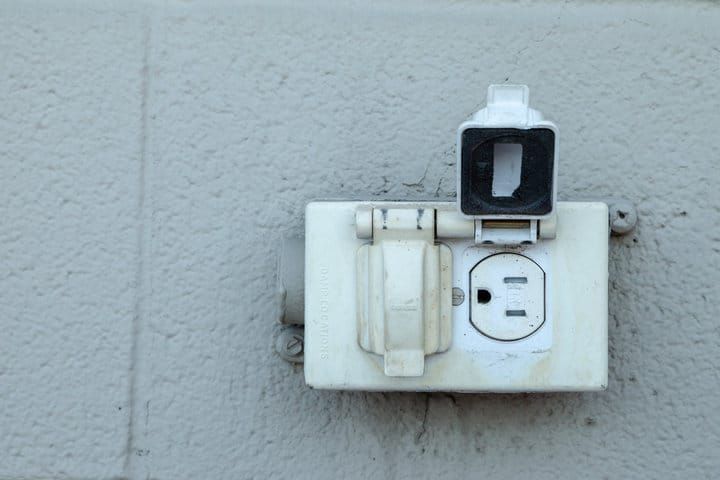
A weatherproof fixture is only half the job. The connections feeding it are the weakest points in the circuit, and that’s where water typically gets in.
Put The Circuit On GFCI Protection
Before anything else: any outdoor outlet or circuit feeding outdoor lighting must be protected by a Ground Fault Circuit Interrupter (GFCI in the U.S., RCD in the UK/EU). The U.S. National Electrical Code requires it under Article 210.8 for nearly every outdoor receptacle. A GFCI cuts power within milliseconds when it detects current leaking to ground — exactly what happens when water bridges a connection. Without one, you can do everything else right and still have an unsafe installation.
Add protection at the breaker (a GFCI breaker on the outdoor circuit) or at the outlet (a GFCI receptacle as the first device on the run). If the existing outlet isn’t already GFCI-protected, have an electrician add it before installing outdoor lights.
Sockets
Whether you’re plugging into an indoor or outdoor socket, anything outdoors needs a weatherproof cover. Standard outdoor receptacles ship with a flip-up cover that only seals when nothing is plugged in — fine for an electric mower, useless for lights left plugged in 24/7.
To weatherproof an in-use outlet:
- Switch off the breaker feeding the outlet.
- Replace the standard cover with a hinged in-use (bubble) cover — like these boxes — that closes around a plugged-in cord.
- Confirm the cover is rated WR (weather-resistant) and TR (tamper-resistant) per code.
- Restore power and test the GFCI.
If you have to extend a cord, the cord itself must be rated for outdoor use — look for a W in the cable type (SJTW, SJEOW) and a UL/ETL listing. A waterproof box around an indoor-rated cord is a false sense of security; the insulation will degrade in UV and freezing temperatures. For the cord-to-cord junction, use a waterproof connection cover: connect the plugs, place the joint inside the box, and clamp it shut.
Connectors
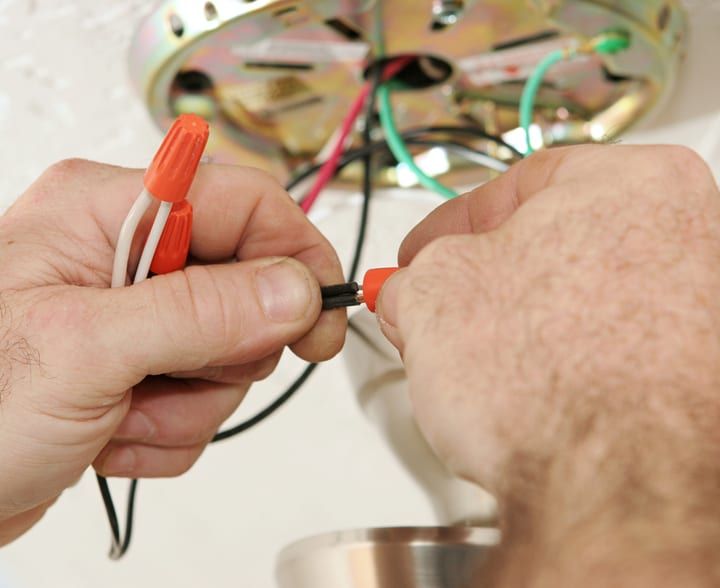
Every wire-to-wire splice in your outdoor circuit needs to be fully sealed. Two reliable methods:
Sealed (gel-filled) wire nuts — like these — work like indoor wire nuts but include a silicone sealant:
- Cut power at the breaker.
- Strip the wire ends to the manufacturer’s recommended length.
- Twist the bare conductors together.
- Insert them fully into the nut and twist clockwise until snug — the gel will surround the splice.
Adhesive-lined waterproof heat-shrink tubing is the best option for soldered or crimped joints:
- Slide a length of tubing onto one wire before joining the conductors.
- Solder or crimp the connection.
- Slide the tubing over the joint, centered on the splice.
- Heat evenly with a heat gun until the tubing shrinks tight and a bead of adhesive appears at each end.
Buried Cable And Low-Voltage Landscape Lighting
If wiring runs underground — say, to a row of path lights or a pond fixture — use cable rated for direct burial or run standard cable inside conduit. In the U.S., that means UF-B (underground feeder) for 120 V circuits, or low-voltage landscape cable (commonly 12/2 or 10/2) for 12 V systems fed from a UL-listed transformer.
Standard indoor wire (NM/Romex, lamp cord, speaker wire) is not rated for burial — UV, moisture, and rodent damage will destroy it. Bury cable at the depth specified by your local code, and protect any portion that comes above grade with conduit.
Can Patio And Christmas Lights Be Used In The Rain?
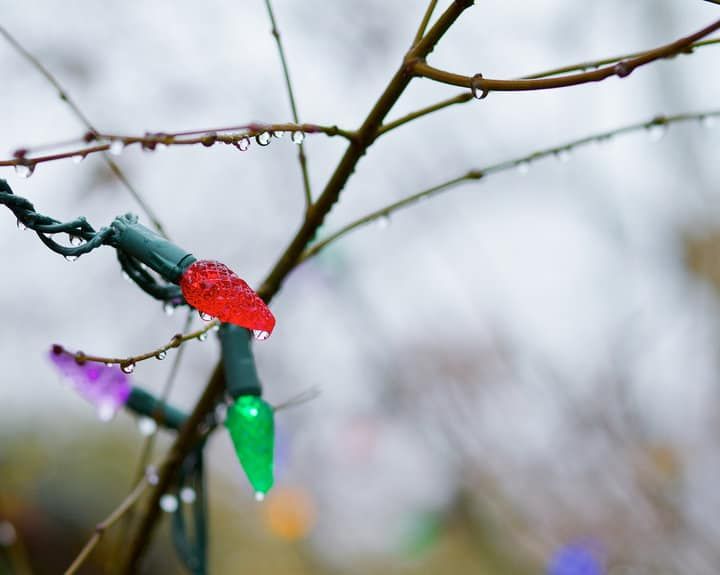
Yes, provided the strings are rated for outdoor use and powered through a GFCI-protected outlet. Most outdoor patio and Christmas lights are rated IP44, IP65, or IP67.
IP44 only covers splashing water from any direction, so it’s fine for hanging strings under cover but not for pressure washing or heavy direct spray. IP65 adds resistance to low-pressure jets — a better default for fully exposed runs. IP67 lights are dust-tight and can withstand temporary immersion in up to 1 meter of water for 30 minutes, which is why many decking lights are rated this highly.
What About CSA And FCC Marks?
CSA Group is a North American safety-certification body recognized by both Canadian regulators and U.S. OSHA as an NRTL. A CSA mark indicates a product has passed safety testing — it isn’t a waterproof rating per se, though waterproof claims may be part of the testing scope.
FCC marks are unrelated to waterproofing. FCC-rated electrical devices comply with limits on radio-frequency interference under Part 15 — i.e., they don’t emit enough electromagnetic noise to disrupt other electronics. Useful information, but it has nothing to do with rain.
Final Words
Rain doesn’t have to be a problem for outdoor lighting if you cover the four basics:
- Match the IP rating to the location — IP44 sheltered, IP65 exposed, IP67 ground-level.
- Seal every connection with gel-filled wire nuts or adhesive-lined heat-shrink tubing.
- Cover any in-use outdoor receptacle with a hinged weatherproof bubble cover, and use only outdoor-rated (W-marked) cords.
- Put the circuit on GFCI protection, and look for UL or ETL listings on every component.
Get those right and a wet evening is just an excuse to enjoy the lights you installed.