
Can You Wire Two Motion Sensors To The Same Light? Wiring Diagram
Daisy-chaining two PIR sensors in series means both must trigger simultaneously — so approaching from one direction leaves the light completely off. Parallel wiring is what actually gives you two independent controls on one fixture.
 Eugen
EugenEugen Nikolajev
Creator of LED Lighting Info
Hi, I am Eugen. I was always one of those kids who had all sorts of weird lighting gadgets for every occasion.
Now, I want to share my knowledge and experience about lighting with you on LED Lighting Info.
Read my editorial standards
Key Takeaways
You can wire two motion sensors to the same light, but not in series; otherwise, both would need to be triggered for the light to work. You can wire the sensors to the light separately in a parallel circuit, and they will work independently.
Motion sensors are directional by design — each one covers a defined area, which means a single sensor can't monitor multiple approaches to a light.
But what if you have one light that you want activated depending on movement in different places? Can you wire one light (or set of lights) to two sensors?
Can I Have Two Motion Sensors To The Same Light?
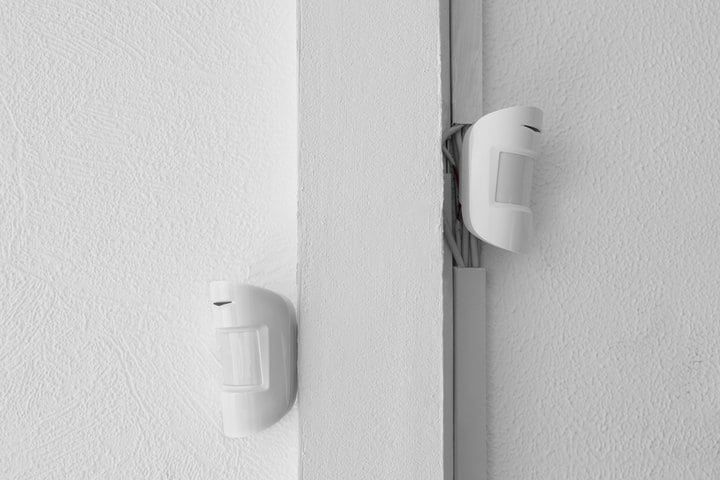
Wiring two motion sensors to one light is perfectly feasible, provided you do it correctly. The setup is electrically analogous to a 3-way switch circuit — two controls operating one light from different locations — so if you've ever installed a 3-way switch, the logic will feel familiar.
For indoor use, you might put a sensor at the top and bottom of a staircase so the lights switch on when you approach from either floor.
Outside, you may prefer to wire your lights to sensors covering the front and rear of your home.
Using your outdoor lights to deter potential intruders, you'll gain more coverage without doubling up on fixtures — just add more sensors.
In theory, you can add several sensors to one circuit — though practical limits depend on each sensor's load rating and standby current draw — which is useful for covering multiple directions around an expansive yard.
What matters is how they're wired. Let's look at that.
Can You Daisy Chain PIR Sensors?
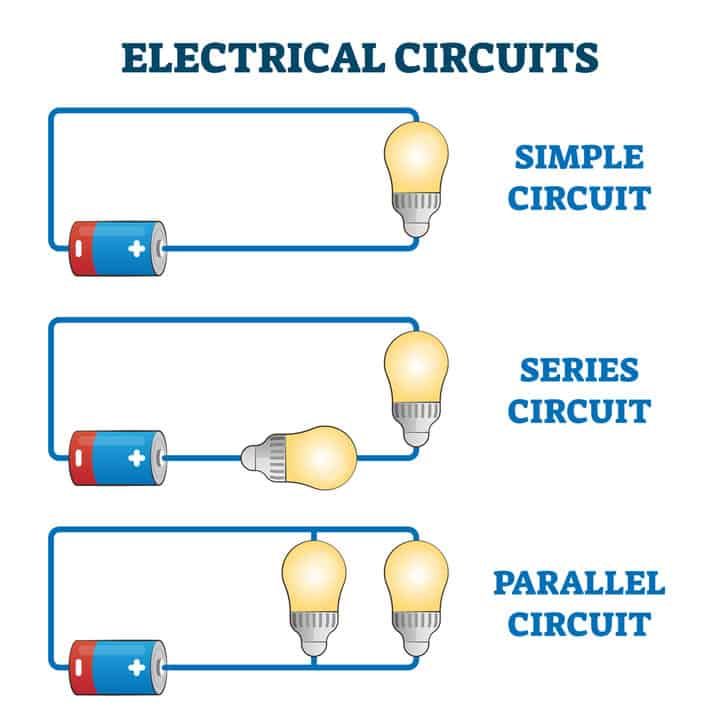
Daisy-chaining motion sensors means putting them on the same circuit in a single loop — a series circuit, where current travels from the power source through each component in turn.
This won't behave the way most people want it to.
A motion sensor behaves like a normally-open switch. When there's no movement, the sensor is off and the circuit is broken. When motion triggers it, the sensor closes the circuit — just like flipping a light switch on. After a set hold time, it snaps back to the off position and breaks the circuit again.
Current only flows through a complete circuit. If there's a break anywhere, nothing wired into that circuit is powered.
So with two sensors wired in series, both have to be triggered at the same time for the light to turn on. If only one detects movement, the other still breaks the circuit — and the light stays off.
Technically, you can daisy-chain PIR sensors in series — but only if you want the light to activate when both sensors trigger simultaneously. The main legitimate use case is a security system that requires detection from two zones at once to reduce false alarms. For standard residential lighting, this isn't the behavior you want.
Series vs. Parallel At A Glance
| Series Wiring | Parallel Wiring | |
|---|---|---|
| Both sensors must trigger? | Yes | No |
| Either sensor triggers light? | No | Yes |
| Useful for standard use? | Rarely | Yes |
| Wiring complexity | Lower | Slightly higher |
Related: Why Do Motion Sensors Give False Positives?
How Do I Wire Multiple Motion Sensors On One Circuit?
As covered above, you can wire more than one motion sensor into a circuit but can't just wire them in series. The useful approach is to wire them in parallel.
Parallel wiring creates two parallel paths to the same light. As long as each sensor sits on its own branch, either one triggering will complete the circuit and turn the light on.
Before You Start: Two Things To Check
Load rating. Each sensor must be rated for the full fixture load. The light's wattage flows through whichever sensor triggered it — it isn't split between the two. Most residential PIR sensors are rated around 300–500W incandescent, with lower ceilings for LED loads, so compare both sensors' specs against your fixture's wattage.
Neutral wire. Most hardwired PIR sensors need a neutral wire at the sensor location to power their internal electronics. Older switch-leg wiring often doesn't include one, so confirm a neutral is available at both sensor locations before buying.
Wiring Steps
- Connect the power supply LINE wire to the input terminal of Sensor A.
- Connect the power supply LINE wire to the input terminal of Sensor B (parallel tap).
- Connect the output terminal of both sensors to the LINE-in terminal of the light fixture.
- Connect NEUTRAL through to the fixture.
- Close the circuit at the breaker.
Here is a diagram:
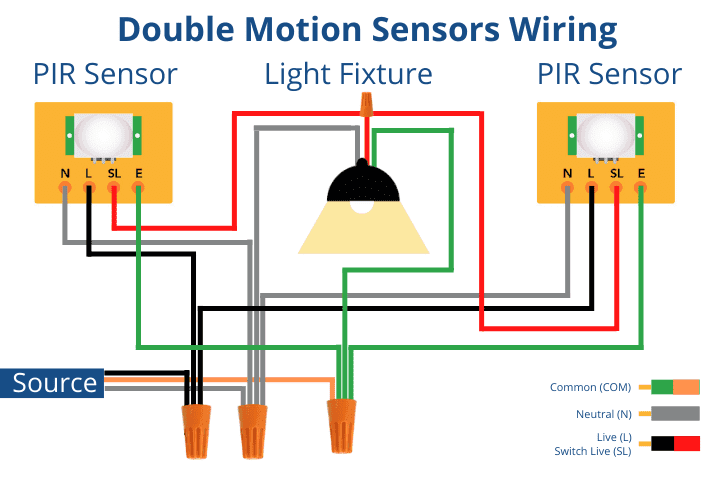
As soon as either motion sensor is triggered, the circuit closes and the light turns on.
One Minor Side Effect
If you trigger both sensors one after the other, the light will stay on slightly longer than usual.
Take the staircase example. You approach the bottom of the stairs, trigger that sensor, and the lights come on. As you reach the top, you trigger the upper-floor sensor. When the lower-floor sensor's hold timer runs out, the upper sensor is still active — so the light stays on for a few extra seconds until the upper sensor times out too.
A minor inconvenience, but worth knowing about.
What About Smart Or Wireless Motion Sensors?
Everything above applies to hardwired PIR sensors. If you're using smart or wireless sensors — Z-Wave, Zigbee, or Wi-Fi — the wiring logic doesn't apply. Those systems handle multi-sensor control through automation rules in a hub or app: any sensor in a group triggers a scene that turns the light on, so the "parallel" behavior happens in software rather than on a wire. Easier to set up, but reliant on your smart-home platform staying online.
Also read: Do Motion Sensors Work Through Glass?
Final Words
Wire two motion sensors in parallel — not series — and either one can turn the light on. Confirm each sensor's load rating covers the fixture, check for a neutral wire at both sensor locations, and you're set.
How do you have your motion sensors set up? If you've hit any wiring snags along the way, share your setup in the comments.