
Do Motion Sensor Lights Work Through Glass?
Standard window glass absorbs the exact 7–14 µm wavelengths a PIR sensor reads, so mounting one indoors and aiming it through a window isn't a workaround — it's a dead end.
 Eugen
EugenEugen Nikolajev
Creator of LED Lighting Info
Hi, I am Eugen. I was always one of those kids who had all sorts of weird lighting gadgets for every occasion.
Now, I want to share my knowledge and experience about lighting with you on LED Lighting Info.
Read my editorial standards
Key Takeaways
PIR motion sensors don't work through standard window glass — the silicon–oxygen bonds in the glass absorb the 7–14 µm infrared wavelengths that warm bodies emit. Microwave (radar) sensors do see through glass, but they're typically more expensive than PIR and prone to false triggers from rain and wind. For reliable detection, mount an exterior-rated PIR sensor outdoors instead of aiming one through a window.
If you're installing a new motion sensor for your outdoor lights and wondering whether you can mount it indoors and aim it through a window, the answer is almost always no — and the reason comes down to physics, not the sensor itself.
In this article I'll explain:
- Why PIR sensors can't see through glass
- Whether glass thickness or proximity changes the answer
- How microwave sensors are different
- Whether dusk-to-dawn sensors work through glass
- Where to mount your sensor outdoors
- How to shield a PIR sensor with the right plastic
Do PIR Motion Sensors Work Through Clear And Frosted Glass?
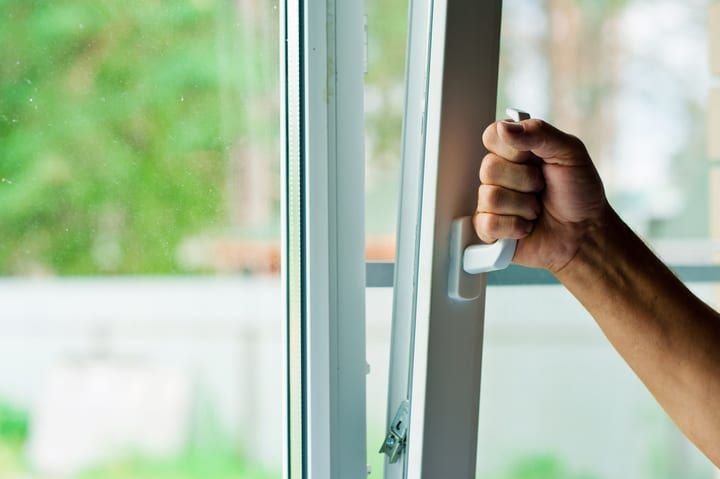
PIR motion sensors won't work through window glass, clear or frosted. PIR stands for Passive Infrared: the sensor doesn't emit anything of its own. Two pyroelectric elements measure infrared signals to detect changes in the ambient IR that warm bodies naturally emit — most of it in the 7–14 µm long-wavelength band.
When the area in front of the sensor warms up because someone has stepped into view, the differential between the two pyroelectric elements triggers the unit and the light switches on.
Standard window glass is opaque to that 7–14 µm band. The silicon–oxygen molecular bonds in the glass absorb energy at those wavelengths, so the long-wave IR never reaches the sensor. Glass does transmit visible light and near-IR — that's why sunlight still warms a closed car — but the heat-signature wavelengths a PIR sensor watches for are blocked. The temperature change behind the window is invisible to it, and the sensor never triggers.
Does Proximity And Thickness Of Glass Affect The Motion Sensor?

Glass thickness matters less than you might hope. A standard windowpane is always thick enough to stop a PIR sensor cold, and even a thin glass-protected recess is unreliable.
Here's what to expect by scenario:
| Scenario | Likely Outcome |
|---|---|
| Standard window pane | Won't work — far-IR is fully absorbed |
| Sensor pressed against thin glass | Unreliable at best — expect missed triggers |
| Polyethylene (HDPE) cover | Works — same material as PIR fresnel lenses |
| Acrylic, polycarbonate, or PET cover | Won't work — these absorb far-IR like glass |
If a sensor pressed against thin glass appears to fire occasionally, don't trust it for security: missed triggers will be the rule, not the exception.
What About Microwave Sensors?
Microwave sensors work on a different principle. They emit a low-power radar signal and detect motion via the Doppler shift of the reflection. Microwaves pass through glass and most non-metallic materials, so a microwave sensor mounted indoors can pick up movement through a window — something a PIR simply can't do.
The trade-offs are real:
- They're typically more expensive than PIR, not cheaper.
- They false-trigger more easily — rain, swaying branches, falling leaves, even wind-blown debris can register as motion.
- They can see through interior walls too, so motion in the next room may fire the light.
For awkward placements, dual-technology sensors combine PIR and microwave in a single unit and only fire when both detect motion. The AND-logic dramatically cuts false alarms — useful in security applications where one technology alone struggles.
Do Dusk To Dawn Sensors Work Through Glass?
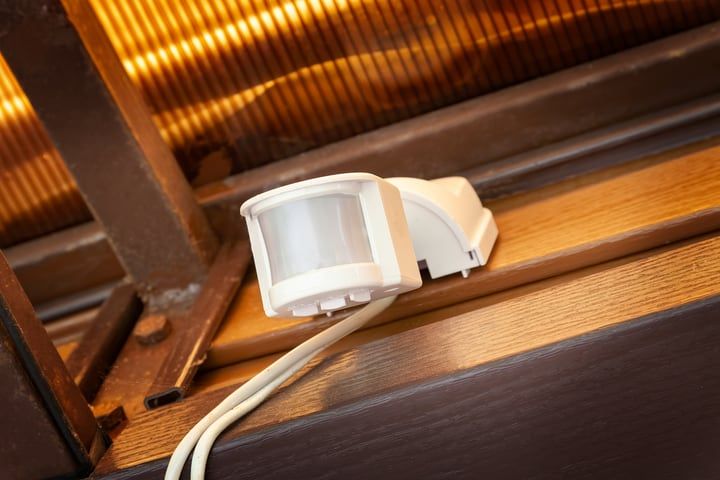
Yes — dusk-to-dawn sensors work fine through clear or frosted glass. They only measure ambient light level, and visible light passes through window panes without trouble.
Some motion sensors have a dusk to dawn sensor bolted on so the light only triggers after dark. Others run purely on the photocell, holding the light on whenever ambient light is low — no motion detection involved.
These light sensors can be adjusted so the trigger threshold matches your local sky. Without that tuning, your light will constantly turn on on overcast days and waste electricity.
Frosted glass scatters visible light but doesn't absorb it, so the photocell still has no trouble detecting that light levels have dropped at sunset.
If you're set on mounting a sensor behind a window and don't mind the light running all night, a photocell-only fixture will do the job — but you'll lose the energy savings of motion-only triggering and accept a constantly-lit yard until dawn.
Where Should I Place The Motion Sensor?
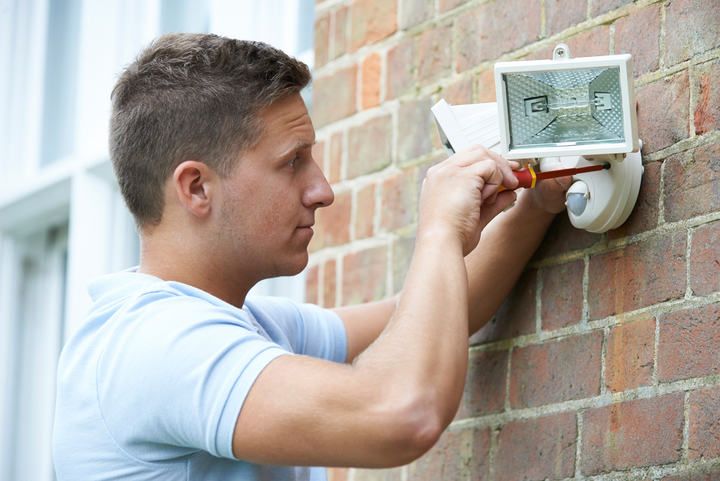
A PIR sensor remains the best option for most homes — which means mounting it outdoors on the wall it's meant to watch, not indoors aiming through a window.
Pick The Right IP Rating
IP44 is the minimum for sheltered positions — under a porch, eave, or covered walkway. For any wall fully exposed to direct rain, look for IP65 or higher: that adds dust-tight protection and resistance to water jets, not just splashes. Coastal or harsh-weather sites warrant IP66.
Mount At The Right Height
Most outdoor PIR sensors are designed for a mounting height of 6–10 feet (1.8–3 m). Lower than that and you'll catch pets while losing range; higher and the detection cone shoots over the heads of anyone walking close to the wall.
Match The Field Of View
Typical PIR detection patterns cover 90–180° horizontally and a narrower 15–30° vertically. If you want the sensor to fire when someone passes directly beneath it — say, walking up to your front door — pick a model with a downward-tilted lens or a multi-directional design.
Don't Worry About Wind
PIR sensors react to changes in IR radiation from warm bodies, not motion in the visual sense. A gust of cold air carries no thermal signature, so wind alone won't set off your PIR motion sensor. (Wind blowing a sun-warmed leaf across the field of view is a different story — but that's the leaf, not the wind.)
How To Shield A PIR Sensor
If a sensor needs to live inside a fixture housing or behind a custom cover, don't reach for any plastic. Most plastics block far-IR almost as effectively as glass.
The right material is high-density polyethylene (HDPE). That's exactly what every PIR fresnel lens is moulded from, and it transmits the 7–14 µm wavelengths the sensor cares about. HDPE can look milky or even opaque to your eye and still pass IR — visible light and infrared are different parts of the spectrum, so a material that blocks one doesn't necessarily block the other.
Avoid clear acrylic (PMMA), polycarbonate, and PET. They look transparent but absorb far-IR almost as effectively as glass. Specialty IR-transmitting acrylics exist, but they're a niche product, not what's sitting on the shelf at the hardware store.
Related: Can A Laser Pointer Set Off Motion Lights?
Final Thoughts
If you were hoping to hide a motion sensor indoors and aim it through a window for your outdoor lighting setup, the physics aren't on your side. Standard glass blocks the long-wave IR a PIR sensor reads, and every workaround comes with a trade-off — microwave sensors that ignore glass also see through interior walls, and HDPE covers solve the IR-transmission problem but won't fit every fixture.
For most homes the simplest answer is the obvious one: an exterior-rated PIR sensor mounted outdoors, on the wall it's meant to watch. There's no glass to fight, no radar bouncing through interior walls, and the housing is built for the weather it'll face.