Can A Projector Lamp Be Replaced With LED?
HID projector lamps cost $300 or more to replace — and the LED you swap in may look brighter on the box than it performs on screen, because raw marketing lumens can run two to three times the equivalent ANSI figure.
 Eugen
EugenEugen Nikolajev
Creator of LED Lighting Info
Hi, I am Eugen. I was always one of those kids who had all sorts of weird lighting gadgets for every occasion.
Now, I want to share my knowledge and experience about lighting with you on LED Lighting Info.
Read my editorial standards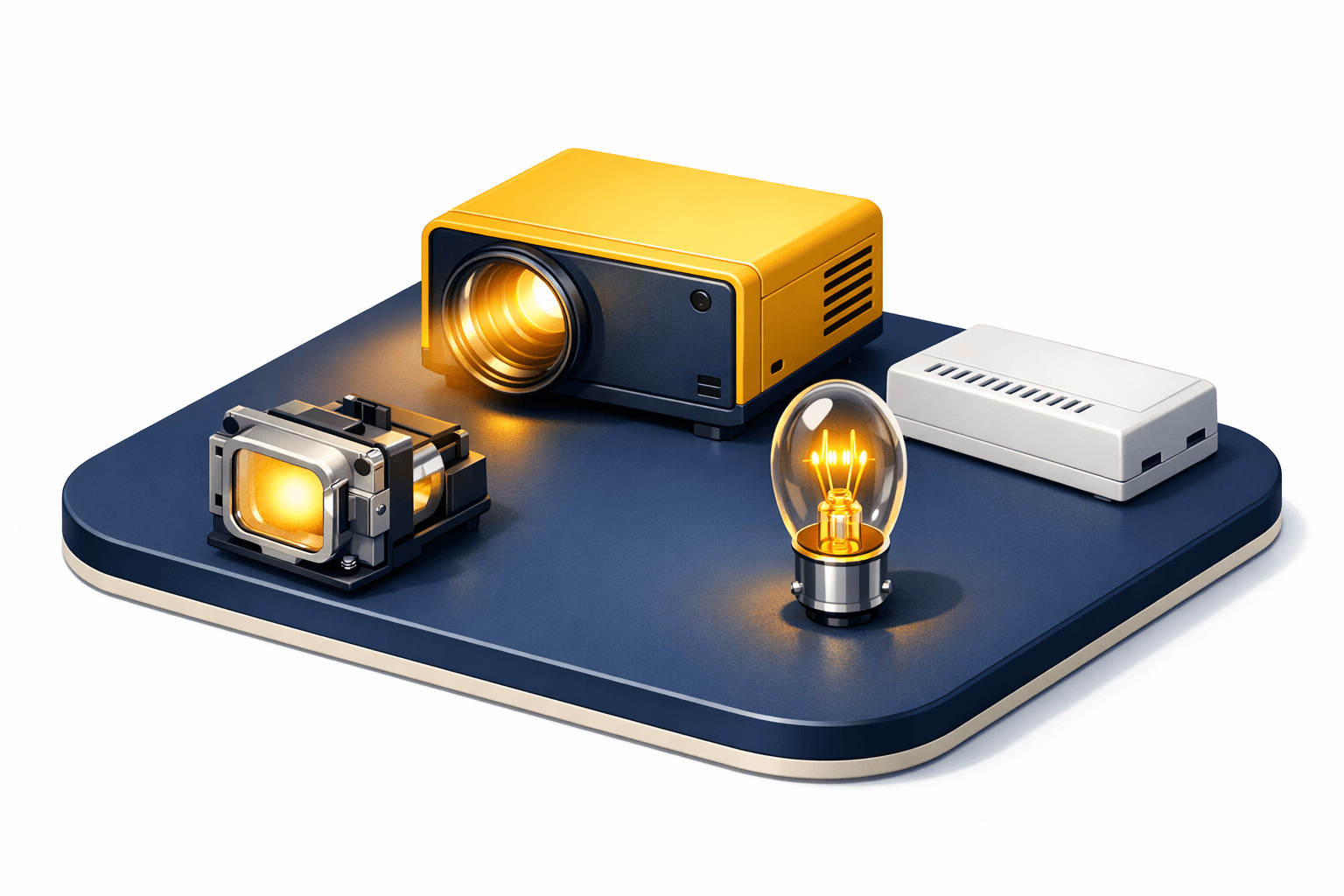
Key Takeaways
HID, UHP, and halogen projector bulbs can be replaced with LEDs, but the swap is rarely straightforward. Because LEDs have very different electrical and thermal characteristics, the projector's motherboard, heat sink, or transformer may need to be modified to accept them.
HID projector bulbs can cost $300 or more to replace, so I understand why owners of older projectors look for cheaper alternatives. The good news: an LED retrofit is possible — though rarely plug-and-play.
Image projectors trace back to the 17th-century magic lantern, but projected motion pictures arrived in 1895 when the Lumière brothers' Cinématographe held its first paying audience screening in Paris. Modern projectors evolved from those early film projectors to throw still images, films, and video onto large screens.
What Type of Bulbs Is Used In Projectors?
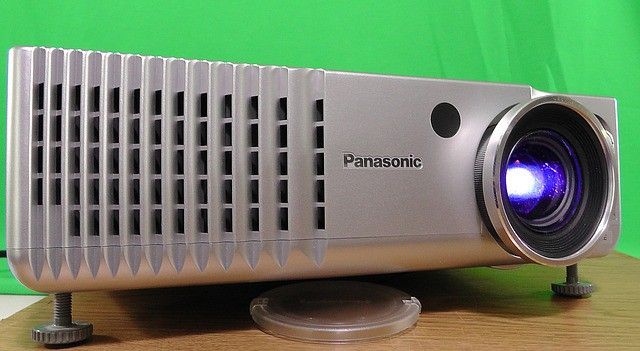
Projectors have cycled through four main light sources: halogen, HID, LED, and laser. Each has different physics, lifespans, and retrofit options, and that's what determines whether an LED swap is realistic.
Halogen
Old projectors used candles and oil lamps as their light source, eventually giving way to incandescents and then halogens. Halogen bulbs work much like incandescents — a tungsten filament inside a gas-filled capsule — but the halogen gas extends bulb life by recycling tungsten atoms back onto the filament. Halogens have largely been superseded in projector use by HID and LED light sources.
Also read: Do LED Bulbs Have Gas In Them?
HID (Metal Halide and UHP)
After halogens came high-intensity discharge (HID) lamps. The two HID types most often used in projectors are metal halide lamps (introduced for projection in the late 1960s) and the ultra-high-performance (UHP) mercury short-arc lamp, a Philips technology introduced in 1995 that became the standard for digital projectors. UHP lamps use only mercury, not the metal halide additives, so the two are distinct technologies.
HIDs emit light when an electric current is driven across two (typically tungsten) electrodes inside a gas-filled quartz capsule. The current vaporizes the gas, which forms a light-emitting plasma.
The main downside of HIDs is a multi-minute warm-up and cool-down, plus internal cooling fans that can be noisy.
LED
Today the most common projector light source is the light-emitting diode (LED). LEDs produce light using a semiconductor chip: when current flows across the junction, negatively charged electrons recombine with positively charged 'holes,' releasing the energy as photons — a process called electroluminescence.
LED projectors are smaller, longer-lasting, and reach full brightness instantly. They run cooler than HIDs, but they still produce heat at the junction and rely on heat sinks and fans for cooling — a detail that becomes important when retrofitting one into a fixture designed for a hotter HID lamp.
Laser
The newest projector light source is the laser. A laser beam is created when electrons are excited by an electric current; each emits the same wavelength of light, and the photons merge into a coherent, parallel beam.
Like LEDs, lasers are extremely long-lasting and start up immediately. They produce far less heat than HID lamps, but both LEDs and lasers still generate enough waste heat to need active cooling — fans, heat sinks, or in higher-end models thermoelectric coolers.
Replaceable laser modules exist in some installation-grade projectors, but consumer laser projectors are almost always sealed units with the light engine integrated. A user-serviceable laser swap on a home projector is rarely an option.
| Bulb Type | Average Lifespan | Average Cost | Average Lumens Per Watt |
|---|---|---|---|
| HID (UHP / metal halide) | 3,000 hours | $50 – $200 | 75 – 100 |
| LED | 20,000 – 60,000 hours | $100 – $200 | ~60 |
| Laser | 30,000 hours | $1,500 – $8,000 | 30 – 60 |
Can HID Lamps Be Replaced With LED?
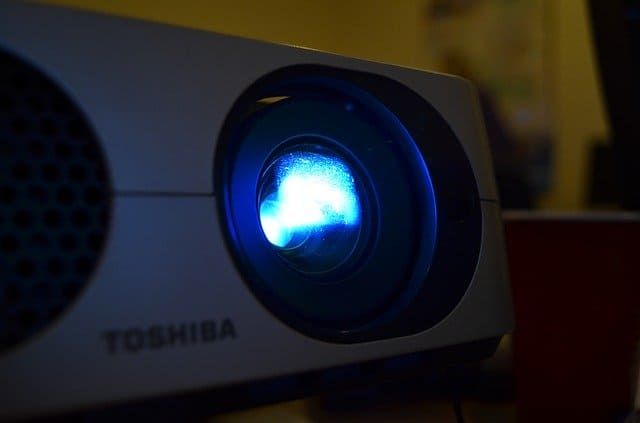
Picked up an old HID projector and don't want to spend hundreds on a new lamp? An LED retrofit is doable — but plan around four technical requirements before you start.
Most projectors split white light into red, green, and blue channels. How efficiently those channels reach the screen varies by technology — three-chip designs (3LCD, 3-chip DLP, LCoS) recombine all three channels, while single-chip DLP projectors using a color wheel show each color sequentially and lose more light in the process. If the LED you fit produces too few lumens, the projected image will look dim or washed out (blurriness, by contrast, is a focus issue, not a brightness one).
- Lumen output — match or exceed the original rating, and pay attention to ANSI lumens versus raw lumens. Projector brightness is standardized in ANSI lumens, while many LED bulbs are sold using raw marketing lumens that can be two to three times higher than the equivalent ANSI figure. A 1,000-ANSI-lumen HID needs an LED rated meaningfully above that on raw lumens to land at the same on-screen brightness.
- Heat dissipation — LEDs run cooler than HIDs but still produce heat at the junction, and the confined space inside a projector lets it build up quickly. Excess heat dramatically shortens LED lifespan, so add a fan, vent, or chipset cooler to keep the LED inside its rated operating temperature.
- Motherboard compatibility — projectors built exclusively for HID lamps will refuse to drive an LED. The most common workaround is to locate and disable the projector's optocouplers, which fools the motherboard into reading the LED as a legitimate HID lamp. This is advanced PCB-level work; doing it wrong can damage the projector, void the warranty, or create electrical hazards, so attempt it only if you're comfortable with electronics modification.
- Color temperature — HID projector lamps typically run around 5,500–6,500 K. An LED with a noticeably warmer or cooler color point will shift the projector's color reproduction, so match the original lamp's color temperature as closely as you can.
Safety: UHP and other HID lamps operate under high internal pressure and can shatter violently if dropped or mishandled. Switch off the projector, unplug it, and let the lamp cool fully before removing it. Wear eye protection and gloves, and dispose of the old lamp at a hazardous-waste facility — UHP capsules contain mercury.
Do LED Projectors Have Integrated Bulbs?
LED bulbs may be long-lasting, but they aren't invincible. So what happens if your LED projector's light source fails? Can it be replaced?
The short answer: probably not, at least on consumer hardware.
Most consumer LED projectors aren't designed to allow light-source replacement. Because LEDs have very long lifespans, manufacturers assume that by the time output drops to 70% of its initial light level (L70), the projector itself will be due for replacement.
To cut costs during manufacturing, they integrate the LEDs with the rest of the projector's motherboard, which makes them difficult to separate. Some professional and installation-grade projectors do offer replaceable LED light engines, but those are the exception rather than the rule.
Is Your Projector Lamp Replaceable?
Start with the product manual. It will state plainly whether the lamp is user-replaceable. Most consumer LED projectors are sealed units, while many HID projectors are designed for tool-free lamp swaps via an access panel.
If a replacement is supported, search for the OEM lamp by model number on the manufacturer's site, Amazon, or eBay. Stick to genuine or reputable third-party lamps — bargain-bin replacements often fall short on rated lumens and burn out early.
If the lamp is integrated, an LED retrofit is your remaining option. Expect to void any remaining warranty, and budget time for the electronics work covered above. Video tutorials for popular models can save hours of guesswork; even an unrelated walkthrough is often worth watching for the layout conventions and disassembly tips that carry over between projectors.
Final Thoughts
Projector lamps are difficult but not impossible to replace. LED brightness has climbed steadily — 3,500-lumen LED projectors were a 2017 milestone, and today LED and laser-phosphor projectors comfortably exceed that range. Replaceable LED light engines are also appearing in more installation-grade projectors, so the all-or-nothing trade-off between long-life solid-state and serviceable lamps is starting to ease.
If you're sitting on an old HID projector, an LED retrofit is genuinely worth attempting before writing the unit off — just go in with realistic expectations about ANSI lumens, heat, and the optocoupler workaround, and treat the old lamp as the hazardous-waste item it is.