
Do Dimmer Switches Get Hot?
Modern dimmer switches run hottest at near-full brightness — not dimmed low. That's the opposite of how older rheostat dimmers behaved, and it changes how you diagnose an overheating switch.
 Eugen
EugenEugen Nikolajev
Creator of LED Lighting Info
Hi, I am Eugen. I was always one of those kids who had all sorts of weird lighting gadgets for every occasion.
Now, I want to share my knowledge and experience about lighting with you on LED Lighting Info.
Read my editorial standards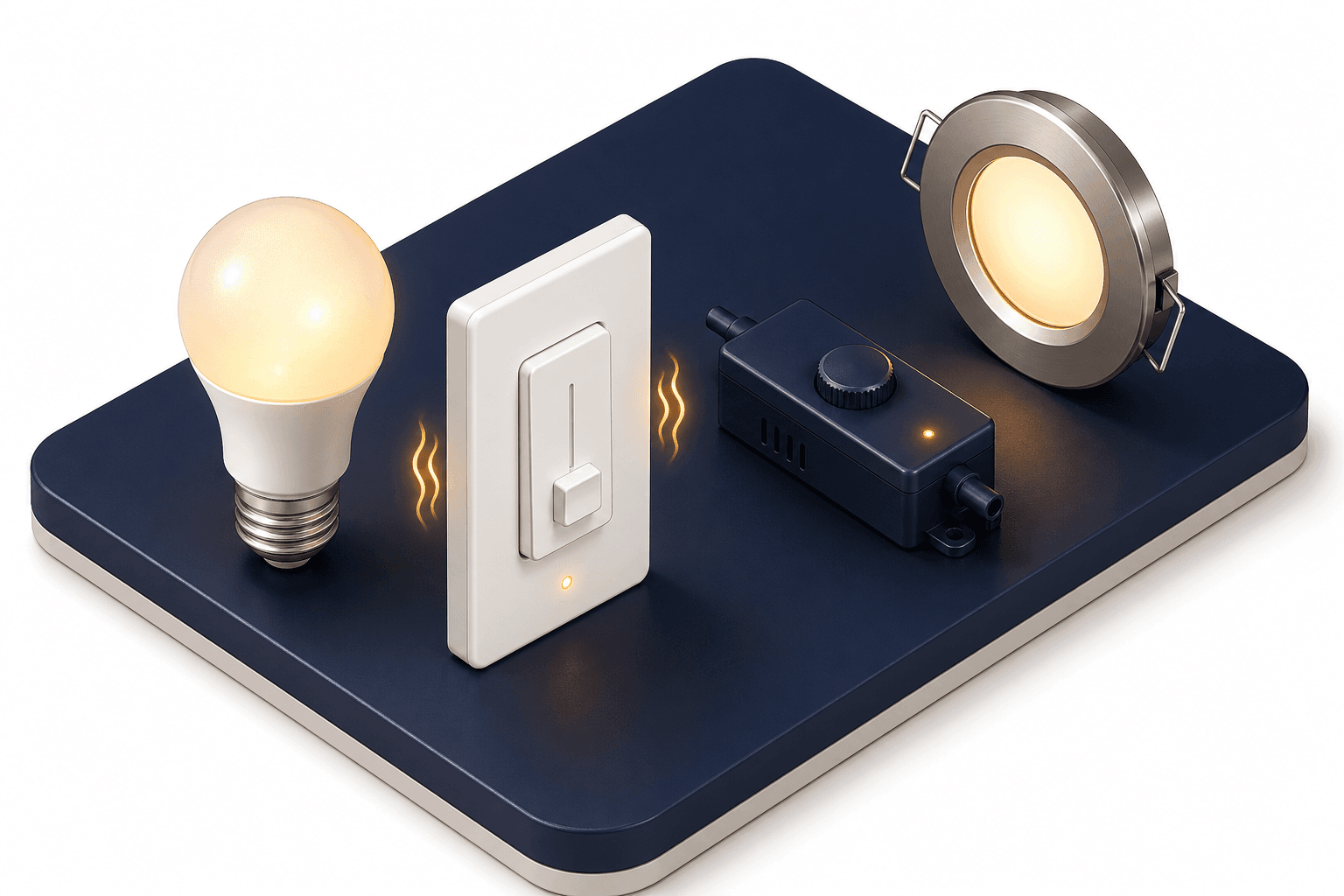
Key Takeaways
Yes, dimmer switches get warm under load, and a slightly warm cover plate is normal. The warning signs are different: a switch you can't comfortably hold a finger on for two or three seconds, a burning smell, or visible discoloration. Those point to overload or an electrical fault and need attention.
In my experience, the cause is almost always one of three things: too much wattage on the circuit, the wrong dimmer paired with LED bulbs, or a switch that's been damaged by heat or a voltage spike. Each has a different fix, and the diagnosis starts with adding up the load.
Why Do Dimmer Switches Get Warm?
A modern dimmer doesn't reduce current the way a faucet reduces water flow. Instead, it uses a TRIAC — a semiconductor that rapidly switches the AC current on and off many times per second. By varying how long current flows during each AC cycle, the dimmer controls perceived brightness. The heat you feel is a byproduct of that switching, plus a small amount of resistance through the device itself.
Older rheostat-style dimmers work differently. They use a variable resistor to drop voltage, and at low brightness the resistor wastes the unused energy as heat. That's why old rheostat dimmers run hottest when dimmed low — not when brightening.
Modern TRIAC and MOSFET dimmers are over 90% efficient, so heat scales with the load current. They're warmest at near-full brightness, when the most current is flowing — not because of which direction you slide the dimmer.
Under UL 1472, the safety standard for solid-state dimming controls, dimmers are designed to stay below roughly 195°F (about 90°C) at internal test points during normal operation. A typical warm dimmer in everyday use sits closer to 140°F (60°C). Both figures describe internal component temperatures, not the cover plate you touch — by the time the plate feels uncomfortable, the inside is significantly hotter.
To shed that heat, the metal yoke (the strap behind the cover plate) doubles as a heat sink. When two or more dimmers share a multi-gang box, the heat-sink fins are usually broken off so the dimmers fit, which reduces dissipation. Most manufacturers require derating the dimmer in that case — for example, a 600W dimmer may drop to 500W when ganged with one neighbor and 400W with two. Check the dimmer's label for the derating table.
What's Normal vs. What's Concerning?
Use this as a quick reference for what the heat is telling you.
| Switch feel | Likely cause | Action |
|---|---|---|
| Slightly warm | Normal under load | None needed |
| Uncomfortable to hold for 2–3 seconds | Overload or LED incompatibility | Run the wattage check; verify the dimmer is LED-rated |
| Hot when fully off, for extended periods | Wiring fault or stuck circuit | Cut power at the breaker; call an electrician |
| Burning smell, discoloration, or buzzing | Serious overload or electrical fault | Switch off at the breaker immediately; call an electrician |
Will Overload Burn Out Your Dimmer or Bulbs?
Running a dimmer past its rated load shortens its life and stresses everything connected to it.
When a dimmer fails from chronic overload, it usually fails silently. A failed dimmer typically won't pass voltage to the bulb, and on a multimeter it can show as either an open circuit (no continuity) or a short, depending on how it failed. Dimmers aren't user-serviceable — replace rather than repair.
Voltage spikes from power surges can also damage a dimmer suddenly, even if it isn't running over its rated load. The TRIAC or driver electronics can be punched through by a single transient.
Bulbs are the other casualty. In an incandescent bulb, excess current overheats the tungsten filament until it fails. LEDs don't have a filament — they rely on a driver circuit that converts AC line voltage to the low DC voltage the LEDs need. When an LED bulb burns out from a dimmer-related fault, it's almost always the driver — electrolytic capacitors or MOSFETs — failing under voltage spikes or thermal stress, not 'filament damage.' If you keep replacing LED bulbs on a single dimmer, the dimmer or its compatibility is the suspect, not the bulbs.
There are many other reasons light bulbs burn out. If the dimmer stays cool and steady, it's probably not the cause.
Can a Hot Dimmer Switch Cause a Fire?
The most dangerous outcome of a chronically overloaded dimmer is fire. If the dimmer's internal temperature climbs well past its rated maximum, that heat conducts out to the housing, the yoke, and the surrounding wall plate.
Polycarbonate and nylon enclosures resist temperatures well above 90°C, but softer PVC plates can begin to soften and deform under sustained heat. The bigger danger isn't the plate itself — it's that overheating signals an electrical fault that could damage wire insulation or ignite combustible material inside the wall.
If you smell burning or singed plastic, or see browning around the switch, switch the circuit off at the breaker and have it inspected. Don't keep using it in the hope that the smell goes away.
A warm dimmer on a heavily loaded circuit — like a chandelier with multiple bulbs — is normal. A switch that burns your fingertip after a second or two is not.
Why Does My Dimmer Switch Get Hot When Turned Off?
A dimmer that stays hot long after you've turned it off is unusual, and worth investigating.
First, confirm the dimmer is actually off. Many switches click audibly at the bottom of their travel — particularly single-bulb dimmers. Without that click, the dimmer may still be at its lowest brightness rather than fully off, and on older rheostat-style dimmers that's the warmest setting.
If the switch is genuinely off and still hot, two possibilities remain. The dimmer may have been so chronically overloaded that the heat sink can't catch up, leaving residual heat for an extended period. More concerning is a wiring fault — a loose connection, a back-stab terminal arcing inside the box, or aged insulation — heating the switch even with no load. Either case warrants cutting power at the breaker and calling an electrician. Heat with no load is a strong signal of a bad connection somewhere in the box.
How to Fix an Overheating Dimmer Switch
Before replacing hardware, check that the load actually fits the dimmer.
Wattage rule: Total bulb wattage ≤ 80% of the dimmer's rated capacity. The label on a dimmer (or its datasheet) shows two ratings — one for incandescent/halogen and a lower one for LEDs. Use the rating that matches your bulbs, and aim for total load to stay under 80% of it as a safety margin.
Worked example: a chandelier with twelve 60W incandescent bulbs draws 720W total. That exceeds a typical 600W incandescent dimmer and will run hot. Swapping those twelve incandescents for 9W LED equivalents drops the load to 108W — well below the LED rating of most LED-compatible dimmers, and below the 80% safety margin on any reasonable model.
There are three ways to bring the circuit back into balance:
- Switch to LED bulbs. The cheapest and most effective fix in most cases. A 9W LED produces roughly the same light as a 60W incandescent, so the load drops by 80–90%. Make sure both the bulb and the dimmer are explicitly LED-compatible — pairing a standard incandescent dimmer with LEDs commonly causes flickering, buzzing, and uneven heat (more on that below).
- Upgrade to a higher-rated dimmer. Higher-capacity models exist (Lutron Nova T 1500W, Lutron Centurion 1500W, Leviton Renoir architectural dimmers up to 2000W), but most are incandescent/halogen-rated and many are spec-grade rather than off-the-shelf retail. For LED loads, dimmers above ~600W are uncommon — reducing the load is usually easier.
- Rewire the circuit. If the load can't be reduced and a single dimmer can't carry it, an electrician can split fixtures across multiple switches.
LED-rated dimmers and the minimum-load problem
Two things aren't obvious from the dimmer's label: not every dimmer works cleanly with LEDs, and many LED dimmers also have a minimum load. Standard incandescent dimmers use leading-edge phase control, which most LED drivers don't tolerate cleanly — the symptoms are flicker, hum, and the dimmer running hotter than expected. Look for a dimmer marked CL, ELV, or 'LED+' for explicit LED compatibility.
On the minimum side, many LED dimmers require around 25W of load to operate stably. A single 9W LED on an incandescent dimmer can flicker, buzz, or stay slightly on at the bottom of the travel — sometimes warm enough to feel. If you've swapped to LEDs and the dimmer still runs hot or behaves oddly, this combination is usually the reason.
⚠️ Call a licensed electrician if any of the following apply: a burning smell, visible discoloration around the switch, the switch staying hot after its breaker is off, or repeated tripping of the breaker. Don't try to diagnose internal wiring damage by hand.
Bottom Line
A faintly warm dimmer is normal. A switch you can't keep a finger on, one that's hot when off, or one showing discoloration is not. Run the checks in this order:
- Add up your bulbs' total wattage and compare it to the dimmer's LED and incandescent ratings — keep the load under 80% of whichever applies.
- If you're using LEDs, confirm the dimmer is explicitly LED-compatible (CL, ELV, or LED+).
- Replace incandescents with LEDs to drop the load before considering a higher-wattage dimmer.
- If the switch is hot when off, smells of burning, or shows discoloration, cut power at the breaker and call an electrician.
FAQ
Is it normal for a dimmer switch to feel warm to the touch?
Yes. Dimmers dissipate heat continuously while a load is on, and a slightly warm cover plate is expected — especially on heavily loaded circuits. The threshold to worry about is when you can't comfortably hold a finger on the plate for two or three seconds, when the switch stays hot after being turned off, or when you notice a burning smell or discoloration.
Why does my LED bulb flicker on a dimmer switch?
Most likely the dimmer isn't LED-compatible. Standard incandescent dimmers use leading-edge phase control that LED drivers don't always tolerate. Look for a dimmer marked CL, ELV, or 'LED+' for explicit LED compatibility. Flickering can also occur when a single LED falls below the dimmer's minimum load — many LED dimmers need roughly 25W of load to operate stably.
What's the wattage limit for a typical residential dimmer?
Standard residential dimmers are usually rated 600W for incandescent/halogen loads and 150–250W for LED loads on the same device — the LED rating is lower because LED drivers stress the dimmer differently. Higher-capacity models (1000–1500W) exist for incandescent loads, mostly from Lutron and Leviton, but high-wattage LED-rated dimmers are uncommon.
Should I call an electrician if my dimmer feels hot?
Not for normal warmth under load. Call an electrician if the switch is too hot to hold for more than a couple of seconds and the load already fits the dimmer's rating, if it stays hot after the breaker is off, if there's a burning smell or visible discoloration, or if the breaker keeps tripping. Those symptoms point to a wiring fault or internal damage that isn't a DIY fix.