
Can You Dim Pool Lights?
Pentair explicitly warns that wiring the IntelliBrite 5G to a dimmer permanently damages the light. For most LED pool lights, where dimming is possible at all, it runs through a proprietary controller — not your wall switch.
 Eugen
EugenEugen Nikolajev
Creator of LED Lighting Info
Hi, I am Eugen. I was always one of those kids who had all sorts of weird lighting gadgets for every occasion.
Now, I want to share my knowledge and experience about lighting with you on LED Lighting Info.
Read my editorial standards
Key Takeaways
120V incandescent or halogen lights work with a standard wall dimmer. Low-voltage (12V) LED fixtures need a dimmer matched to the transformer type, installed after the transformer, and only if the fixture's spec sheet confirms it's dimmable.
Most major LED pool lights from Pentair, Jandy, and Hayward are not dimmable via switches at all; brightness control, when offered, runs through proprietary automation systems.
Pool lighting should be planned for ambiance, not glare — but a fixed brightness isn't always what you want. Sometimes you'd rather dim the lights for a quiet evening swim, or push them up for visibility when guests are in the water.
Can you put pool lights on a dimmer? It depends on the bulb type, the voltage, and whether the fixture itself is rated dimmable.
Get this wrong and you can damage the fixture, the transformer, or both. Here's what to know:
- Whether you can put pool lights on a regular dimmer
- How to wire dimming on each circuit type
- Which brands actually support dimming, and how
- Safety and code requirements you can't skip
Can You Put Pool Lights On A Regular Dimmer?
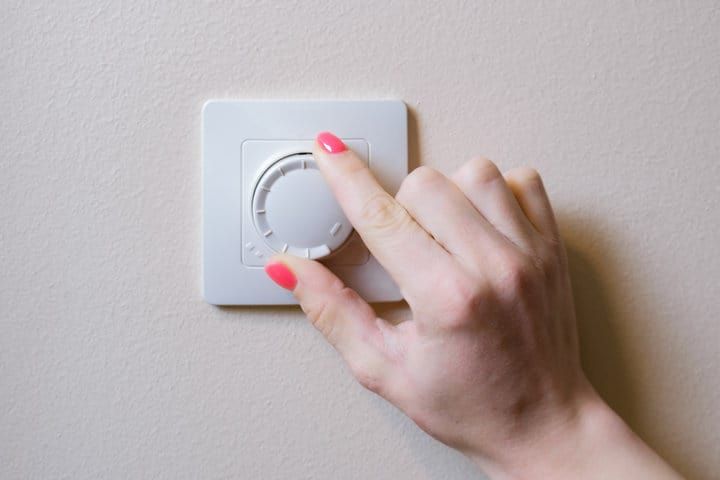
Pool lights come in two main voltage options — 120V (line voltage) and 12V (low voltage with a transformer). Both incandescent and modern LED fixtures are sold in either voltage. The industry has trended toward 12V for safety and installation cost reasons (no GFCI or bonding required at the fixture, saving roughly $150 per light), but 120V LEDs from Pentair, Hayward, and other brands are still widely sold.
Two questions decide whether a regular dimmer will work on your circuit:
- What type of bulb is it?
- What voltage is it?
For a 120V incandescent or halogen bulb, a standard wall dimmer works fine.
For an LED, the fixture itself has to be rated dimmable on its spec sheet. If the spec sheet doesn't say so, assume it isn't. Most LED pool lights use a built-in driver that expects clean AC — the phase-cut waveform from a standard dimmer destabilizes the input voltage, which causes flickering, overheats the driver, and leads to premature failure of the controller. Manufacturers commonly void the warranty if a non-dimmable LED is wired to a dimmer.
For low-voltage (12V) lights, a 120V wall dimmer is the wrong tool entirely — line-voltage dimmers phase-cut a 120V AC waveform and aren't designed to regulate the output of a transformer. The right approach is covered in the next section.
How To Dim Pool Lighting

Before touching wiring: pool electrical work is governed by NEC Article 680 in the US, which sets specific requirements for bonding, GFCI protection, and how close switches and dimmers can be installed to the water. Hire a licensed electrician for anything beyond swapping a like-for-like switch, and check whether a permit is required in your jurisdiction. The wiring steps below are a general overview, not a substitute for code compliance.
Option A: Dimming 120V Incandescent Or Halogen Lights
- Switch off the breaker feeding the light circuit and verify the line is dead with a non-contact tester.
- Remove the existing switch and replace it with a dimmer rated for incandescent/halogen at or above the fixture wattage.
- Restore power and confirm the dimmer operates smoothly across its full range without buzz or flicker.
Option B: Dimming 12V Low-Voltage LED Lights
A standard wall dimmer placed before the transformer can introduce DC components that damage the transformer, and most pool light transformers aren't listed for dimming in any case. The dimmer has to go on the secondary (low-voltage) side, after the transformer.
- Confirm on the spec sheet that the LED fixture itself is rated dimmable.
- Confirm the transformer is listed for use with a dimmer. Most pool light transformers from Pentair, Hayward, and Jandy are not, and those manufacturers don't recommend dimming through them.
- Switch off the breaker and verify the line is dead.
- Install a low-voltage dimmer matched to the transformer type — a magnetic low-voltage (MLV) dimmer like the Lutron DVLV-600PH for magnetic transformers, or an electronic low-voltage (ELV) dimmer for electronic transformers. Mismatching the dimmer type causes hum, flicker, RF interference, and can burn out the dimmer or transformer.
- Wire the dimmer between the transformer and the fixture, on the 12V side.
- Power up and test the full dimming range, watching for flicker, audible hum, or excess warmth at the transformer.
Outdoor-rated low-voltage dimmers are hard to source. If the transformer is mounted indoors, install the dimmer indoors next to it. Otherwise, two practical workarounds:
- Mount an indoor-rated dimmer inside a weather-rated enclosure on the transformer cabinet.
- Use a wireless RF dimmer receiver — the receiver lives sealed inside the transformer cabinet while a remote or in-wall RF transmitter handles control, which avoids running new switch wiring outdoors.
When you're dimming landscape lighting, a transformer with a built-in dimmer is another option. But a landscape lighting transformer can't be used for pool lights — the transformer must be one designed and listed for pool fixtures, and dimmable pool-rated transformers are not currently offered by the major manufacturers.
Which Brands Of Pool Lights Are Dimmable?

Even with the right wiring, the fixture itself has to support dimming. Here's where the major brands stand on their current in-ground pool lights:
| Brand | Product line | Type | Dimmable? | How |
|---|---|---|---|---|
| Pentair | SpaBrite, AquaLight | Incandescent / halogen | Yes | Standard 120V dimmer |
| Pentair | IntelliBrite 5G | LED | No | Not via dimmer or IntelliCenter automation |
| Jandy | Color LED | LED | No | — |
| Jandy | WaterColors HydroCool (white) | LED | Verify spec sheet | Not broadly advertised by Jandy |
| Hayward | Universal ColorLogic 2.0 (post-June 2018, 12V) | LED | Yes | OmniLogic / OmniHub automation, 20% increments |
A few notes on the table above:
- Pentair states that the IntelliBrite 5G "cannot be used on a dimmer circuit" and that doing so will permanently damage the light. Pentair's IntelliCenter and EasyTouch automation can run color shows and switch the light on or off, but cannot dim it — IntelliCenter's documentation explicitly notes that brightness dimming is supported only for incandescent tungsten-filament fixtures.
- Jandy's WaterColors Nicheless HydroCool white LED is sometimes described as dimmer-compatible in third-party listings, but Jandy's own product pages and sell sheets do not advertise wall-dimmer compatibility. Pull the current spec sheet for the exact model before assuming it dims.
- Hayward's Universal ColorLogic 2.0 supports OmniDirect Mode — 20% dimming increments, plus speed control and ten extra colors — when paired with an OmniLogic or OmniHub controller. The feature requires the post-June 2018 low-voltage Universal ColorLogic models. iAquaLink can switch ColorLogic colors but does not expose dimming — that's locked to Hayward's own automation platform.
The pattern across the industry: where modern LED pool lights offer brightness control at all, it's through a proprietary automation system rather than a wall dimmer. If smooth dimming matters, the cleanest path is choosing a fixture and controller built to support it together — usually Hayward's Universal ColorLogic with OmniLogic or OmniHub.
Final Words
Before changing wiring or buying a dimmer, pull the spec sheets for both the fixture and the transformer and confirm dimming is supported on each. Get a licensed electrician involved for anything more than swapping a 120V switch — pool circuits sit under NEC Article 680 for a reason, and the cost of getting it wrong is measured in damaged fixtures or worse.
The shortcut that saves the most pain: pick lights and a controller designed for dimming from the start, rather than trying to retrofit it onto a system that wasn't.