
How To Dim Low Voltage LED Landscape Lighting?
Mismatching your dimmer to your transformer type is the single most common cause of flicker, buzz, and early failure on low-voltage LED systems — and it's entirely avoidable once you know whether your transformer is magnetic or electronic.
 Eugen
EugenEugen Nikolajev
Creator of LED Lighting Info
Hi, I am Eugen. I was always one of those kids who had all sorts of weird lighting gadgets for every occasion.
Now, I want to share my knowledge and experience about lighting with you on LED Lighting Info.
Read my editorial standards
Key Takeaways
To dim low-voltage LED landscape lighting properly, three things have to line up: dimmable bulbs, a dimmer matched to your transformer type (MLV or ELV) installed on the 120V line side, and — ideally — a transformer designed for dimming. Non-dimmable bulbs may run fine at 100%, but they tend to flicker, buzz, or fail prematurely once the output is reduced.
No matter how much planning goes into your landscape lighting, there's no way to know exactly how it will look until everything is wired up and switched on. Even a carefully designed setup can feel too bright the first time you flick the switch — or you may simply want the option to brighten things on some evenings and soften them on others.
In this article I'm going to cover:
- Quick fixes when landscape lights are too bright
- Whether your bulbs and fixtures can be dimmed
- How to wire an inline dimmer correctly
- Choosing a dimmable transformer (and the MLV vs ELV question)
- Why LEDs flicker when dimmed — and how to avoid it
What To Do If Landscape Lights Are Too Bright

Before adding a dimmer to the system, it's worth knowing that there are simpler fixes for over-bright landscape lights. They don't give ongoing control, but they can solve the problem for a fraction of the cost.
Move the fixture
Moving a fixture 3–6 inches further from a wall or surface can noticeably reduce the perceived brightness of the light on a wash or flood effect. If you can shift the housing without disturbing the buried cable, this is the fastest fix and costs nothing.
Apply a gel filter
Slip a gel filter (Amazon) over the lens to soften and reduce output. Gels are also useful for color correction with outdoor lighting. This is one of the most cost-effective short-term solutions available, but each gel has to be cut to size and weatherproofed, and the result is rarely uniform across multiple fixtures.
Swap to lower-lumen bulbs
If the fixtures take replaceable bulbs, swap in a lower-lumen LED. The result is uniform across the run and LED bulbs are inexpensive — but you lose the option to adjust brightness later.
Here's how the quick fixes compare with the two dimming options covered later in the article:
| Solution | Estimated Cost | Time to Implement | Ongoing Control? |
|---|---|---|---|
| Move fixture | Free | Low | No |
| Gel filter | Under $10 | Medium | No |
| Swap to lower-lumen bulbs | $5–$20 | Low | No |
| Inline dimmer (matched to transformer) | $15–$50 | Medium | Yes |
| Dimmable transformer | $80–$200+ | Low | Yes |
Are Landscape Lights Dimmable?
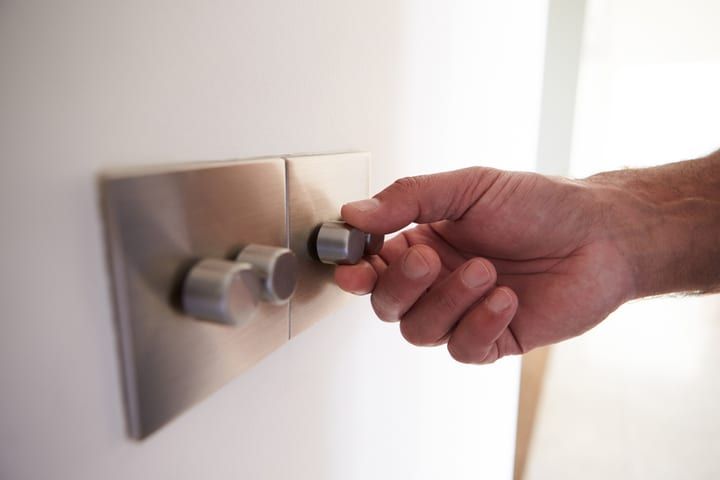
Not every landscape light can be dimmed. Two things determine whether yours can:
- Are the lights themselves dimmable?
- Is the transformer dimmable (or can a dimmer be added before it)?
On the bulb side, what matters is the bulb itself, not the fixture. If your fixtures take replaceable lamps, fit dimmable LED light bulbs. For sealed integrated fixtures, the whole unit has to be rated dimmable.
If the product listing does not explicitly state that the fixture is dimmable, assume it is not. Dimmable LEDs use more internal components and cost more, so manufacturers always advertise the feature when it's available.
Before buying any dimmer, confirm whether your system runs on 12V AC or 12V DC. Most low-voltage landscape kits are 12V AC (transformer-based). Modern integrated LED systems sometimes use 12V DC drivers — and the dimmer types are not interchangeable.
Related: Do Landscape Lights Increase Home Value?
Adding an Inline Dimmer (the Budget Route)
If your existing transformer isn't dimmable, you don't necessarily need to replace it. Adding an inline dimmer is the cheapest route to ongoing brightness control — but it has to be wired correctly, and the dimmer has to match the transformer.
Where the dimmer goes
Standard industry practice — and what dimmer manufacturers like Lutron specify — is to install the dimmer on the 120V line side, between the wall and the transformer. The dimmer reduces the line voltage feeding the transformer, which in turn dims the lights.
Signal flow: Mains → Dimmer → Transformer → LED Fixtures
- Switch off the breaker feeding the outlet or junction box that powers the transformer.
- Identify your transformer type — magnetic (MLV) or electronic (ELV). It's printed on the case or in the manual.
- Choose a dimmer to match: leading-edge / MLV dimmer for magnetic transformers, trailing-edge / ELV dimmer for electronic ones.
- Wire the dimmer into the 120V circuit between the wall switch (or breaker) and the transformer's primary input — following the dimmer's instructions.
- Restore power and test across the full dimming range, watching for flicker or buzz.
⚠️ Using a generic incandescent dimmer with a magnetic transformer can damage it through residual DC offset. Using the wrong type with an electronic transformer typically shows up as flicker. Match the dimmer to the transformer.
What about a 12V dimmer on the output side?
DIY guides sometimes show a 12V dimmer wired between the transformer and the fixtures. It can work, but only with a dimmer specifically designed for that role and with confirmed compatibility from the transformer maker — which most won't certify. The dimmer also sits outside, so it has to be rated and waterproofed for outdoor use. For most installs, the primary-side approach is cleaner and safer.
For 12V DC LED driver systems (no AC transformer), the rules change again: use a PWM (Pulse Width Modulation) DC dimmer wired into the DC output. Putting an AC dimmer on a DC driver circuit can damage components.
Selecting a Dimmable Transformer

Most landscape transformers aren't dimmable, so a dimming-capable model usually means swapping out what's in your enclosure now. Selection is narrower than for standard transformers, but reputable brands — Dekor, Paradise/Sterno Home, VOLT, Moonrays, EMCOD — sell dimmable models on Amazon and through specialty retailers.
Sizing it correctly
The 80% rule still applies: never run a transformer at more than 80% of its rated capacity. To find your minimum size, divide your total fixture wattage by 0.80.
For 200W of lighting: 200 ÷ 0.80 = 250W minimum. A 300W transformer gives extra headroom for future fixtures and is a sensible buy if you expect to expand. See our transformer sizing guide for a worked example with longer runs.
MLV vs. ELV
Dimmable transformers come in two flavors:
- Magnetic (MLV) — heavier, more tolerant, paired with a leading-edge / MLV dimmer.
- Electronic (ELV) — lighter, more efficient, paired with a trailing-edge / ELV dimmer.
Mismatching the two is the single most common cause of flicker, buzz, and premature failure on low-voltage installs.
Watch the minimum load
Many dimmable transformers also have a minimum load they need to function correctly. A small system — say, four 3W path lights totalling 12W — may dim erratically on a transformer that needs 25W or more on the secondary. Check the spec sheet before buying, especially for compact installs.
Smart and digital features
Most current dimmable transformers are digital, often with timers, photocells, and Wi-Fi or app control. Some integrate with Alexa or Google Home for voice commands, scheduling, and scene presets. If smart features matter to you, confirm two things before buying: that the transformer's location is in Wi-Fi range (or that you can extend coverage with a mesh node), and that the brand's ecosystem matches what you already use indoors. Analog (knob/dial) dimmable transformers still exist but are increasingly rare on the consumer market.
Why LEDs Flicker When Dimmed
Flicker is the single most common complaint when people first try to dim outdoor LEDs. Three things cause it:
- Dimmer/transformer mismatch — a leading-edge dimmer on an electronic transformer, or vice versa.
- Non-dimmable bulbs on a dimmable circuit — held at 100% they're usually fine, but reduce the output and they tend to buzz, flicker, or fail early.
- Output below the minimum load — too little wattage on the line and the dimmer or transformer's electronics can't regulate cleanly.
If lights flicker only at low brightness, you're likely below a minimum load threshold. If they flicker across the whole range, suspect compatibility — start with the dimmer/transformer pairing.
FAQ
Can I use a regular indoor dimmer on landscape lights?
Only if it matches your transformer type. Standard incandescent dimmers can damage a magnetic low-voltage (MLV) transformer through residual DC offset. Use a leading-edge / MLV dimmer with magnetic transformers, and a trailing-edge / ELV dimmer with electronic transformers. The dimmer should sit on the 120V line side, between the wall and the transformer.
Why do my LED landscape lights flicker only when dimmed low?
That pattern almost always points to a minimum-load problem. The dimmer or transformer needs a certain wattage on the line to regulate smoothly, and a small fixture run can fall below that threshold at low brightness. Either add more fixtures to the circuit or use a dimmer/transformer rated for very low loads.
Will dimming shorten the life of my LED bulbs?
Dimming a properly-matched, dimmable LED on a compatible dimmer typically extends life slightly. The opposite is also true: running non-dimmable bulbs on a dimmable circuit (at any output below 100%) can cause early failure. Compatibility — not dimming itself — is what determines lifespan impact.
Are most low-voltage landscape systems 12V AC or 12V DC?
Most kit-based and contractor-installed systems are 12V AC, fed by a step-down transformer. Some integrated LED fixtures and modern smart systems use a 12V DC driver instead. The dimmer requirements differ — AC systems use phase-cut MLV/ELV dimmers, DC systems use PWM dimmers — so confirm before buying any dimming hardware.
Final Thoughts
Done well, dimming gives you the most control over a landscape system — soft for entertaining, brighter for security. The single biggest mistake I see is treating dimmer compatibility as an afterthought; match the dimmer to the transformer type from the start, and most flicker problems disappear before they begin.
If you're on a tight budget, gel filters or lower-lumen bulbs are still legitimate fixes for over-bright lights. If you want ongoing control, the inline-dimmer-on-the-line-side route is dramatically cheaper than swapping the transformer — provided you match dimmer type to transformer type. And if you want smart features, scheduling, or scenes, a dimmable digital transformer is worth the spend.
If you're sizing or replacing a transformer, the landscape lighting transformer size guide walks through the math in more detail.