
Do Outdoor Lights Need To Be On Their Own Circuit?
A fault in your outdoor fitting can kill the lights inside your house — and that's exactly what happens when outdoor lighting piggy-backs an indoor circuit. A dedicated outdoor circuit stops that cold.
 Eugen
EugenEugen Nikolajev
Creator of LED Lighting Info
Hi, I am Eugen. I was always one of those kids who had all sorts of weird lighting gadgets for every occasion.
Now, I want to share my knowledge and experience about lighting with you on LED Lighting Info.
Read my editorial standards
Key Takeaways
Ideally, outdoor lights should be on a dedicated circuit with appropriate weatherproofing and earth-fault protection (RCD in the UK, GFCI in the US). They don't have to be on a separate circuit, but the cabling, fittings, and protection devices must be rated for outdoor use.
Outdoor lights don't legally have to be on their own circuit — but they should be, and there's good reason for it.
In my experience, retrofitted outdoor lighting often gets piggy-backed onto the nearest indoor lighting circuit. That works electrically, but it means a fault out in the rain can take down the lights inside your house, and it makes circuit protection harder to size correctly.
A dedicated outdoor circuit, with the right cable, burial depth, and earth-fault protection, isolates outdoor faults from the rest of your home and is sized properly for the conditions outside.
In this article I'll cover:
- Whether outdoor lights need a dedicated circuit (and why I recommend one)
- Cable type, size, and burial depth for outdoor runs
- IP ratings, RCD/GFCI protection, and code compliance
- Low-voltage landscape lighting as an alternative
- Whether you can control outdoor lights from an indoor switch
📝 Note: Cable and circuit specifications below reference UK standards (BS 7671 — SWA cable, mm² conductor sizing, mm burial depths) alongside US NEC requirements where they differ. Country is called out wherever the guidance diverges. Always confirm with local code and a qualified electrician for your jurisdiction.
What Circuit Should Outdoor Lights Be On?
Series vs Parallel Is Not the Real Question
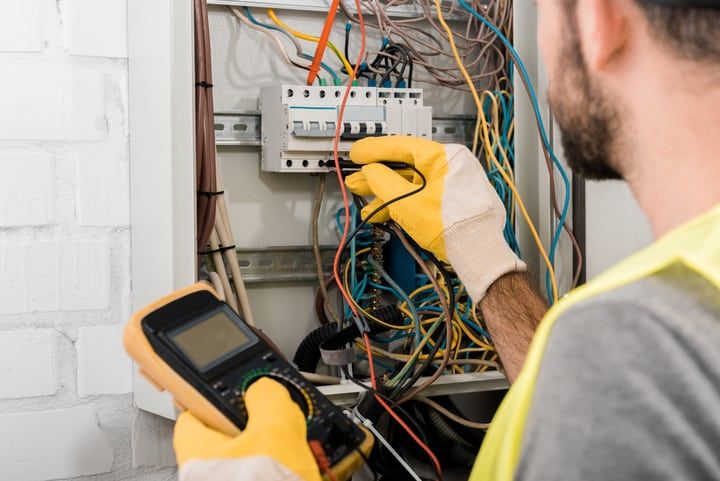
Mains-wired residential lighting — indoor or outdoor — is wired in parallel, so each fitting receives the full supply voltage. Wiring mains lights in series would split the supply across each fixture and isn't standard or compliant practice. The "one bulb fails, all go dark" pattern is a quirk of cheap incandescent Christmas-light strings, not garden lighting installs.
The real choice for outdoor lighting comes down to two decisions:
- Dedicated vs shared circuit — a dedicated outdoor circuit isolates faults from indoor lighting and lets you size cable, MCB, and RCD/GFCI for outdoor conditions. A shared circuit is acceptable when properly protected, but a single fault outside can take indoor lighting offline.
- Hub-and-spoke vs daisy-chain topology — applies mainly to low-voltage landscape lighting on a transformer. Each fixture either runs back to the transformer (hub-and-spoke) or shares a common cable run (daisy-chain). Both wire fixtures in parallel; the difference is voltage drop along the run, not circuit topology.
If the install is part of a larger garden overhaul, plan the lighting circuits early so you can route, insulate, and bury them before paths and beds go in. Retrofitting an outdoor circuit through a finished landscape is significantly more disruptive and expensive than running it during groundworks. See adding outdoor lighting to an existing setup for the trade-offs when you can't dig everything up.
Circuit Rating: 6A, 15A, or 20A?
Circuit protection ratings depend on which wiring standard your installation follows:
- UK (BS 7671): Outdoor lighting circuits are typically protected by a 6A Type B MCB (or a 6A/30mA RCBO) on 1.0–1.5 mm² Twin & Earth or SWA cable. Older installations may still use a 5A rewireable fuse to BS 3036 — these are now uncommon in new work.
- US (NEC): Residential lighting branch circuits are 15A or 20A. There is no standard 5A residential branch circuit — that figure is a holdover from old UK rewireable fuses and shouldn't be applied to a US install. See more on the right amp fuse for an outside light.
In both jurisdictions, all outdoor circuits must have earth-fault protection — a 30mA RCD or RCBO in the UK, GFCI in the US. The detail on what the NEC actually requires for hard-wired lighting outlets vs receptacles is in the FAQ below, because it's narrower than most articles claim.
What Cable Is Suitable For Outdoor Lighting?
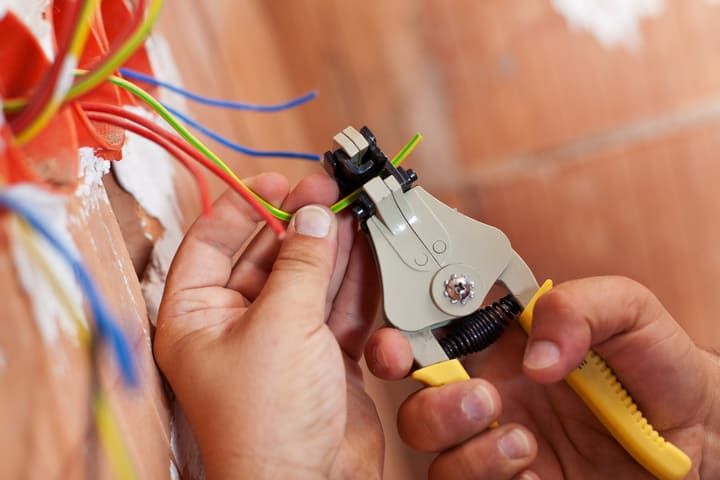
Unlike indoor wiring, outdoor cables face rain, UV exposure, burrowing animals, and physical disturbance from spades and lawnmowers — all of which require a more robust install than running Twin & Earth through a wall cavity. That's why protecting your wiring is as much about cable choice as it is about burial depth.
SWA Cable: What It's Actually Made Of
For buried or otherwise exposed runs, use SWA (Steel-Wire Armoured) cable. Modern SWA to BS 5467 has four layers:
- XLPE (cross-linked polyethylene) insulated conductors
- A PVC bedding layer
- A galvanised steel-wire armour layer
- A PVC outer sheath (or LSZH where low-smoke performance is needed)
Older articles sometimes describe SWA as rubber-insulated — that's outdated. Mainstream SWA today is XLPE/PVC, and the steel armour is what makes it appropriate for direct burial: it shrugs off spades, mowers, and rodent attacks that would slice through unarmoured cable.
Cable Sizing
- UK: 1.5 mm² Twin & Earth or 1.5 mm² SWA is usually adequate for a typical residential outdoor lighting circuit on a 6A MCB. For long runs (over ~30m at typical loads), size up to 2.5 mm² to control voltage drop. Note the unit is mm² (cross-sectional area), not mm — older articles often drop the squared, which is technically wrong.
- US: 14 AWG (≈2.08 mm²) is the minimum for a 15A circuit; 12 AWG (≈3.31 mm²) for a 20A circuit. Use UF-B (Underground Feeder) cable for direct burial, or THHN/THWN-2 inside conduit.
Burial Depth
Burial depths are not just folk wisdom — they're set by code based on the likelihood of disturbance. Use this as a quick reference:
| Region | Location / Cable Type | Minimum Burial Depth |
|---|---|---|
| UK (BS 7671) | Garden / hand-dug ground | 500 mm (20 in) |
| UK (BS 7671) | Under driveway / sealed surface | 450 mm (18 in) |
| US (NEC 300.5) | Direct-buried UF cable, 120V | 610 mm (24 in) |
| US (NEC 300.5) | GFCI-protected residential 120V branch (≤20A) | 457 mm (18 in) |
| US (NEC 300.5) | Listed low-voltage (≤30V) landscape lighting | 152 mm (6 in) |
| US (NEC 300.5) | Under driveway, low-voltage | 457 mm (18 in) |
Counter-intuitively, the depth under a driveway can be shallower than under a lawn. The reason is risk of disturbance: a sealed driveway is unlikely to be hand-dug, while a garden bed will be turned over with a spade many times across the cable's life. See related guidance on running landscape cable under a sidewalk.
Above any buried cable, lay electrical route marker tape at around 150 mm (6 in) below the finished surface. This acts as a warning to anyone digging in future — long after the install drawings have been lost.
IP Ratings: Don't Forget the Fittings
Cable protection is only half the story. The fittings themselves must be rated for outdoor exposure. Look for an IP (Ingress Protection) rating on every fixture's spec sheet — the first digit covers solids (dust), the second covers liquids (water).
- IP44 — minimum for general covered exterior locations (porches, soffits, anywhere with overhead shelter from direct rain).
- IP65 — exposed wall lights, post lights, and anything in direct rain.
- IP67 — in-ground uplights and recessed deck lights that may sit in standing water.
- IP68 — submerged fittings (pond, pool, fountain lighting).
A fitting rated below the conditions it's installed in will admit moisture and fail — often inside its first season. Check the IP rating before you buy, not after the third bulb has corroded.
Low-Voltage Landscape Lighting (12V Systems)
A large share of garden lighting sold today runs on 12V DC via a low-voltage transformer — path lights, deck lights, uplights, and most off-the-shelf landscape kits. These sit in a different regulatory bracket from mains wiring:
- The transformer plugs into a GFCI/RCD-protected outdoor receptacle and steps mains down to 12V.
- Low-voltage landscape cable (typically 12 AWG or 16 AWG) can be buried at just 152 mm (6 in) under NEC for listed ≤30V systems, since shock and fire risks are minimal.
- Fixtures can be daisy-chained along a single cable run or fed hub-and-spoke from the transformer. Both wire fixtures in parallel; the choice affects voltage drop, not topology.
For most homeowners adding garden lighting without commissioning new electrical work, a 12V system is the simpler and safer DIY route. It avoids notifiable mains work, sidesteps deep-burial requirements, and forgives small mistakes that would be hazardous on a 230V or 120V circuit.
Permits and Code Compliance
Adding a new outdoor mains circuit isn't always something you can legally do yourself:
- UK: Outdoor electrical work falls under Part P of the Building Regulations. Notifiable work — including most new circuits — must either be carried out by a registered electrician on a Part P competent-person scheme (NICEIC, NAPIT, ELECSA) or signed off by Building Control.
- US: Most jurisdictions require a permit and inspection for new branch circuits. Specific requirements vary by city and county — check with your local Authority Having Jurisdiction (AHJ) before pulling cable.
Low-voltage landscape lighting plugged into an existing GFCI receptacle generally does not require a permit, since you're not modifying fixed wiring. That's the easiest legal route for a DIY install.
Can You Wire An Outside Light To An Indoor Switch?
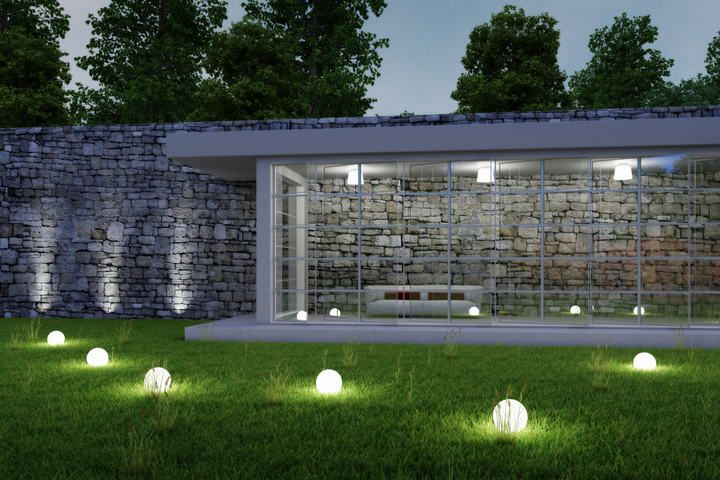
Yes — an indoor switch can control outdoor fittings, and it's a common arrangement for porch lights, soffit lights, and similar perimeter fixtures. Many installs also pair the switch with a motion sensor or photocell for automatic control.
The switch itself sits on the indoor (dry) side of the wall, so it doesn't need any special weatherproofing. The cabling between switch and fitting must transition cleanly through the wall, with sealing at the penetration point.
The risk to manage isn't the switch — it's water ingress through the outdoor fitting tracking back along the cable into the indoor circuit. If the outdoor fitting's IP rating is wrong, or the cable gland on the back of the fitting isn't sealed, moisture can wick into the wall cavity and cause faults far from where you'd expect.
Two practical rules cover most installs:
- Use an outdoor-rated fitting (IP44 minimum) with a properly tightened cable gland.
- If the outdoor light shares a circuit with indoor lighting, ensure the whole circuit has RCD/GFCI protection — a fault outside should trip protection before it can damage indoor wiring.
Related: What Is The Best Season To Install Landscape Lighting?
FAQ
FAQ
Do outdoor lights require GFCI or RCD protection?
In the US, the NEC requires GFCI protection for outdoor receptacles at dwellings under 210.8(A)(3), and for most outdoor outlets at dwellings under 210.8(F). However, hard-wired outdoor lighting outlets are specifically excluded from 210.8(F) — so a hard-wired porch light isn't required to be on GFCI by that section, while any outdoor receptacle used to power plug-in lights must be. In the UK, BS 7671 requires 30mA RCD or RCBO protection on all outdoor circuits, including hard-wired lighting. UK guidance is therefore stricter than the US NEC for fixed outdoor lighting. As a practical matter, putting all outdoor circuits on RCD/GFCI is the safer default regardless of jurisdiction.
Can I power outside lights from an indoor socket?
Yes, provided the socket is GFCI-protected (US) or on an RCD-protected circuit (UK), and the load stays within the socket circuit's rating. Most plug-in outdoor lights — string lights, plug-in landscape kits, low-voltage transformers — are designed for exactly this. Adding a permanent socket onto a dedicated lighting circuit is technically possible, but it isn't preferable: if you want hard-wired outdoor lights, run them on a dedicated outdoor circuit rather than retrofitting a socket onto an indoor lighting circuit. See more on the trade-offs of a socket on a lighting circuit.
What size cable do I need for outdoor lighting?
In the UK, 1.5 mm² Twin & Earth or SWA is usually adequate for a residential outdoor lighting circuit on a 6A MCB; size up to 2.5 mm² for runs over about 30m to control voltage drop. In the US, 14 AWG (≈2.08 mm²) is the minimum for a 15A circuit and 12 AWG (≈3.31 mm²) for a 20A circuit, using UF-B for direct burial or THHN/THWN-2 in conduit.
How deep do outdoor cables need to be buried?
Under BS 7671 (UK), the industry-standard minimum is 500 mm in gardens or anywhere likely to be hand-dug, with around 450 mm acceptable under driveways and other sealed surfaces. Under NEC 300.5 (US), direct-buried 120V cable needs 24 in (610 mm), 18 in (457 mm) for GFCI-protected residential branch circuits, and 6 in (152 mm) for listed low-voltage (≤30V) landscape lighting. Lay marker tape at around 150 mm above any buried cable.
The 3-Step Outdoor Lighting Safety Checklist
Before energising any new outdoor lighting, run through these three checks. If any one is missing, the install isn't ready:
- Dedicated circuit. Wire outdoor lights on a separate circuit from indoor lighting wherever possible, sized for the cable type and run length you're using (6A MCB on 1.5 mm² in the UK; 15A or 20A breaker on 14/12 AWG in the US).
- Correct cable and burial depth. Use SWA (UK) or UF-B (US) for direct burial. Bury at the depth required by your country's standard, with marker tape ~150 mm above the cable.
- Earth-fault protection plus IP-rated fittings. RCD/RCBO (UK) or GFCI (US) on the circuit, and an IP44+ fitting at every outdoor location — IP65 or higher in fully exposed positions.
If any of those three is missing, the install isn't safe — and it's almost always cheaper to bring in a registered electrician than to redo a buried run after the fact.